Unit 3: Logical reasoning
Logical reasoning tests the ability to analyze information, identify patterns, and apply rules to solve problems. This unit focuses on sequence-based logic and encryption/decryption patterns fundamental to analytical thinking.
1. Number Series
Number series questions involve a sequence of numbers that follow a specific mathematical logic or rule. The objective is to identify the pattern and find the missing or wrong term.
Key Concepts and Patterns
- Arithmetic Progressions (AP): The difference between consecutive terms is constant (e.g., ).
- Geometric Progressions (GP): The ratio between consecutive terms is constant (e.g., ).
- Prime Number Series: Numbers are consecutive primes (2, 3, 5, 7, 11...).
- Square and Cube Series:
- Perfect squares: (1, 4, 9, 16...)
- Perfect cubes: (1, 8, 27, 64...)
- Variations: , , .
- Two-Tier (Difference of Differences): The logic is not in the numbers themselves but in the difference between them.
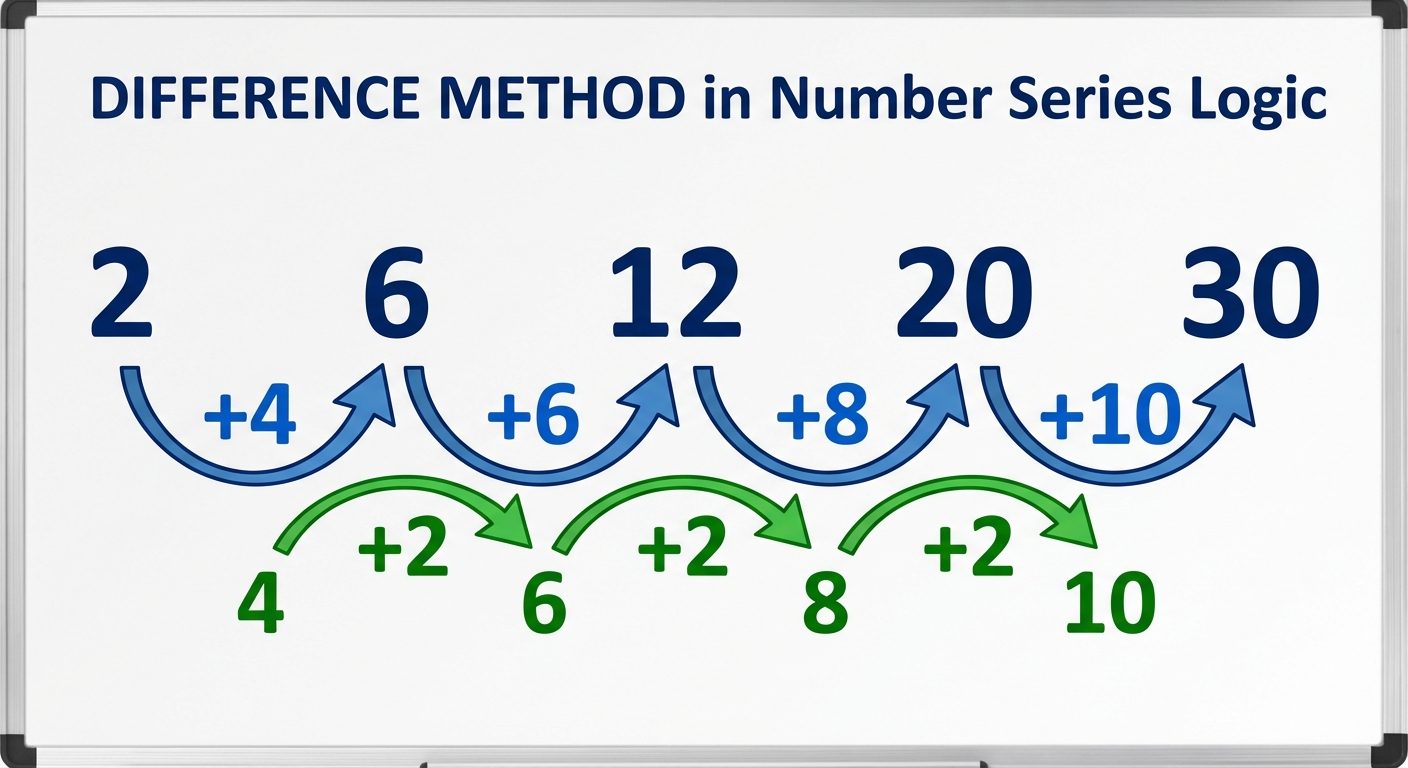
Solved Examples
Example 1: Mixed Arithmetic
- Series: 5, 11, 24, 51, 106, ?
- Logic:
- Solution: .
Example 2: Alternating Series
- Series: 15, 14, 19, 11, 23, 8
- Logic: Two series intermixed.
- Series A (Odd positions): 15, 19, 23 (+4 pattern)
- Series B (Even positions): 14, 11, 8 (-3 pattern)
2. Alphabet Series
Alphabet series require finding the missing letter(s) based on position in the English alphabet. Mastery of positional values is essential.
The Positional Value System
- Forward Order (A to Z): A=1, B=2 ... Z=26.
- Reverse Order (Z to A): Z=1, Y=2 ... A=26.
Mnemonic Techniques:
- EJOTY: E=5, J=10, O=15, T=20, Y=25 (Multiples of 5).
- CFILORUX: Multiples of 3 (3, 6, 9, 12, 15, 18, 21, 24).
Reverse Pairs
Letters that sum to 27 in positional value (1+26, 2+25, etc.).
- A - Z (Amazon)
- B - Y (Boy)
- C - X (Crux)
- D - W (Dew)
- M - N (Man)
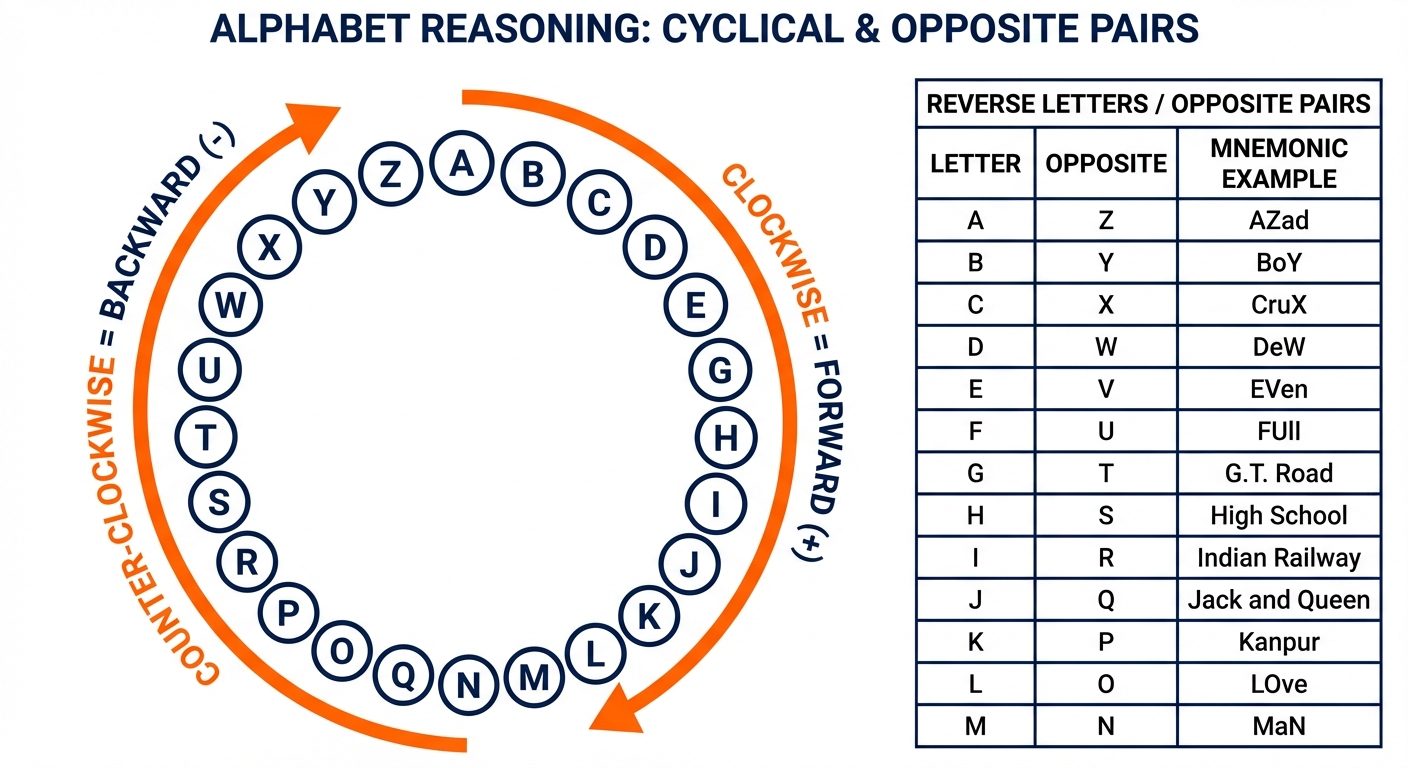
Example:
- Series: B, E, H, K, ?
- Logic: B(2) +3 = E(5); E(5) +3 = H(8); H(8) +3 = K(11).
- Next: K(11) +3 = N(14). Answer: N.
3. Alphanumeric Series
These series combine numbers, alphabets, and symbols. The logic for the number component and the letter component usually runs independently but concurrently.
Strategy
- Separate the series into elements (First letter, Number, Second letter).
- Solve the pattern for the first letter.
- Solve the pattern for the numbers.
- Solve the pattern for the final letter.
Example:
- Series: 2Z5, 7Y7, 14X9, 23W11, 34V13, ?
- Number Logic: 2 (+5) → 7 (+7) → 14 (+9) → 23 (+11) → 34 (+13) → 47
- Letter Logic: Z (-1) → Y (-1) → X (-1) → W (-1) → V (-1) → U
- Last Number Logic: 5 (+2) → 7 (+2) → 9 (+2) → 11 (+2) → 13 (+2) → 15
- Answer: 47U15
4. Alphabet Test
This topic tests the ability to manipulate letters based on specific instructions rather than finding a missing term.
Types of Problems
-
Word Formation: Can a specific word be formed using the letters of a given keyword?
- Keyword: ESTABLISHMENT
- Target: TABLE (Yes), TENT (No - only one 'T' available? Check count. 'ESTABLISHMENT' has two T's, so Yes. 'TENT' requires two T's. If target was 'TITAN', no, because no 'I').
-
Dictionary Order: Arranging words alphabetically.
- Compare first letters; if same, move to the second, etc.
-
Position Test: Locating a letter based on left/right directions.
- Formula: If directions are Same (Left-Left or Right-Right), Subtract values.
- Formula: If directions are Different (Left-Right or Right-Left), Add values.
- Example: Which letter is 5th to the right of the 10th letter from the left?
- Different directions (R + L) → .
- 15th from Left = O.
5. Coding and Decoding
Coding involves encoding a message into a pattern; decoding involves deciphering it.
Major Patterns
-
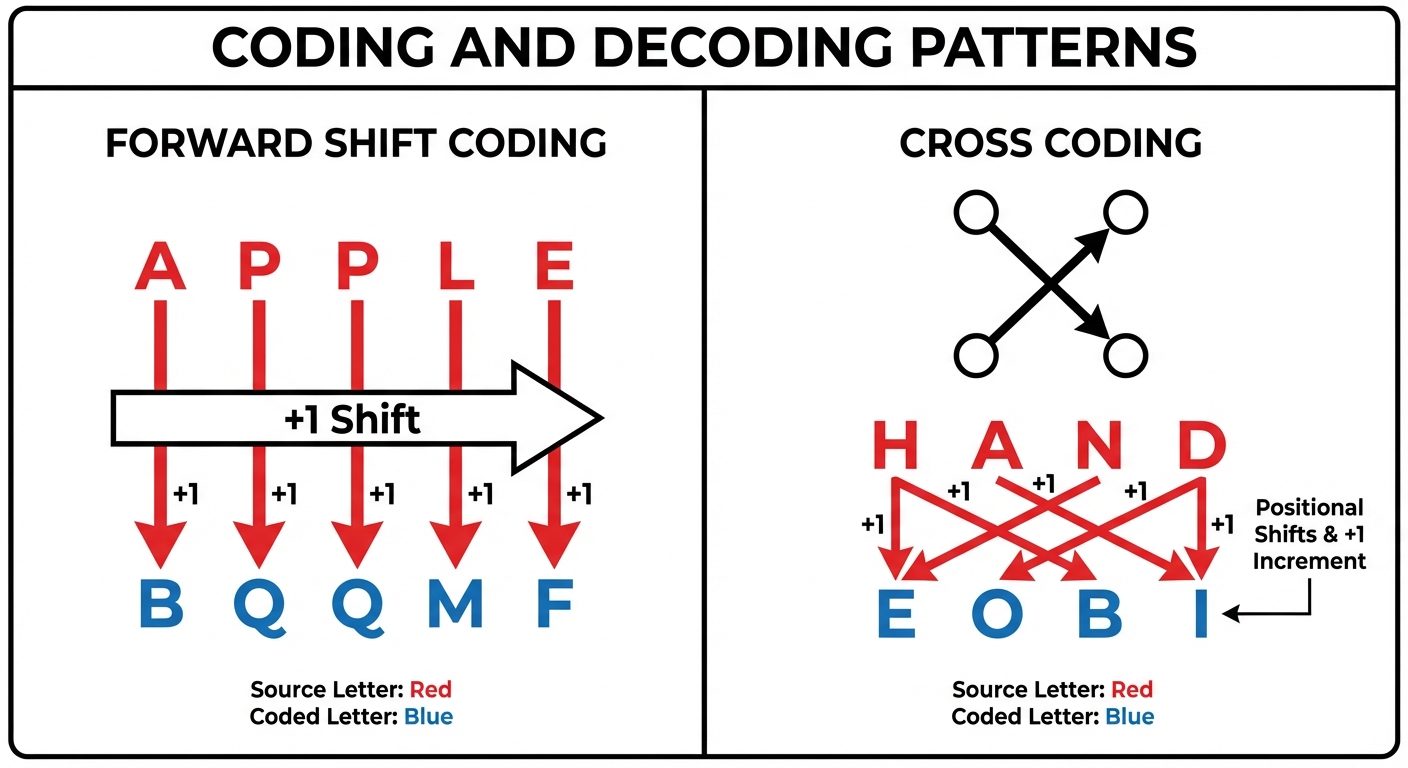
Letter Coding: Shifting letters forward or backward.
- Forward Shift: A → B (+1)
- Backward Shift: B → A (-1)
- Cross Coding: Letters exchange positions in a specific pattern.
-
Number Coding: Words are assigned numerical values.
- Sum of Place Values: CAT = 3 + 1 + 20 = 24.
- Reverse Sum: Using Z=1 values.
-
Substitution Coding: Specific names are substituted.
- Question: If "White" is called "Blue", "Blue" is called "Red", "Red" is called "Yellow". What is the color of blood?
- Logic: Blood is Red. In code, Red is called Yellow.
- Answer: Yellow.
6. Language Coding (Chinese Coding)
In these problems, artificial sentences are translated into code. The goal is to identify which code word represents a specific natural word by comparing sentences and eliminating common terms.
Steps to Solve:
- Identify two sentences that share a common word.
- Look for the common code term between those two sentences.
- Map the common word to the common code.
- Eliminate mapped words to find the remaining ones.
Example:
- Statement 1:
pit dar nameans "you are good" - Statement 2:
dar tok pameans "good and bad" - Statement 3:
tim na tokmeans "they are bad"
Analysis:
- Compare (1) and (2): Common word is "good". Common code is
dar. Therefore, good = dar. - Compare (2) and (3): Common word is "bad". Common code is
tok. Therefore, bad = tok. - Compare (1) and (3): Common word is "are". Common code is
na. Therefore, are = na.
Result:
- In statement 1, remaining word is "you" and remaining code is
pit. So, you = pit.
Did this save you a night before the exam?
LPU Notes is free, and it stays free. Ads cover part of the server bill. The rest comes out of a student's own pocket: the domain, the storage, and keeping the site up through the weeks everyone needs it at once.
The payment button didn't load. An ad blocker or a filtered network is the usual reason. to try again.
Nothing here is ever locked, and nothing unlocks. Chip in only if it was worth it. What it pays for →