Unit 2: Percentage, Profit Loss Discount
Part 1: Fundamentals of Percentage
1. Concept and Calculation
Percentage comes from the Latin "per centum," meaning "by the hundred." It is a fraction with a denominator of 100.
- Symbol:
- Meaning:
Basic Calculation:
To find of :
2. Percentage to Fraction Conversion
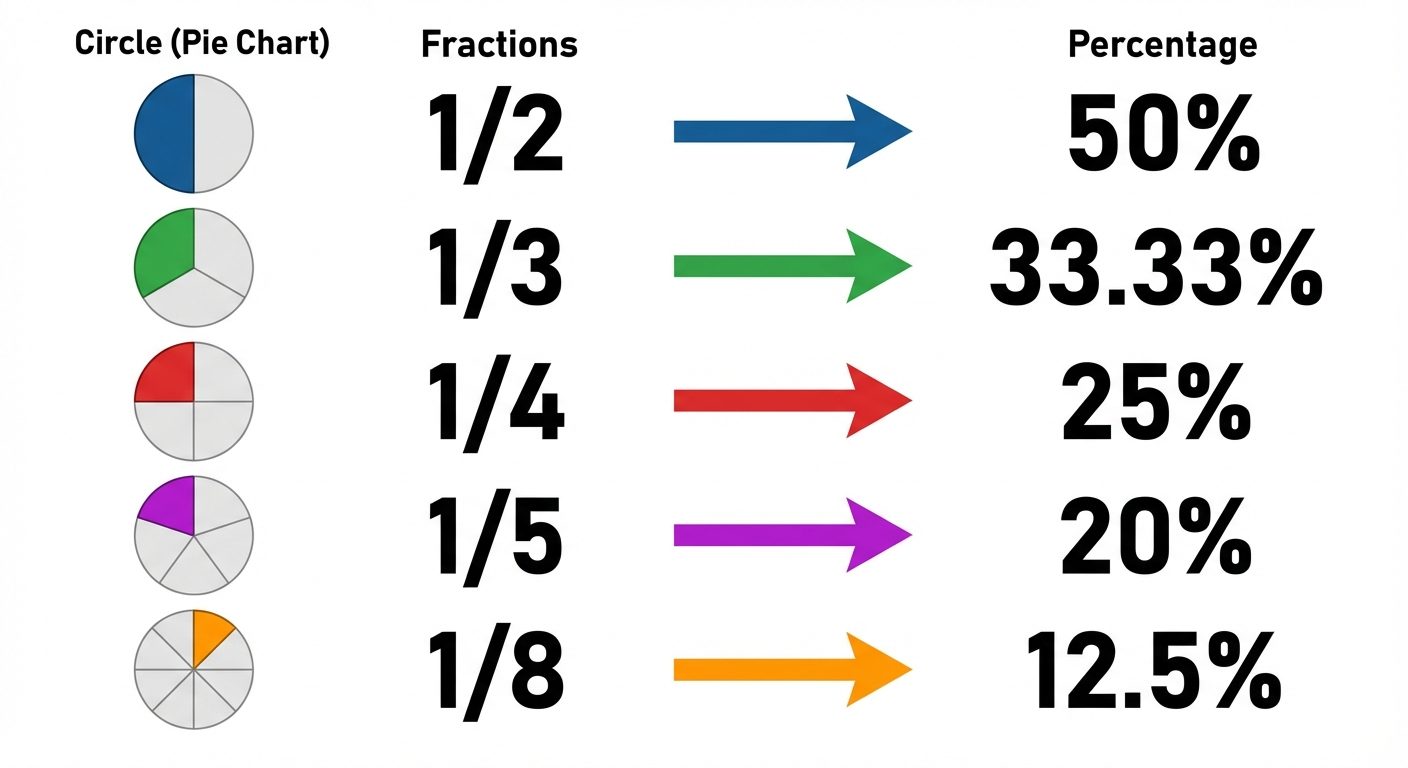
Speed in calculation relies heavily on memorizing standard percentage-to-fraction equivalents. This eliminates the need to divide by 100 manually during complex problems.
| Fraction | Percentage | Decimal | Fraction | Percentage | Decimal | |
|---|---|---|---|---|---|---|
3. Percentage Comparison
This involves comparing two values, and .
- A is what % of B?
- A is what % more than B?
- A is what % less than B?
Key Rule: The value mentioned after "than" or "of" is usually the base (denominator).
4. Successive Percentage Change
If a value changes by and then by , the net percentage change is not simply .
Formula Method:
- Use positive signs for increase and negative signs for decrease.
Multiplication Factor Method:
If a number increases by and then decreases by :
Part 2: Applications of Percentage
1. Problems Based on Marks
Usually involves a student scoring marks and failing by marks, while another scores marks and gets marks more than the passing score.
- Concept: The difference in percentage corresponds to the difference in absolute marks.
2. Problems Based on Elections
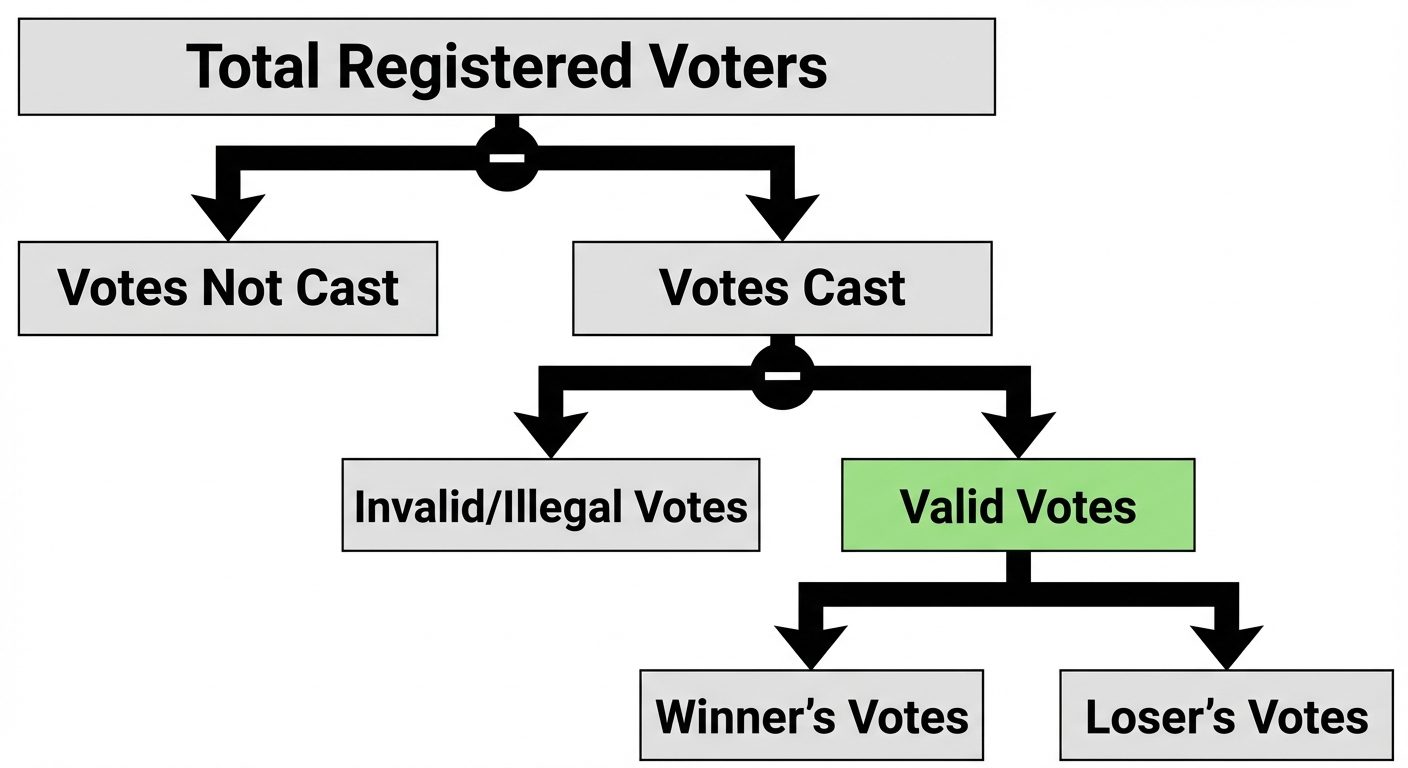
These problems typically involve a hierarchy of votes.
- Total Voters: Everyone on the list.
- Votes Cast: Total Voters minus those who didn't vote.
- Valid Votes: Votes Cast minus Invalid/Illegal votes.
- Winner's Votes: Usually a percentage of Valid Votes (read question carefully).
3. Population and Depreciation
These follow the concept of Compound Interest.
If current population is and rate of growth is :
- Population after n years:
- Population n years ago:
For depreciation (value of machine decreasing), use a minus sign inside the bracket: .
4. Percentage Error
This measures the inaccuracy in a measurement relative to the true value.
- Error = |True Value - Measured Value|
Part 3: Profit, Loss, and Discount
1. Fundamental Terminologies
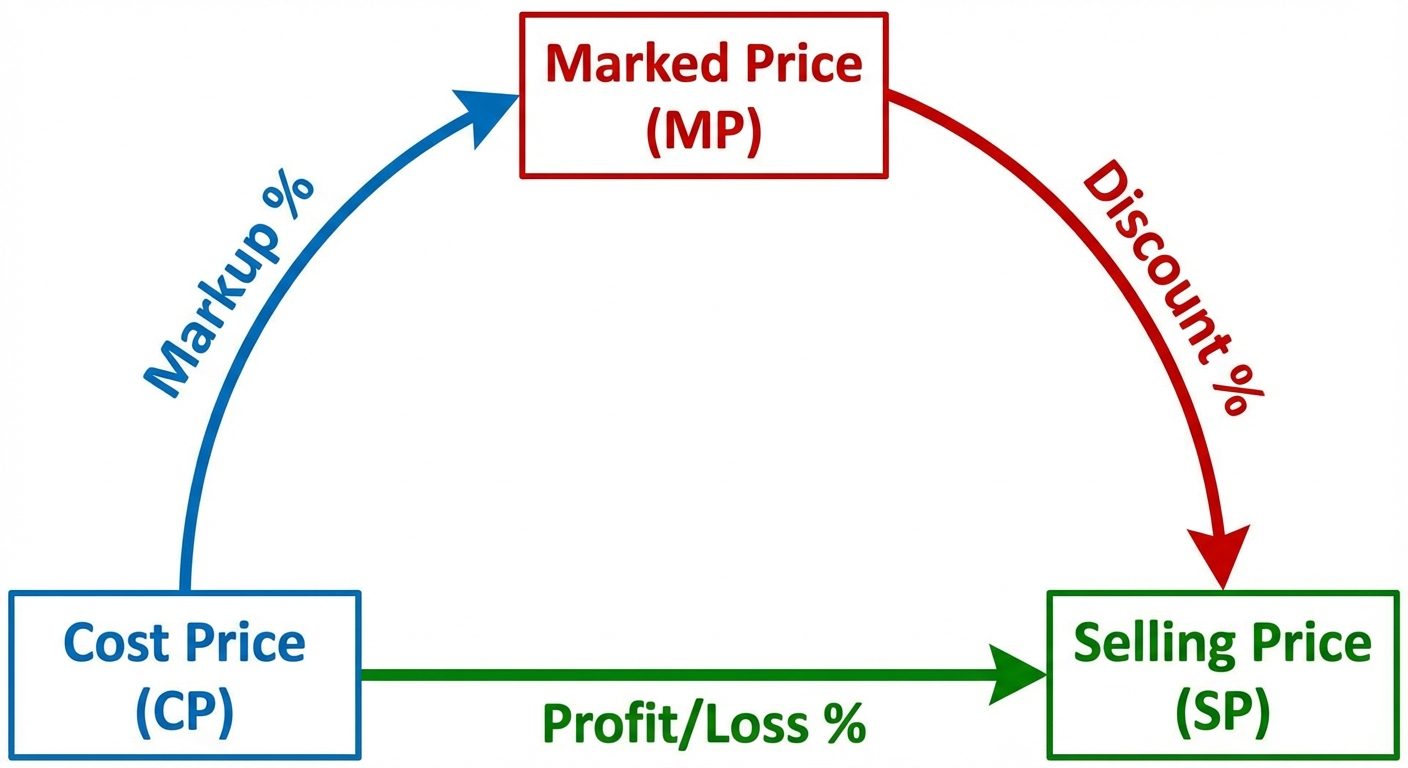
- Cost Price (CP): The price at which an article is purchased. This includes overheads (transport, repair).
- Selling Price (SP): The price at which the article is sold.
- Marked Price (MP): The price printed on the label (List Price/Tag Price).
2. Profit and Loss Calculations
Profit and Loss are always calculated on the Cost Price unless specified otherwise.
- Profit:
- Loss:
- Profit %:
- Loss %:
Calculating SP from CP:
- (in case of Profit)
- (in case of Loss)
3. Discount and Marked Price
Discount is always calculated on the Marked Price (MP).
- Discount:
- Discount %:
- Selling Price (related to MP):
4. Relation between CP and MP
When a trader allows a discount of and still gains a profit of :
- This formula is a shortcut to avoid calculating SP intermediately.
Part 4: Advanced Profit/Loss Scenarios
1. Dishonest Dealer (Faulty Weights)
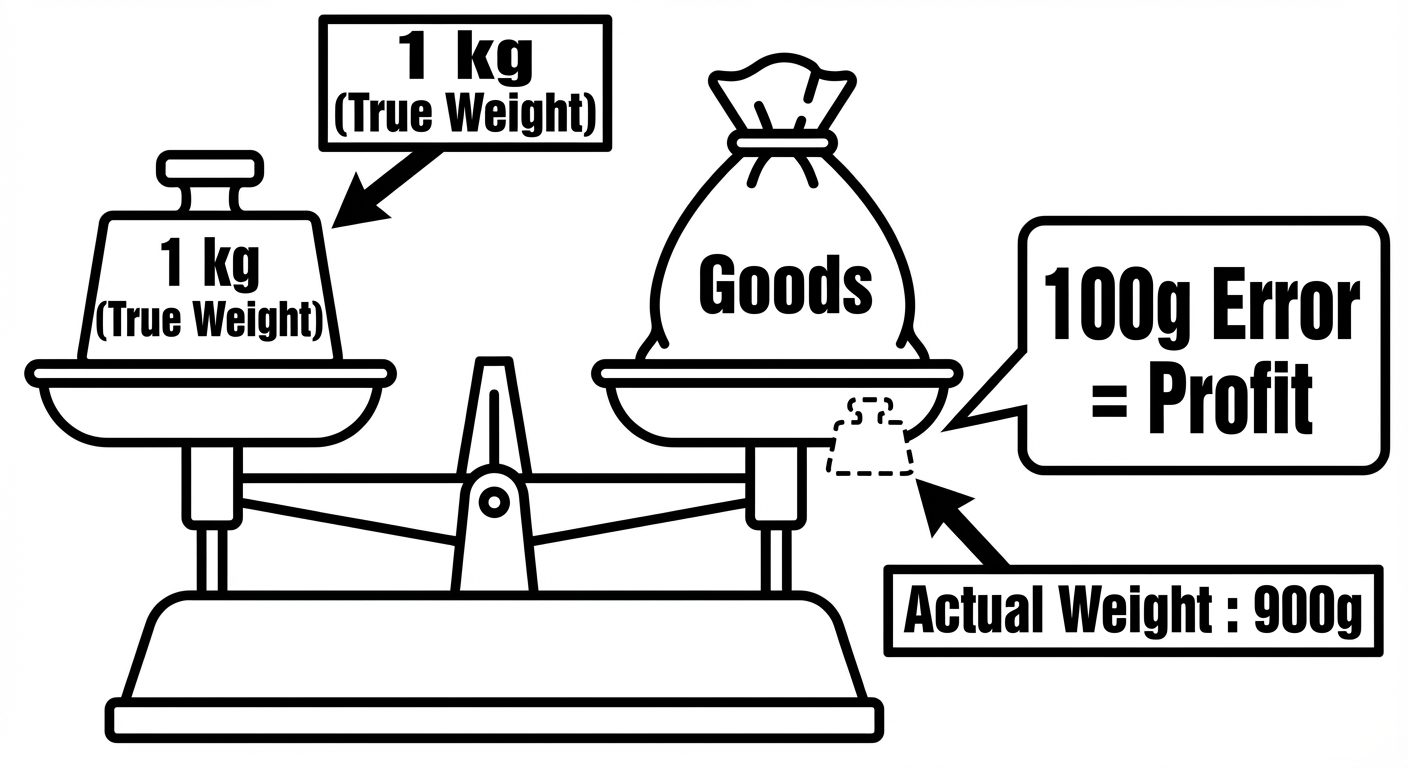
A dealer claims to sell at Cost Price but uses a false weight (e.g., uses a 900g weight instead of 1kg).
- Concept: The dealer saves goods, which equates to profit.
- Formula:
- Example: If using 900g instead of 1000g: Error is 100g.
2. Problems Based on Number of Articles
Sometimes CP and SP are given in terms of quantity rather than currency.
- Example: CP of 15 articles equals SP of 12 articles.
- Method: Assume the price of 1 article = 1 unit or take the LCM of the quantities.
- Shortcut Formula:
- (Note: The denominator is Articles Sold, not Bought).
3. Common Selling Price (Same SP)
If two articles are sold at the same Selling Price, where one is sold at profit and the other at loss:
- Result: There is ALWAYS a net LOSS.
- Loss Formula:
- Note: This formula only applies when the Selling Price is the same and the numerical value of profit % and loss % is the same.
Did this save you a night before the exam?
LPU Notes is free, and it stays free. Ads cover part of the server bill. The rest comes out of a student's own pocket: the domain, the storage, and keeping the site up through the weeks everyone needs it at once.
The payment button didn't load. An ad blocker or a filtered network is the usual reason. to try again.
Nothing here is ever locked, and nothing unlocks. Chip in only if it was worth it. What it pays for →