Unit 4: Idea generation using AI
1. Introduction to AI in Entrepreneurship
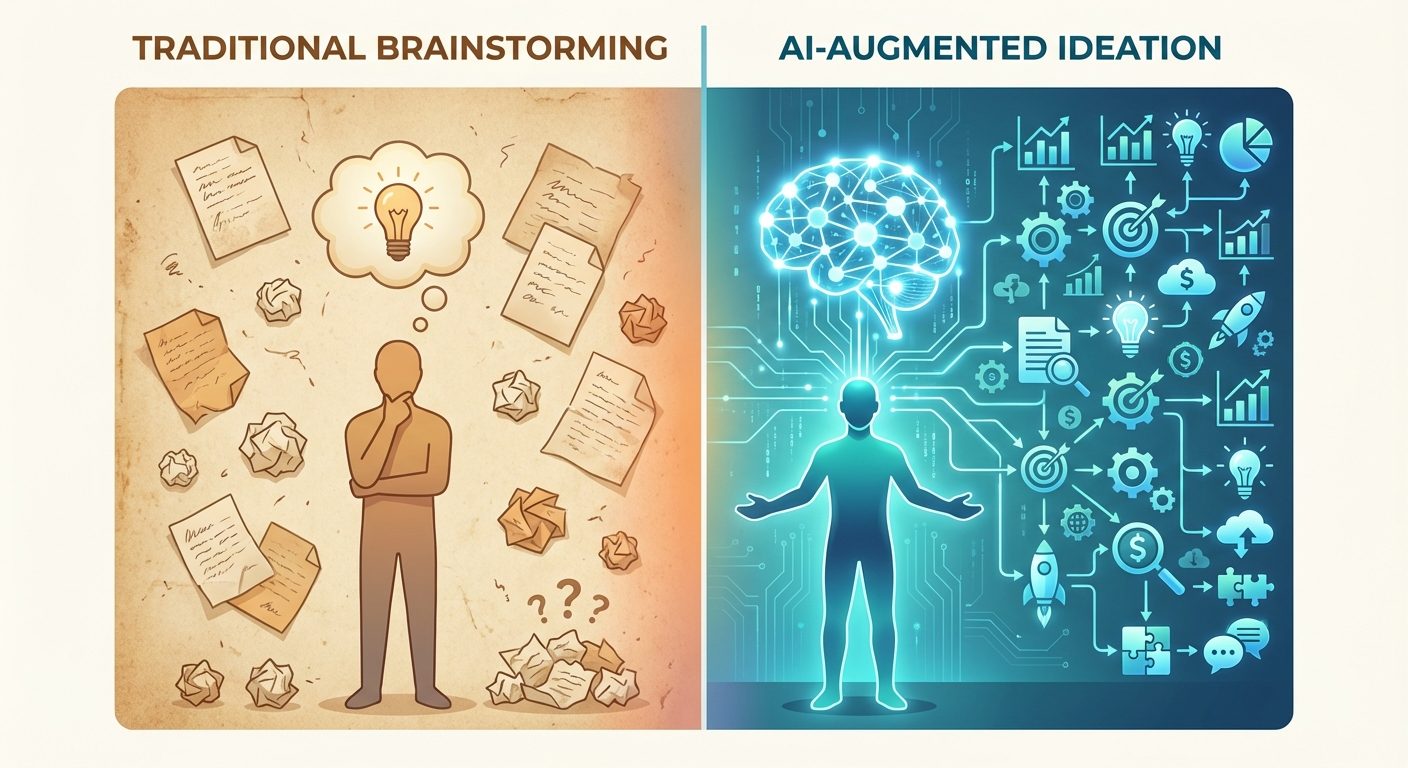
Artificial Intelligence (AI) has shifted the entrepreneurial landscape from manual, time-consuming brainstorming to rapid, data-driven ideation. In the context of business basics, AI does not replace the entrepreneur's vision but acts as a force multiplier—expanding the scope of possibilities, identifying market gaps, and structuring thoughts into actionable plans.
Key Benefits:
- Divergent Thinking: AI can generate hundreds of ideas in seconds, overcoming "writer’s block."
- Pattern Recognition: AI tools analyze vast datasets to identify trends that human intuition might miss.
- Bias Reduction: AI provides objective suggestions, distancing the ideation process from the founder's personal biases.
2. Text-Based AI Tools for Idea Generation
Generative AI models (Large Language Models or LLMs) are the primary tools for generating initial business concepts.
2.1 Key Tools
- ChatGPT (OpenAI): Excellent for conversational brainstorming, role-playing (e.g., "Act as a venture capitalist"), and refining value propositions.
- Claude (Anthropic): Known for handling large amounts of context and providing nuanced, safe business advice.
- Gemini (Google): useful for integrating real-time web search data into idea generation.
- Jasper/Copy.ai: While primarily for marketing, these are excellent for generating product names, slogans, and initial descriptions.
2.2 Techniques for Prompt Engineering in Ideation
To get the best business ideas, entrepreneurs must master "Prompt Engineering."
A. The "SCAMPER" Technique via AI
Use AI to apply the SCAMPER method to existing products.
- Prompt Example: "Apply the SCAMPER method to a traditional backpack. Suggest 5 innovative changes that would appeal to digital nomads."
- Substitute (e.g., solar panels for fabric)
- Combine (e.g., backpack + wifi hotspot)
- Adapt, Modify, Put to another use, Eliminate, Reverse.
B. Problem-First Ideation
Instead of asking for ideas, ask for problems.
- Prompt Example: "List 10 distinct, recurring pain points for remote workers regarding physical health. For each pain point, suggest a SaaS (Software as a Service) solution and a hardware solution."
C. Constraint-Based Innovation
Creativity thrives on constraints. AI excels at finding solutions within strict parameters.
- Prompt Example: "Generate 5 business ideas for the pet care industry that require less than $1,000 startup capital and utilize a subscription model."
3. Visual Planning: AI-Powered Mind Mapping
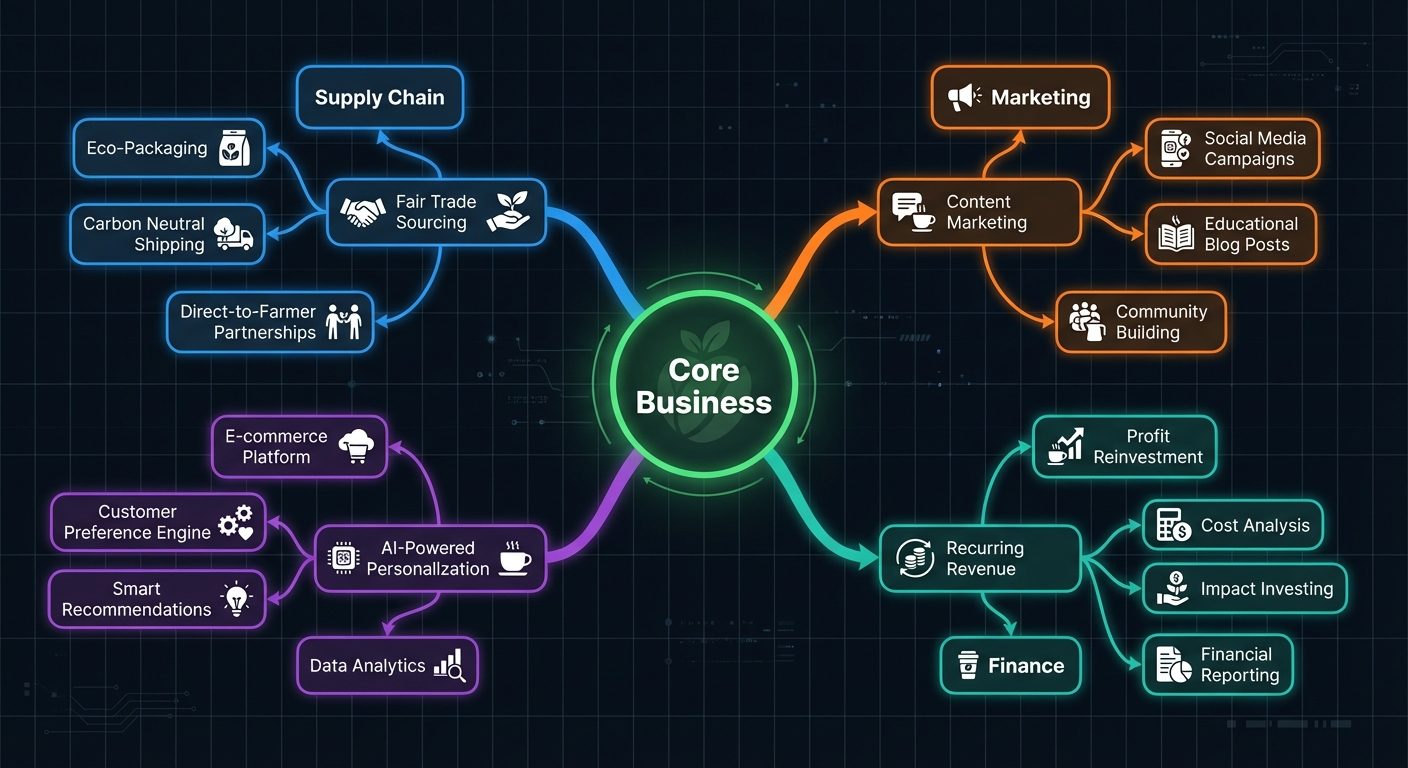
Once text ideas are generated, they must be structured. Mind mapping helps visualize the relationships between different aspects of a business (operations, marketing, finance).
3.1 What is AI Mind Mapping?
Traditional mind mapping requires the user to manually draw nodes and branches. AI mind mapping tools take a central topic (e.g., "Organic Skincare Brand") and automatically generate a multi-tiered hierarchy of necessary steps, departments, and strategies.
3.2 Leading Tools
- XMind AI: Integrates GPT technology to expand mind map branches automatically.
- Miro (Miro Assist): A digital whiteboard that uses AI to cluster sticky notes and generate diagrams from text prompts.
- Taskade: Uses AI to convert mind maps directly into task lists and project boards.
- Ayoa: Uses generative AI to suggest "branches" when the user gets stuck.
3.3 The Process of AI Mind Mapping
- Input Central Node: Define the core business concept.
- AI Expansion: The AI suggests Level 1 branches (e.g., Marketing, Product Development, Logistics).
- Drill Down: User selects a branch (e.g., Marketing) and asks AI to expand further (e.g., Social Media, Email Campaigns, Influencer Partnerships).
- Cross-Linking: Identifying dependencies between branches (e.g., linking "Product Launch Date" in Operations to "Campaign Start" in Marketing).
4. The Integrated Workflow: From Prompt to Plan
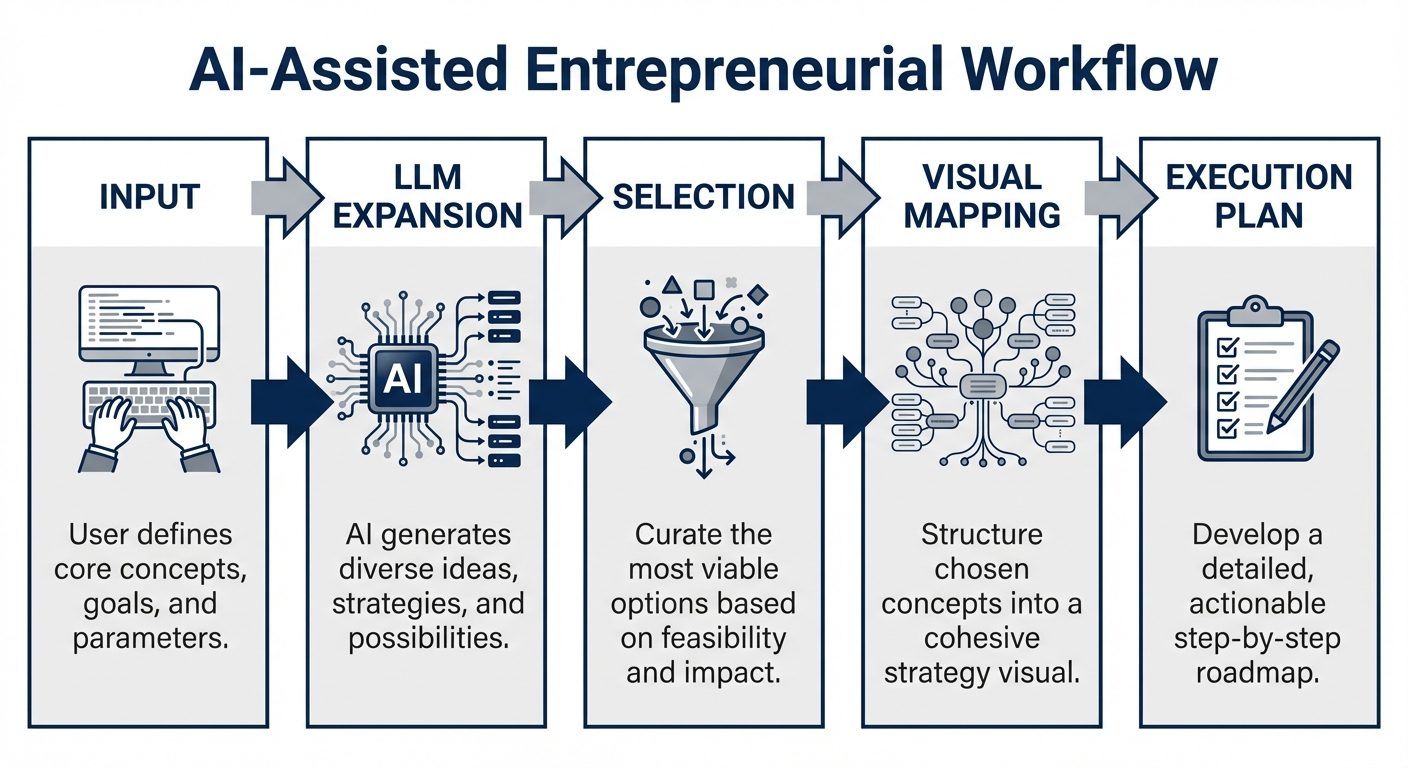
To successfully plan a new venture, an entrepreneur should combine text generation with visual mapping.
Phase 1: Divergence (Quantity)
- Tool: ChatGPT / Claude
- Action: Generate 50 iterations of a business concept.
- Outcome: A long list of potential ideas, ranging from safe to radical.
Phase 2: Convergence (Selection)
- Tool: ChatGPT (Analysis Mode)
- Action: Input the list back into the AI. Ask it to "Score these ideas based on feasibility, scalability, and competition on a scale of 1-10."
- Outcome: Top 3 viable candidates.
Phase 3: Visualization (Structure)
- Tool: Whimsical AI / Miro / XMind
- Action: Take the winning concept and generate a full business model canvas or mind map.
- Outcome: A visual architecture showing how the business functions.
Phase 4: Gap Analysis (Refinement)
- Tool: AI Chatbot
- Action: Upload the mind map structure (or describe it). Ask: "What is missing from this plan? Identify potential failure points."
- Outcome: A risk assessment report.
5. Limitations and Ethical Considerations
While AI is a powerful tool for Unit 4, students must understand its limitations.
- Hallucinations: AI can invent facts, market data, or cite non-existent competitors. All data must be verified.
- Context Window Limits: AI may lose track of the initial constraints if the conversation becomes too long.
- Generic Output: If prompts are too simple, AI produces generic business ideas that lack competitive advantage.
- Intellectual Property: Ideas generated wholly by AI currently sit in a legal gray area regarding copyright ownership in many jurisdictions.
6. Summary Checklist for Students
- [ ] Can you define Prompt Engineering in the context of business?
- [ ] Have you used an LLM to apply SCAMPER to a product?
- [ ] Can you explain the difference between text-based ideation and visual mind mapping?
- [ ] Do you understand the workflow of moving from a raw AI suggestion to a structured visual plan?
Did this save you a night before the exam?
LPU Notes is free, and it stays free. Ads cover part of the server bill. The rest comes out of a student's own pocket: the domain, the storage, and keeping the site up through the weeks everyone needs it at once.
The payment button didn't load. An ad blocker or a filtered network is the usual reason. to try again.
Nothing here is ever locked, and nothing unlocks. Chip in only if it was worth it. What it pays for →