Unit 2: Business Opportunity
1. Environment Scanning
Environment scanning is the careful monitoring of an organization's internal and external environments for detecting early signs of opportunities and threats that may influence its current and future plans. It is the process of gathering information about events and identifying their relationships within an organization's internal and external environments.
1.1 Importance of Environment Scanning
- Identification of Opportunities: Helps in finding new market segments and product gaps.
- Identification of Threats: Provides early warning signals (e.g., new regulations, emerging competitors).
- Sensitization of Management: Keeps the entrepreneur alert to changing needs and trends.
- Strategy Formulation: Forms the basis for strategic planning and decision-making.
1.2 PESTLE Analysis Framework
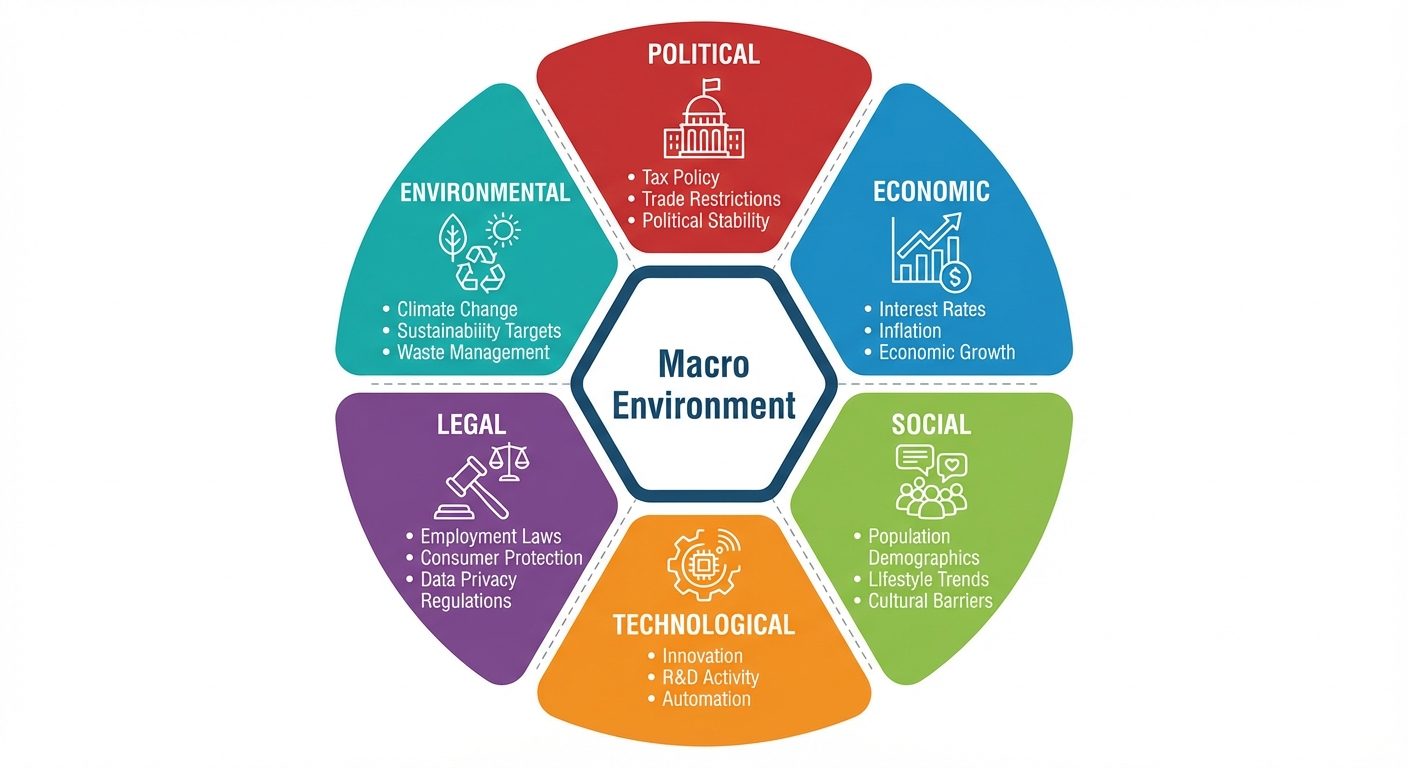
The most common tool for macro-environmental scanning is the PESTLE framework.
- Political: Government stability, tax policies, trade regulations, and labor laws.
- Economic: Inflation rates, interest rates, exchange rates, economic growth patterns, and disposable income.
- Social: Demographics, lifestyle changes, population growth, and cultural barriers.
- Technological: R&D activity, automation, technology incentives, and rate of technological change.
- Legal: Employment laws, consumer protection, health and safety regulations, and antitrust laws.
- Environmental: Ecological regulations, sustainability trends, carbon footprint, and waste management.
1.3 SWOT Analysis
While PESTLE analyzes the external macro-environment, SWOT connects internal capabilities with external conditions.
- Strengths (Internal): Resources, capabilities, and positive attributes.
- Weaknesses (Internal): Lack of resources, gaps in capabilities.
- Opportunities (External): Market growth, lifestyle changes, competitor vulnerabilities.
- Threats (External): New competitors, regulatory changes, economic downturns.
2. Need Assessment
Need assessment is a systematic process for determining and addressing needs, or "gaps" between current conditions and desired conditions or "wants".
2.1 The Process of Need Assessment
- Identification: Recognizing that a problem exists or a specific demographic has an unfulfilled requirement.
- Verification: confirming that the need is real and not just a perceived or temporary trend.
- Basis for Entrepreneurship: Business ideas generally stem from solving a "pain point."
- Example: The need for quick transportation led to Uber; the need for affordable accommodation led to Airbnb.
2.2 Types of Needs
- Normative Need: Defined by experts/professionals (e.g., safety standards).
- Felt Need: What people say they want (expressed desires).
- Comparative Need: Derived by comparing one group with another (e.g., Group A has internet access, Group B does not).
3. Resource Assessment and Sources of Information
Once a need is identified, the entrepreneur must determine if they have the capacity to fulfill it.
3.1 Resource Assessment
This involves evaluating the inputs required to launch and sustain the venture.
- Physical Resources: Land, buildings, machinery, raw materials, and inventory.
- Financial Resources: Seed capital, working capital, creditworthiness, and access to investors/banks.
- Human Resources: Technical expertise, management team, skilled and unskilled labor.
- Intangible Resources: Intellectual property (patents), brand reputation, networks, and trade secrets.
3.2 Sources of Information
Entrepreneurs require data to validate their opportunities.
Primary Sources (First-hand data)
- Surveys & Questionnaires: Direct feedback from potential customers.
- Focus Groups: deeply analyzing the reactions of a small target group.
- Interviews: One-on-one discussions with experts or consumers.
- Observation: Watching consumer behavior in real-time.
Secondary Sources (Existing data)
- Government Publications: Census data, industrial reports, economic surveys.
- Trade Journals: Industry-specific magazines and newsletters.
- Competitor Reports: Annual reports, websites, and press releases of existing firms.
- Internet Databases: Market research reports (e.g., Gartner, Nielsen).
4. Criteria for Selection of Viable Project Opportunity
Not all ideas are opportunities. An opportunity is an idea that has been evaluated and found to be commercially viable.
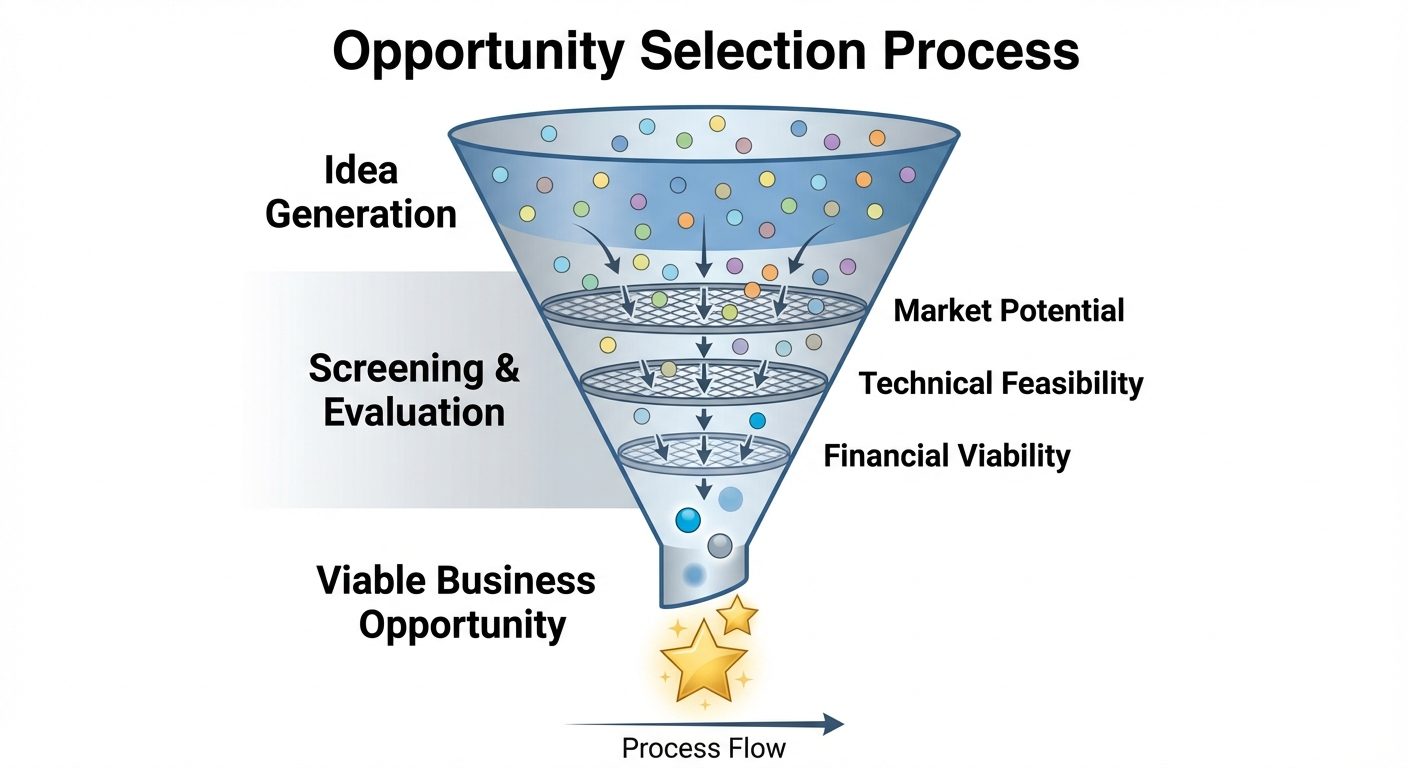
Key Selection Criteria:
- Market Potential: Is the market size large enough? Is it growing?
- Technical Feasibility: Can the product actually be made with current technology? Are raw materials available?
- Financial Viability: Are the projected returns higher than the cost of capital? (ROI, IRR).
- Competitor Analysis: Is the market saturated? What is the barrier to entry?
- Risk Assessment: Is the risk-reward ratio acceptable?
- Entrepreneurial Competence: Does the entrepreneur possess the necessary skills or passion for this specific project?
- Legal/Regulatory Compliance: Can the business operate legally within the current framework?
5. Viable Project Opportunities in Sectors
5.1 Manufacturing Sector
This involves the conversion of raw materials into finished goods.
- Agro-based Industries: Food processing (jams, pickles), organic fertilizer production, dairy processing.
- Textile & Apparel: Garment manufacturing, specialized sportswear, eco-friendly fabrics.
- Engineering & Technology: Spare parts manufacturing, 3D printing services, assembly of electronic gadgets.
- Chemical/Pharma: Generic drug manufacturing, soap and detergent production, packaging materials.
5.2 Service Sector
This involves providing intangible value to customers.
- Information Technology: App development, cybersecurity consultancy, cloud services.
- Tourism & Hospitality: Eco-tourism resorts, travel agencies, event management, niche restaurants.
- Healthcare: Diagnostic centers, telemedicine platforms, home care for the elderly.
- Education: Ed-tech platforms, vocational training centers, corporate training consultancies.
- Logistics: Last-mile delivery services, warehousing, cold chain logistics.
6. Project Feasibility
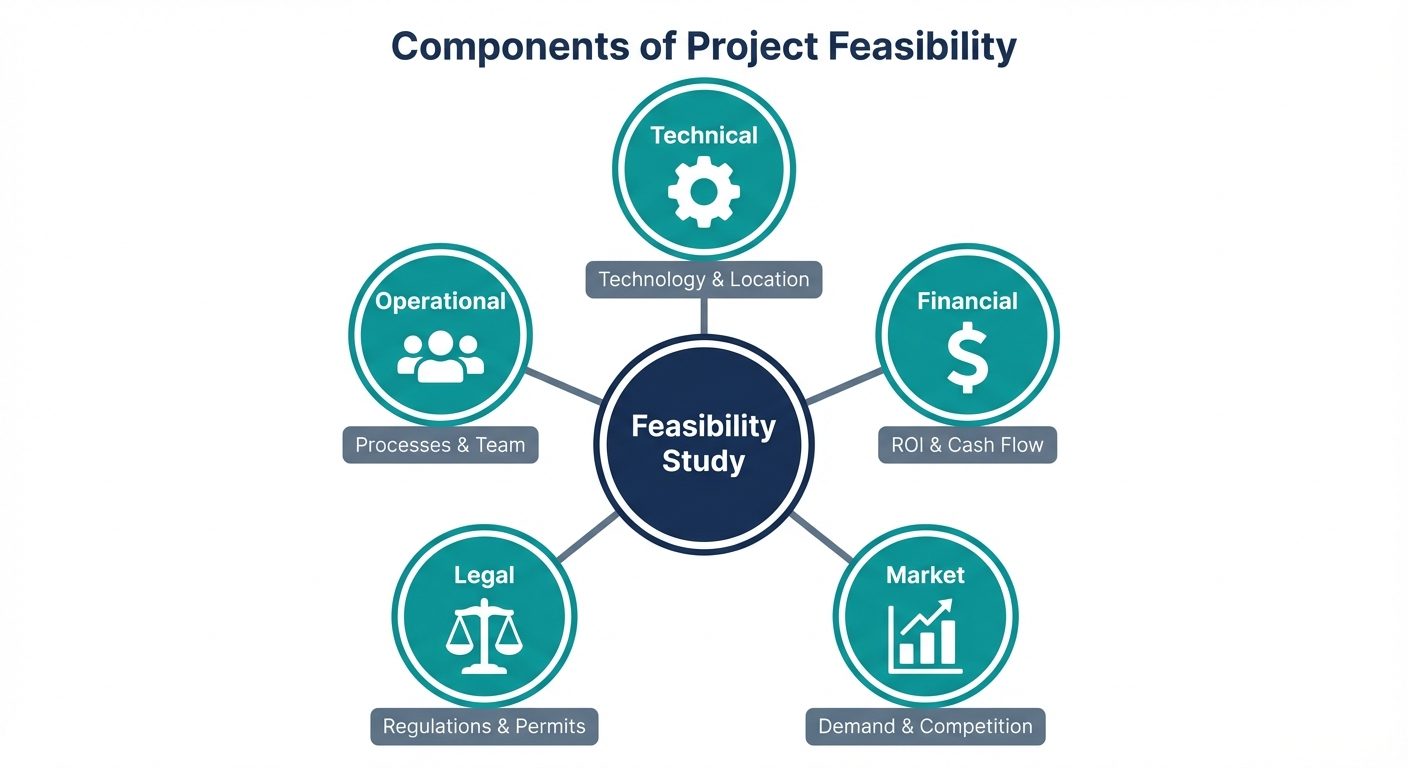
Project feasibility is a detailed study that determines whether a project is likely to succeed. It serves as a "Go/No-Go" decision tool.
Components of a Feasibility Study (TELOS Framework)
-
Technical Feasibility:
- Location and site layout.
- Technology selection (machinery/software).
- Availability of utilities (power, water).
- Waste disposal methods.
-
Economic (Financial) Feasibility:
- Total project cost estimation.
- Means of financing (Equity vs. Debt).
- Projected cash flows.
- Profitability ratios.
-
Legal Feasibility:
- Zoning laws.
- Intellectual property rights.
- Labor laws.
-
Operational Feasibility:
- Can the organization support the project?
- Is there sufficient manpower and management bandwidth?
-
Schedule (Time) Feasibility:
- Can the project be completed within a reasonable deadline?
7. Assessment of Viability of Projects
Once feasibility is established, the viability assessment quantifies the potential success. This is often heavily financial but includes strategic metrics.
7.1 Financial Assessment Techniques
- Break-Even Analysis (BEP): Determines the sales volume at which total revenues equal total costs (No profit, no loss).
- Formula:
- Net Present Value (NPV): The difference between the present value of cash inflows and the present value of cash outflows over a period of time. A positive NPV indicates a viable project.
- Internal Rate of Return (IRR): The expected compound annual rate of return that will be earned on a project. It is compared against the cost of capital.
- Payback Period: The time required to recover the initial investment cost. Shorter periods are generally preferred to reduce risk.
7.2 Non-Financial Assessment
- Scalability: Can the business grow without being hampered by its structure or available resources?
- Sustainability: Long-term environmental and social impact.
- Exit Strategy: Is the business attractive enough to be sold or acquired in the future?
Did this save you a night before the exam?
LPU Notes is free, and it stays free. Ads cover part of the server bill. The rest comes out of a student's own pocket: the domain, the storage, and keeping the site up through the weeks everyone needs it at once.
The payment button didn't load. An ad blocker or a filtered network is the usual reason. to try again.
Nothing here is ever locked, and nothing unlocks. Chip in only if it was worth it. What it pays for →