Unit 1: Introduction to Entrepreneurship
1. Importance and Relevance of Entrepreneurship
Definition
Entrepreneurship is the dynamic process of creating incremental wealth. This wealth is created by individuals who assume the major risks in terms of equity, time, and career commitment of providing value for some product or service. The product or service itself may or may not be new or unique, but value must typically be infused by the entrepreneur by securing and allocating the necessary skills and resources.
Economic Relevance
- Job Creation: Entrepreneurs are the largest source of new job creation in most economies. Small businesses drive employment growth.
- Wealth Creation and Sharing: By establishing the business entity, entrepreneurs invest their own resources and attract capital from investors, lenders, and the public. This mobilizes public wealth and allows people to benefit from the success of entrepreneurs and growing businesses.
- GDP Contribution: The production of goods and services by entrepreneurial ventures contributes significantly to the Gross Domestic Product.
- Regional Development: Entrepreneurs setting up industries in less developed areas lead to the growth of infrastructure (roads, electricity) and public services.
Social and Personal Relevance
- Innovation: Entrepreneurs are "change agents." They introduce new products, methods, and markets that solve societal problems.
- Standard of Living: By producing goods at lower costs or higher quality, entrepreneurs improve the general standard of living.
- Self-Reliance: Entrepreneurship promotes independence and reduces dependence on foreign goods through import substitution.
- Personal Fulfillment: For the individual, it offers financial independence, the ability to leave a legacy, and autonomy over one’s time.
2. Exploring Self: Self-Assessment and Entrepreneurial Competencies
To become a successful entrepreneur, one must understand their own psychology, strengths, and weaknesses. This is often achieved through a SWOT Analysis (Strengths, Weaknesses, Opportunities, Threats) regarding one's own character.
Personal Entrepreneurial Competencies (PECs)
Behavioral scientists have identified a set of competencies that are consistently found in successful entrepreneurs. These are often categorized into three major clusters:
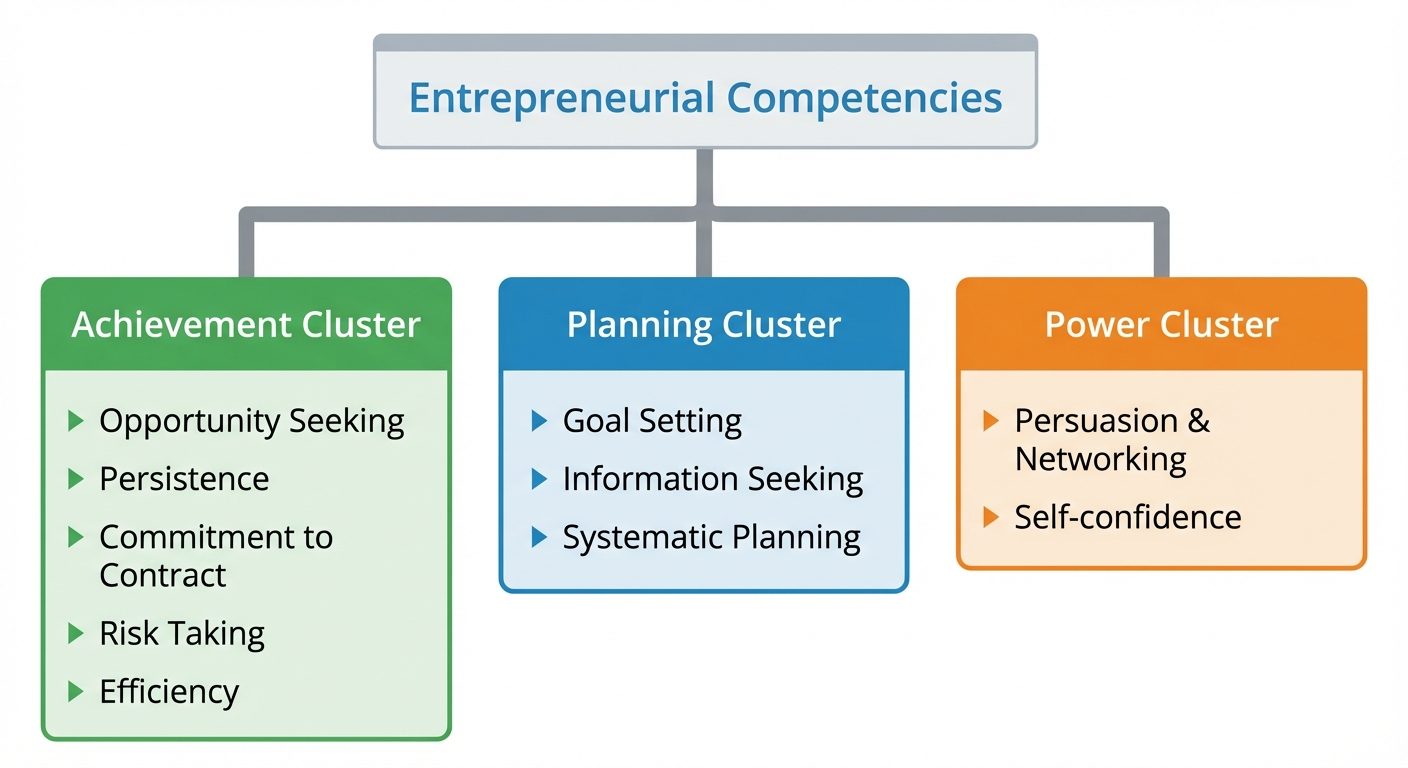
A. Achievement Cluster
- Opportunity Seeking: Acting on new business opportunities or expanding into new areas.
- Persistence: Repeated actions to overcome obstacles.
- Commitment to Work Contract: Accepting full responsibility for completing a job for customers.
- Demand for Quality and Efficiency: Acting to do things that meet or beat existing standards of excellence.
- Risk Taking: Taking calculated, moderate risks (not gambling).
B. Planning Cluster
- Goal Setting: Setting clear and specific short-term and long-term objectives.
- Information Seeking: Personally seeking information from clients, suppliers, or competitors.
- Systematic Planning and Monitoring: Developing logical, step-by-step plans to reach goals and monitoring progress.
C. Power Cluster
- Persuasion and Networking: Using deliberate strategies to influence others and maintaining business contacts.
- Self-Confidence: Expressing confidence in one’s own ability to complete a task or meet a challenge.
3. Goal Setting
Goal setting is the process of deciding what you want to accomplish and devising a plan to achieve the result. For entrepreneurs, goals serve as the roadmap for the venture.
The SMART Framework
Goals must not be vague (e.g., "I want to be rich"). They must follow the SMART criteria:
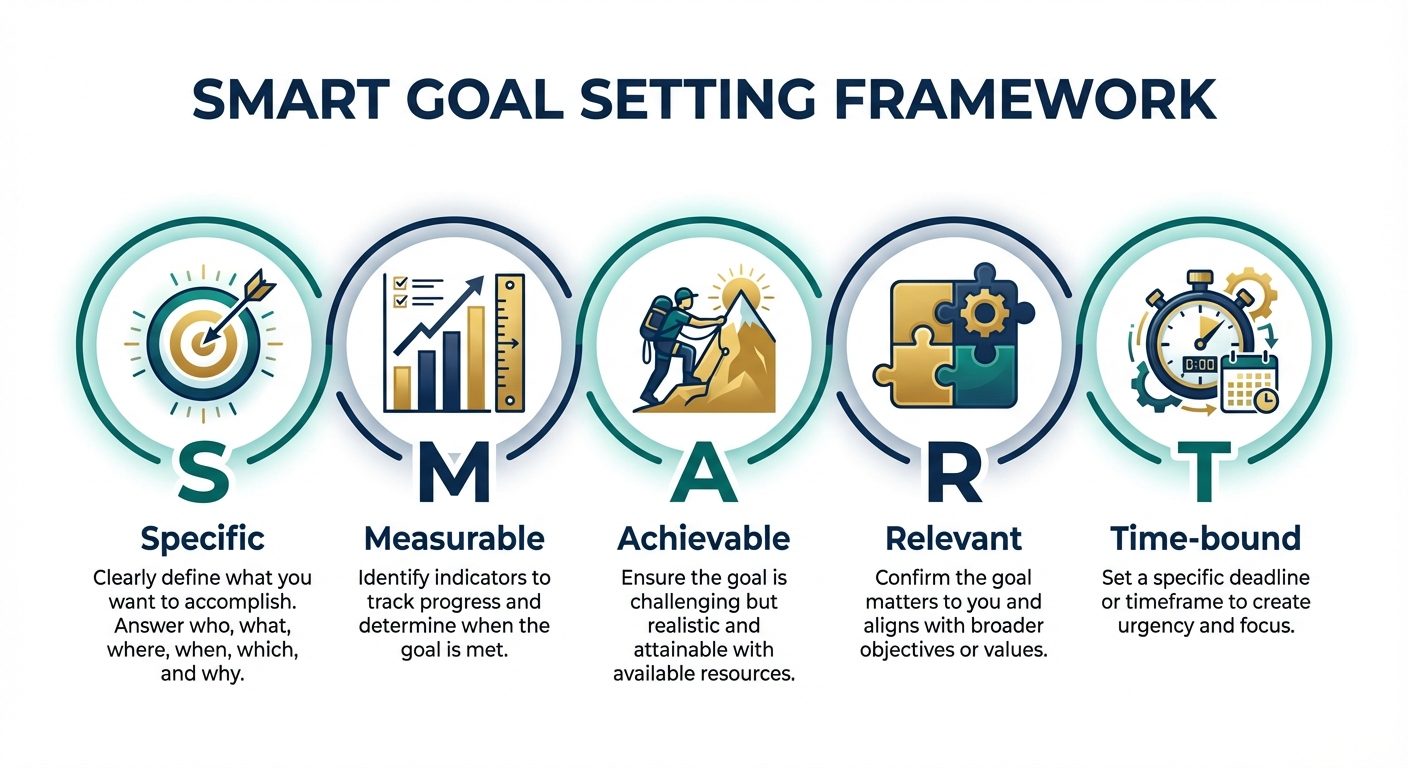
- Specific: The goal should be clear and unambiguous. (e.g., "Increase sales by 10%" rather than "Increase sales").
- Measurable: There must be concrete criteria for measuring progress.
- Achievable: The goal must be realistic and attainable given available resources.
- Relevant: The goal must matter to the business and align with other relevant efforts.
- Time-bound: Every goal needs a target date to prevent everyday tasks from taking priority over longer-term goals.
4. Systematic Planning
Systematic planning is a logical, step-by-step approach to achieving objectives. It moves from the abstract (vision) to the concrete (action).
Steps in Systematic Planning
- Analyze the Environment: Assess internal resources and external market conditions.
- Set Objectives: Define what needs to be achieved (using SMART goals).
- Formulate Strategies: Determine how to achieve the objectives (e.g., cost leadership, differentiation).
- Develop Action Plans: Break strategies down into specific tasks, assigning responsibilities and deadlines.
- Implement: Execute the plan.
- Monitor and Evaluate: Compare actual performance against the plan and adjust as necessary (Feedback Loop).
Why is it crucial?
- Minimizes risk and uncertainty.
- Facilitates coordination among team members.
- Ensures efficient utilization of resources.
5. Team Building and Communication Skills
No entrepreneur succeeds entirely alone. Building a cohesive team and communicating the vision effectively are foundational skills.
Team Building
A team is a group of individuals working together to achieve a common goal.
- Synergy: The concept that the combined output of a team is greater than the sum of individual efforts ().
- Stages of Team Development (Tuckman's Model):
- Forming: Team meets, learns about the opportunity/challenge.
- Storming: Different ideas compete; conflict may arise.
- Norming: Team agrees on rules, values, and methods.
- Performing: The team functions at a high level with autonomy.
Communication Skills
Effective communication involves the exchange of information, ideas, and feelings.
- The Communication Process: Sender Message Channel Receiver Feedback.
- Active Listening: Paying full attention to the speaker, understanding the message, and responding appropriately. Crucial for understanding customer pain points.
- Non-Verbal Communication: Body language, eye contact, and tone of voice often convey more than words.
- Clarity and Conciseness: Entrepreneurs must pitch complex ideas simply to investors and customers.
6. Factors Influencing Entrepreneurship
Entrepreneurship does not happen in a vacuum. It is the result of an interaction between the individual and the environment.
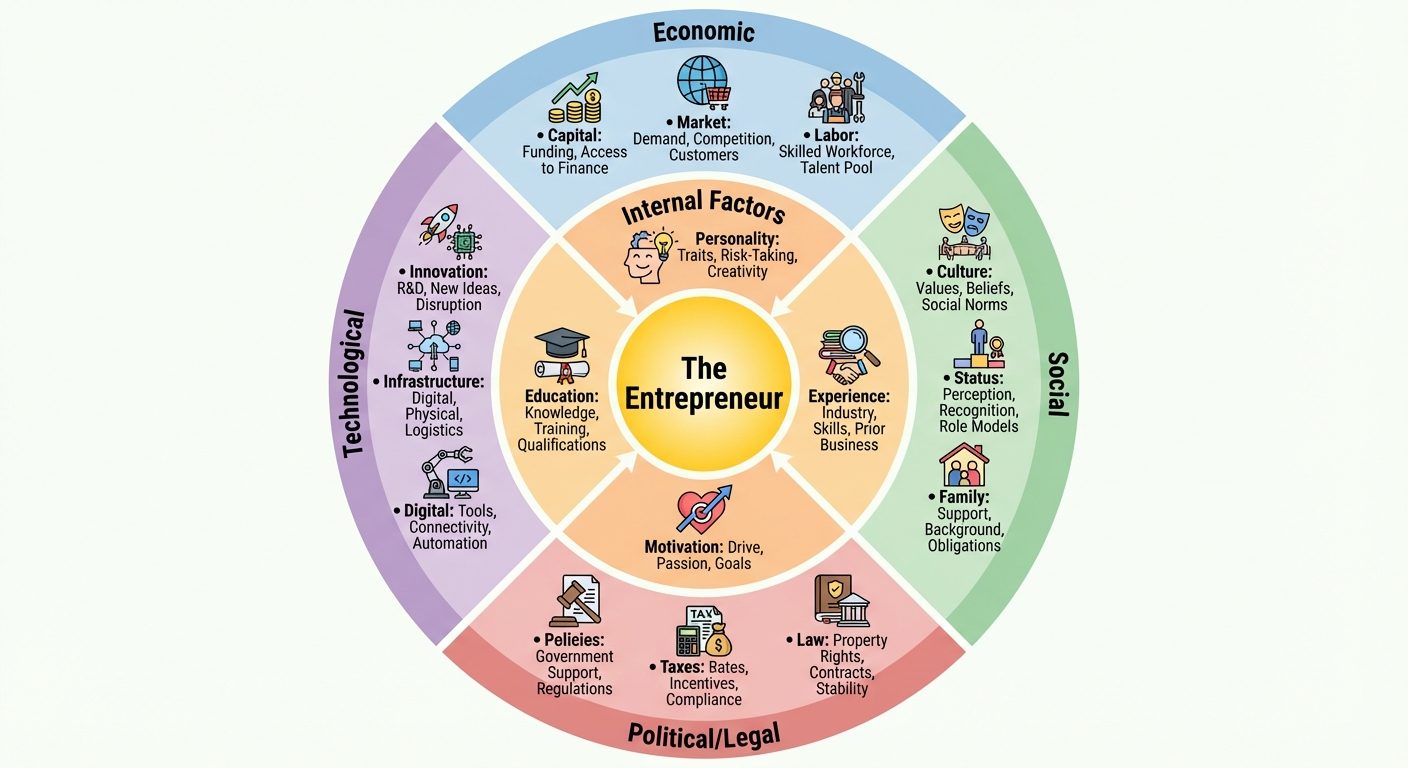
A. Internal Factors (Micro)
- Motivation: The internal drive (e.g., need for achievement).
- Education and Skills: Technical knowledge and business acumen increase the likelihood of success.
- Experience: Previous exposure to business or a specific industry helps in identifying opportunities.
- Risk Tolerance: The psychological ability to handle uncertainty.
B. External Factors (Macro)
- Economic Factors:
- Capital: Availability of funds (loans, venture capital).
- Labor: Availability of skilled workforce at reasonable wages.
- Raw Materials: Access to necessary inputs.
- Market: Size and purchasing power of the target customer base.
- Social and Cultural Factors:
- Legitimacy of Entrepreneurship: Does society admire entrepreneurs?
- Family Background: Support from family or a history of family business.
- Social Mobility: The ability to move up the social ladder through business success.
- Political and Legal Factors:
- Government Policies: Support schemes, subsidies, and ease of doing business.
- Taxation: Favorable tax rates encourage business formation.
- Legal Framework: Protection of intellectual property and contract enforcement.
- Technological Factors:
- Access to modern technology reduces costs and improves quality.
- Technological advancements create new business opportunities (e.g., the rise of AI startups).
Did this save you a night before the exam?
LPU Notes is free, and it stays free. Ads cover part of the server bill. The rest comes out of a student's own pocket: the domain, the storage, and keeping the site up through the weeks everyone needs it at once.
The payment button didn't load. An ad blocker or a filtered network is the usual reason. to try again.
Nothing here is ever locked, and nothing unlocks. Chip in only if it was worth it. What it pays for →