Unit 5: Reported Speech
1. Direct Speech vs. Reported Speech
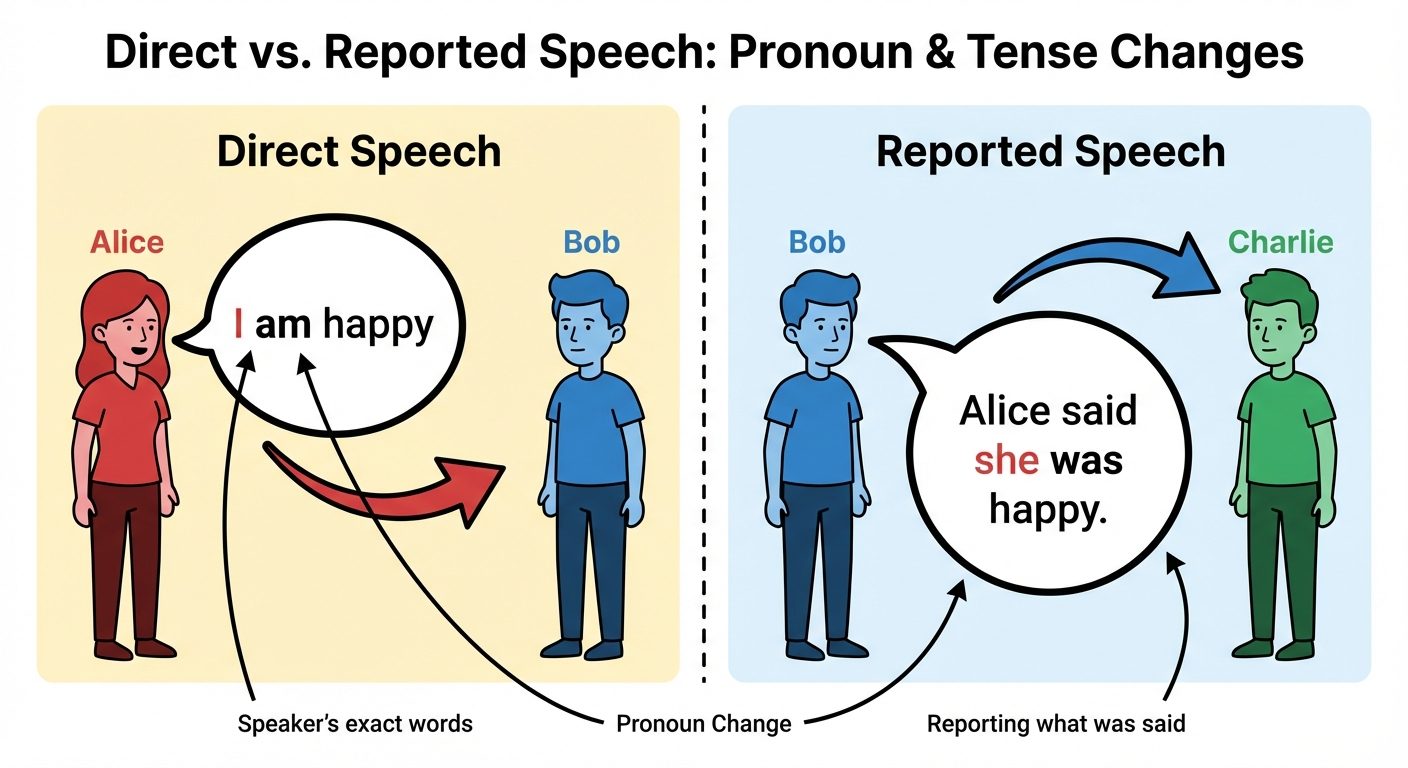
To communicate effectively at an upper-intermediate level, one must distinguish between quoting someone verbatim and integrating their meaning into one's own speech.
Direct Speech
Direct speech repeats, or quotes, the exact words spoken. When we use direct speech in writing, we place the words spoken between quotation marks (" ") and there is no change in these words.
- Example: She said, "I am watching TV."
Reported Speech (Indirect Speech)
Reported speech is usually used to talk about the past, so we normally change the tense of the words spoken. We use reporting verbs like 'say', 'tell', 'ask', and we may use the word 'that' to introduce the reported words. Quotation marks are removed.
- Example: She said (that) she was watching TV.
2. Overview of Changes in Reported Speech
When transforming direct speech into reported speech, three main types of changes occur:
- Tenses (The "Backshift")
- Pronouns
- Time and Place Expressions
A. Tense Changes (The Backshift)
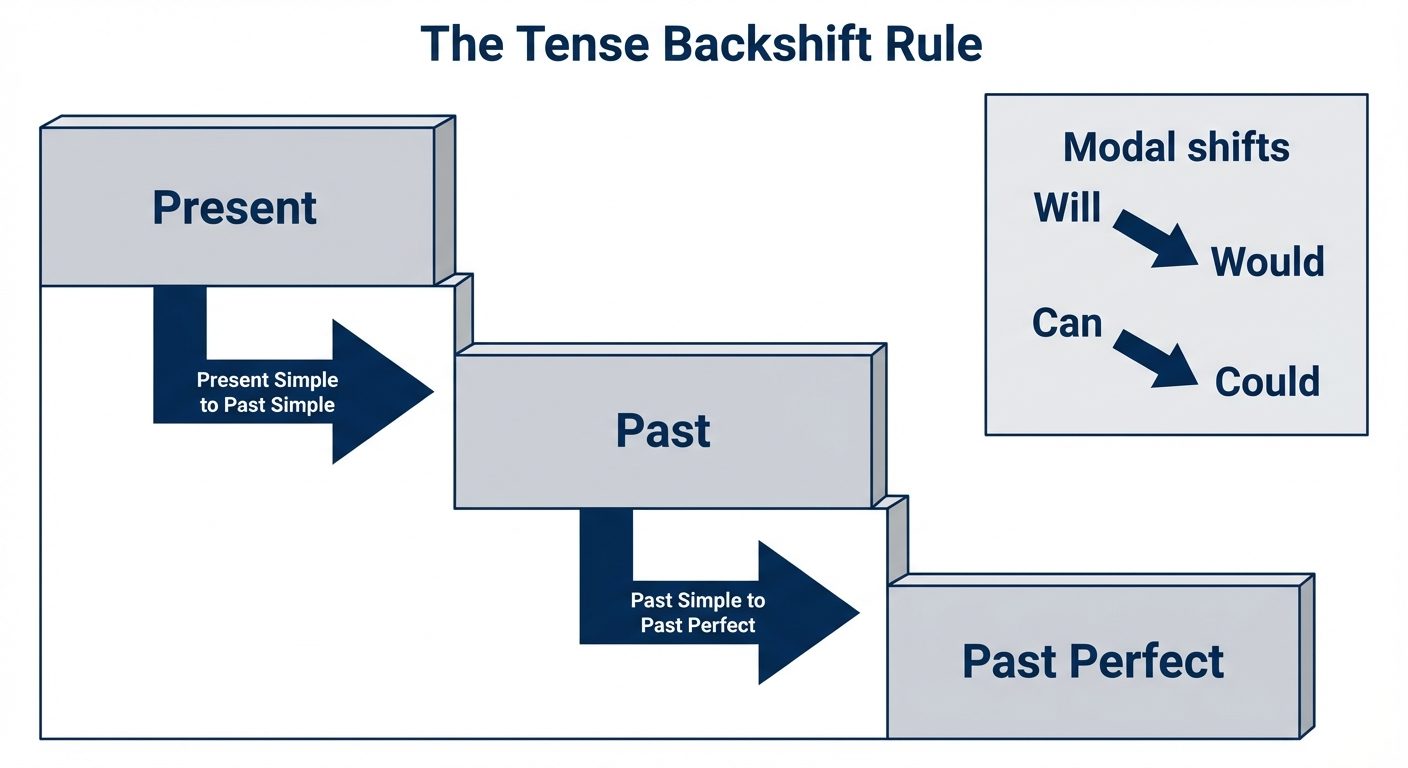
Usually, if the reporting verb (e.g., said, told) is in the past tense, the verbs in the reported clause move one step back into the past.
| Direct Speech Tense | Reported Speech Tense | Example Transformation |
|---|---|---|
| Present Simple | Past Simple | "I work hard." He said he worked hard. |
| Present Continuous | Past Continuous | "I am working." He said he was working. |
| Past Simple | Past Perfect | "I worked yesterday." He said he had worked the day before. |
| Present Perfect | Past Perfect | "I have worked there." He said he had worked there. |
| Past Continuous | Past Perfect Continuous | "I was working." He said he had been working. |
| Will (Future) | Would | "I will work later." He said he would work later. |
| Can | Could | "I can help." He said he could help. |
| Must | Had to | "I must go." He said he had to go. |
Note: Past Perfect and Past Perfect Continuous do not change.
B. Pronoun Changes
Pronouns change according to the perspective of the reporter.
- Direct: "I like my car," said John.
- Reported: John said he liked his car.
C. Time and Place Changes
Expressions indicating nearness in time or place must shift to distance.
- Time:
- Now Then / At that time
- Today That day
- Yesterday The day before / The previous day
- Tomorrow The next day / The following day
- Last week The week before
- Place:
- Here There
- This That
3. Reported Questions
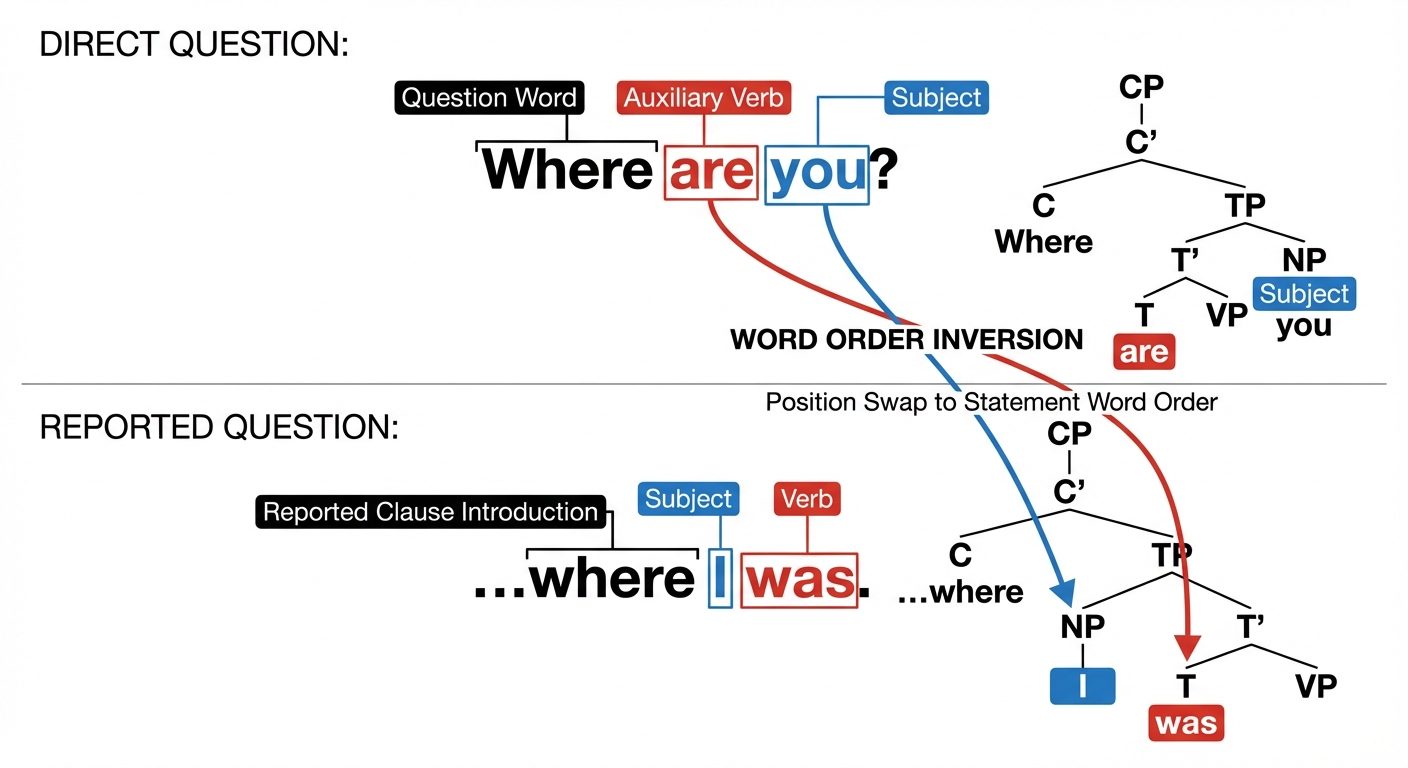
Reported questions have a specific grammatical structure that differs from direct questions. The most important rule is that the word order changes from Question Order to Statement Order. We do not use the auxiliary "do/did" in reported questions, and we do not use a question mark.
A. Wh- Questions (Information Questions)
If the direct question begins with a question word (who, where, why, when, how), we repeat that word in the reported speech.
- Structure: Reporting Verb + Subject + Wh-Word + Subject + Verb
- Direct: "Where are you going?"
- Reported: He asked me where I was going. (NOT: where was I going)
B. Yes/No Questions
If there is no question word (questions starting with Do, Is, Have, Can), we use if or whether.
- Structure: Reporting Verb + (Object) + if/whether + Subject + Verb
- Direct: "Do you like coffee?"
- Reported: She asked if I liked coffee.
4. Reported Requests and Commands
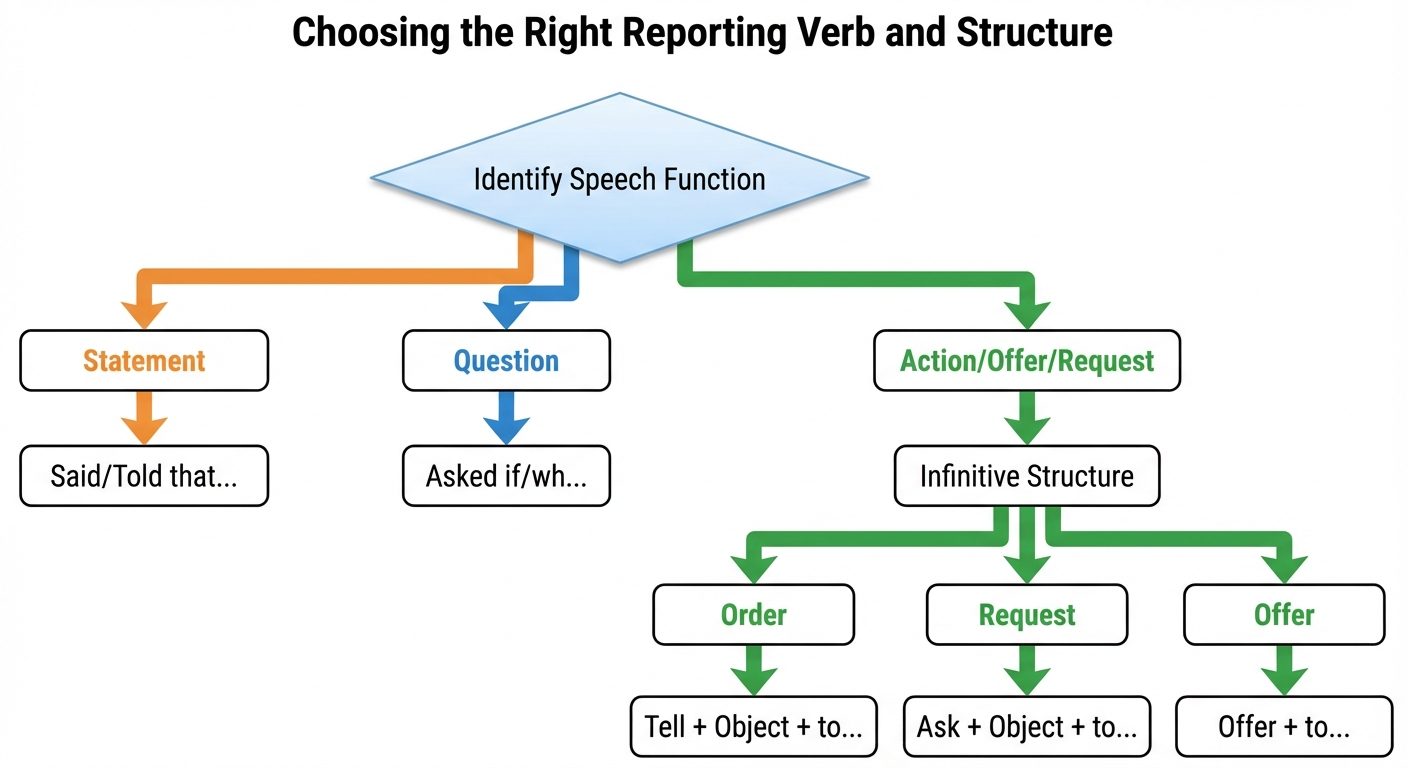
When reporting requests, orders, or commands, we do not usually use "that" clauses. Instead, we use the Infinitive form (to + verb).
The Structure
- Pattern: Reporting Verb + Object + (not) + to + Infinitive
Common Reporting Verbs
- Requests: ask, beg, plead
- Commands: tell, order, command, warn
Examples
- Positive Command:
- Direct: "Sit down, please."
- Reported: The teacher told the students to sit down.
- Negative Command:
- Direct: "Don't touch the wire!"
- Reported: The electrician warned us not to touch the wire.
- Request:
- Direct: "Could you help me?"
- Reported: She asked me to help her.
5. Reported Offers
Offers function similarly to promises or threats in reported speech. While you can sometimes use "said that," it is much more precise to use the verb offer.
Structure Options
Option A: Offer + to + Infinitive (Most Common)
This is used when the subject of the reporting verb is the one performing the action.
- Direct: "I'll carry your bag."
- Reported: He offered to carry my bag.
Option B: Offer + Noun
- Direct: "Would you like a drink?"
- Reported: She offered me a drink.
Contextual Nuance
In upper-intermediate communication, recognizing the "function" of the speech is clearer than translating word-for-word.
- Direct: "Shall I drive you home?"
- Weak Report: He asked if he should drive me home.
- Strong Report: He offered to drive me home.
Did this save you a night before the exam?
LPU Notes is free, and it stays free. Ads cover part of the server bill. The rest comes out of a student's own pocket: the domain, the storage, and keeping the site up through the weeks everyone needs it at once.
The payment button didn't load. An ad blocker or a filtered network is the usual reason. to try again.
Nothing here is ever locked, and nothing unlocks. Chip in only if it was worth it. What it pays for →