Unit 4: Modals Review & Determiners
This unit provides an in-depth review of modal auxiliary verbs, focusing on their nuances in varying contexts, followed by a comprehensive analysis of determiners and their specific functions in noun phrases.
Part 1: Modal Verbs Review
Modal verbs modify the meaning of the main verb to express concepts such as possibility, ability, permission, and obligation. Key characteristics include:
- They do not take an -s in the third person singular.
- They are followed by the bare infinitive (without 'to'), except for ought to and have to.
- They function as auxiliary verbs in questions and negatives.
1. Ability
Expressing the capacity to perform an action.
- Can: Used for general ability in the present.
- Example: "She can analyze complex data sets effectively."
- Could: Used for general ability in the past.
- Example: "Before the merger, we could make decisions faster."
- Be able to: Used for specific ability (a single particular occasion) or when a modal form doesn't exist (e.g., future or perfect tenses).
- Example: "Despite the traffic, they were able to reach the meeting on time." (Specific achievement, not general ability).
- Example: "I will be able to join the call later."
2. Permission
Seeking or granting authorization.
- Can: Informal and most common.
- Example: "Can I leave the office early today?"
- Could: More polite and formal than 'can'.
- Example: "Could I borrow your quarterly report?"
- May: The most formal notation; often used in written notices or strict professional settings.
- Example: "You may begin the examination now."
3. Possibility and Probability (Deduction)
Expressing degrees of certainty regarding a situation.
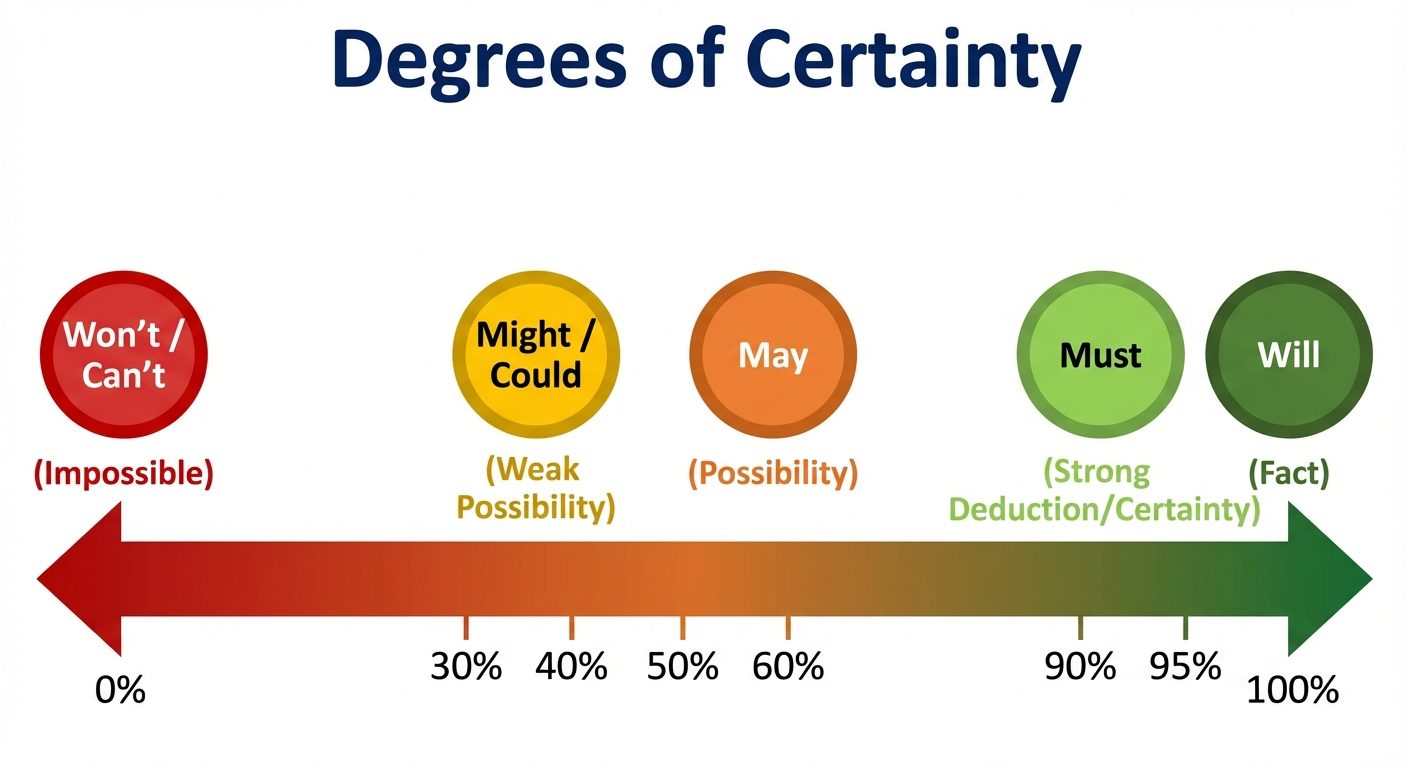
- Must: 90–95% certainty based on evidence (Logical Deduction).
- Example: "His phone is off and his office is dark. He must be in the conference room."
- May / Might / Could: 30–50% certainty (Possibility). Might suggests slightly less probability than may.
- Example: "We might expand to the Asian market next year, but it depends on the budget."
- Can’t: 90–95% certainty that something is not true (Negative Deduction).
- Example: "That can’t be the final invoice; the totals don't match."
4. Necessity and Obligation
Rules, laws, and personal duties.
| Modal | Usage | Example |
|---|---|---|
| Must | Internal obligation (speaker feels it is necessary) or written rules. | "I must finish this report tonight." (My decision) |
| Have to | External obligation (facts, rules, authorities require it). | "We have to wear ID badges." (Company rule) |
| Should / Ought to | Advice, recommendation, or mild obligation. | "You should update your software." |
| Needn't / Don't have to | Lack of obligation (it is not necessary). | "You don't have to attend the meeting if you are busy." |
Note: "Mustn't" means prohibition (illegal/not allowed), whereas "don't have to" means optional.
5. Social Interaction: Requests, Suggestions, Offers, Invitations
- Requests: Can (informal), Could (polite), Will (casual), Would (very polite).
- Example: "Would you mind checking this email?"
- Suggestions: Shall (with I/we), Should, Could.
- Example: "Shall we discuss the budget now?" / "We could try a different marketing strategy."
- Offers: Can, Shall, Will.
- Example: "Shall I carry that for you?" / "I will help you with the installation."
- Invitations: Would.
- Example: "Would you like to join us for lunch?"
6. Past Modals (Modals of Lost Opportunity & Deduction)
These refer to past events and generally follow the structure: Modal + Have + Past Participle (V3).
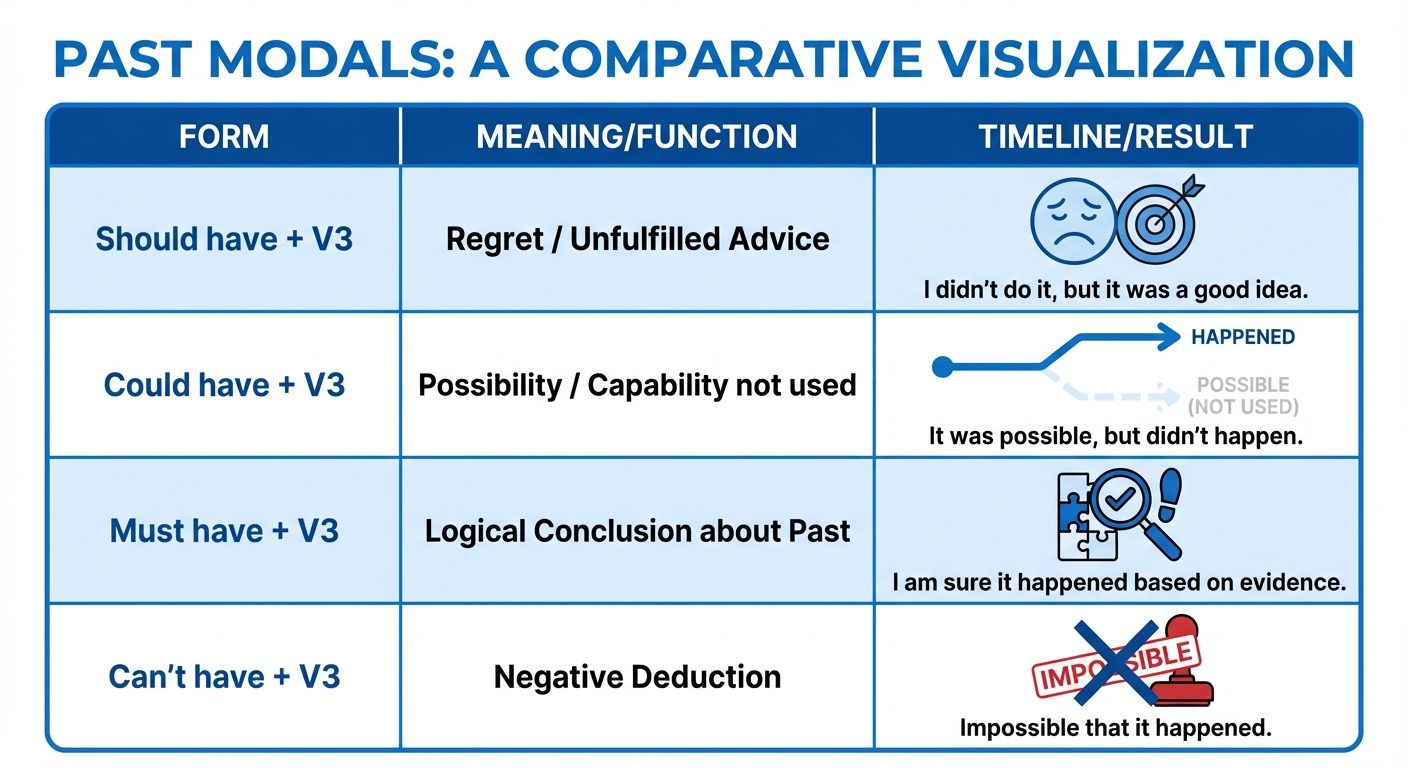
- Must have + V3: Certainty that something happened.
- Example: "The files are missing. Someone must have taken them."
- Can't have / Couldn't have + V3: Certainty that something did not happen.
- Example: "He can't have stolen the money; he was with me all day."
- Could have + V3: Something was possible but didn't happen.
- Example: "You could have got a promotion if you had worked harder."
- Should have + V3: Regret or criticism about a past mistake.
- Example: "We should have signed the contract earlier."
Part 2: Determiners
Determiners are words placed in front of a noun to specify quantity or clarify what the noun refers to. They always come before any adjectives used to describe the noun.
Structure: Determiner + (Adjective) + Noun
1. Possessive Determiners
These indicate ownership or relationship. They change form depending on the possessor, not the possessed object.
- Forms: My, Your, His, Her, Its, Our, Their.
- Usage: "Please submit your final assignment." / "The company changed its policy."
- Distinction: Do not confuse with possessive pronouns (Mine, Yours, Ours), which replace the noun entirely.
2. Demonstrative Determiners
These indicate the physical or temporal distance of the noun relative to the speaker.
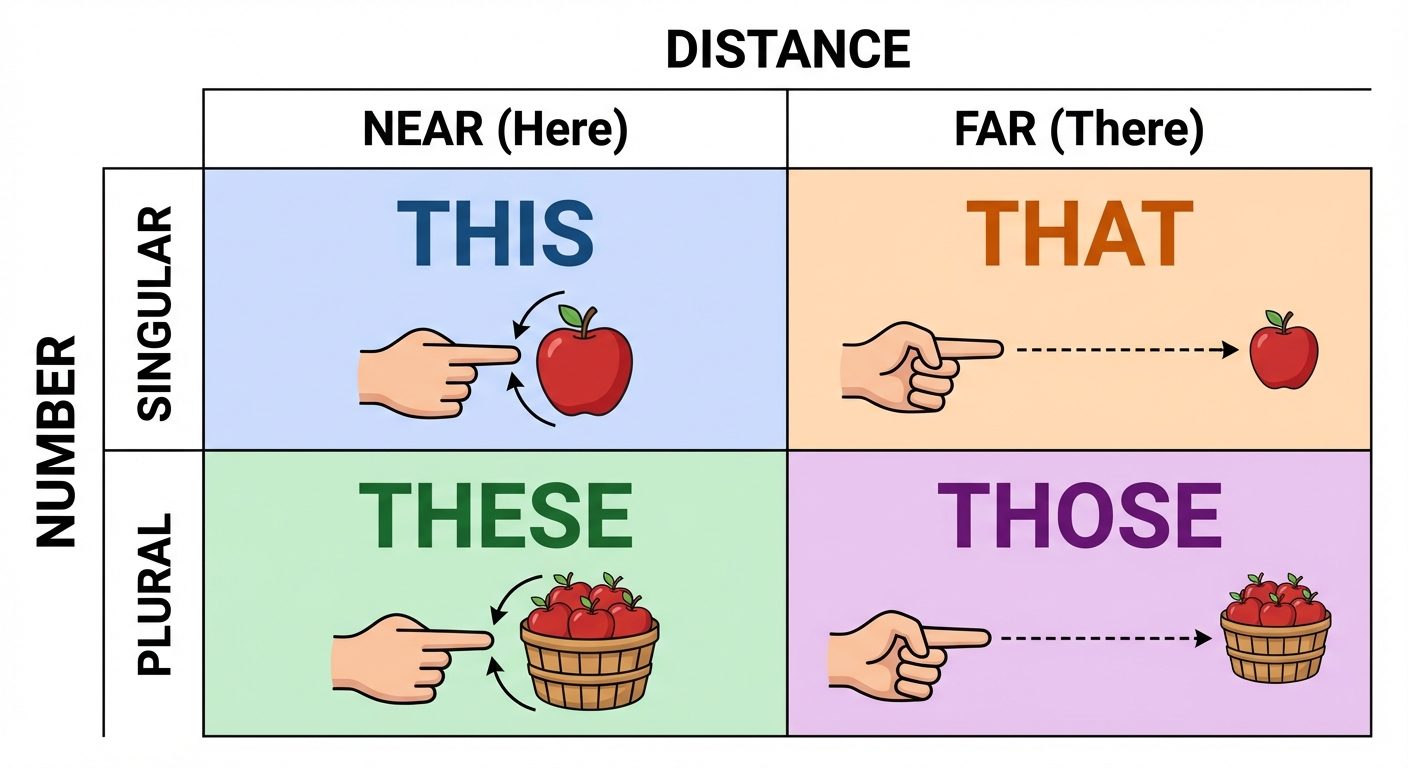
- This: Singular, near. (This idea is great.)
- That: Singular, far (physical or abstract). (That deadline was unrealistic.)
- These: Plural, near. (These documents need signing.)
- Those: Plural, far. (Those clients were difficult.)
3. Distributive Determiners
These refer to members of a group individually or collectively.
- Each: Focus on individual members of a group. Used with singular nouns.
- Example: "Each employee must sign the NDA." (Focus on the individual).
- Every: Focus on the group as a whole (similar meaning to 'all'). Used with singular nouns.
- Example: "Every computer in the lab was updated." (Focus on the total).
- Either: One or the other of two options.
- Example: "Either day is fine for the meeting."
- Neither: Not the one and not the other (negative).
- Example: "Neither strategy worked."
- All: Refers to the total group. Used with plural or uncountable nouns.
- Example: "All participants agreed."
4. Quantitative Determiners (Quantifiers)
These express the amount or quantity of the noun. The choice of quantifier depends heavily on whether the noun is Countable or Uncountable.
Countable vs. Uncountable Quantifiers
| Quantifier Category | Used with Countable Nouns | Used with Uncountable Nouns | Used with Both |
|---|---|---|---|
| Large Quantity | Many | Much | A lot of / Lots of / Plenty of |
| Small Quantity | A few (positive)<br>Few (negative) | A little (positive)<br>Little (negative) | - |
| Indefinite | Some / Any | Some / Any | Some / Any |
| Total/None | No | No | No / None of |
Nuance: "A few" vs. "Few" / "A little" vs. "Little"
This is a critical distinction in communication skills.
- With 'A' (A few / A little): Has a positive meaning. It means "some," "enough," or "better than nothing."
- Example: "I have a little money left." (Positive: I can buy lunch).
- Without 'A' (Few / Little): Has a negative meaning. It means "hardly any," "not enough," or "almost none."
- Example: "I have little money left." (Negative: I am broke).
Some vs. Any
- Some: Generally used in positive sentences.
- Example: "We have some issues to resolve."
- Exception: Used in offers/requests ("Would you like some water?").
- Any: Generally used in negative sentences and questions.
- Example: "We don't have any stock left." / "Do you have any questions?"
Did this save you a night before the exam?
LPU Notes is free, and it stays free. Ads cover part of the server bill. The rest comes out of a student's own pocket: the domain, the storage, and keeping the site up through the weeks everyone needs it at once.
The payment button didn't load. An ad blocker or a filtered network is the usual reason. to try again.
Nothing here is ever locked, and nothing unlocks. Chip in only if it was worth it. What it pays for →