Unit 6: Vocabulary
Overview
This unit focuses on Lexical Chunks—multi-word units of language that are stored and retrieved from memory as a whole, rather than generated word-by-word. Mastery of these elements is the defining characteristic of Upper Intermediate and Advanced language proficiency, shifting the focus from individual vocabulary words to natural phrasing.
1. Idioms
1.1 Definition
An idiom is a phrase or expression whose meaning cannot be understood from the ordinary meanings of its individual words. The meaning is figurative, not literal.
- Literal Meaning: "He kicked the bucket." (He struck a pail with his foot.)
- Idiomatic Meaning: "He kicked the bucket." (He died.)
1.2 Characteristics of Idioms
- Fixedness: You usually cannot change the words, grammar, or word order.
- Correct: "It's raining cats and dogs."
- Incorrect: "It's raining dogs and cats." / "It's raining kittens and puppies."
- Cultural Specificity: Idioms often reflect the history, culture, or environment of the native speakers (e.g., cricket metaphors in British English, baseball metaphors in American English).
- Register: Most idioms are informal or colloquial, though some are acceptable in business contexts.
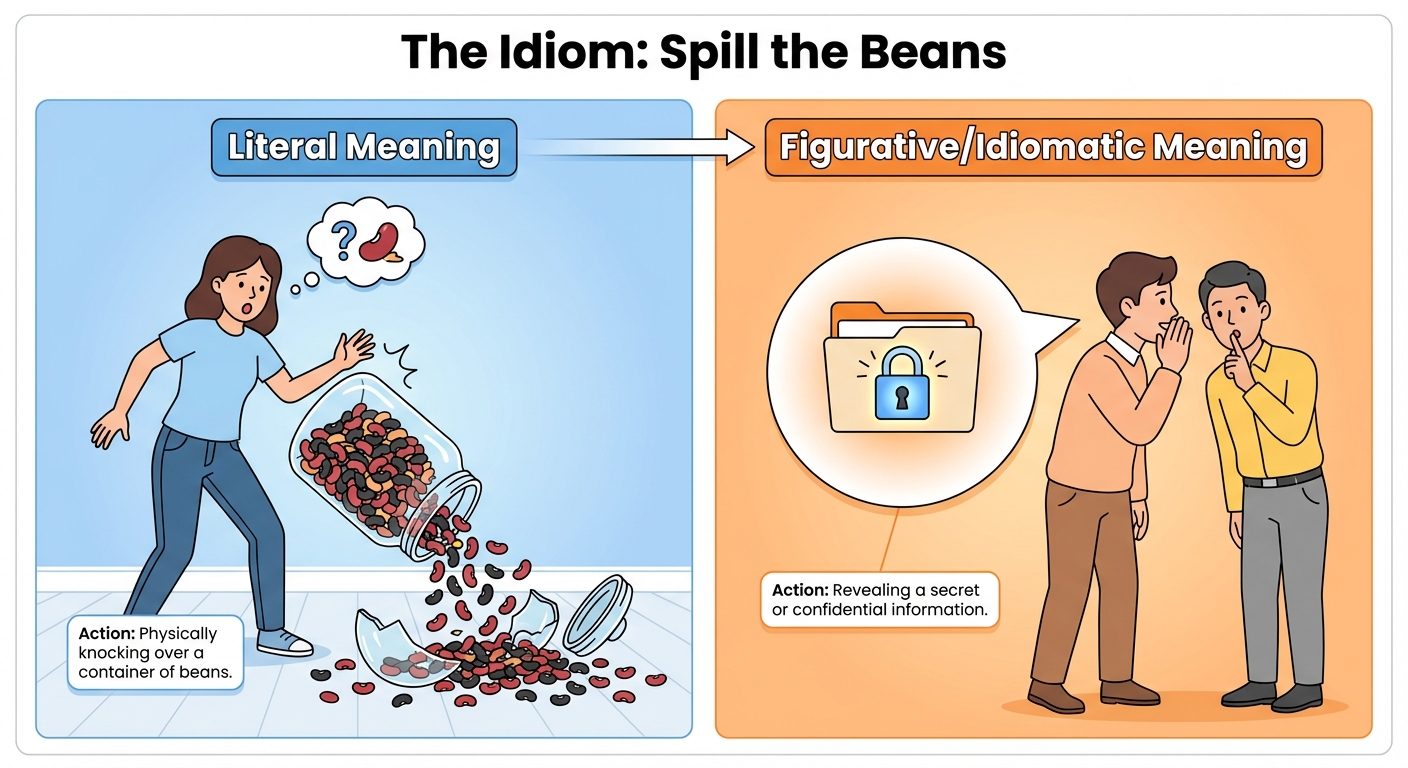
1.3 Common Categories and Examples
| Category | Idiom | Meaning | Example Sentence |
|---|---|---|---|
| Business/Work | Cut corners | Do something badly to save time/money | "They cut corners on the construction, so the roof leaks." |
| Communication | Beat around the bush | Avoid saying what you mean, usually because it is uncomfortable | "Stop beating around the bush and tell me if I'm fired." |
| Difficulty | Bite the bullet | Force yourself to do something unpleasant | "I hate the dentist, but I have to bite the bullet and go." |
| Success | Hit the nail on the head | Describe exactly what is causing a situation or problem | "Alice hit the nail on the head when she said we lack funding." |
1.4 Strategies for Learning Idioms
- Context is King: Never learn idioms in isolation lists. Learn them within full sentences.
- Thematic Grouping: Group by topic (e.g., "Time," "Money," "Body Parts") rather than alphabetically.
- Visual Association: Visualize the literal meaning to help trigger the memory of the phrase.
2. Collocations
2.1 Definition
Collocations are pairs or groups of words that naturally appear together in a language. Native speakers use them instinctively; using a non-collocating synonym often sounds unnatural or "wrong" to a native ear.
- Natural: "Fast food"
- Unnatural: "Quick food" (Grammatically correct, but lexically wrong)
2.2 The Spectrum of Collocation
Collocations range from weak (very flexible) to strong (highly fixed).
- Weak Collocations: Words that can be used with many other words.
- Example: "Big" (big house, big dog, big problem, big mistake).
- Strong Collocations: Words that have very limited associations.
- Example: "Mitigating" mainly collocates with "circumstances" or "factors."
- Fixed Collocations: Similar to idioms, the link is rigid.
- Example: "To and fro."
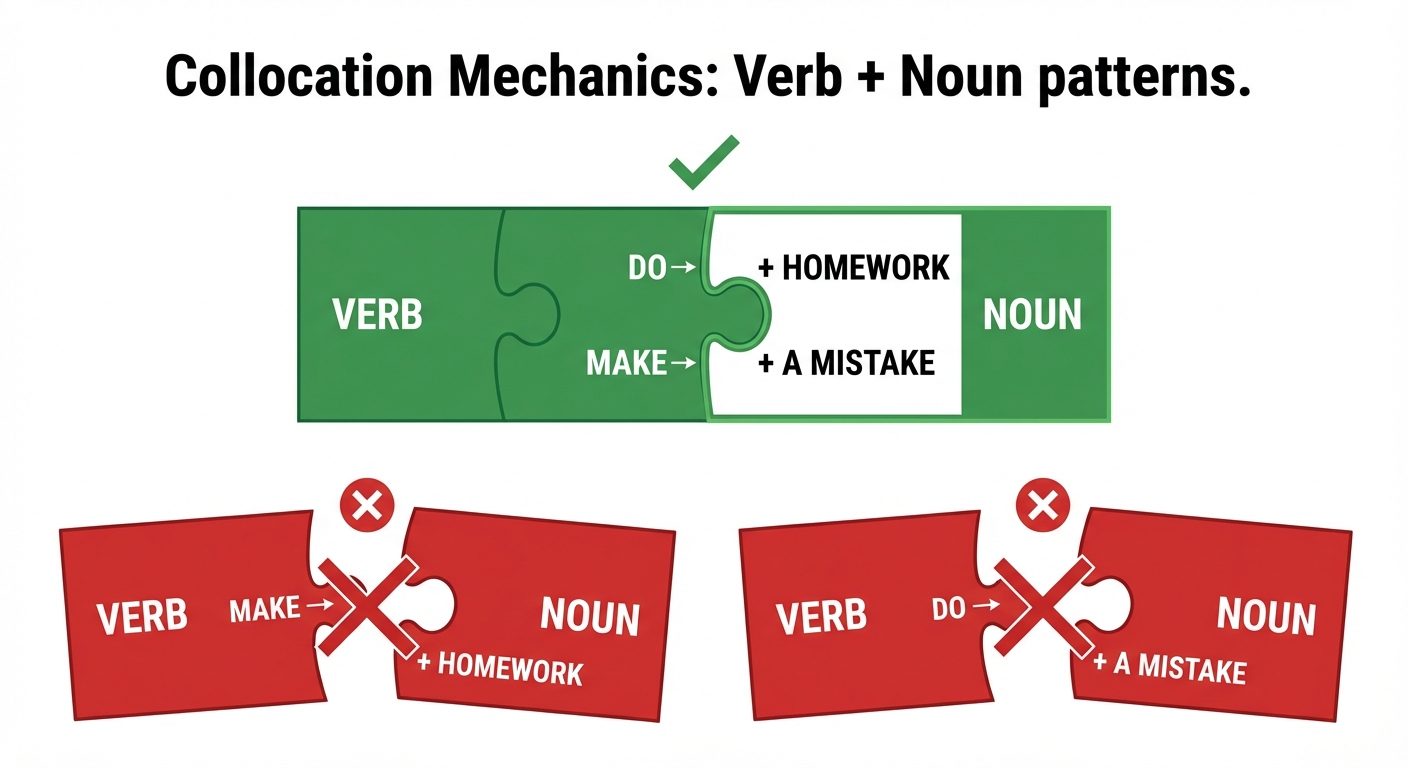
2.3 Common Grammatical Types of Collocations
A. Adjective + Noun
- Heavy rain (Not "strong rain")
- High temperature (Not "tall temperature")
- Deep sleep
B. Verb + Noun
- Commit a crime (Not "do a crime")
- Give a presentation
- Make an effort
C. Noun + Noun
- A surge of anger
- A bar of soap
- Round of applause
D. Adverb + Adjective
- Utterly ridiculous
- Fully aware
- Highly controversial
E. Verb + Preposition (Dependent Prepositions)
- Apologize for
- Believe in
- Depend on
3. Formulaic Expressions (Functional Language)
3.1 Definition
Formulaic expressions (also called fixed phrases or gambits) are multi-word units used to perform specific pragmatic functions in communication. Unlike idioms, their meaning is usually transparent, but they are learned as a single "chunk" to aid fluency.
3.2 Functions of Formulaic Expressions
These expressions serve as the "lubricant" of conversation, allowing speakers to organize their thoughts and manage social interactions smoothly.
A. Social Interaction
- Greeting: "How's it going?" / "Long time no see."
- Closing: "Have a good one." / "Keep in touch."
- Apologizing: "I'm terribly sorry about that."
B. Discourse Management (Structuring Talk)
- Starting: "To begin with..." / "First of all..."
- Adding: "On top of that..." / "Furthermore..."
- Contrasting: "On the other hand..." / "Having said that..."
C. Stalling and Fluency (Buying Time)
- "Let me see..."
- "That's a good question..."
- "What I'm trying to say is..."
3.3 The "Fluency Paradox"
Formulaic expressions allow speakers to speak faster because the brain retrieves one "chunk" (e.g., “at the end of the day”) rather than six individual words. This frees up cognitive processing power to focus on the actual content of the message.
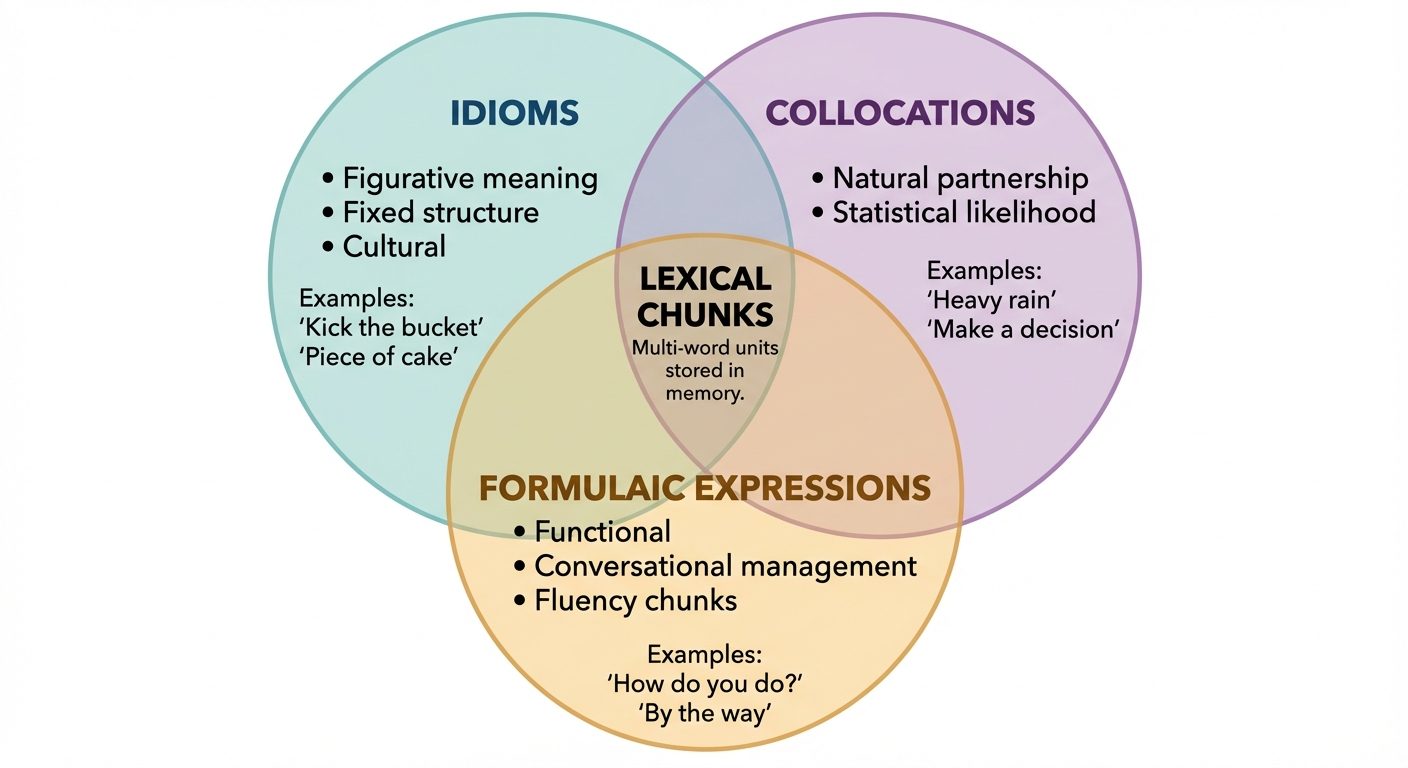
4. Comparative Analysis: Idioms vs. Collocations vs. Formulaic Expressions
Understanding the nuance between these three categories is essential for upper-intermediate communication.
- Idioms are about Meaning (Figurative).
- Collocations are about Word Partnership (Habitual co-occurrence).
- Formulaic Expressions are about Function (Pragmatic usage).
5. Study Exercises for Unit 6
Exercise 1: Collocation Correction
Identify and correct the collocation errors in the following sentences:
- Please do a reservation for dinner tonight. (Correction: Make a reservation)
- The traffic was strong this morning. (Correction: Heavy traffic)
- I fully agree with your opinion. (Correction: Agree is correct, but Share your opinion or Agree entirely are stronger).
Exercise 2: Idiom Contextualization
Replace the bracketed text with an appropriate idiom:
- I think we should [stop working for the day]. -> Call it a day.
- It happens [very rarely]. -> Once in a blue moon.
- Don't [reveal the secret] yet! -> Spill the beans / Let the cat out of the bag.
Exercise 3: Functional Mapping
Match the expression to its function:
- "Mind if I jump in here?" -> Interrupting
- "I see where you're coming from, but..." -> Disagreeing politely
- "In a nutshell..." -> Summarizing
Did this save you a night before the exam?
LPU Notes is free, and it stays free. Ads cover part of the server bill. The rest comes out of a student's own pocket: the domain, the storage, and keeping the site up through the weeks everyone needs it at once.
The payment button didn't load. An ad blocker or a filtered network is the usual reason. to try again.
Nothing here is ever locked, and nothing unlocks. Chip in only if it was worth it. What it pays for →