Unit 5: Active Passive Voice
1. Introduction to Voice
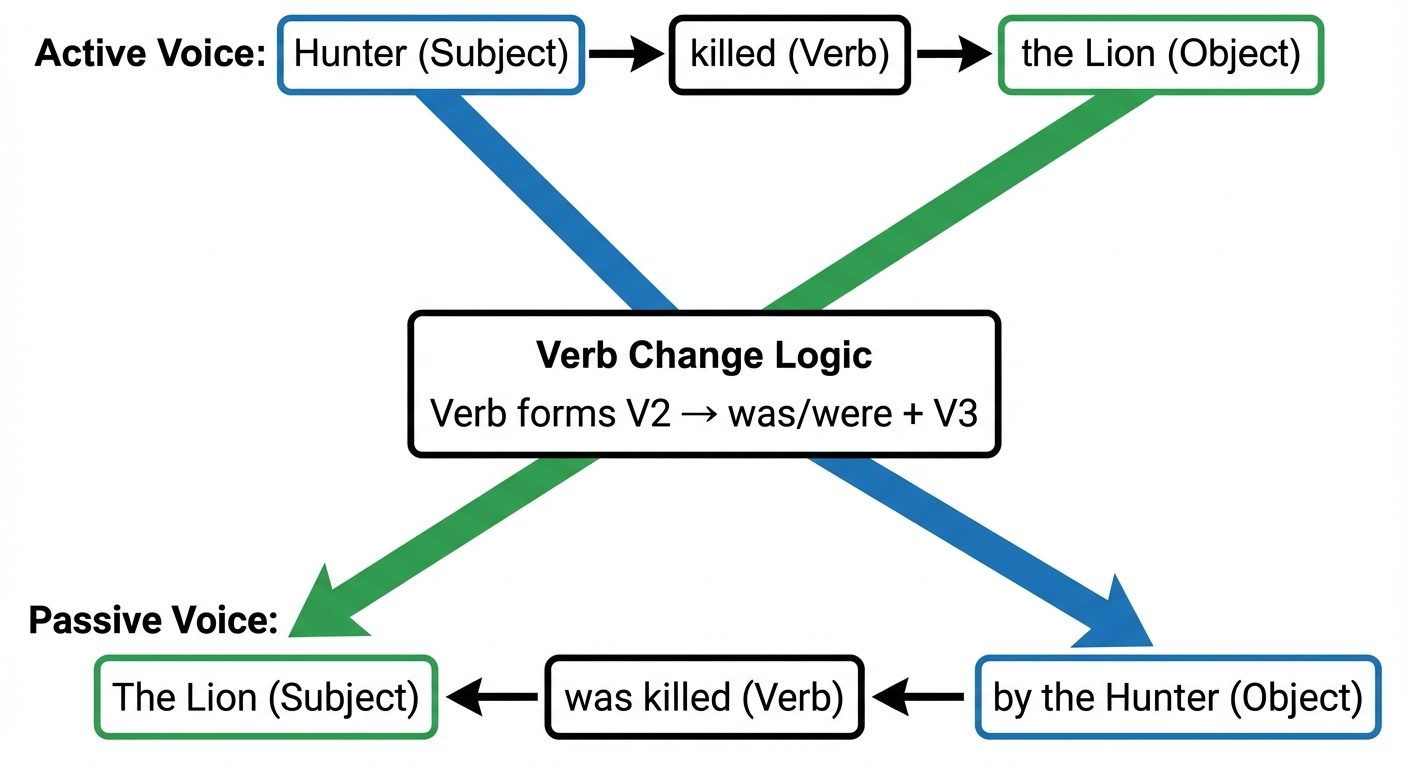
Voice is the quality of a verb that indicates whether the subject acts or is acted upon. It demonstrates the relationship between the Subject, the Verb, and the Object in a sentence.
1.1 Active Voice
- Definition: In the active voice, the subject performs the action expressed by the verb.
- Structure: Subject + Verb + Object.
- Focus: The focus is on the "doer" (the agent).
- Example: The chef (Subject) prepared (Verb) the meal (Object).
1.2 Passive Voice
- Definition: In the passive voice, the subject receives the action expressed by the verb. The object of the active sentence becomes the subject of the passive sentence.
- Structure: Object (New Subject) + Helping Verb + Past Participle (V3) + by + Subject (New Object).
- Focus: The focus is on the "action" or the "receiver," rather than the doer.
- Example: The meal (New Subject) was prepared (Verb) by the chef (New Object).
2. Fundamental Rules of Conversion
To change a sentence from Active to Passive voice, five fundamental changes must occur:
- Swap Positions: The Object of the active sentence becomes the Subject of the passive sentence; the Subject of the active sentence becomes the Object (Agent) of the passive sentence.
- Change the Verb: The main verb is always changed into the Past Participle form (V3).
- Add Auxiliary Verb: A form of the verb "to be" (is, am, are, was, were, be, been, being) is placed before the main verb according to the tense.
- Add Preposition: The preposition "by" is usually added before the agent (the doer).
- Pronoun Change: If the subject is a pronoun, it changes from the subjective case to the objective case.
Pronoun Conversion Chart
| Active Voice (Subjective Case) | Passive Voice (Objective Case) |
|---|---|
| I | Me |
| We | Us |
| You | You |
| He | Him |
| She | Her |
| It | It |
| They | Them |
Note on Intransitive Verbs: Verbs that do not take an object (Intransitive verbs like sleep, go, die, laugh) cannot be changed into the passive voice because there is no object to become the new subject.
3. Tense-Wise Rules and Usage
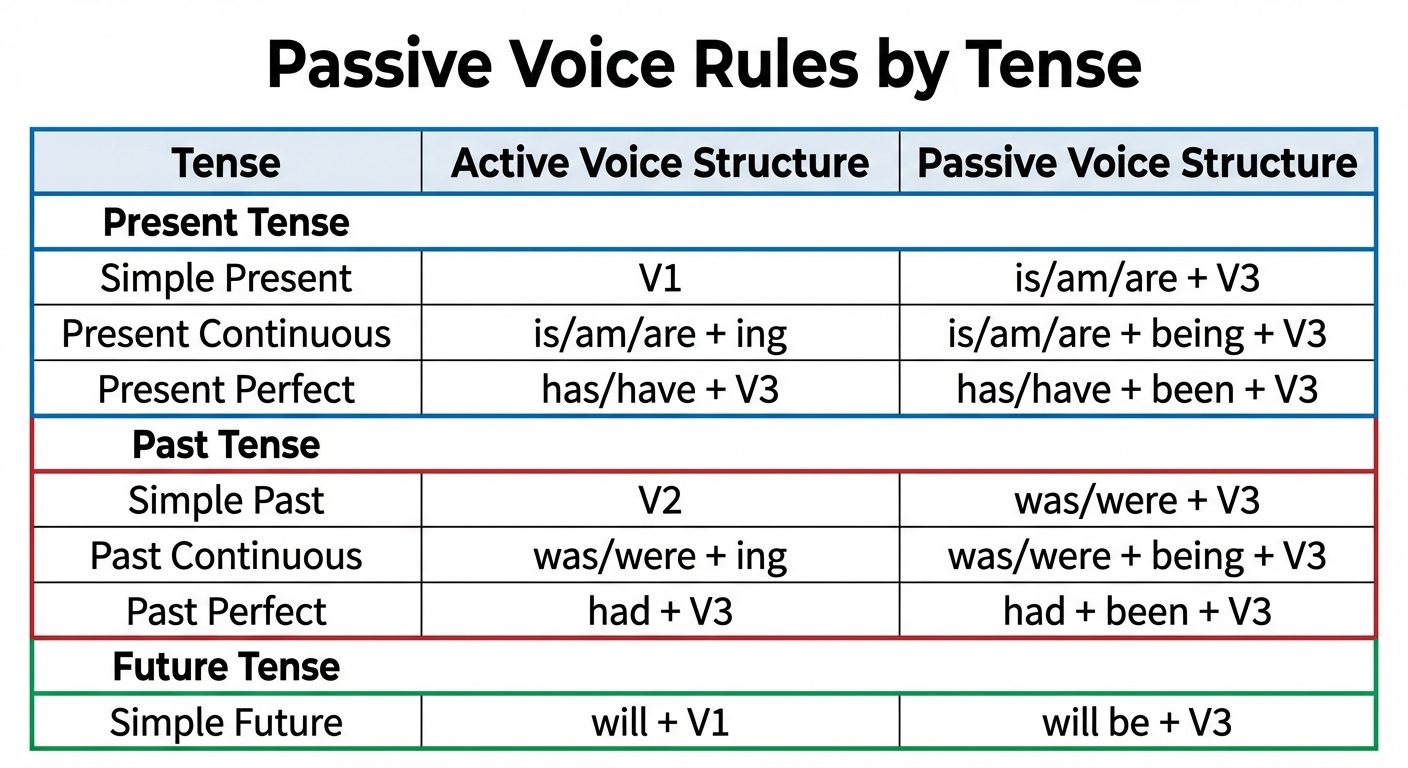
The form of the "to be" verb changes based on the tense of the original active sentence.
3.1 Present Tense
A. Simple Present Tense
- Active Rule: Subject + V1 (s/es) + Object
- Passive Rule: New Subject + is/am/are + V3 + by + New Object
- Example:
- Active: She writes a letter.
- Passive: A letter is written by her.
B. Present Continuous Tense
- Active Rule: Subject + is/am/are + V1 + ing + Object
- Passive Rule: New Subject + is/am/are + being + V3 + by + New Object
- Example:
- Active: They are eating apples.
- Passive: Apples are being eaten by them.
C. Present Perfect Tense
- Active Rule: Subject + has/have + V3 + Object
- Passive Rule: New Subject + has/have + been + V3 + by + New Object
- Example:
- Active: He has challenged me.
- Passive: I have been challenged by him.
(Note: Present Perfect Continuous has no passive form.)
3.2 Past Tense
A. Simple Past Tense
- Active Rule: Subject + V2 + Object
- Passive Rule: New Subject + was/were + V3 + by + New Object
- Example:
- Active: The cat drank the milk.
- Passive: The milk was drunk by the cat.
B. Past Continuous Tense
- Active Rule: Subject + was/were + V1 + ing + Object
- Passive Rule: New Subject + was/were + being + V3 + by + New Object
- Example:
- Active: She was washing the shirt.
- Passive: The shirt was being washed by her.
C. Past Perfect Tense
- Active Rule: Subject + had + V3 + Object
- Passive Rule: New Subject + had + been + V3 + by + New Object
- Example:
- Active: The rain had ruined the crops.
- Passive: The crops had been ruined by the rain.
(Note: Past Perfect Continuous has no passive form.)
3.3 Future Tense
A. Simple Future Tense
- Active Rule: Subject + will/shall + V1 + Object
- Passive Rule: New Subject + will/shall + be + V3 + by + New Object
- Example:
- Active: I will buy a new car.
- Passive: A new car will be bought by me.
B. Future Perfect Tense
- Active Rule: Subject + will/shall + have + V3 + Object
- Passive Rule: New Subject + will/shall + have + been + V3 + by + New Object
- Example:
- Active: She will have finished the work.
- Passive: The work will have been finished by her.
(Note: Future Continuous and Future Perfect Continuous have no passive forms.)
4. Modals and Infinitives
4.1 Modal Verbs (Can, Could, May, Might, Should, Must)
When an active sentence contains a modal auxiliary, the passive forms include "be".
- Rule: Subject + Modal + V1 + Object Object + Modal + be + V3 + by + Subject
- Examples:
- Active: He can solve the problem.
- Passive: The problem can be solved by him.
- Active: You must follow the rules.
- Passive: The rules must be followed by you.
4.2 Infinitive Verbs (To + V1)
- Rule: To + V1 To + be + V3
- Example:
- Active: I want to buy a laptop.
- Passive: I want a laptop to be bought.
5. Special Sentence Structures
5.1 Imperative Sentences (Commands and Requests)
Imperative sentences do not have a visible subject (the subject "You" is implied).
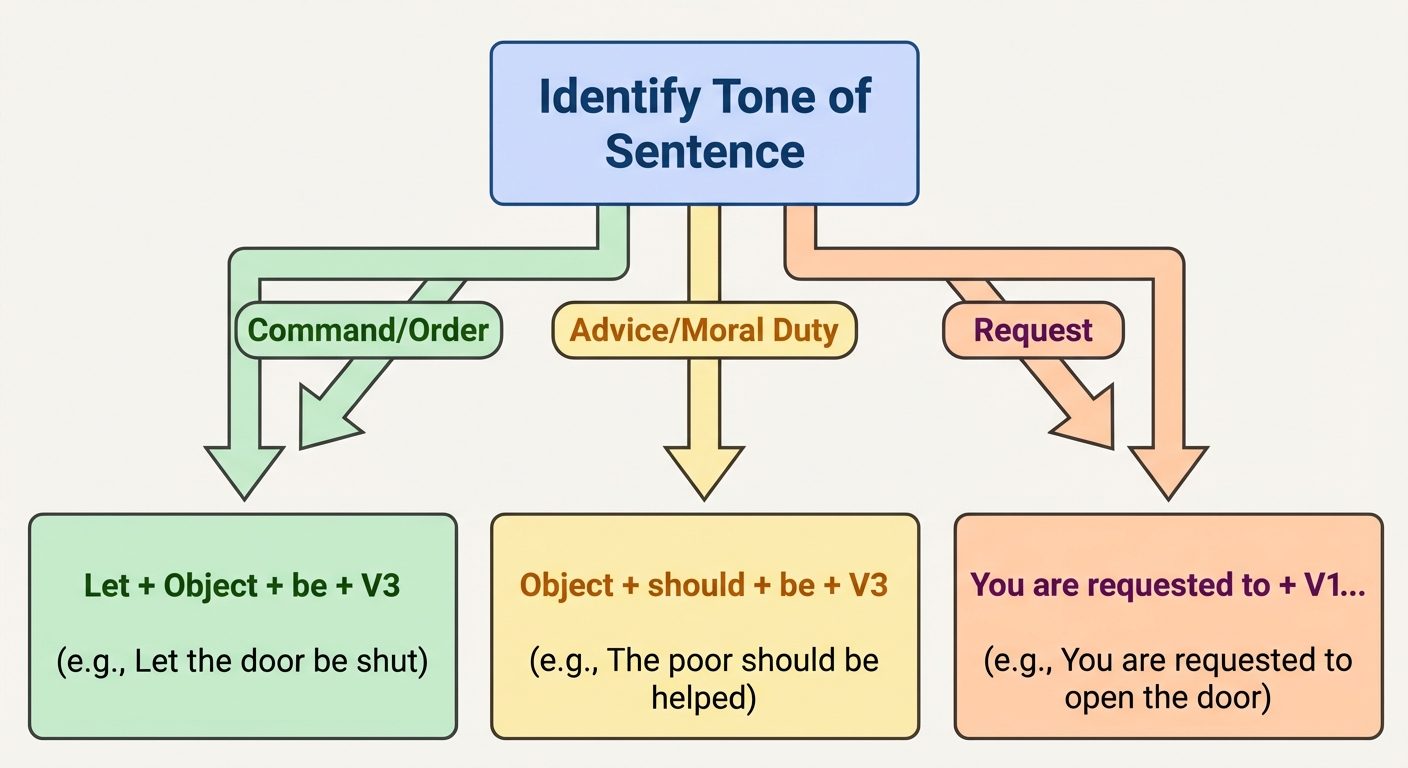
A. With Object (Commands):
- Structure: Let + Object + be + V3
- Active: Shut the door.
- Passive: Let the door be shut.
B. With Object (Advice/Duty):
- Structure: Object + should + be + V3
- Active: Respect your elders.
- Passive: Your elders should be respected.
C. Requests (marked by 'Please' or 'Kindly'):
- Structure: You are requested to + V1 + ...
- Active: Please give me a pen.
- Passive: You are requested to give me a pen.
5.2 Interrogative Sentences (Questions)
The question structure is maintained in the passive voice (Auxiliary Verb usually comes first).
A. Yes/No Questions (Do/Did/Does):
- Active: Did she write the book?
- Passive: Was the book written by her?
B. Wh- Questions (Why, When, Where, How):
The Wh- word usually remains at the beginning.
- Active: Why did you punish him?
- Passive: Why was he punished by you?
C. Who/Whom Exception:
- Who changes to By whom.
- Active: Who broke the glass?
- Passive: By whom was the glass broken?
- Whom changes to Who.
- Active: Whom did you invite?
- Passive: Who was invited by you?
6. Usage: When to Use Passive Voice
While Active Voice is generally preferred for direct and vigorous writing, Passive Voice is essential in specific contexts.
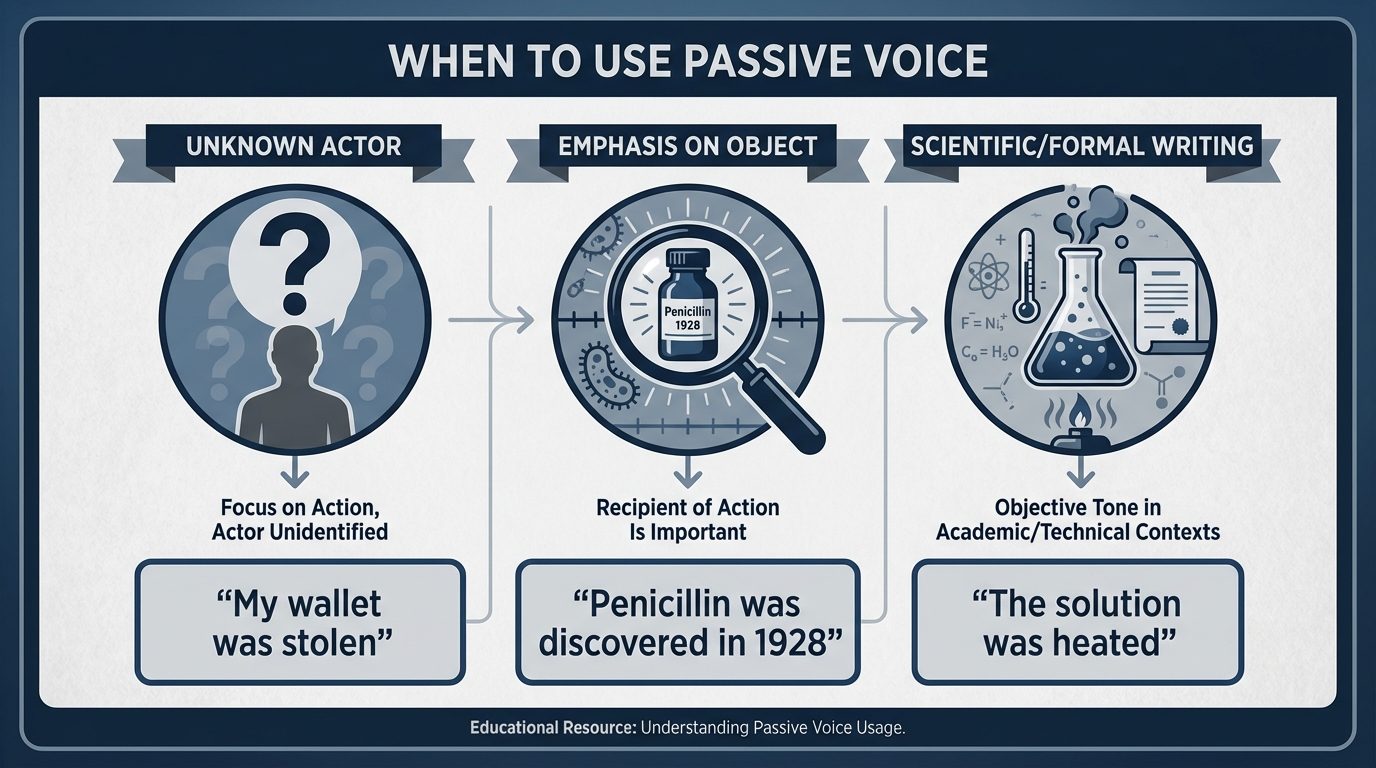
- When the actor is unknown or obvious:
- My wallet was stolen. (We don't know who stole it).
- Rice is grown in India. (By farmers—this is obvious).
- When the emphasis is on the action or the result, not the agent:
- The new bridge will be inaugurated tomorrow. (The event is more important than who cuts the ribbon).
- In scientific or technical writing:
- Scientific reports focus on objective processes.
- The mixture was heated to 100°C.
- To avoid assigning blame (Diplomatic language):
- Mistakes were made. (Instead of "We made mistakes").
Did this save you a night before the exam?
LPU Notes is free, and it stays free. Ads cover part of the server bill. The rest comes out of a student's own pocket: the domain, the storage, and keeping the site up through the weeks everyone needs it at once.
The payment button didn't load. An ad blocker or a filtered network is the usual reason. to try again.
Nothing here is ever locked, and nothing unlocks. Chip in only if it was worth it. What it pays for →