Unit 4: Articles and indefinites
1. Articles: Definite, Indefinite, and No Article
Articles are determiners used to clarify whether a noun is specific or general. In English, there are two types of articles: the Definite Article (The) and the Indefinite Articles (A, An). Often, no article (Zero Article) is required.
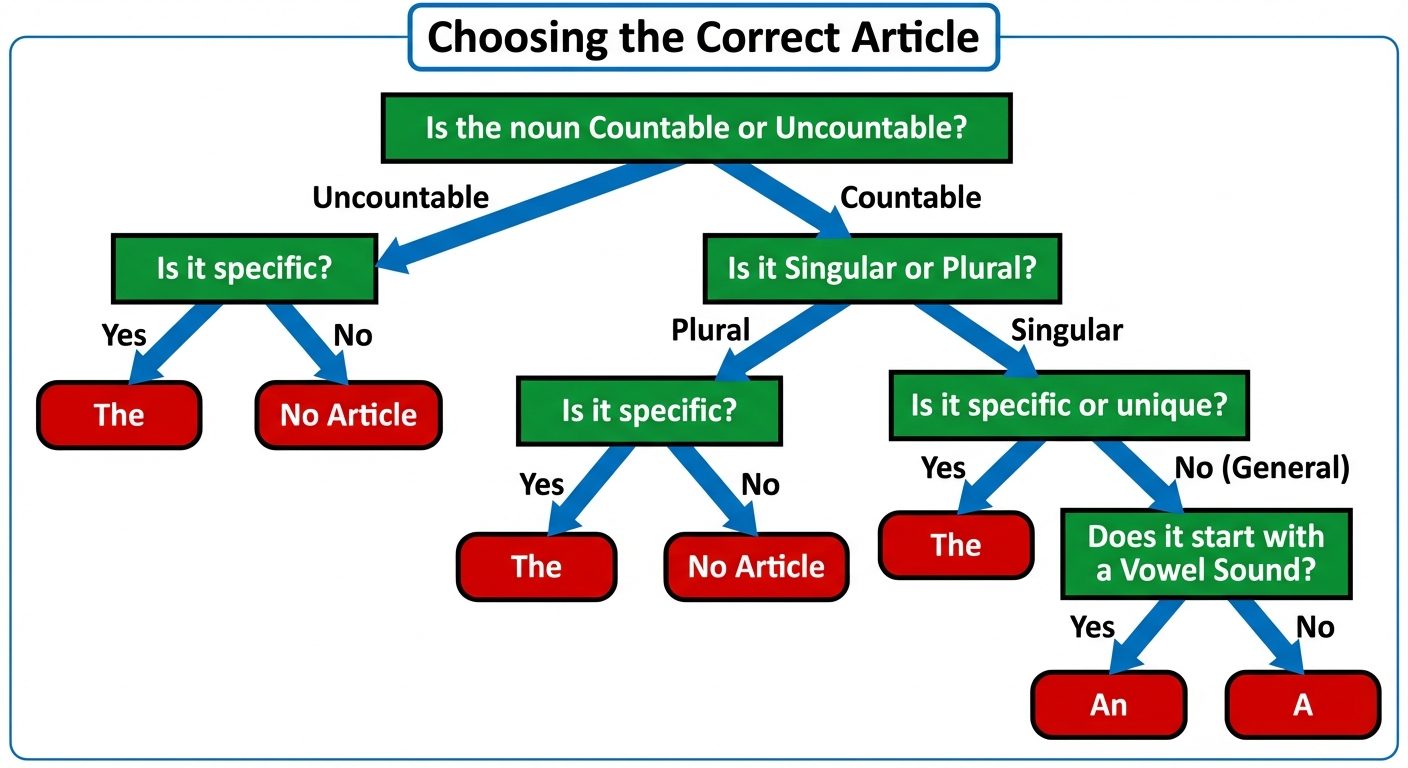
A. Indefinite Articles (A / An)
Used with singular countable nouns when the listener/reader does not know exactly which one is being referred to, or when mentioning something for the first time.
- "A" Usage:
- Used before words beginning with a consonant sound.
- Examples: A book, a car, a university (starts with 'y' sound), a one-eyed man (starts with 'w' sound).
- "An" Usage:
- Used before words beginning with a vowel sound (a, e, i, o, u).
- Examples: An apple, an hour (h is silent), an M.P. (starts with 'em' sound).
Key Functions:
- First Mention: "I saw a bird." (The listener doesn't know which bird yet).
- Classification: "He is an engineer." (One of a group).
- Meaning 'One': "I have a brother."
B. Definite Article (The)
Used to point out a specific person, place, or thing. It implies the listener knows exactly which noun is being discussed.
Key Functions:
- Second Mention: "I saw a bird. The bird was blue." (Referring back to the previously mentioned bird).
- Specific/Unique Objects: The sun, the moon, the internet.
- Superlatives: The best, the tallest.
- Ordinal Numbers: The first, the second.
- With Objects (Contextual Specificity): When the object is understood from context.
- Example: "Pass the salt." (The salt shaker on this table).
- Example: "Shut the door." (The specific door to this room).
C. No Article (Zero Article)
Certain nouns do not take an article.
Rules:
- Plural/Uncountable Nouns in a General Sense:
- "Dogs are loyal." (All dogs generally). contrast with "The dogs in the park are barking" (Specific dogs).
- "I love music." (Not the music).
- Proper Nouns: Names of people, most countries, cities, and languages.
- Examples: John, London, France, English. (Exceptions: The USA, The UK, The Philippines).
- Meals and Institutions:
- "I have breakfast at 8 AM."
- "He goes to school." (As a student). Contrast with "He went to the school" (To the specific building, perhaps for a meeting).
2. Quantifiers: Much, Many, More, How
Quantifiers indicate the amount or quantity of a noun. The choice depends heavily on whether the noun is Countable (can be counted: 1 pen, 2 pens) or Uncountable (cannot be counted: water, sugar, information).
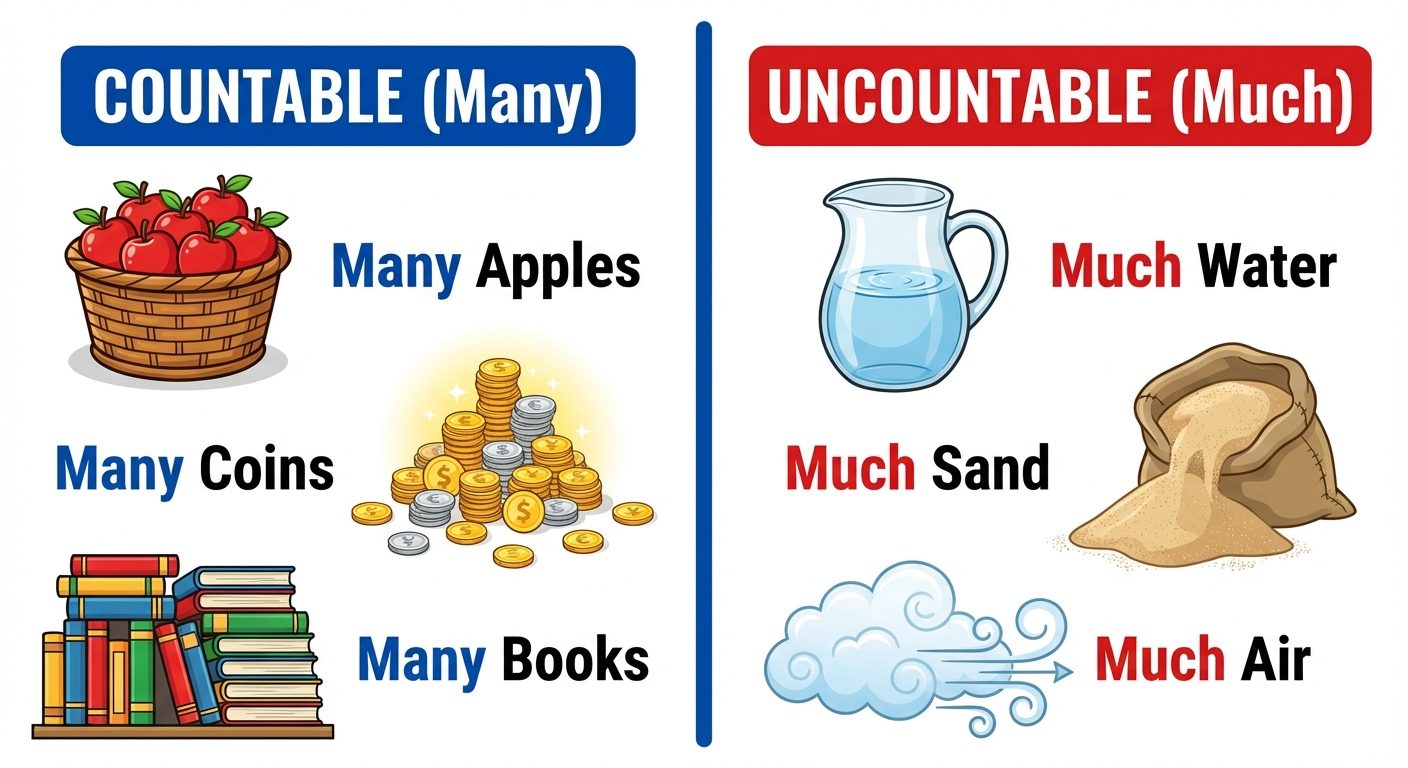
A. Much vs. Many
| Quantifier | Usage | Examples |
|---|---|---|
| Many | Used with Plural Countable Nouns. | I have many friends.<br>There are many books on the shelf. |
| Much | Used with Uncountable Nouns. Mostly used in negative sentences and questions. | I don't have much time.<br>Did you drink much water? |
Note: In positive sentences, "a lot of" is often preferred over "much" (e.g., "I have a lot of work" sounds more natural than "I have much work").
B. Usage of "How"
"How" is combined with many/much to ask about quantity.
- How many: For countable nouns.
- "How many students are in the class?"
- How much: For uncountable nouns (and price).
- "How much sugar do you want?"
- "How much does this shirt cost?"
C. Usage of "More"
"More" is the comparative form used for both countable and uncountable nouns.
- Countable: "I need more chairs."
- Uncountable: "Please give me more rice."
3. Distributives: Every and Each
These words refer to members of a group individually, but there is a subtle difference in focus. Both take singular verbs.
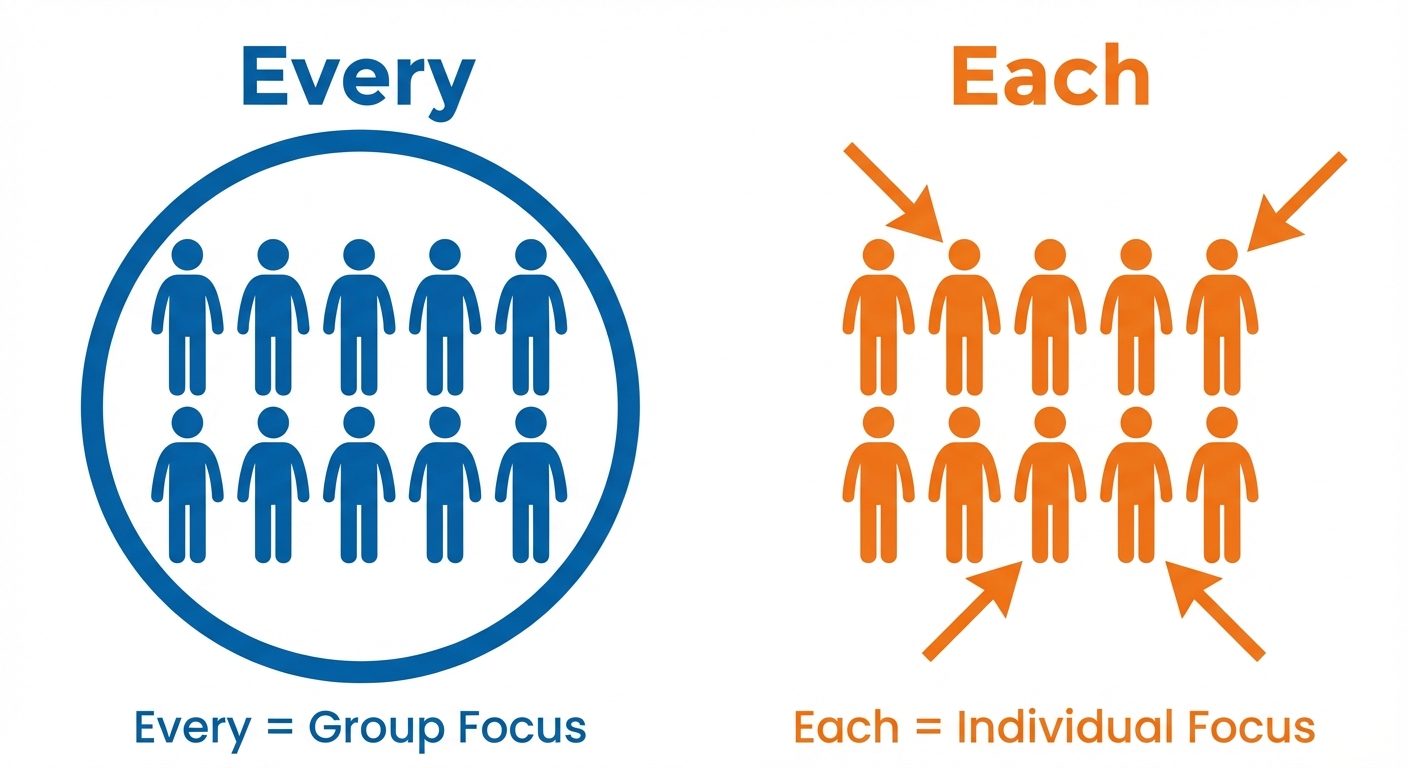
A. Every
- Focus: Refers to the group as a series of members. It is closer in meaning to "all".
- Usage: Used for three or more items. Often used to generalize.
- Example: "Every student passed the exam." (All of them).
- Frequency: Used for repeated actions (Every day, every week).
B. Each
- Focus: Refers to individual members of a group separately.
- Usage: Used for two or more items.
- Example: "Each student received a certificate." (Focuses on the individual act of receiving).
- Small numbers: Used when the number is limited/definite. "Study each hand carefully." (Since we only have two hands).
4. Indefinite Pronouns: One, Another, Other, Others
These words act as determiners or pronouns to refer to people or things without naming them specifically.
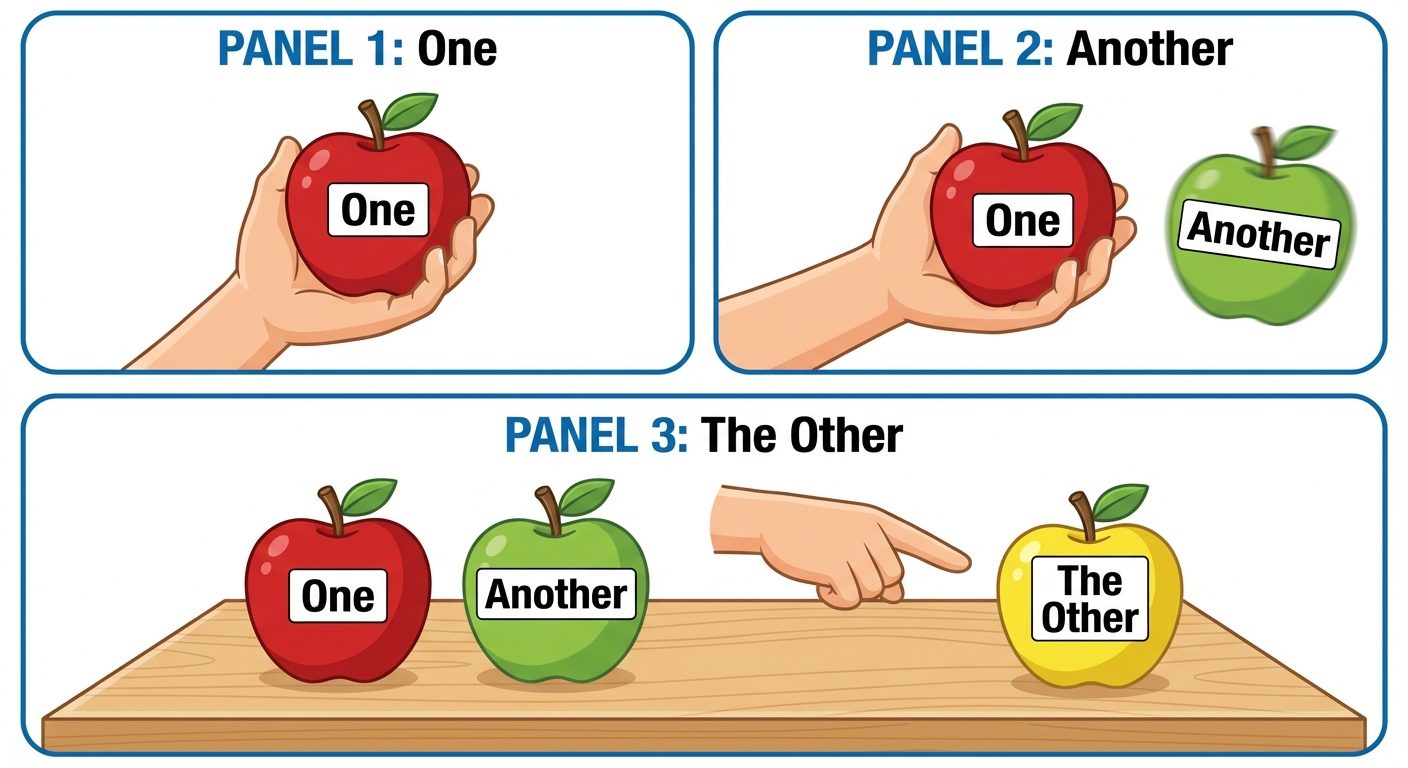
A. One
Used to replace a singular countable noun mentioned earlier.
- Example: "I lost my pen. I need to buy a new one."
B. Another (An + Other)
- Meaning: One more (indefinite) addition; an alternative.
- Grammar: Singular.
- Example: "This cake is delicious. May I have another (slice)?"
- Example: "I don't like this shirt. Show me another."
C. Other / Others
"Other" is non-specific (unless "The" is added).
- Other (Adjective/Determiner): Followed by a noun.
- Singular: "Is there any other way?"
- Plural: "I have other plans."
- Others (Pronoun): Replaces the noun. Always plural.
- Example: "Some students went home; others stayed behind." (Replaces "other students").
D. The Other / The Others (Specific)
When "The" is added, the reference becomes specific (the remaining part of a set).
- The Other (Singular): The specific remaining one of two.
- "I have two brothers. One is a doctor; the other is a lawyer."
- The Others (Plural): The specific remaining group.
- "I chose three books. I kept one and returned the others."
Did this save you a night before the exam?
LPU Notes is free, and it stays free. Ads cover part of the server bill. The rest comes out of a student's own pocket: the domain, the storage, and keeping the site up through the weeks everyone needs it at once.
The payment button didn't load. An ad blocker or a filtered network is the usual reason. to try again.
Nothing here is ever locked, and nothing unlocks. Chip in only if it was worth it. What it pays for →