Unit 6: Phrasal Verbs
1. Introduction to Phrasal Verbs
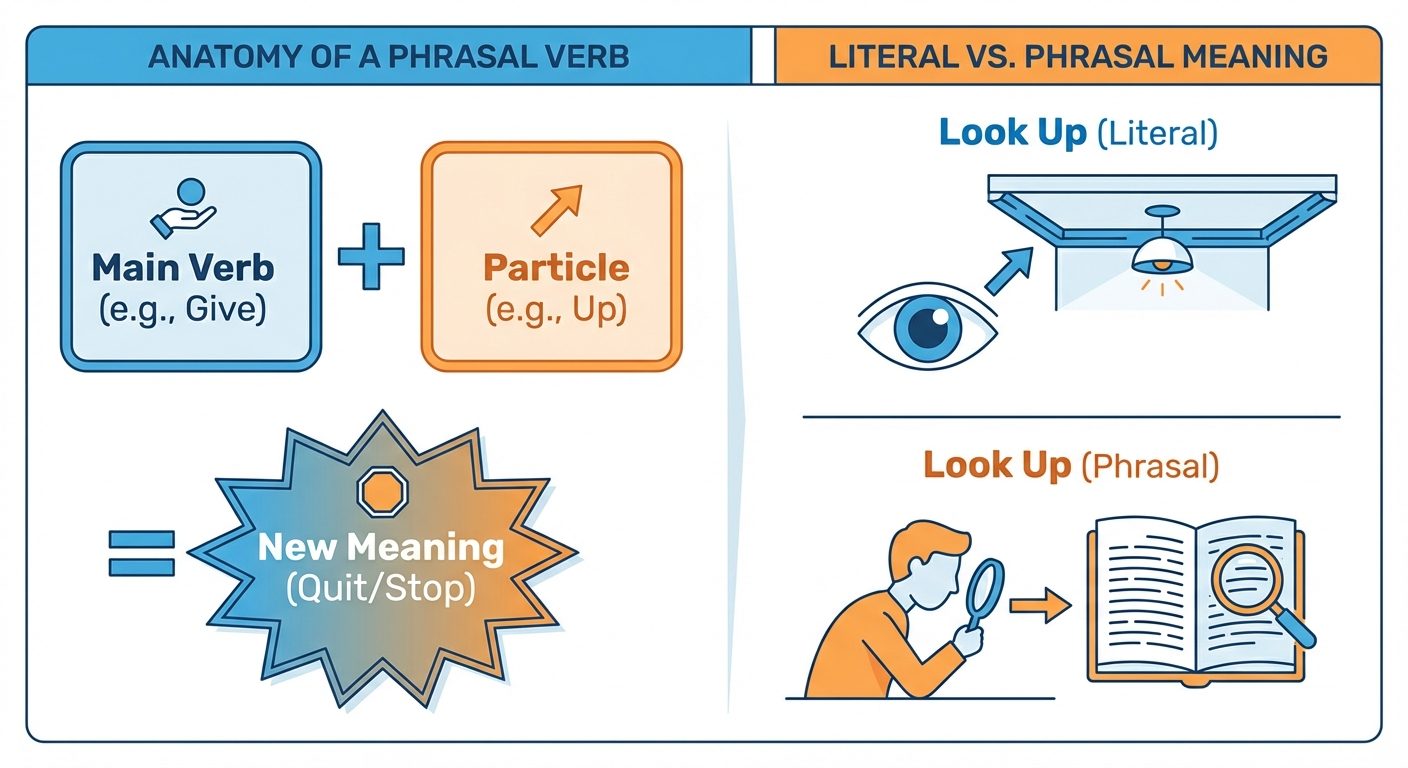
A phrasal verb is a combination of two or three words from different grammatical categories—a verb and a particle, such as an adverb or a preposition—to create a single semantic unit on a lexical or syntactic level.
The defining characteristic of a phrasal verb is that its meaning is usually idiomatic; the meaning of the phrase cannot be deduced by simply defining the individual words.
Formula:
- Literal Example: "He looked up at the sky." (He physically moved his eyes upward).
- Phrasal Verb Example: "He looked up the word in the dictionary." (He searched for information).
2. Categories of Phrasal Verbs
To use phrasal verbs correctly in speech and writing, one must understand their grammatical categories.
A. Transitive vs. Intransitive
- Intransitive Phrasal Verbs: These do not require a direct object.
- Example: "The plane took off." (No object follows the verb).
- Example: "My car broke down."
- Transitive Phrasal Verbs: These require a direct object to complete the sentence.
- Example: "Please turn on the light." (The light is the object).
B. Separable vs. Inseparable
This distinction only applies to transitive phrasal verbs.
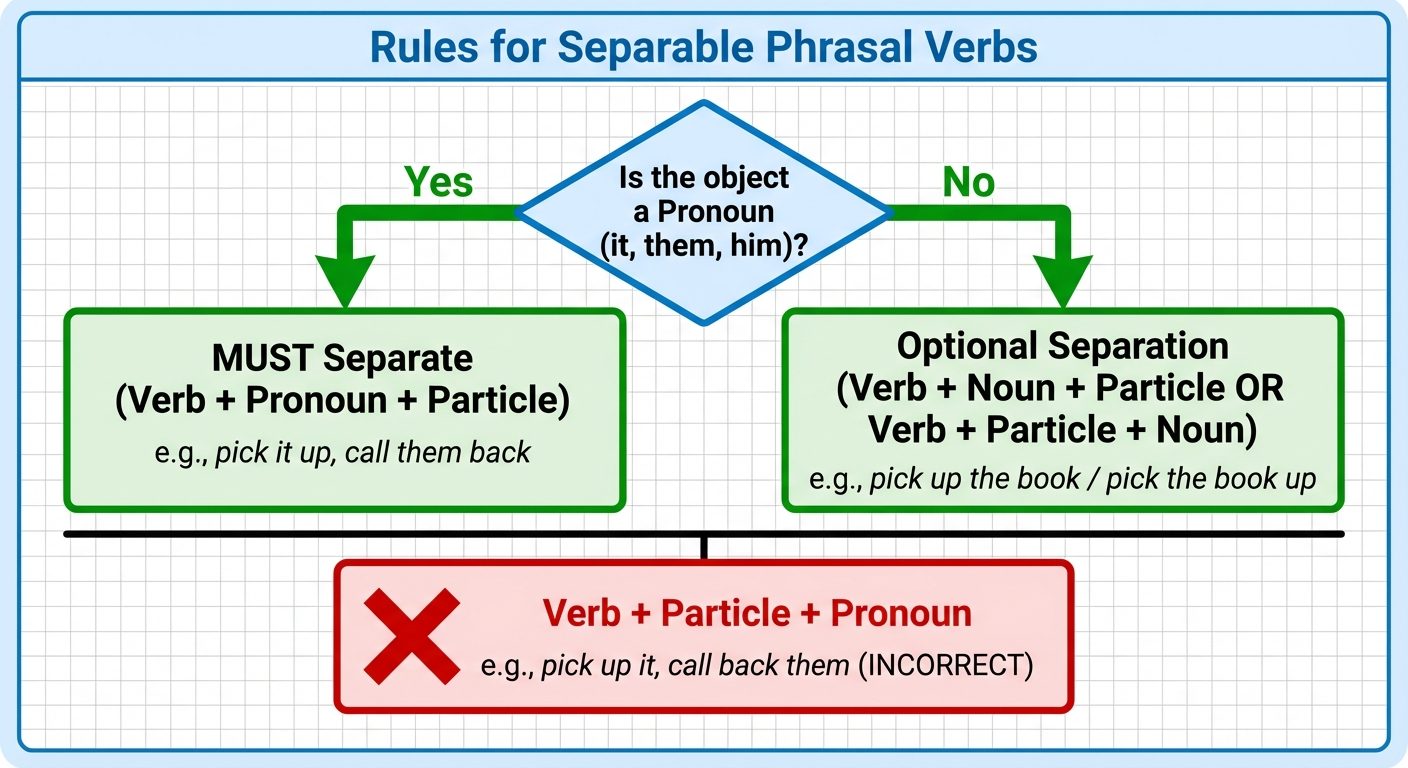
- Separable Phrasal Verbs: The object can be placed between the verb and the particle.
- Rule: If the direct object is a pronoun (me, it, him, her, them), the phrasal verb MUST be separated.
- Correct: "I took it off."
- Incorrect: "I took off it."
- Noun usage: "I turned the light on" OR "I turned on the light."
- Inseparable Phrasal Verbs: The object must always follow the particle, even if it is a pronoun.
- Example: "I ran into an old friend." (NOT: I ran an old friend into).
3. Commonly Used Phrasal Verbs
In professional and daily communication, phrasal verbs often replace more formal Latinate verbs (e.g., "give up" instead of "surrender," "put off" instead of "postpone").
| Phrasal Verb | Meaning | Example Sentence |
|---|---|---|
| Bring up | To mention a topic | Don't bring up the budget during the party. |
| Call off | To cancel | The manager had to call off the meeting. |
| Figure out | To understand/solve | I need time to figure out this math problem. |
| Give up | To quit/stop trying | Never give up on your dreams. |
| Hand in | To submit work | Please hand in your reports by Friday. |
| Look after | To take care of | Can you look after my dog while I travel? |
| Make up | To invent (a story) or resolve a conflict | He made up an excuse for being late. |
| Pass out | To lose consciousness | It was so hot that he passed out. |
| Put off | To postpone/delay | We shouldn't put off the decision any longer. |
| Run into | To meet by chance | I ran into my professor at the grocery store. |
| Turn down | To refuse/reject | She turned down the job offer. |
4. Phrasal Verbs Followed by Prepositions (Three-Part Verbs)
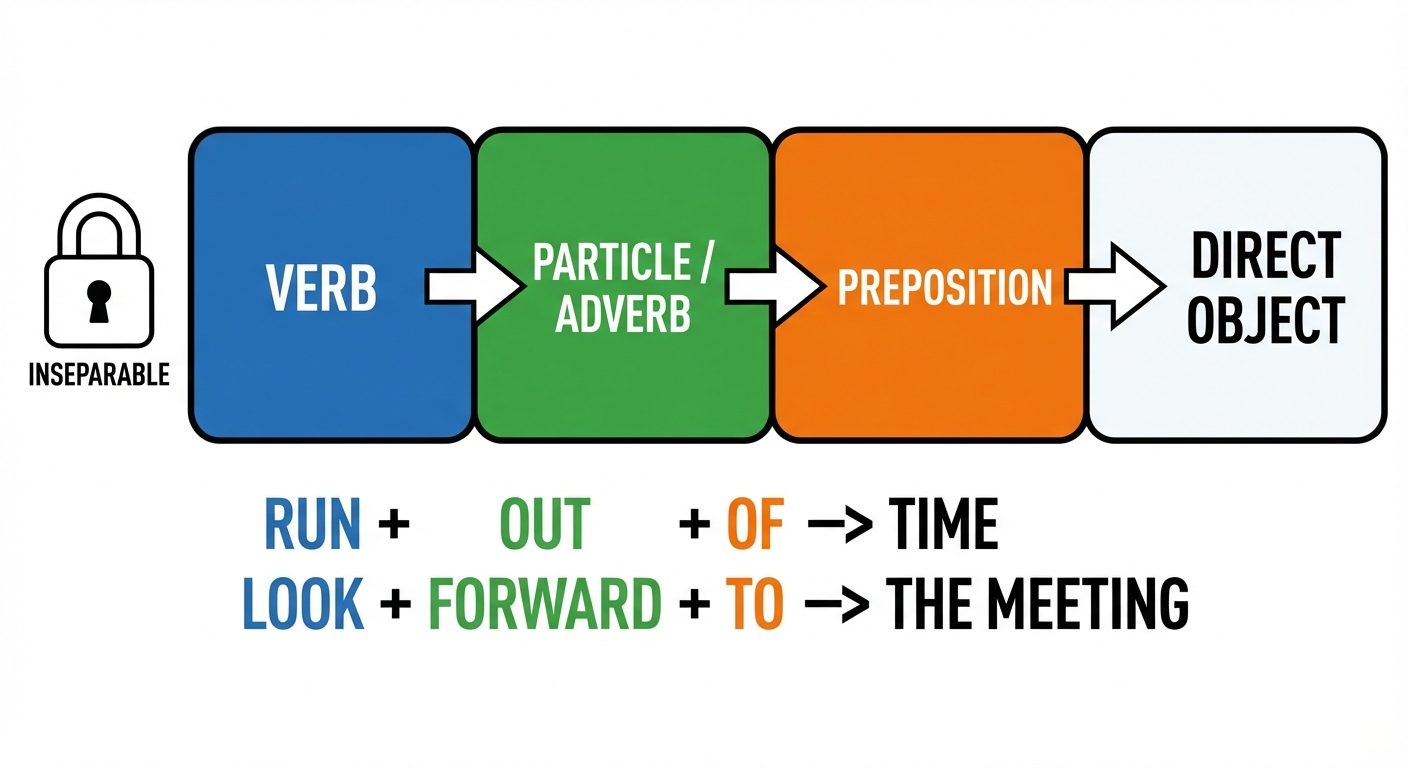
Some phrasal verbs consist of three parts: Verb + Adverb + Preposition. These are almost always transitive (require an object) and inseparable.
Structure:
- Get (Verb) + Along (Adverb) + With (Preposition)
Common Three-Part Phrasal Verbs:
- Come up with: To produce or create (an idea or plan).
- Usage: "She came up with a brilliant solution."
- Get along with: To have a harmonious relationship.
- Usage: "I really get along with my colleagues."
- Look forward to: To await with excitement.
- Usage: "I look forward to hearing from you." (Note: Followed by a gerund/noun).
- Run out of: To have none left.
- Usage: "We have run out of paper for the printer."
- Put up with: To tolerate/endure.
- Usage: "I cannot put up with this noise anymore."
5. Conjugating Phrasal Verbs and Spoken Usage
When using phrasal verbs in conversation, it is crucial to conjugate the verb portion according to the tense. The particle(s) never change form.
A. Conjugation Rules
- Present Tense: I wake up at 6 AM.
- Past Tense: I woke up at 6 AM. (Only 'wake' becomes 'woke').
- Continuous Tense: I am waking up now.
- Perfect Tense: I have woken up early for years.
B. Register: Formal vs. Informal
In "Communication Skills," understanding register is vital. Phrasal verbs are generally more informal than their single-word equivalents.
-
Informal (Spoken): "Please fill out this form."
-
Formal (Written/Official): "Please complete this form."
-
Informal: "We need to cut down on spending."
-
Formal: "We need to reduce expenditure."
6. Common Words Often Confused
In communication, misusing similar-sounding words or words with related meanings can damage credibility. This section covers lexical pairs often confused alongside phrasal verbs.
A. Homophones and Near-Homophones
-
Accept vs. Except
- Accept (v): To receive or agree to. ("I accept your apology.")
- Except (prep): Excluding. ("Everyone went except John.")
-
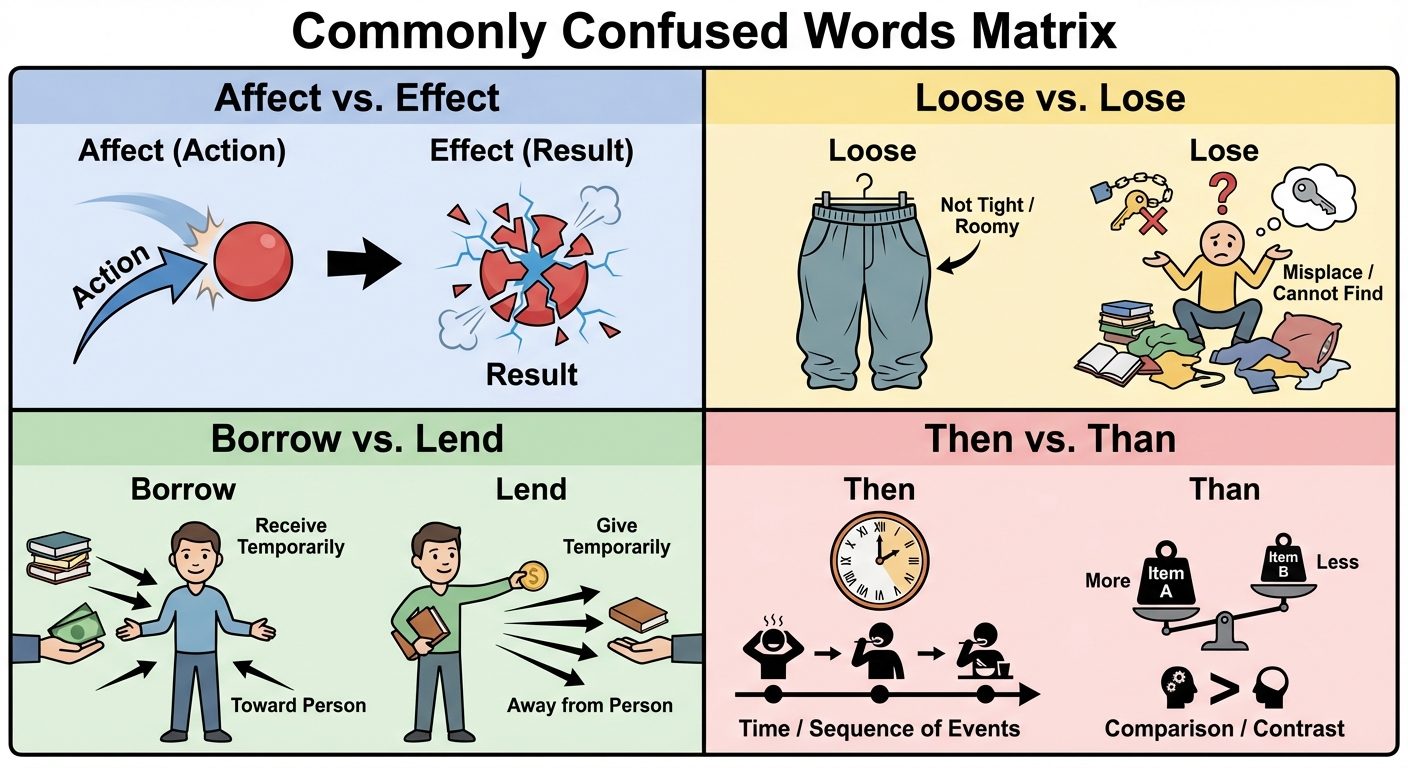
Affect vs. Effect
- Affect (v): To influence. ("The weather affected his mood.")
- Effect (n): The result. ("The new law had a positive effect.")
-
Lose vs. Loose
- Lose (v): To misplace or fail to win. (Pronounced with a 'z' sound). ("Don't lose your keys.")
- Loose (adj): Not tight. (Pronounced with an 's' sound). ("These pants are too loose.")
-
Then vs. Than
- Then: Relates to time. ("We ate, then we slept.")
- Than: Relates to comparison. ("She is taller than him.")
B. Confused Actions
-
Borrow vs. Lend
- Borrow: To take temporarily. ("Can I borrow your pen?")
- Lend: To give temporarily. ("Can you lend me your pen?")
-
Say vs. Tell
- Say: Used for the words spoken. ("He said hello.")
- Tell: Used for the information given to a person. ("He told me hello" is incorrect -> "He told me the news.")
Did this save you a night before the exam?
LPU Notes is free, and it stays free. Ads cover part of the server bill. The rest comes out of a student's own pocket: the domain, the storage, and keeping the site up through the weeks everyone needs it at once.
The payment button didn't load. An ad blocker or a filtered network is the usual reason. to try again.
Nothing here is ever locked, and nothing unlocks. Chip in only if it was worth it. What it pays for →