Unit 4: Graphs theory I
1. Graph Terminologies
A Graph consists of a set of vertices (nodes) and a set of edges connecting pairs of vertices.
- Directed Graph (Digraph): Edges have direction (ordered pairs).
- Undirected Graph: Edges have no direction (unordered pairs).
- Loop: An edge connecting a vertex to itself.
- Parallel Edges (Multi-graph): Multiple edges connecting the same pair of vertices.
- Simple Graph: A graph with no loops and no parallel edges.
- Degree of a Vertex (): The number of edges incident to a vertex.
- Isolated Vertex: Degree = 0.
- Pendant Vertex: Degree = 1.
- Handshaking Theorem: . (Sum of degrees is twice the number of edges).
- In-Degree / Out-Degree (Digraphs):
- : Number of edges entering .
- : Number of edges leaving .
- .
2. Special Types of Graphs
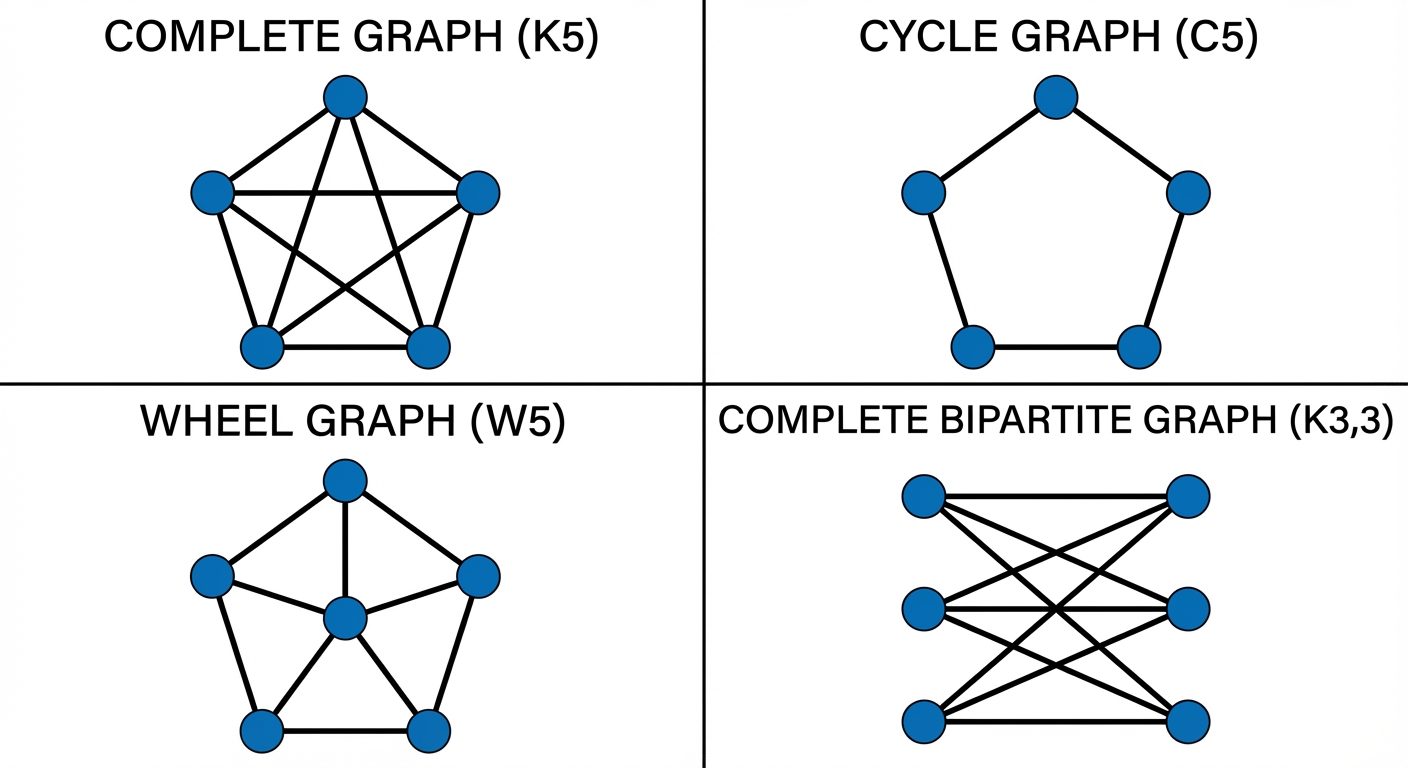
- Complete Graph (): A simple graph where every pair of distinct vertices is connected by a unique edge.
- Number of edges: .
- Regularity: -regular.
- Cycle Graph (): A closed loop of vertices () and edges.
- Wheel Graph (): Formed by adding a center vertex to a cycle and connecting it to all vertices in the cycle. Total vertices: .
- Regular Graph: Every vertex has the same degree (-regular).
- Cube (Hypercube ): Vertices represent -bit strings. Two vertices are connected if their strings differ by exactly one bit.
- Bipartite Graph: Vertex set can be partitioned into two disjoint sets and such that every edge connects a vertex in to one in . No edges exist within or within .
- Complete Bipartite Graph (): Every vertex in set (size ) is connected to every vertex in set (size ).
3. Representing Graphs
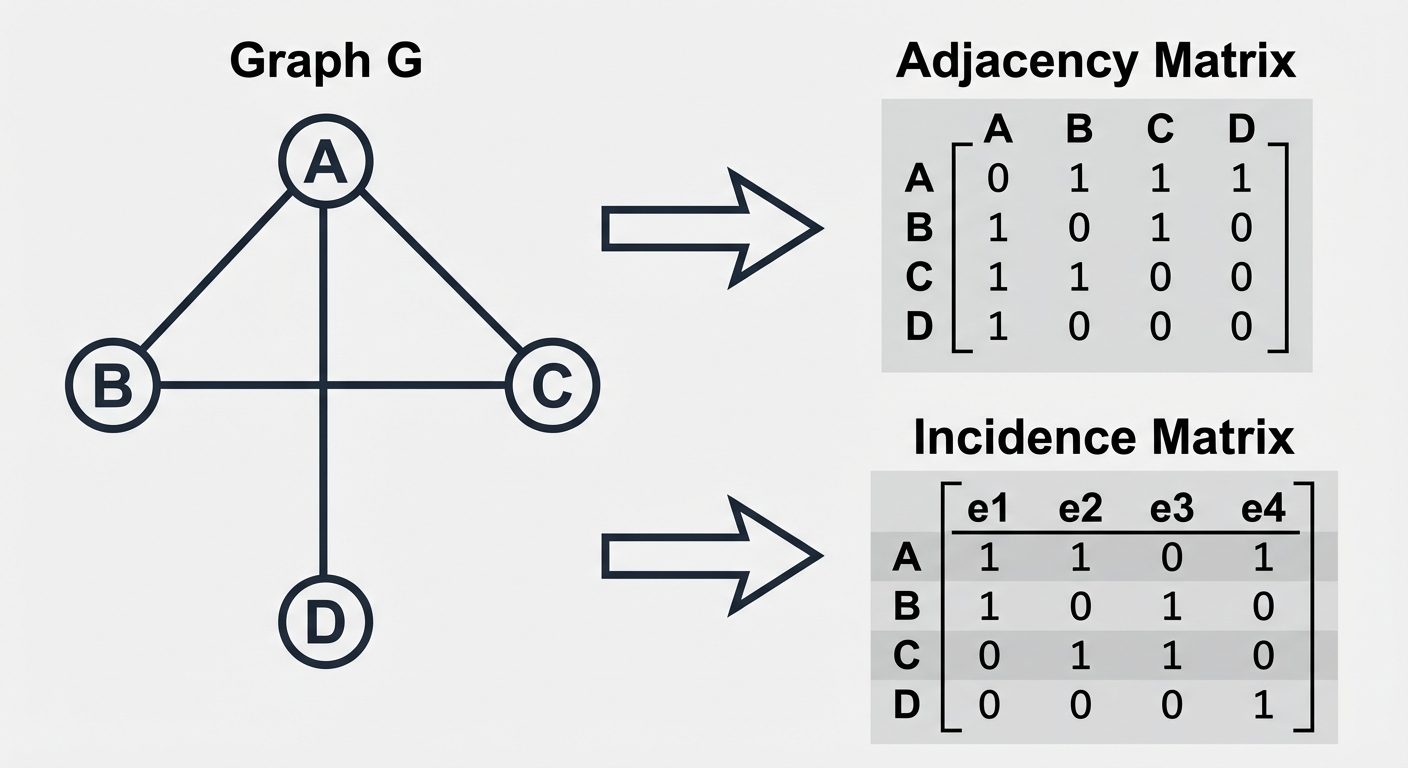
Adjacency Matrix ()
A square matrix of size (where ).
- if there is an edge from to .
- otherwise.
- For undirected graphs, the matrix is symmetric.
Incidence Matrix ()
A matrix of size (Vertices Edges).
- if edge is incident on vertex .
- otherwise.
Adjacency List
An array of lists where the -th list contains the neighbors of vertex . More space-efficient for sparse graphs.
4. Graph Isomorphism
Two graphs and are isomorphic if there exists a one-to-one and onto function (bijection) that preserves adjacency.
Necessary Conditions (Invariants):
For graphs to be isomorphic, they must have the same:
- Number of vertices.
- Number of edges.
- Degree sequence (list of degrees sorted in non-increasing order).
Note: These conditions are necessary but not sufficient.
5. Path and Connectivity
Definitions
- Walk: Alternating sequence of vertices and edges.
- Trail: A walk with no repeated edges.
- Path: A walk with no repeated vertices.
- Circuit: A closed trail (starts and ends at same vertex).
- Cycle: A closed path (starts and ends at same vertex, no other repeats).
Connectivity in Undirected Graphs
- Connected Graph: There is a path between every pair of distinct vertices.
- Cut Vertex (Articulation Point): A vertex whose removal increases the number of connected components.
- Cut Edge (Bridge): An edge whose removal increases the number of connected components.
Connectivity in Digraphs
- Strongly Connected: For every pair , there is a directed path AND .
- Weakly Connected: The underlying undirected graph (ignoring direction) is connected.
6. Dijkstra’s Algorithm (Shortest Path)
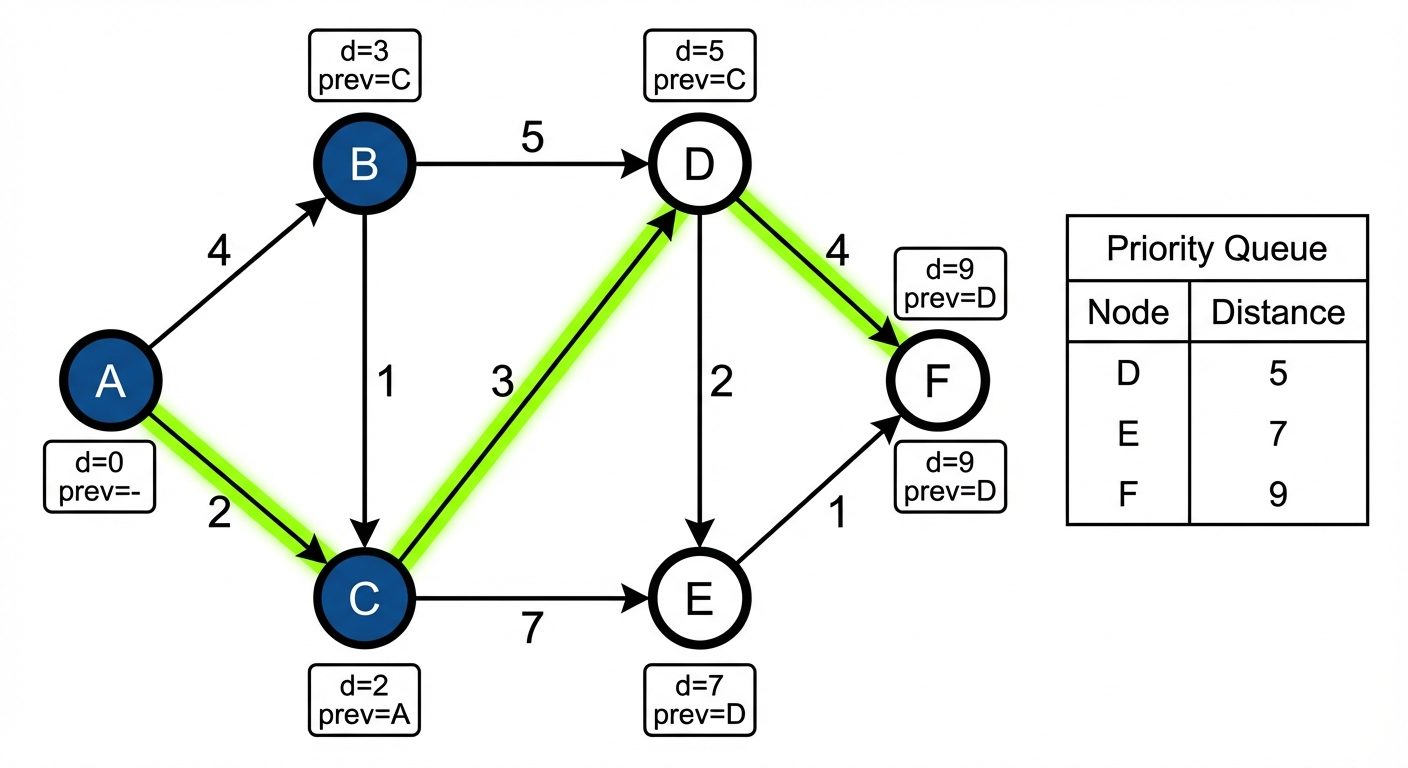
Used to find the shortest path from a source node to all other nodes in a weighted graph (weights must be non-negative).
The Algorithm (Greedy Approach)
- Initialization:
- Set distance to source = 0.
- Set distance to all other nodes = .
- Mark all nodes as unvisited.
- Selection: Select the unvisited node with the smallest tentative distance (call it
u). - Relaxation:
- For each unvisited neighbor
vofu:- Calculate
new_dist = distance(u) + weight(u, v). - If
new_dist < distance(v), updatedistance(v) = new_dist.
- Calculate
- For each unvisited neighbor
- Termination: Mark
uas visited. Repeat steps 2-4 until the destination is visited or all reachable nodes are processed.
Complexity
- with simple array.
- with priority queue.
Did this save you a night before the exam?
LPU Notes is free, and it stays free. Ads cover part of the server bill. The rest comes out of a student's own pocket: the domain, the storage, and keeping the site up through the weeks everyone needs it at once.
The payment button didn't load. An ad blocker or a filtered network is the usual reason. to try again.
Nothing here is ever locked, and nothing unlocks. Chip in only if it was worth it. What it pays for →