Unit 5: Graphs theory II
1. Planar Graphs and Euler’s Formula
Planar Graphs
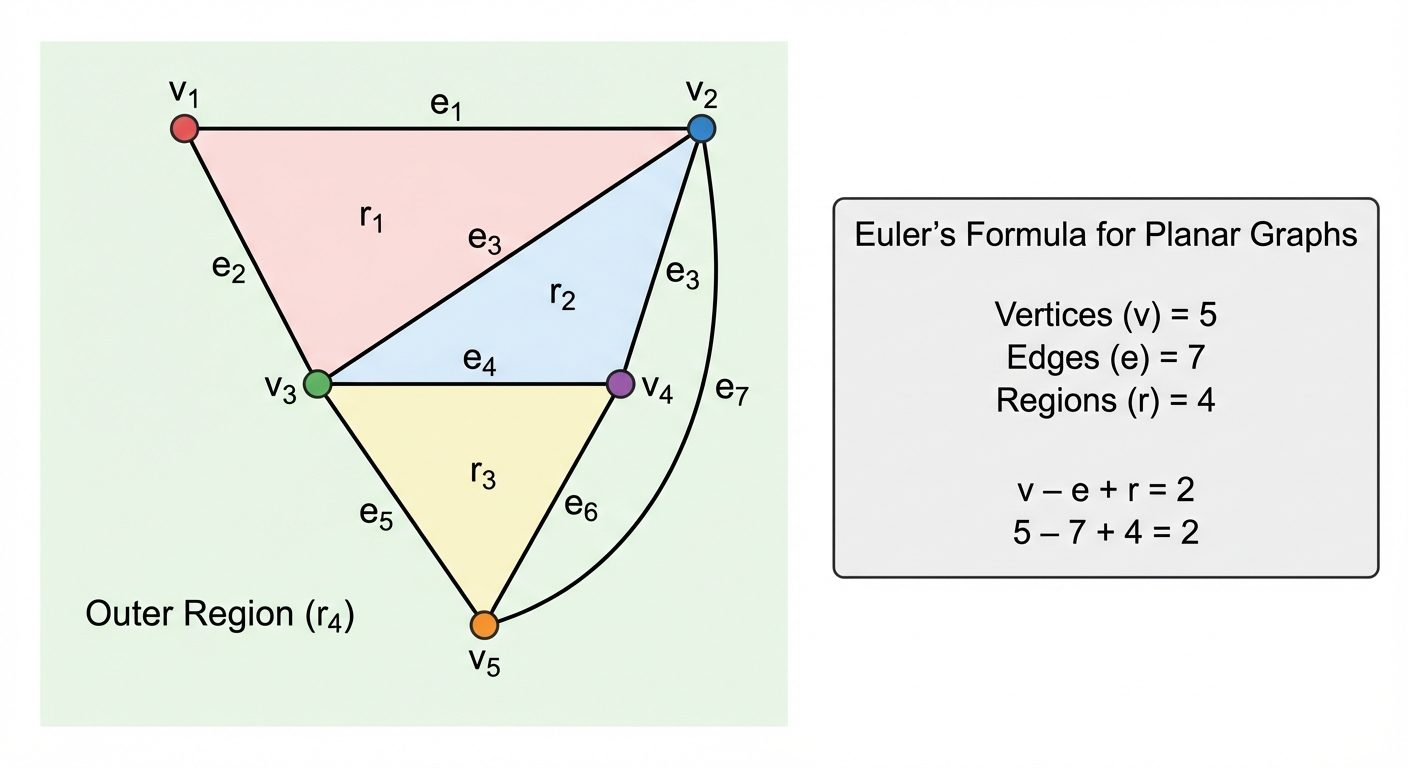
A graph is planar if it can be drawn on a 2D plane without any edges crossing each other. Such a drawing is called a planar embedding.
- Regions (Faces): A planar representation divides the plane into regions, including the unbounded (infinite) outer region.
- Kuratowski's Theorem: A graph is non-planar if and only if it contains a subgraph homeomorphic to (complete graph with 5 vertices) or (complete bipartite graph).
Euler’s Formula
For a connected planar graph with vertices, edges, and regions (faces):
Corollaries for Simple Connected Planar Graphs ():
- If the graph has no triangles (shortest cycle length ), then .
2. Graph Colouring
Graph Colouring involves assigning colors to vertices such that no two adjacent vertices share the same color.
- Chromatic Number (): The minimum number of colors required to color graph .
- k-colourable: A graph that can be colored using colors.
Key Chromatic Numbers:
- Cycle Graph (): if is even; if is odd.
- Complete Graph (): (every node connects to every other node).
- Bipartite Graph: .
- Planar Graphs: (The Four Color Theorem).
3. Trees and Their Properties
A Tree is a connected undirected graph with no simple cycles.
Fundamental Properties
For a tree with vertices:
- It has exactly edges.
- There is a unique simple path between any two vertices.
- Adding any edge creates exactly one cycle.
- Removing any edge disconnects the graph (every edge is a bridge).
- A collection of disjoint trees is called a Forest.
Rooted Tree
A tree in which one vertex is distinguished as the Root.
- Parent/Child: If is an edge and is closer to the root, is the parent of .
- Leaf: A node with no children.
- Siblings: Nodes sharing the same parent.
- Height/Depth: The length of the path from the root to the deepest node.
- m-ary Tree: Every internal vertex has at most children. (Full m-ary tree: exactly children).
4. Spanning Trees and MST
Spanning Tree
A subgraph of a connected graph that contains all vertices of and is a tree.
- A graph may have multiple spanning trees.
- Removing edges from a cyclic graph until it is acyclic (but still connected) results in a spanning tree.
Minimum Spanning Tree (MST)
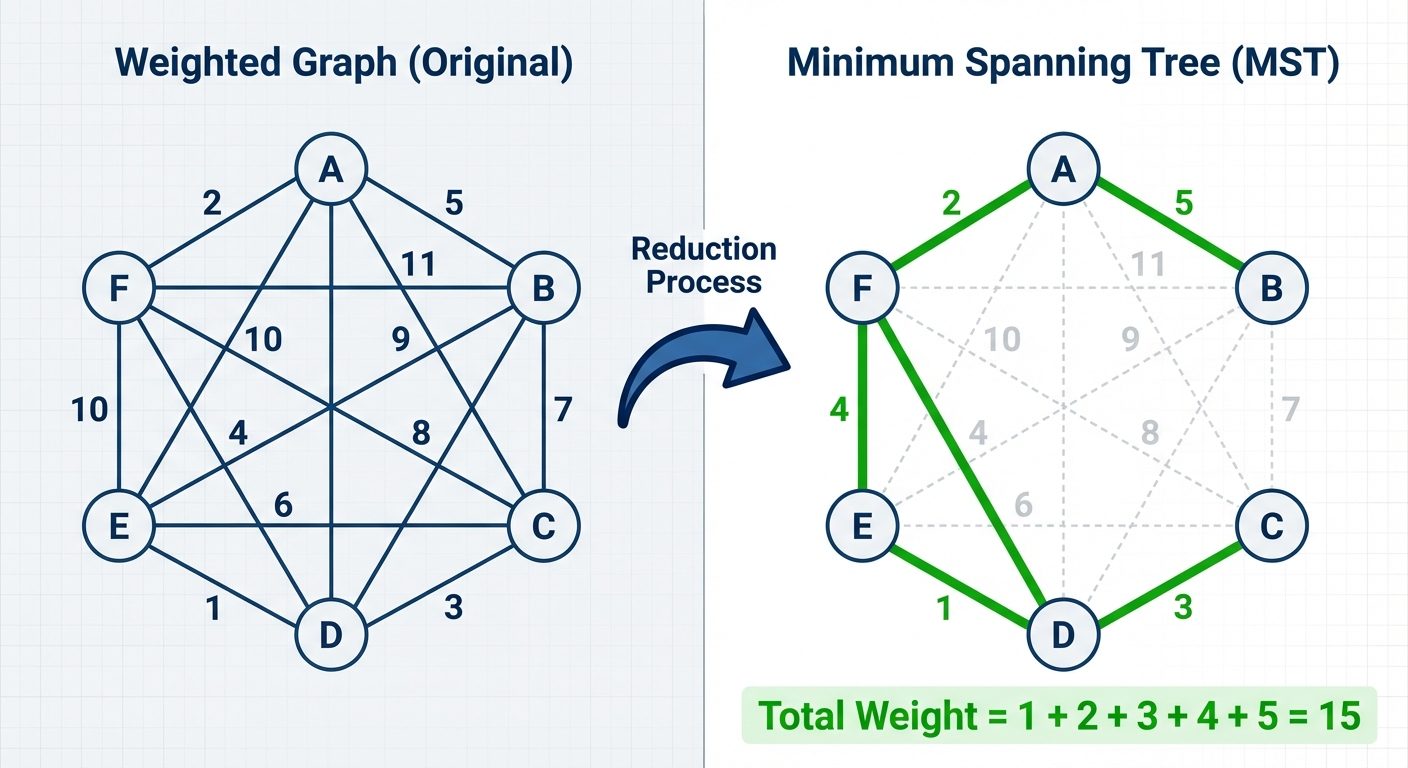
In a weighted graph, the MST is the spanning tree where the sum of edge weights is minimized.
Algorithms:
- Prim’s Algorithm: Grow the tree from a starting vertex by always adding the cheapest edge connected to the existing tree vertices.
- Kruskal’s Algorithm: Sort all edges by weight; add edges from smallest to largest, skipping those that form a cycle.
5. Decision Trees
A Decision Tree is a rooted tree used to model decisions and their possible consequences.
- Internal Nodes: Represent a test or a decision point.
- Branches: Represent the outcome of the test.
- Leaf Nodes: Represent the final class label or decision value.
- Application: Used in sorting algorithms (decision tree lower bound is ), game theory, and machine learning.
6. Tree Traversal (Notations)
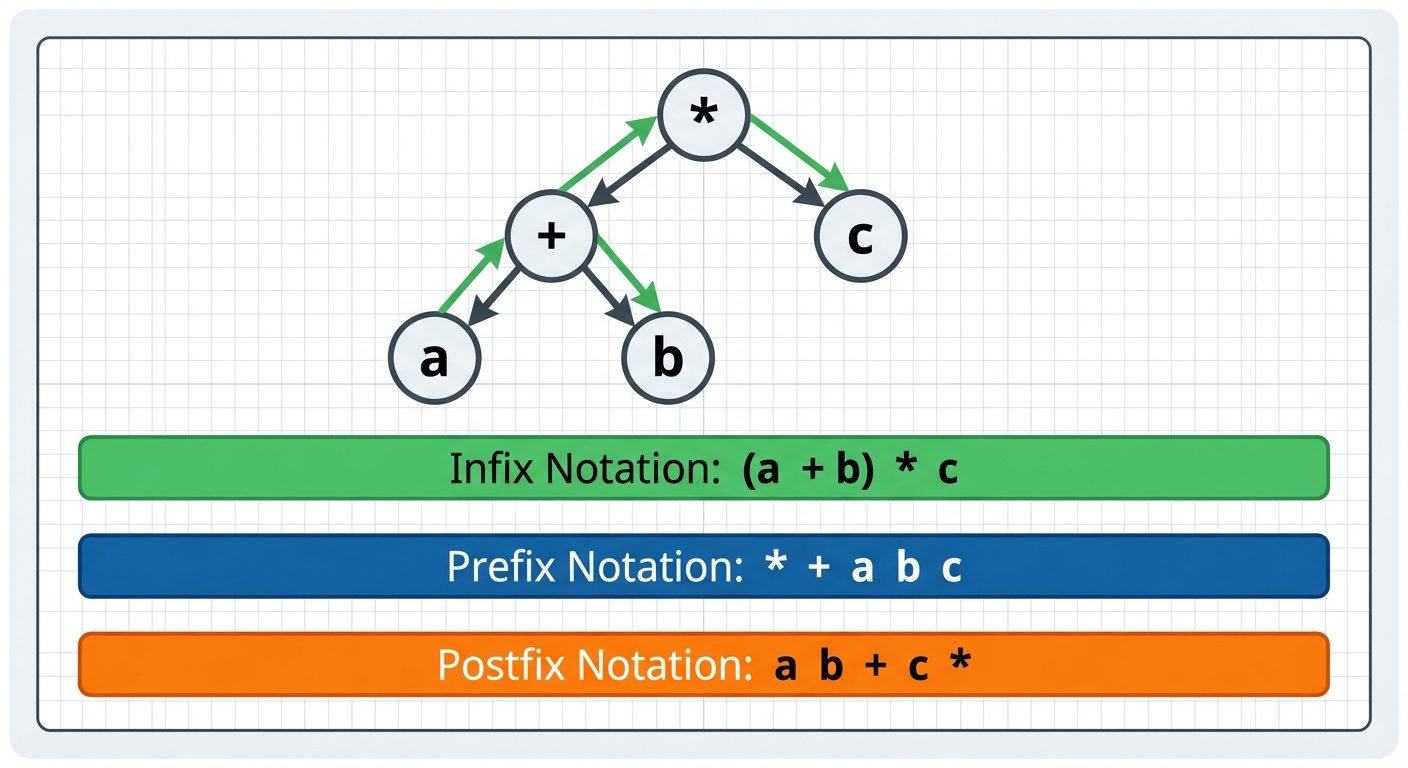
Traversal refers to visiting every node in a tree exactly once. These are commonly applied to Binary Expression Trees where leaves are operands and internal nodes are operators.
1. Infix Notation (In-order Traversal)
Order: Left Child Root Right Child
- Standard arithmetic notation.
- Requires parentheses to preserve order of operations.
- Example:
2. Prefix Notation (Pre-order Traversal)
Order: Root Left Child Right Child
- Also known as Polish Notation.
- Operator precedes operands.
- No parentheses needed.
- Example:
3. Postfix Notation (Post-order Traversal)
Order: Left Child Right Child Root
- Also known as Reverse Polish Notation (RPN).
- Operator follows operands.
- Easily evaluated using a stack.
- Example:
Did this save you a night before the exam?
LPU Notes is free, and it stays free. Ads cover part of the server bill. The rest comes out of a student's own pocket: the domain, the storage, and keeping the site up through the weeks everyone needs it at once.
The payment button didn't load. An ad blocker or a filtered network is the usual reason. to try again.
Nothing here is ever locked, and nothing unlocks. Chip in only if it was worth it. What it pays for →