Unit 5: Disaster Management
1. Introduction to Disaster Management
Definition: A disaster is a sudden, calamitous event bringing great damage, loss, and destruction and devastation to life and property. The damage caused by disasters varies geographically, by climate, and by the vulnerability of the population.
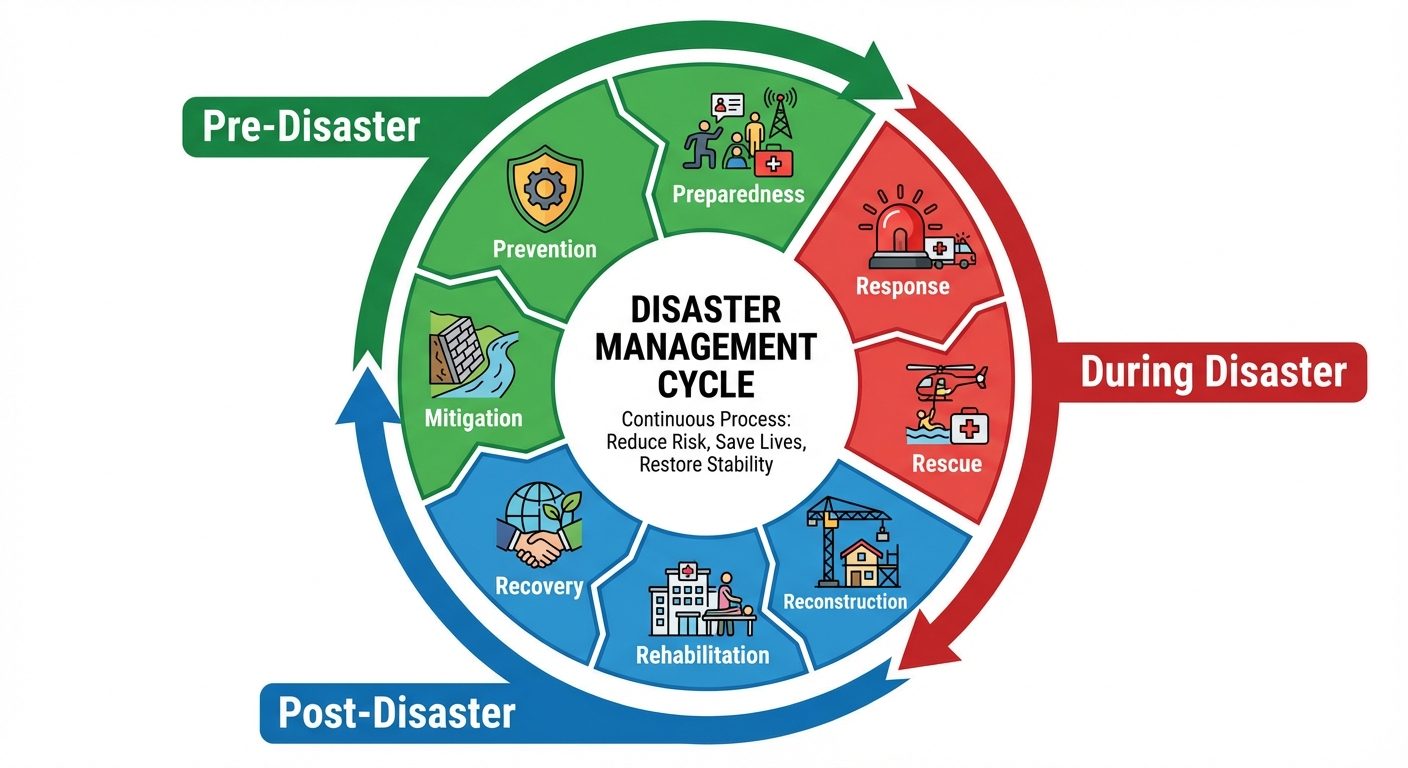
Disaster Management: The continuous and integrated process of planning, organizing, coordinating, and implementing measures which are necessary or expedient for prevention of danger or threat of any disaster, mitigation or reduction of risk, capacity building, preparedness, prompt response, assessing severity, evacuation, rescue, and relief.
2. Natural Disasters
Natural disasters are catastrophic events resulting from natural processes of the Earth. They are broadly classified based on their origin.
A. Water-Related Disasters
1. Floods
- Definition: An overflow of water that submerges land that is usually dry.
- Causes: Heavy rainfall, melting snow/ice, dam failure, storm surges, and poor drainage systems in urban areas.
- Types:
- Flash Floods: Occur within six hours of a rain event; rapid and destructive.
- River Floods: Water levels rise over the top of river banks.
- Coastal Floods: Caused by storm surges or tsunamis.
- Impacts: Loss of life, destruction of crops, waterborne diseases (cholera, typhoid), and economic instability.
- Mitigation: Construction of embankments, flood forecasting, afforestation (to reduce runoff), and proper urban planning.
2. Droughts
- Definition: A prolonged period of abnormally low rainfall, leading to a shortage of water.
- Classifications:
- Meteorological Drought: Deficit in rainfall compared to the average.
- Hydrological Drought: Shortage in water sources like reservoirs, aquifers, and lakes.
- Agricultural Drought: Insufficient soil moisture to support crop production.
- Impacts: Famine, poverty, mass migration, ecological damage, and desertification.
- Mitigation: Rainwater harvesting, drought-resistant crops, drip irrigation, and cloud seeding.
B. Air-Related Disasters
1. Cyclones
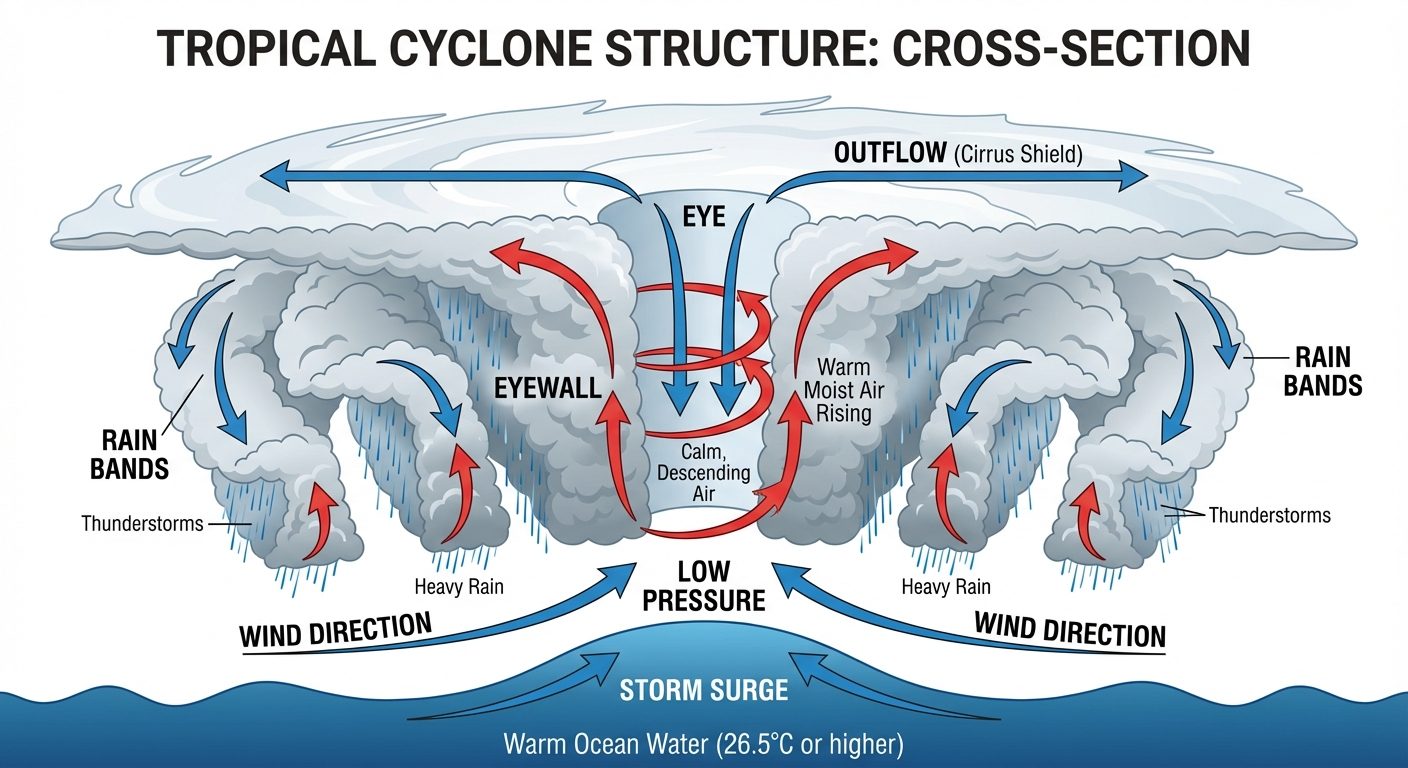
- Definition: A large scale air mass that rotates around a strong center of low atmospheric pressure. Known as Hurricanes in the Atlantic and Typhoons in the Pacific.
- Mechanism: Warm ocean water fuels the storm; moist air rises and condenses, releasing heat that powers the system.
- Key Features:
- The Eye: The calm center of the storm.
- The Eyewall: The area surrounding the eye with the strongest winds.
- Impacts: Destruction of infrastructure, uprooting of trees, communication failure, and loss of life.
2. Storms (Thunderstorms and Tornadoes)
- Thunderstorms: Rain showers accompanied by thunder and lightning. Can cause flash flooding and fires.
- Tornadoes: violently rotating columns of air extending from a thunderstorm to the ground. Extremely high wind speeds destroy everything in their path.
C. Earth-Related Disasters
1. Earthquakes
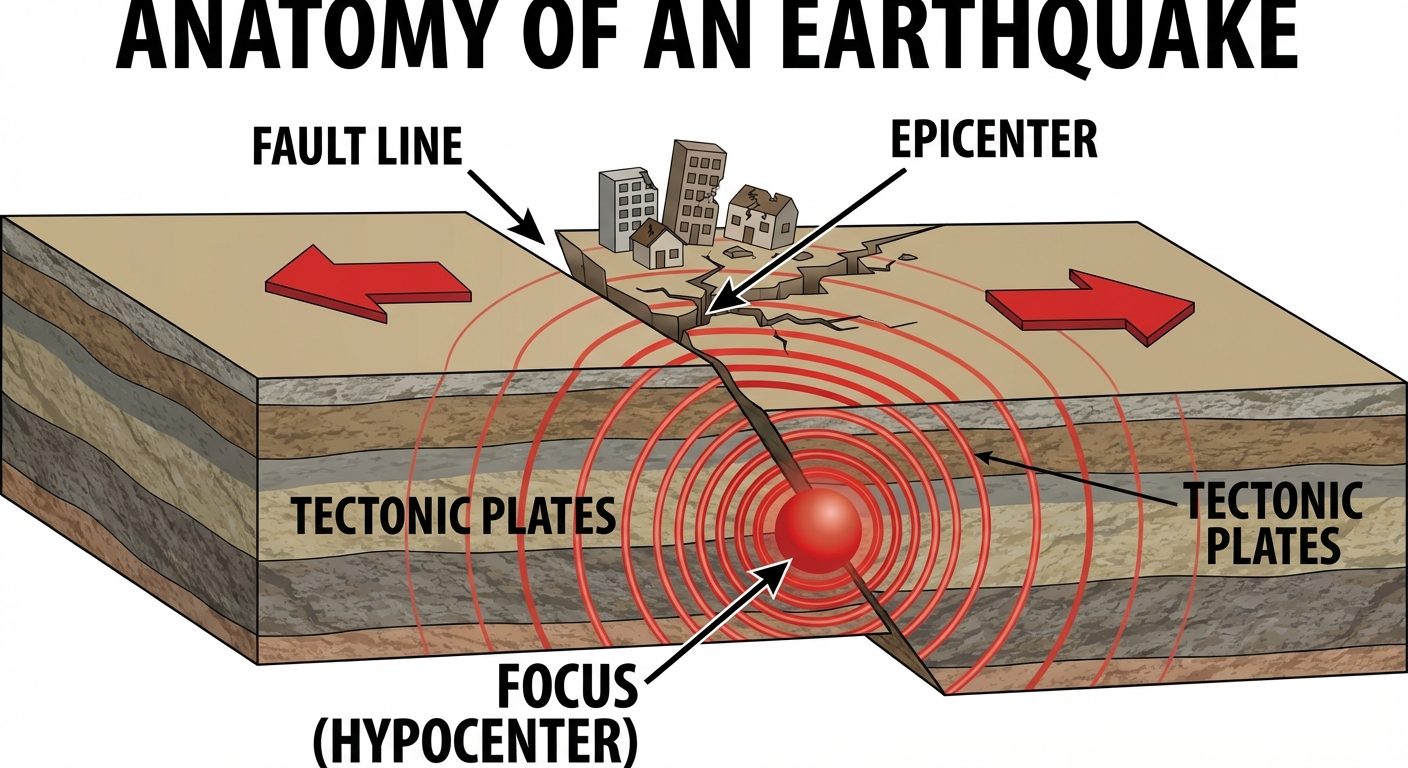
- Definition: Sudden shaking of the ground caused by the passage of seismic waves through Earth’s rocks.
- Key Terms:
- Focus (Hypocenter): The point within the earth where the rupture starts.
- Epicenter: The point on the surface directly above the focus.
- Richter Scale: Measures magnitude (energy released).
- Mercalli Scale: Measures intensity (observed damage).
- Impacts: Collapse of buildings, tsunamis, liquefaction of soil, and fire hazards.
- Mitigation: Seismic retrofitting of buildings, early warning systems, and land-use zoning.
2. Landslides
- Definition: The movement of a mass of rock, debris, or earth down a slope.
- Causes: Gravity acting on an over-steepened slope, triggered by heavy rain, earthquakes, or human activities (deforestation, mining).
- Mitigation: Retaining walls, afforestation on slopes, and drainage control.
3. Avalanches
- Definition: A rapid flow of snow down a sloping surface.
- Triggers: New snowfall loading the pack, warming temperatures, earthquakes, or human noise/movement.
- Impacts: Buries skiers, hikers, and settlements; blocks transport routes.
4. Volcanic Eruptions
- Definition: Rupture in the crust that allows hot lava, volcanic ash, and gases to escape from a magma chamber.
- Hazards:
- Lava Flows: Streams of molten rock.
- Pyroclastic Flows: Fast-moving currents of hot gas and volcanic matter (most deadly).
- Ash Clouds: Disrupt aviation and respiratory health.
3. Manmade (Anthropogenic) Disasters
Disasters caused by human intent, negligence, or error, often involving the failure of a man-made system.
A. Nuclear Disasters
- Nature: Release of radioactive materials into the environment.
- Examples: Chernobyl (1986), Fukushima (2011).
- Causes: Reactor meltdowns, waste leakage, or weapon testing.
- Impacts: Radiation sickness, genetic mutations, cancer, and long-term contamination of soil and water.
B. Chemical Disasters
- Nature: Accidental release of toxic chemicals or industrial explosions.
- Example: Bhopal Gas Tragedy (1984) - Methyl Isocyanate leak.
- Impacts: Instant death, respiratory failure, blindness, and chemical burns.
- Prevention: Strict safety regulations, buffer zones around industrial plants, and hazardous material management.
C. Biological Disasters
- Nature: Devastating effects caused by the spread of a certain kind of living organism.
- Types:
- Epidemics: Localized outbreak (e.g., Ebola).
- Pandemics: Global spread (e.g., COVID-19).
- Bioterrorism: Intentional release of viruses/bacteria (e.g., Anthrax).
- Management: Quarantine, vaccination, sanitation, and rapid medical response.
D. Transport Accidents
- Road/Rail: Derailments, collisions due to human error or mechanical failure.
- Aviation: Plane crashes.
- Maritime: Oil spills (e.g., Deepwater Horizon), which cause massive ecological damage to marine life and coastlines.
4. Disaster Management Framework
A. National Disaster Management Framework
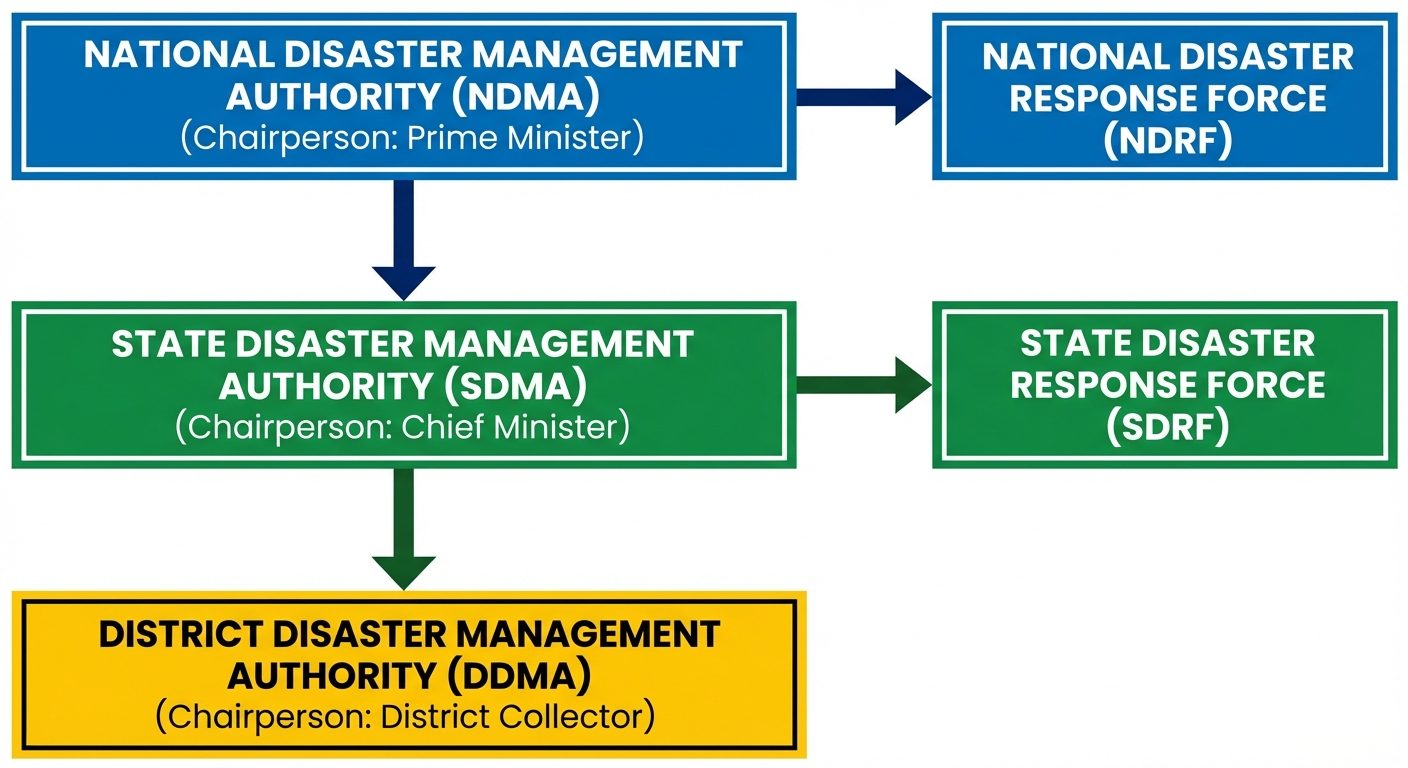
Most nations have a structured framework to handle disasters. In India, for example, the Disaster Management Act, 2005, established the legal framework.
- Structure:
- National Level: National Disaster Management Authority (NDMA) - Headed by the Prime Minister. Policies, plans, and guidelines.
- State Level: State Disaster Management Authority (SDMA) - Headed by the Chief Minister.
- District Level: District Disaster Management Authority (DDMA) - Headed by the District Collector/Magistrate. Execution of rescue and relief.
B. Role of Stakeholders
1. Governmental Agencies
- Policy Formulation: Creating laws and building codes to minimize risk.
- Funding: Allocating budgets for relief funds and reconstruction.
- Early Warning: Meteorological departments (e.g., IMD) predict cyclones and floods.
- Response: Deployment of police, fire services, military, and paramilitary forces (NDRF) for evacuation and rescue.
2. Non-Governmental Organizations (NGOs)
- Gap Filling: Reaching areas where government machinery is slow to reach.
- Relief Work: Distributing food, medicine, and shelter materials.
- Psychological Support: Counseling trauma victims.
- Rehabilitation: helping rebuild homes and livelihoods long after the media attention fades.
3. Community-Based Organizations (CBOs)
- First Responders: Local communities are always the first to respond before external help arrives.
- Local Knowledge: Utilizing traditional knowledge for prediction and coping.
- Self-Help Groups (SHGs): Organizing women and youth for preparedness drills and resource management.
4. Media (Print, Electronic, and Social)
- Pre-Disaster: Disseminating early warnings and educational programs on preparedness.
- During Disaster: Reporting real-time status, helpline numbers, and locations of relief camps.
- Watchdog Role: highlighting gaps in government relief efforts and ensuring accountability.
- Risk: Must avoid spreading panic or fake news (misinformation management).
Did this save you a night before the exam?
LPU Notes is free, and it stays free. Ads cover part of the server bill. The rest comes out of a student's own pocket: the domain, the storage, and keeping the site up through the weeks everyone needs it at once.
The payment button didn't load. An ad blocker or a filtered network is the usual reason. to try again.
Nothing here is ever locked, and nothing unlocks. Chip in only if it was worth it. What it pays for →