Unit 6: Human communities and environment
1. Human Population Growth
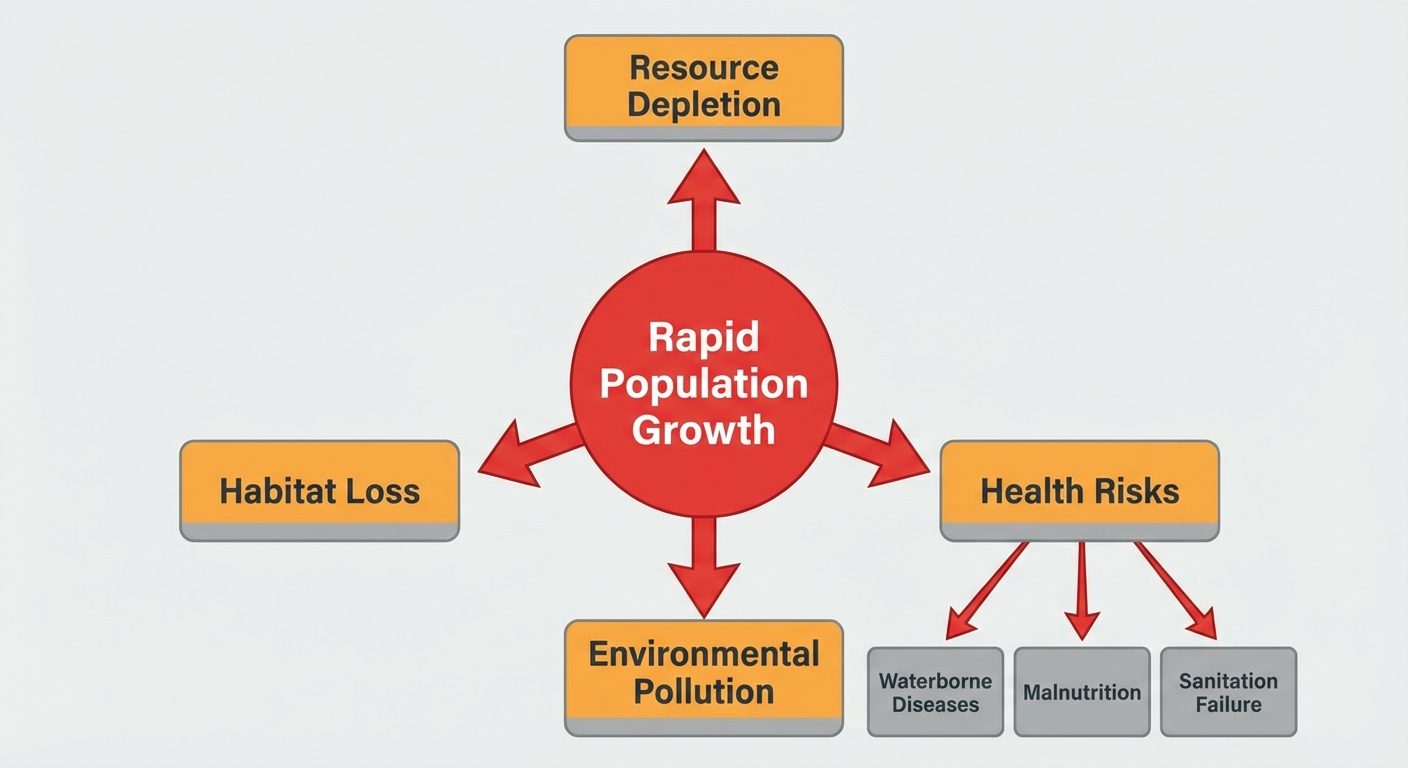
The rapid increase in human population is one of the primary drivers of environmental change. The global population follows a J-shaped growth curve (exponential growth), placing immense pressure on the Earth's carrying capacity.
Impacts on Environment
- Resource Depletion: Over-extraction of non-renewable resources (fossil fuels, minerals) and over-harvesting of renewable resources (fisheries, forests) beyond their regeneration rate.
- Habitat Destruction: Conversion of forests and wetlands into agricultural land, urban areas, and industrial zones leads to loss of biodiversity.
- Pollution: Increased waste generation (solid, liquid, and gaseous) contaminates air, water, and soil.
- Climate Change: Higher population correlates with higher energy consumption, leading to increased Greenhouse Gas (GHG) emissions.
Impacts on Human Health and Welfare
- Spread of Disease: High population density facilitates the rapid transmission of infectious diseases (e.g., Tuberculosis, COVID-19).
- Sanitation and Water: Overcrowding overwhelms municipal sanitation systems, leading to waterborne diseases like Cholera and Typhoid.
- Food Security: Increasing demand for food leads to intensive agriculture, use of pesticides, and soil degradation, potentially leading to malnutrition in vulnerable sectors.
- Social Stress: Resource scarcity (water, land, jobs) can lead to social unrest, migration, and conflict.
2. Environmental Ethics
Environmental ethics is a branch of philosophy that considers the moral relationship between human beings and the natural environment.
Key Ethical Views
- Anthropocentrism: A human-centered view where humans are considered the most significant entity. Nature has value only insofar as it serves human needs (Instrumental value).
- Biocentrism: A life-centered view where all living beings have inherent value, regardless of their usefulness to humans.
- Ecocentrism: An ecosystem-centered view. The whole ecosystem (biotic and abiotic components) has moral status.
Ethical Issues
- Inter-generational Equity: Do we have a moral obligation to leave a habitable planet for future generations?
- Environmental Justice: The poor and marginalized often bear the brunt of environmental degradation (pollution, climate change) caused by the wealthy.
- Development vs. Conservation: The ethical dilemma between economic growth to alleviate poverty and the preservation of nature.
3. Public Awareness
Since the environment belongs to everyone, mass awareness is crucial for conservation.
- Role of Education: Integrating environmental studies into school and college curricula (as mandated by the Supreme Court of India).
- Mass Media: Use of television, radio, and social media to disseminate information regarding climate change and pollution control.
- NGOs: Non-Governmental Organizations play a vital role in bridging the gap between policy and community action (e.g., WWF, Greenpeace, TERI).
- Objectives: To transform individuals from being passive spectators to active protectors of the environment.
4. Cultural Practices and Tribal Populations
Cultural Practices for Conservation
India has a rich tradition of nature conservation embedded in culture and religion.
- Sacred Groves: Patches of forest dedicated to local deities (e.g., Devrai in Maharashtra, Kavu in Kerala). Cutting trees or hunting is strictly prohibited here, preserving biodiversity.
- Totemism: Certain clans consider specific animals or plants as sacred ancestors and protect them.
- Traditional Water Harvesting: Systems like Johads (Rajasthan) and Kuhls (Himachal Pradesh) sustainably manage water resources.
Tribal Populations and Conservation
Tribals (Adivasis) often live in symbiotic relationships with forests.
- Indigenous Knowledge: They possess deep knowledge of medicinal plants, seasonal cycles, and sustainable harvesting.
- Sustainable Livelihoods: Traditional practices like non-timber forest produce collection generally do not harm the forest structure.
- Conflict: Modern conservation laws (like creating Tiger Reserves) sometimes displace tribal communities, leading to conflicts over rights (addressed partly by the Forest Rights Act, 2006).
5. Environmental Laws in India
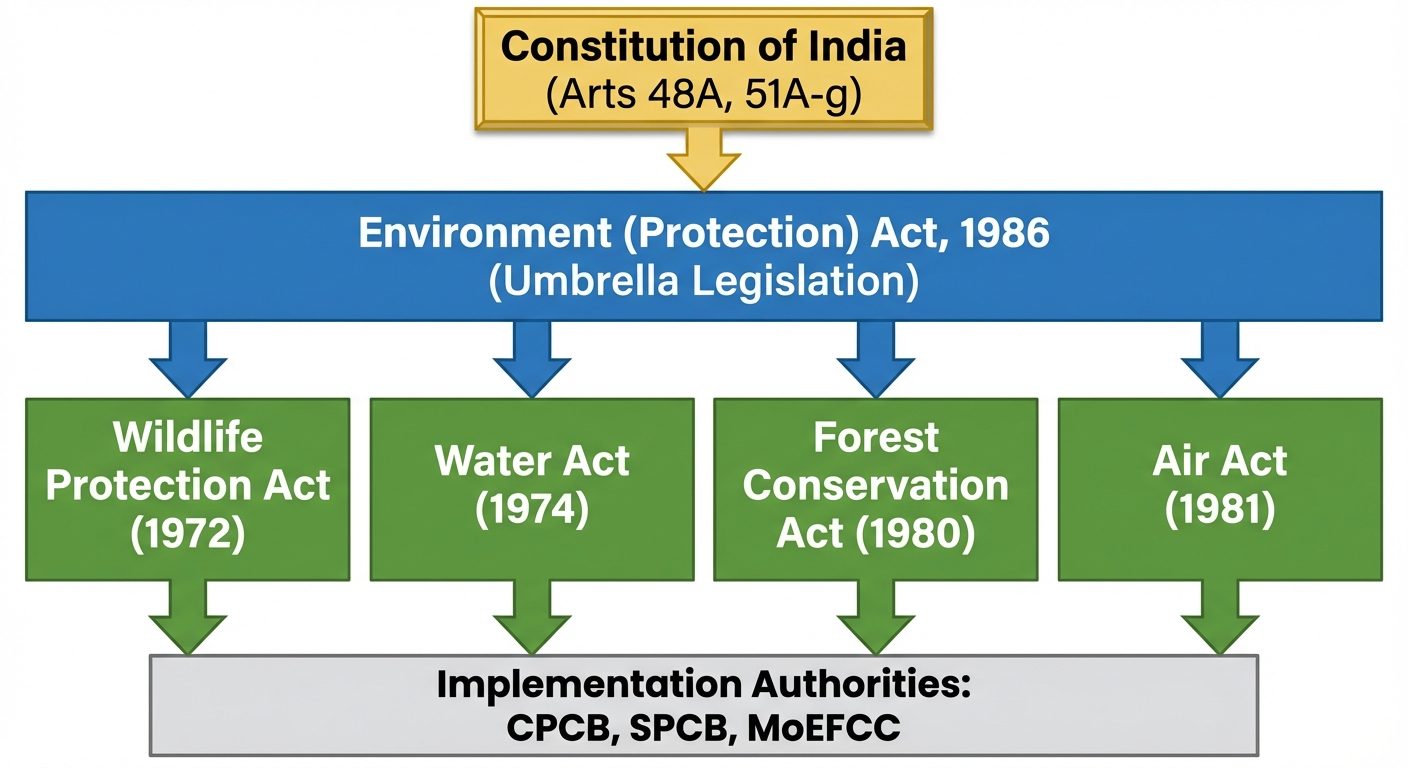
India has a robust constitutional and statutory framework for environmental protection.
Constitutional Provisions
- Article 48-A (Directive Principle): The State shall endeavor to protect and improve the environment and to safeguard the forests and wildlife.
- Article 51-A (g) (Fundamental Duty): It is the duty of every citizen to protect and improve the natural environment including forests, lakes, rivers, and wildlife, and to have compassion for living creatures.
Key Statutory Acts
- Wildlife (Protection) Act, 1972: Prohibits hunting, protects plant and animal species, and establishes Protected Areas (National Parks, Sanctuaries).
- The Water (Prevention and Control of Pollution) Act, 1974: Established Pollution Control Boards (CPCB/SPCB) to regulate water discharge.
- The Forest (Conservation) Act, 1980: Restricts the diversion of forest land for non-forest purposes without central government approval.
- The Air (Prevention and Control of Pollution) Act, 1981: Regulates emission standards for industries and vehicles.
- The Environment (Protection) Act, 1986: An "Umbrella Act" passed after the Bhopal Gas Tragedy. It gives the central government wide powers to protect the environment.
6. Environmental Movements in India
India has a history of grassroots movements protecting the environment against unsustainable development.
Bishnois of Rajasthan (1730 AD)
- Context: King of Jodhpur ordered cutting of Khejri trees for a new palace.
- Action: Amrita Devi Bishnoi and her daughters hugged the trees to protect them. 363 Bishnois sacrificed their lives.
- Significance: First recorded instance of tree-hugging for conservation. "Sar santey rukh rahe to bhi sasto jaan" (If a tree is saved even at the cost of one's head, it's worth it).
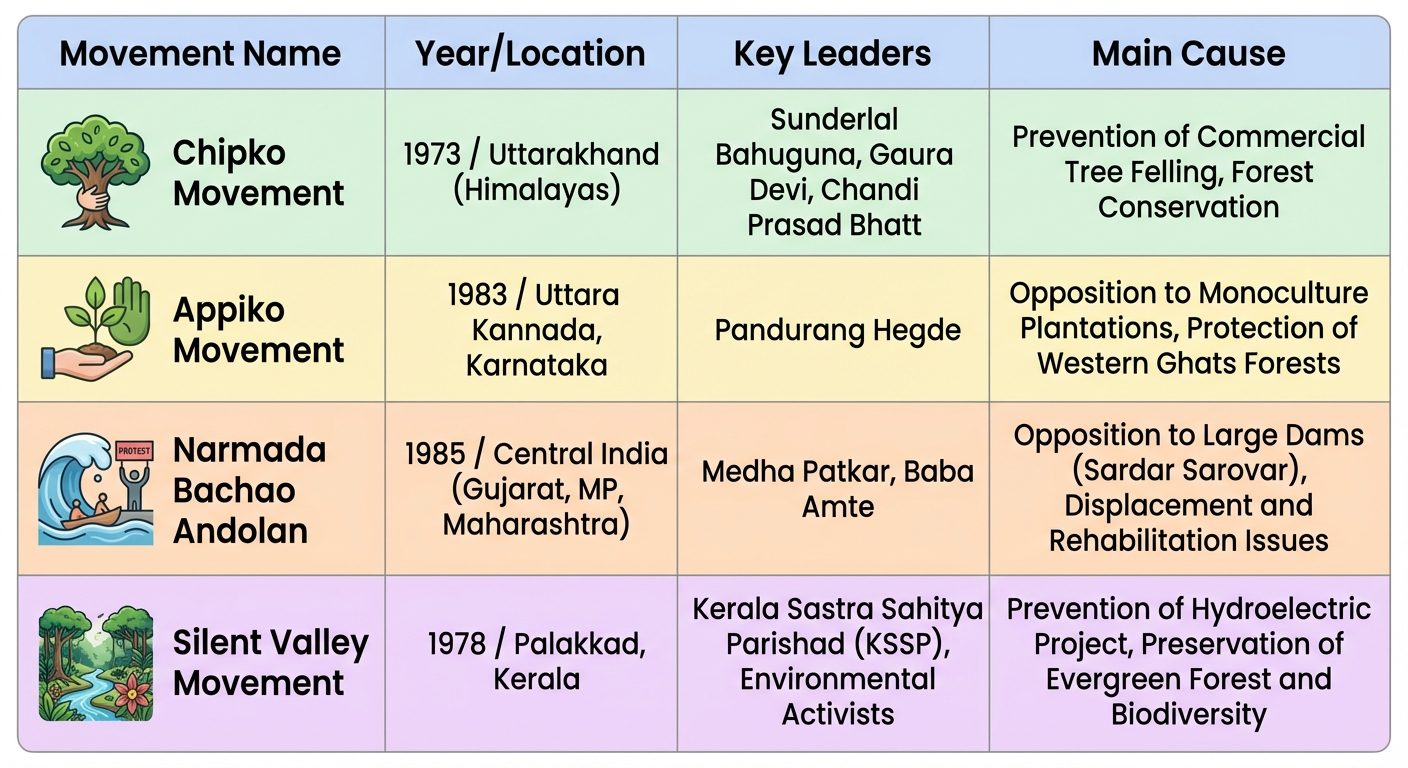
Chipko Movement (1973)
- Region: Chamoli district, Uttarakhand (Garhwal Himalayas).
- Leaders: Sunderlal Bahuguna, Chandi Prasad Bhatt, Gaura Devi.
- Trigger: Government allotted forest trees to a sports goods company while denying locals rights to make agricultural tools.
- Method: Villagers, primarily women, hugged (Chipko) trees to prevent loggers from cutting them.
- Outcome: 15-year ban on felling trees in the Himalayan forests.
Appiko Movement (1983)
- Region: Uttara Kannada, Karnataka (Western Ghats).
- Leader: Pandurang Hegde.
- Slogan: Ulisu (Save), Belesu (Grow), Balasu (Use rationally).
- Context: Inspired by Chipko, villagers protested against the monoculture of teak and eucalyptus replacing natural forests.
Silent Valley Movement (1978)
- Region: Palakkad district, Kerala.
- Trigger: Proposal to build a hydroelectric dam across the Kunthipuzha River.
- Concern: The dam would drown the unique tropical rainforest and threaten the endangered Lion-tailed Macaque.
- Outcome: The project was scrapped, and Silent Valley was declared a National Park in 1985.
Jungle Bachao Andolan (1980s)
- Region: Singhbhum district, Bihar (now Jharkhand).
- Trigger: Government decision to replace natural Sal forests with commercial Teak plantations.
- Significance: Tribal community uprising against "Greed Game Political Populism."
Narmada Bachao Andolan (NBA) (1985 onwards)
- Region: Narmada River (Gujarat, MP, Maharashtra).
- Leaders: Medha Patkar, Baba Amte.
- Trigger: Construction of large dams, specifically the Sardar Sarovar Dam.
- Issues: Massive displacement of tribal people without proper rehabilitation and submergence of vast forest tracts.
- Significance: questioned the paradigm of "Big Dams" as development.
Tehri Dam Conflict (1990s)
- Region: Bhagirathi River, Uttarakhand.
- Leader: Sunderlal Bahuguna.
- Issues:
- Seismic Risk: The dam is located in a high-seismicity zone (Zone V).
- Displacement: Submergence of Old Tehri town and displacement of thousands.
- Status: Despite protests, the dam was constructed and is operational.
Did this save you a night before the exam?
LPU Notes is free, and it stays free. Ads cover part of the server bill. The rest comes out of a student's own pocket: the domain, the storage, and keeping the site up through the weeks everyone needs it at once.
The payment button didn't load. An ad blocker or a filtered network is the usual reason. to try again.
Nothing here is ever locked, and nothing unlocks. Chip in only if it was worth it. What it pays for →