Unit 3: Biodiversity and Conservation
1. Definition and Levels of Biological Diversity
Biodiversity (Biological Diversity) refers to the variety and variability of life on Earth. It encompasses all life forms, from microscopic bacteria to huge plants and animals, and the ecological complexes of which they are part. The term was popularized by the sociobiologist Edward O. Wilson in 1988.
Levels of Biodiversity
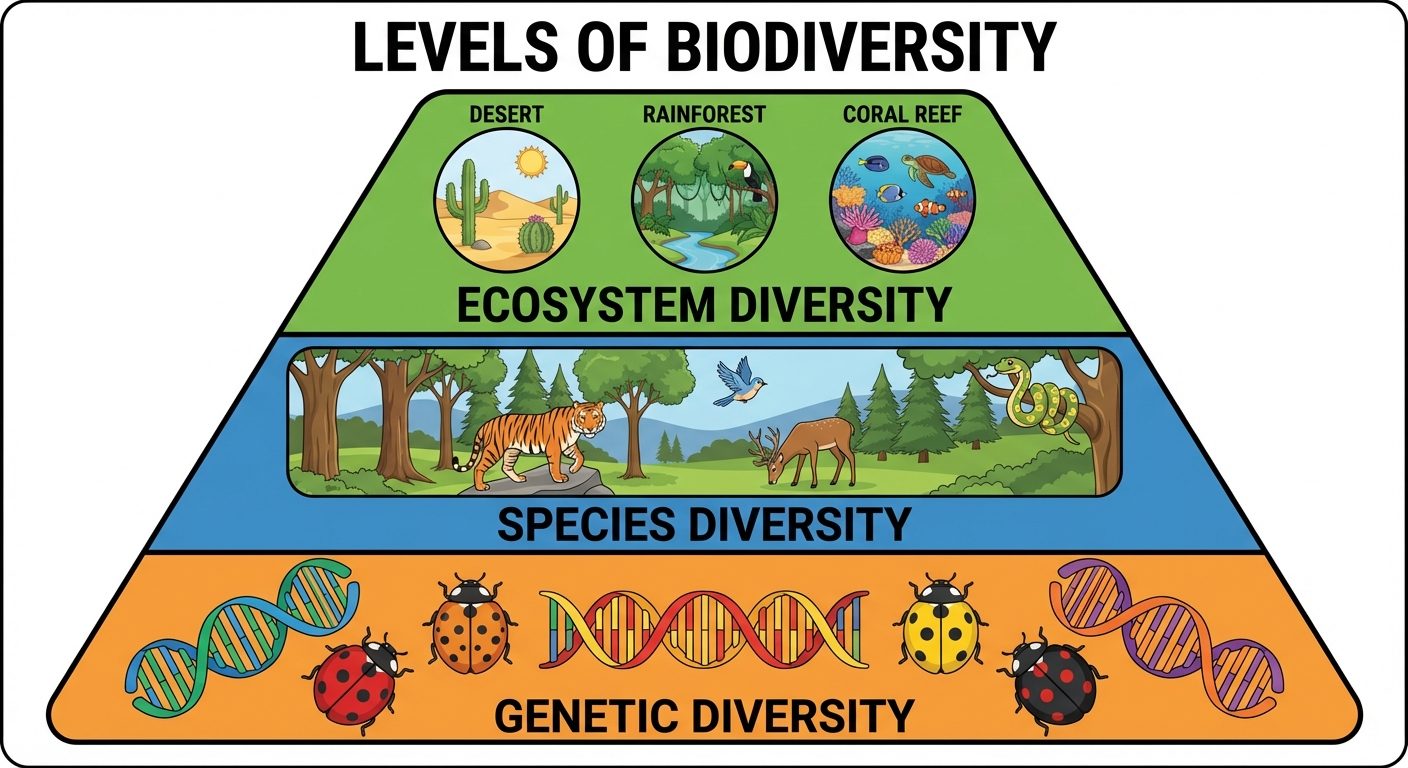
Biodiversity is generally described at three hierarchical levels:
A. Genetic Diversity
- Definition: The variation of genes within a species. It deals with the genetic variability (alleles) among individuals of a single species.
- Significance: Enables populations to adapt to changing environmental conditions. Higher genetic diversity reduces susceptibility to diseases.
- Example: India has more than 50,000 genetically different strains of rice and 1,000 varieties of mango.
B. Species Diversity
- Definition: The variety of species within a particular region.
- Components:
- Species Richness: The number of different species present per unit area.
- Species Evenness: The relative abundance of individuals of each of those species.
- Example: The Western Ghats have a greater amphibian species diversity than the Eastern Ghats.
C. Ecosystem Diversity
- Definition: The diversity of habitats, biological communities, and ecological processes in the biosphere.
- Significance: Different ecosystems provide different flows of energy and cycling of nutrients.
- Example: India possesses a distinct variety of ecosystems including deserts, rain forests, mangroves, coral reefs, wetlands, estuaries, and alpine meadows.
2. Importance of Biodiversity
Biodiversity provides the foundation for ecosystem services to which human well-being is intimately linked.
A. Ecosystem Services
- Provisioning Services: Products obtained from ecosystems (food, fresh water, wood, fiber, genetic resources, medicines).
- Regulating Services: Benefits obtained from regulation of ecosystem processes (climate regulation, flood control, disease regulation, water purification).
- Supporting Services: Services necessary for the production of all other ecosystem services (soil formation, nutrient cycling, primary production).
- Cultural Services: Non-material benefits (spiritual enrichment, recreation, aesthetic experience).
B. Values of Biodiversity
- Ecological Value: Every species plays a unique role (niche). The loss of a "keystone species" can lead to the collapse of an entire ecosystem. Biodiversity maintains the gaseous composition of the atmosphere and controls soil erosion.
- Economic Value: Biodiversity is a source of direct economic benefits (timber, fish, medicinal plants). The bio-prospecting of new resources is a major economic sector.
- Social/Ethical Value: Many indigenous communities are dependent on local biodiversity for their livelihood and cultural identity. There is an ethical argument that every species has an intrinsic right to exist.
- Aesthetic Value: The beauty of nature creates opportunities for eco-tourism, photography, and recreational activities (bird watching, hiking).
- Informational Value: Biodiversity acts as a library of genetic information. Nature provides blueprints for new technologies (biomimicry).
3. Biogeographic Zones of India
India is divided into 10 distinct biogeographic zones based on climate, soil, flora, and fauna characteristics.
- Trans-Himalayas: Cold desert regions (Ladakh, Lahaul-Spiti). Flora involves sparse alpine vegetation; Fauna includes Snow Leopard, Tibetan Wild Ass.
- Himalayas: Covers the entire mountain chain (Northwest, West, Central, East). Rich in orchids, rhododendrons; Fauna includes Musk Deer, Red Panda.
- Desert: The Thar desert of Rajasthan and Kutch. Fauna includes Great Indian Bustard, Blackbuck.
- Semi-Arid: Transition zone between desert and dense forests (Punjab, Gujarat). Fauna includes Asiatic Lion (Gir).
- Western Ghats: High rainfall zone running along the west coast. Extremely high endemism. Fauna includes Lion-tailed Macaque, Nilgiri Tahr.
- Deccan Peninsula: The largest zone covering the central plateau. Deciduous forests. Fauna includes Tiger, Sloth Bear.
- Gangetic Plain: Fertile alluvial plains. Agriculture dominated. Fauna includes Rhinoceros, Gangetic Dolphin.
- Coasts: Mangroves and sandy beaches. Fauna includes Dugong, Olive Ridley Turtles.
- North-East India: Transition zone between Indian, Indo-Malayan, and Indo-Chinese biogeographies. Extremely high diversity.
- Islands: Andaman & Nicobar, Lakshadweep. High endemism due to isolation. Coral reefs are prominent.
India as a Mega Diversity Nation
India is one of the 17 Mega-diverse countries in the world.
- Criteria: A country must have at least 5,000 strictly endemic plant species and border marine ecosystems.
- Stats: India has only 2.4% of the world's land area but accounts for 7-8% of all recorded species.
- Endemism: Approximately 33% of flowering plants and 62% of amphibians found in India are endemic (found nowhere else).
4. Hot Spots of Biodiversity
Biodiversity Hotspots are regions with very high levels of species richness and high degrees of endemism that are under severe threat. The concept was developed by Norman Myers.
Criteria for a Hotspot
- Endemism: Must contain at least 1,500 species of vascular plants (> 0.5% of the world’s total) as endemics.
- Threat: Must have lost at least 70% of its original primary vegetation.
Biodiversity Hotspots in India
Out of 36 global hotspots, 4 cover Indian regions:
- The Himalayas: Includes the entire Indian Himalayan region (and Pakistan, Tibet, Nepal, Bhutan, China, Myanmar).
- Indo-Burma: Includes North-Eastern India (except Assam), Andaman group of Islands, and Myanmar, Thailand, Vietnam, etc.
- The Western Ghats and Sri Lanka: Runs along the western edge of peninsular India.
- Sundaland: Includes Nicobar group of Islands (and Indonesia, Malaysia).
5. Threats to Biodiversity
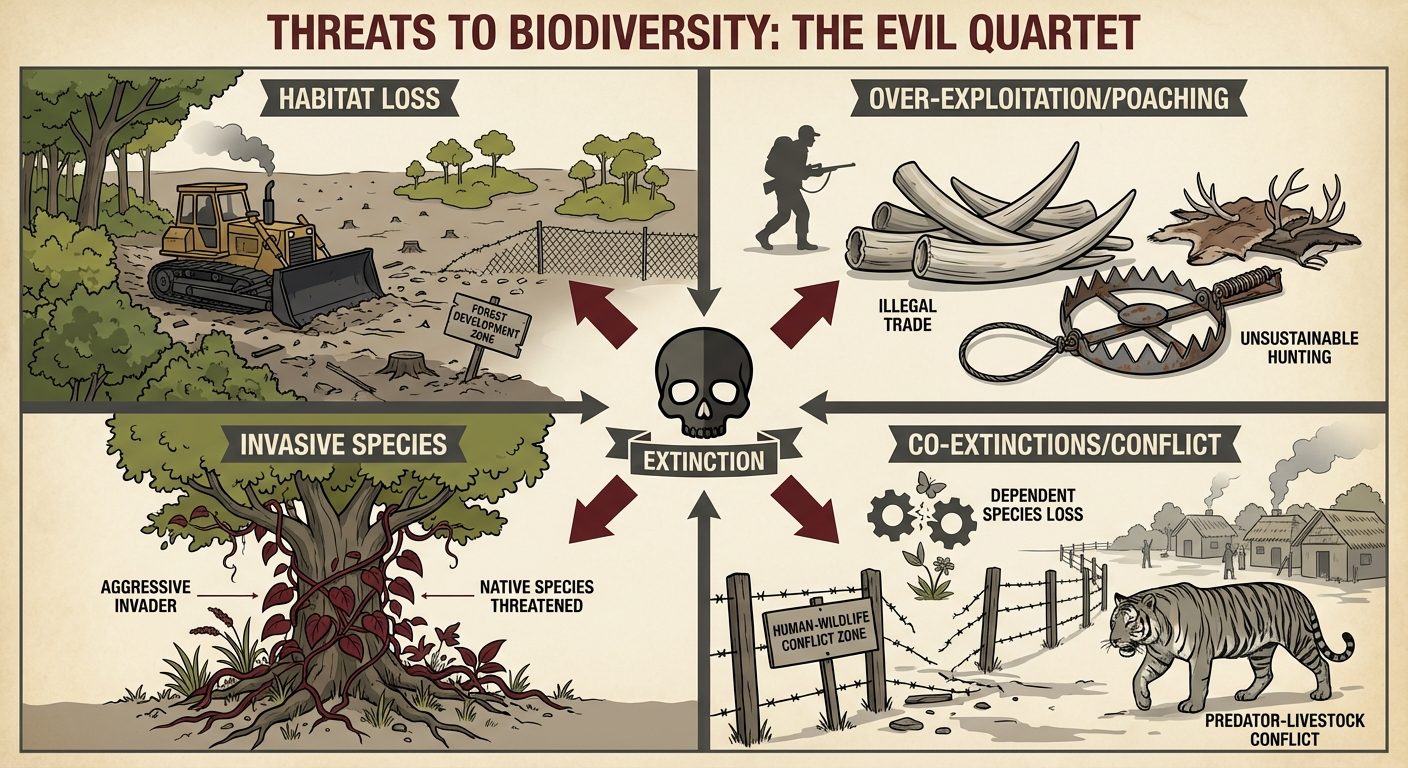
The accelerated rate of extinction is largely due to human activities, often summarized by the acronym HIPPO or the "Evil Quartet".
A. Habitat Loss and Fragmentation (The Major Threat)
- Cause: Deforestation for agriculture, urbanization, mining, and dams.
- Fragmentation: Large habitats are broken into smaller patches. Mammals and birds requiring large territories (e.g., Tigers, Elephants) are severely affected.
- Effect: Loss of food, shelter, and breeding grounds.
B. Poaching and Illegal Wildlife Trade
- Motivation: International market for hides, skins, tusks, horns, and bones.
- Examples: Tigers (bones for medicine), Rhinos (horns), Elephants (ivory), Pangolins (scales).
C. Biological Invasions (Invasive Alien Species)
- Definition: Non-native species introduced unintentionally or deliberately that spread aggressively and harm native species.
- Mechanism: They compete for resources, lack natural predators, or act as parasites.
- Examples in India:
- Water Hyacinth (Eichhornia): Clogs water bodies, killing aquatic life.
- Lantana camara: Replaces native forest undergrowth.
- African Catfish (Clarias gariepinus): Threatens indigenous catfish.
D. Human-Wildlife Conflict
- Cause: Encroachment of human settlements into forests reduces the buffer zone.
- Consequence: Animals raid crops (elephants, wild boars) or prey on livestock (leopards), leading to retaliatory killings by humans.
6. Species of Conservation Concern
The IUCN (International Union for Conservation of Nature) publishes the Red List, categorizing species based on their risk of extinction.
IUCN Categories
- Extinct (EX): No individuals remaining anywhere (e.g., Dodo, Passenger Pigeon).
- Extinct in the Wild (EW): Known only to survive in captivity or cultivation (e.g., Northern White Rhino).
- Critically Endangered (CR): Extremely high risk of extinction in the wild (e.g., Great Indian Bustard, Gharial, Pygmy Hog).
- Criteria: Population decline >90% in 10 years, or <50 mature individuals.
- Endangered (EN): Very high risk of extinction (e.g., Bengal Tiger, Asian Elephant).
- Vulnerable (VU): High risk of extinction (e.g., Indian Rhinoceros).
- Rare Species: Species with small populations that are not yet endangered but are at risk due to restricted range (e.g., Himalayan Desert species).
EDGE Species
- Definition: Evolutionarily Distinct and Globally Endangered.
- Concept: These species have few close genetic relatives (unique evolutionary history) and are also facing a high risk of extinction.
- Examples: Purple Frog (Western Ghats), Ganges River Dolphin, Pangolin.
7. Conservation of Biodiversity
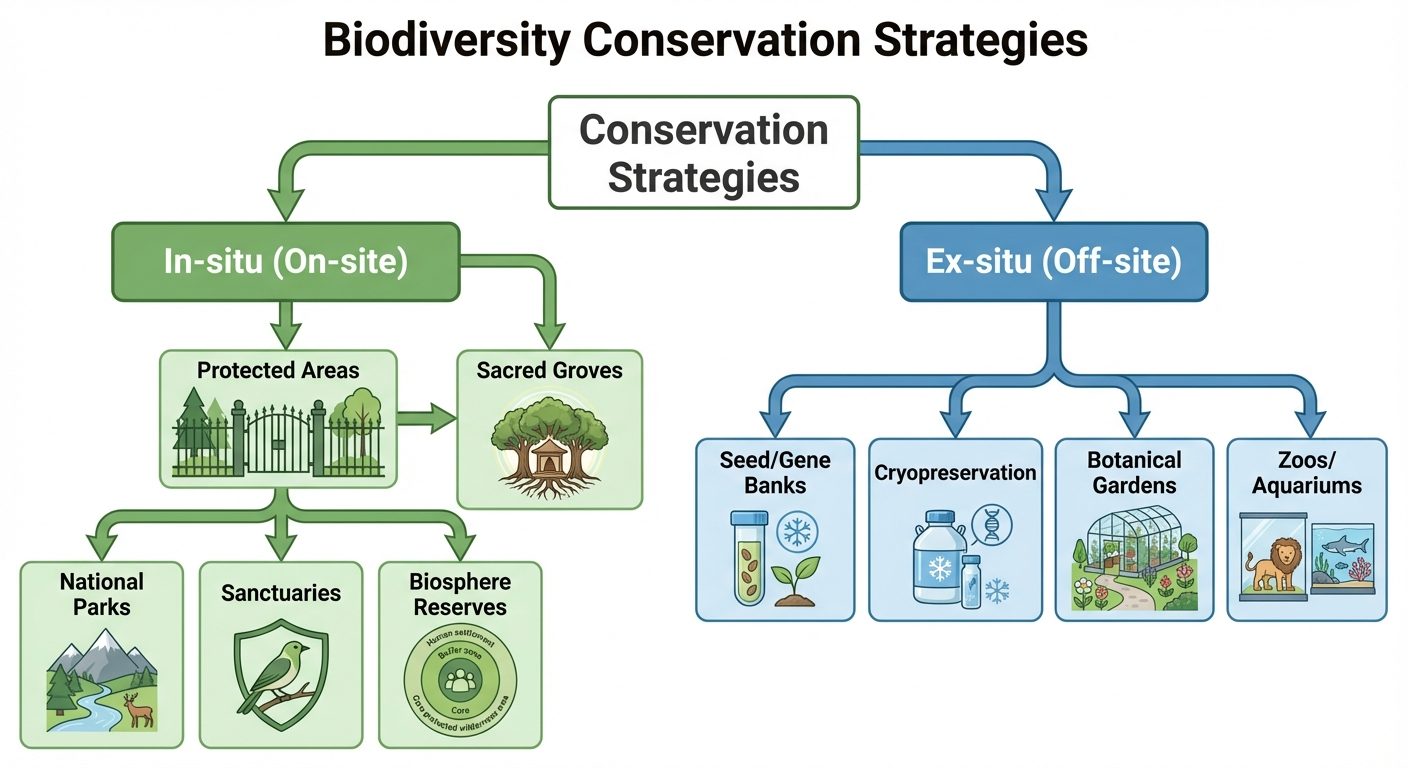
Conservation strategies are broadly classified into two categories: In-situ and Ex-situ.
A. In-situ Conservation (On-site)
Conservation of species within their natural habitats. This preserves the entire ecosystem and allows evolutionary processes to continue.
- Protected Areas (PAs):
- National Parks: Strict protection; no human activity (grazing, forestry) allowed. (e.g., Jim Corbett, Kaziranga).
- Wildlife Sanctuaries: Protection of fauna; limited human activity allowed if it doesn't disturb wildlife. (e.g., Periyar, Bhitarkanika).
- Biosphere Reserves: Large areas zoned for conservation, research, and sustainable development. Contains Core (strict), Buffer (research/education), and Transition (settlements) zones. (e.g., Nilgiri, Nanda Devi).
- Sacred Groves: Forest patches protected by local communities due to religious beliefs. (e.g., Devarakadu in Karnataka).
B. Ex-situ Conservation (Off-site)
Conservation of species outside their natural habitats. Used for species where the population is too low to survive in the wild.
- Zoological Parks: For captive breeding and education (e.g., captive breeding of Pygmy Hog).
- Botanical Gardens: Conservation of plant species (e.g., Indian Botanic Garden, Kolkata).
- Seed Banks / Gene Banks: Storage of seeds, sperm, or eggs at low temperatures (Cryopreservation at -196°C in liquid nitrogen).
- Tissue Culture: Propagating plants in sterile labs to produce clones.
Did this save you a night before the exam?
LPU Notes is free, and it stays free. Ads cover part of the server bill. The rest comes out of a student's own pocket: the domain, the storage, and keeping the site up through the weeks everyone needs it at once.
The payment button didn't load. An ad blocker or a filtered network is the usual reason. to try again.
Nothing here is ever locked, and nothing unlocks. Chip in only if it was worth it. What it pays for →