Unit 2: Natural resources and ecosystem
1. Ecosystem: Structure and Function
An ecosystem is a functional unit of nature where living organisms (biotic) interact among themselves and also with the surrounding physical environment (abiotic).
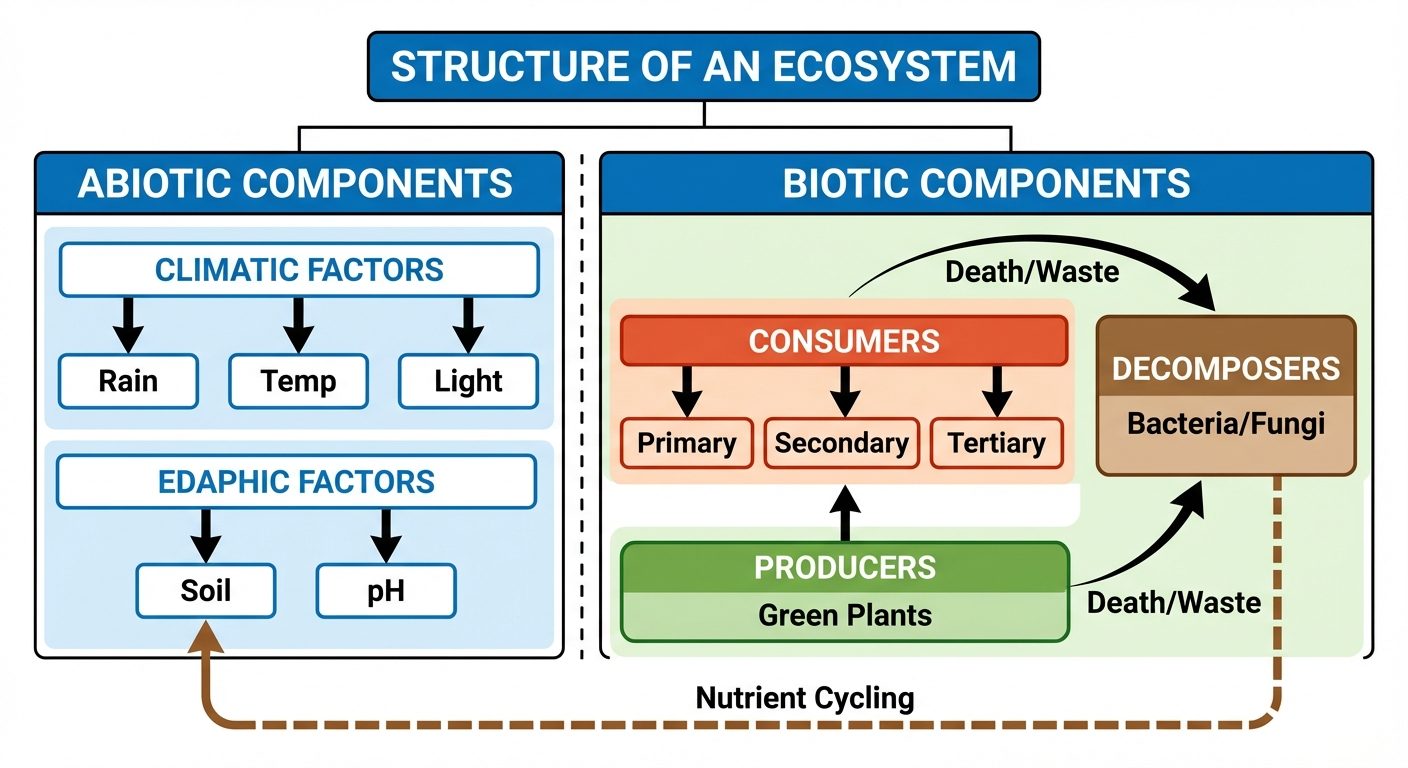
Structure of an Ecosystem
The structure is characterized by the organization of both biological and non-biological components.
-
Abiotic Components (Non-living):
- Climatic factors: Sunlight, temperature, rainfall, humidity.
- Edaphic factors: Soil texture, pH, minerals, topography.
- Inorganic substances: Water, carbon, nitrogen, sulfur, phosphorus.
- Organic compounds: Proteins, carbohydrates, lipids (link biotic and abiotic).
-
Biotic Components (Living):
- Producers (Autotrophs): Synthesize food using sunlight (photosynthesis) or chemicals. Examples: Green plants, algae, phytoplankton.
- Consumers (Heterotrophs): Depend on others for food.
- Primary Consumers (Herbivores): Eat producers (e.g., Deer, Rabbit).
- Secondary Consumers (Primary Carnivores): Eat herbivores (e.g., Frog, Fox).
- Tertiary Consumers (Top Carnivores): Eat secondary consumers (e.g., Lion, Tiger).
- Decomposers (Saprotrophs): Break down dead organic matter and recycle nutrients back into the soil. Examples: Bacteria, Fungi.
Functions of an Ecosystem
- Productivity: The rate of biomass production (Gross Primary Productivity vs. Net Primary Productivity).
- Decomposition: Breakdown of complex organic matter into inorganic substances (fragmentation, leaching, catabolism, humification, mineralization).
- Energy Flow: Unidirectional flow of energy from the sun to producers and then consumers.
- Nutrient Cycling (Biogeochemical Cycles): The movement of nutrient elements through the various components of an ecosystem (e.g., Carbon cycle, Nitrogen cycle).
Types of Ecosystems
- Natural Ecosystems:
- Terrestrial: Forest, Grassland, Desert.
- Aquatic: Fresh water (Pond, Lake, River) and Marine (Ocean, Estuary).
- Artificial (Man-made) Ecosystems: Crop fields, Gardens, Aquariums, Dams.
2. Energy Flow in an Ecosystem
Energy flow is strictly unidirectional.
- Source: The Sun is the ultimate source of energy.
- Capture: Plants capture only 1-5% of solar radiation (PAR - Photosynthetically Active Radiation).
- Transfer: Energy is transferred from one trophic level to the next.
- Loss: At each transfer, a major part of energy (approx. 90%) is lost as heat (Second Law of Thermodynamics).
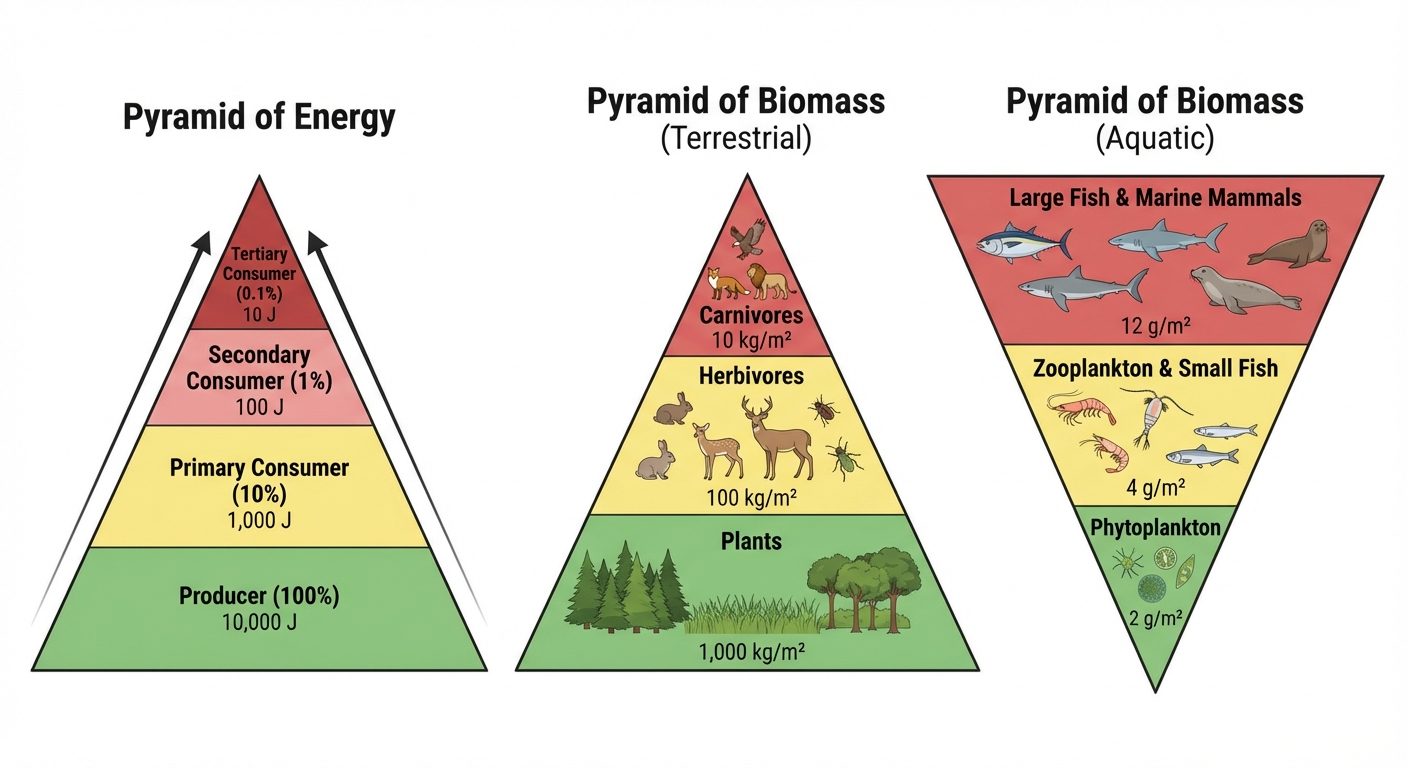
- 10% Law (Lindeman): Only about 10% of energy is transferred to the next higher trophic level.
Food Chains and Food Webs
- Food Chain: A linear sequence of organisms where nutrients and energy are transferred from one organism to another.
- Grazing Food Chain (GFC): Starts with green plants. (Grass Goat Lion).
- Detritus Food Chain (DFC): Starts with dead organic matter. (Dead leaves Wood louse Blackbird).
- Food Web: A network of interconnected food chains. It provides stability to the ecosystem because consumers have multiple food sources.
Ecological Pyramids
Graphical representations of the trophic structure of an ecosystem.
- Pyramid of Numbers: Represents the number of individuals per unit area.
- Upright: Grassland/Pond ecosystem.
- Inverted: Tree ecosystem (One tree supports many birds, which support many parasites).
- Pyramid of Biomass: Represents the total dry weight of organisms.
- Upright: Forest/Grassland.
- Inverted: Pond ecosystem (small standing crop of phytoplankton supports large biomass of zooplankton/fish).
- Pyramid of Energy: Always Upright. Represents the amount of energy at each level. Energy decreases as we move to higher trophic levels.
3. Ecological Succession
The gradual and predictable change in the species composition of a given area is called ecological succession.
- Pioneer Community: The first species to colonize an area (e.g., Lichens on rocks).
- Seral Stages: Transitional communities between pioneer and climax.
- Climax Community: The final, stable community that is in near equilibrium with the environment (e.g., a mature forest).
Types of Succession
- Primary Succession: Occurs in areas where no life existed before (e.g., bare rock, newly cooled lava, sand dunes). Very slow process.
- Secondary Succession: Occurs in areas where life existed but was destroyed (e.g., burned forest, flooded land). Faster process because soil is already present.
4. Introduction to Natural Resources
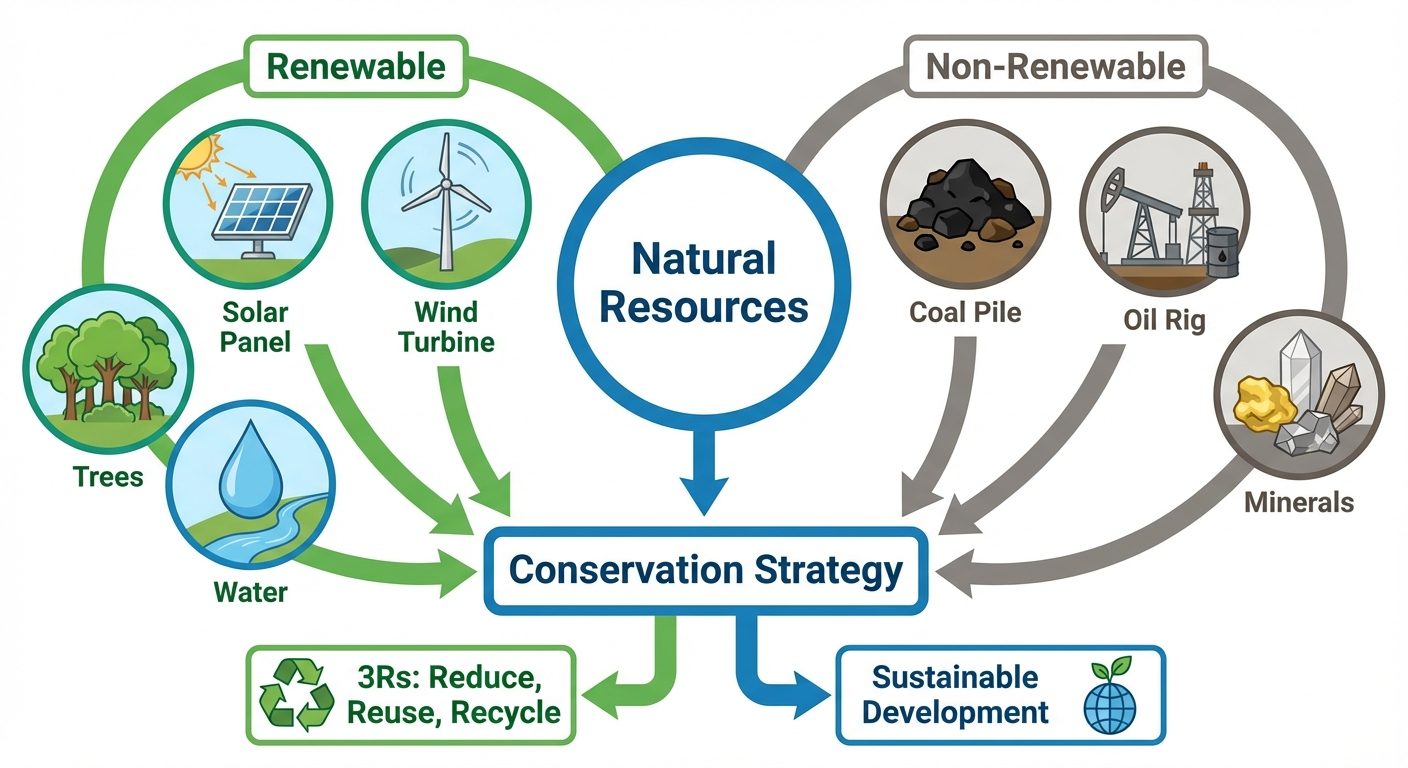
Natural resources are materials or substances such as minerals, forests, water, and fertile land that occur in nature and can be used for economic gain.
Classification
- Renewable Resources: Can be replenished or reproduced easily. They are inexhaustible if managed well.
- Examples: Solar energy, wind energy, tidal energy, geothermal energy, biomass.
- Non-renewable Resources: Formed over long geological periods. They are finite and exhaustible.
- Examples: Fossil fuels (Coal, Petroleum, Natural Gas), Minerals (Iron, Copper), Nuclear fuels (Uranium).
5. Specific Resources: Problems and Remedial Measures
A. Forest Resources
Uses: Timber, fuel wood, raw material for paper/pulp, oxygen production, prevention of soil erosion, habitat for wildlife.
- Problems:
- Deforestation: Cutting down trees for agriculture, urbanization, or mining.
- Mining and Dams: Submergence of forests and displacement of tribal people.
- Forest Fires: Destruction of biodiversity.
- Remedial Measures:
- Afforestation/Reforestation: Planting trees on barren land or replanting cut forests.
- Social Forestry: Involving local communities in forest management.
- Strict Laws: Enforcement of Forest Conservation Acts.
B. Water Resources
Uses: Drinking, agriculture (irrigation), industry, hydroelectricity, transportation.
- Problems:
- Over-exploitation: Lowering of water table due to excessive pumping.
- Floods & Droughts: Caused by deforestation and climate change.
- Conflicts: Disputes over water sharing between states/nations (e.g., Kaveri river dispute).
- Pollution: Industrial effluents and sewage.
- Remedial Measures:
- Rainwater Harvesting: Catching and storing rain.
- Watershed Management: Managing land and water resources comprehensively.
- Drip Irrigation: Reducing water wastage in agriculture.
- Desalination: Converting sea water to fresh water (costly but useful).
C. Land Resources
Uses: Agriculture, housing, industry, mining, waste disposal.
- Problems:
- Land Degradation: Loss of soil quality.
- Soil Erosion: Removal of topsoil by wind or water.
- Desertification: Productive land turning into desert due to overgrazing/deforestation.
- Salinization: Accumulation of salts due to waterlogging.
- Remedial Measures:
- Contour Farming & Terracing: To reduce erosion on slopes.
- Afforestation: Roots hold the soil.
- Crop Rotation: To maintain soil fertility.
- Controlled Grazing: Limiting livestock density.
D. Energy Resources
Uses: Electricity generation, transportation, industrial machinery, domestic cooking.
- Problems:
- Depletion: Fossil fuels are running out rapidly.
- Environmental Pollution: Burning coal/oil releases , , causing global warming and acid rain.
- Nuclear Hazards: Risk of radiation leaks and waste disposal issues.
- Remedial Measures:
- Shift to Renewable Energy: Promoting Solar, Wind, Hydro, and Biomass energy.
- Energy Efficiency: Using LED bulbs, energy-efficient appliances (star rated).
- Bio-fuels: Using ethanol and biodiesel.
6. Role of Individual in Conservation of Natural Resources
Conservation cannot be achieved by governments alone; individual participation is crucial.
-
Energy Conservation:
- Switch off lights and fans when not in use.
- Use natural light during the day.
- Use solar water heaters.
- Walk or cycle for short distances; use public transport.
-
Water Conservation:
- Fix leaking taps immediately.
- Don't keep the tap running while brushing or shaving.
- Reuse water used for washing vegetables to water plants.
- Install rainwater harvesting systems in homes.
-
Soil and Forest Conservation:
- Plant trees in surroundings.
- Stop using single-use plastics that degrade soil quality.
- Use separate bins for biodegradable and non-biodegradable waste (Composting).
- Don't waste paper (paper is made from trees).
-
Practice the 3 Rs:
- Reduce: Minimize consumption (buy only what is needed).
- Reuse: Use items again (e.g., glass jars, cloth bags).
- Recycle: Process waste materials into new products (paper, glass, metals).
-
Consumer Awareness: Buy eco-friendly products and boycott products made from endangered species (fur, ivory).
Did this save you a night before the exam?
LPU Notes is free, and it stays free. Ads cover part of the server bill. The rest comes out of a student's own pocket: the domain, the storage, and keeping the site up through the weeks everyone needs it at once.
The payment button didn't load. An ad blocker or a filtered network is the usual reason. to try again.
Nothing here is ever locked, and nothing unlocks. Chip in only if it was worth it. What it pays for →