Unit 6: Simple and compound interest, Analytical reasoning
1. Concept of Interest Calculation
Interest is the cost of borrowing money or the return on lending money. It is the additional amount paid by the borrower to the lender for the use of money.
Key Terminology
- Principal (P): The original sum of money borrowed or invested.
- Rate (R): The percentage of the principal charged as interest per specific period (usually per annum/year).
- Time (T or n): The duration for which the money is borrowed or invested.
- Amount (A): The total money paid back at the end of the time period.
- Formula:
2. Comparison of Simple and Compound Interest
Simple Interest (SI)
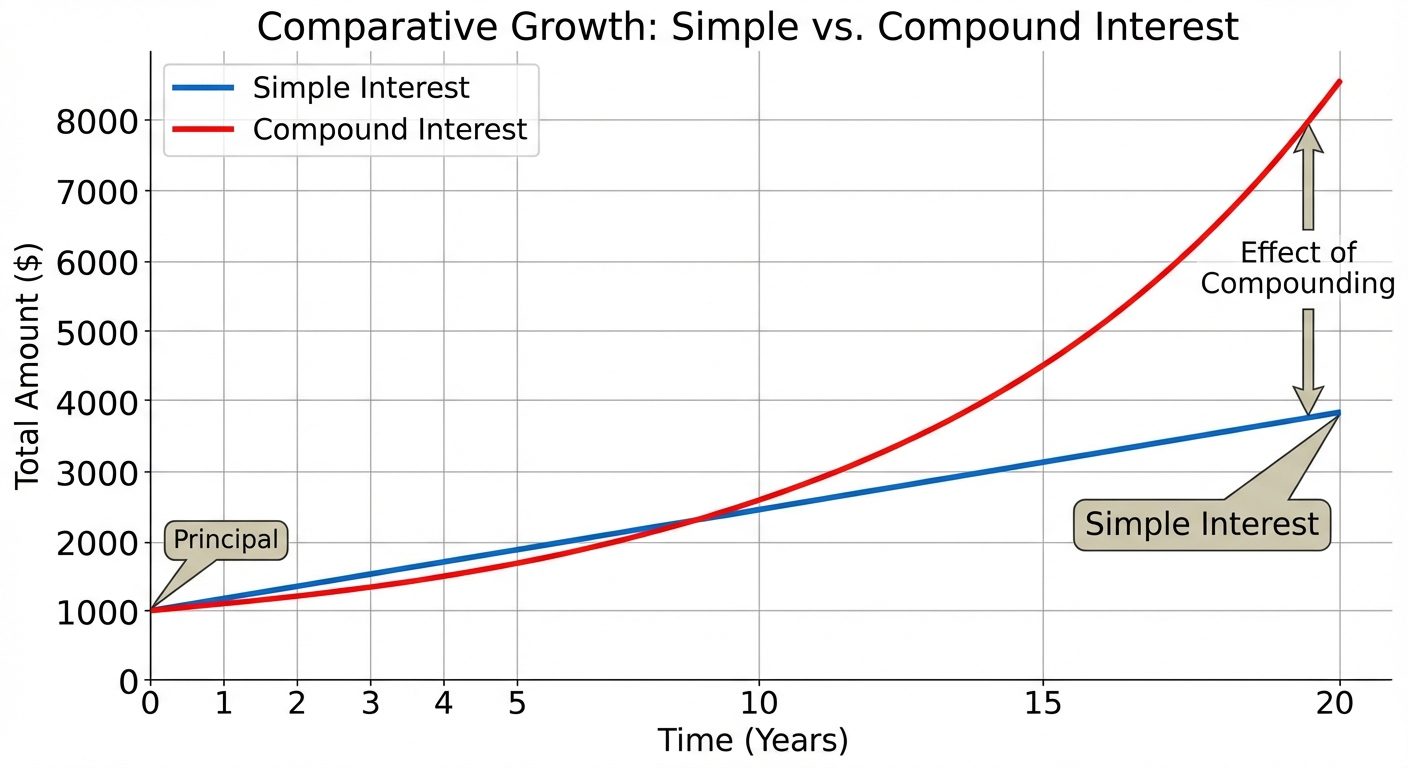
Simple Interest is calculated only on the original principal amount for the entire duration. The principal remains constant throughout the tenure.
Formula:
Total Amount:
Compound Interest (CI)
Compound Interest is calculated on the principal plus the accumulated interest from previous periods. This is often referred to as "interest on interest." The principal increases every compounding period.
Formula (Annual Compounding):
(Where is the number of years/periods)
Variations in Compounding:
- Half-yearly: Rate becomes , Time becomes .
- Quarterly: Rate becomes , Time becomes .
Key Differences Table
| Feature | Simple Interest (SI) | Compound Interest (CI) |
|---|---|---|
| Basis of Calculation | Calculated on Principal only. | Calculated on Principal + Accumulated Interest. |
| Principal | Constant throughout. | Changes every conversion period. |
| Interest Amount | Constant every year. | Increases every year. |
| Growth Pattern | Linear (Arithmetic Progression). | Exponential (Geometric Progression). |
| Benefit | Better for borrowers (lower cost). | Better for investors (higher returns). |
3. Compounding Based Problems: Depreciation and Growth
The compound interest formula is not limited to finance; it applies to any scenario involving percentage increase or decrease over time.
A. Population and Economic Growth
When a quantity increases by a fixed percentage every year, it follows the compound growth law.
Formula:
- P: Initial population/value.
- R: Growth rate per annum.
- n: Number of years.
B. Depreciation
Depreciation refers to the decrease in the value of an asset (machinery, vehicles, electronics) over time due to wear and tear.
Formula:
- Note: The sign inside the bracket is negative because the value is decreasing.
Key Problem Types:
- Finding Future Value: Given current value and rate, find value after years.
- Finding Past Value: Given current depreciated value, find the original purchase price.
- Variable Rates: If the rate changes every year (e.g., in 1st year, in 2nd year):
4. Analytical Reasoning: Blood Relations
Blood relation tests analyze the student's ability to define the relationship between family members based on a chain of information.
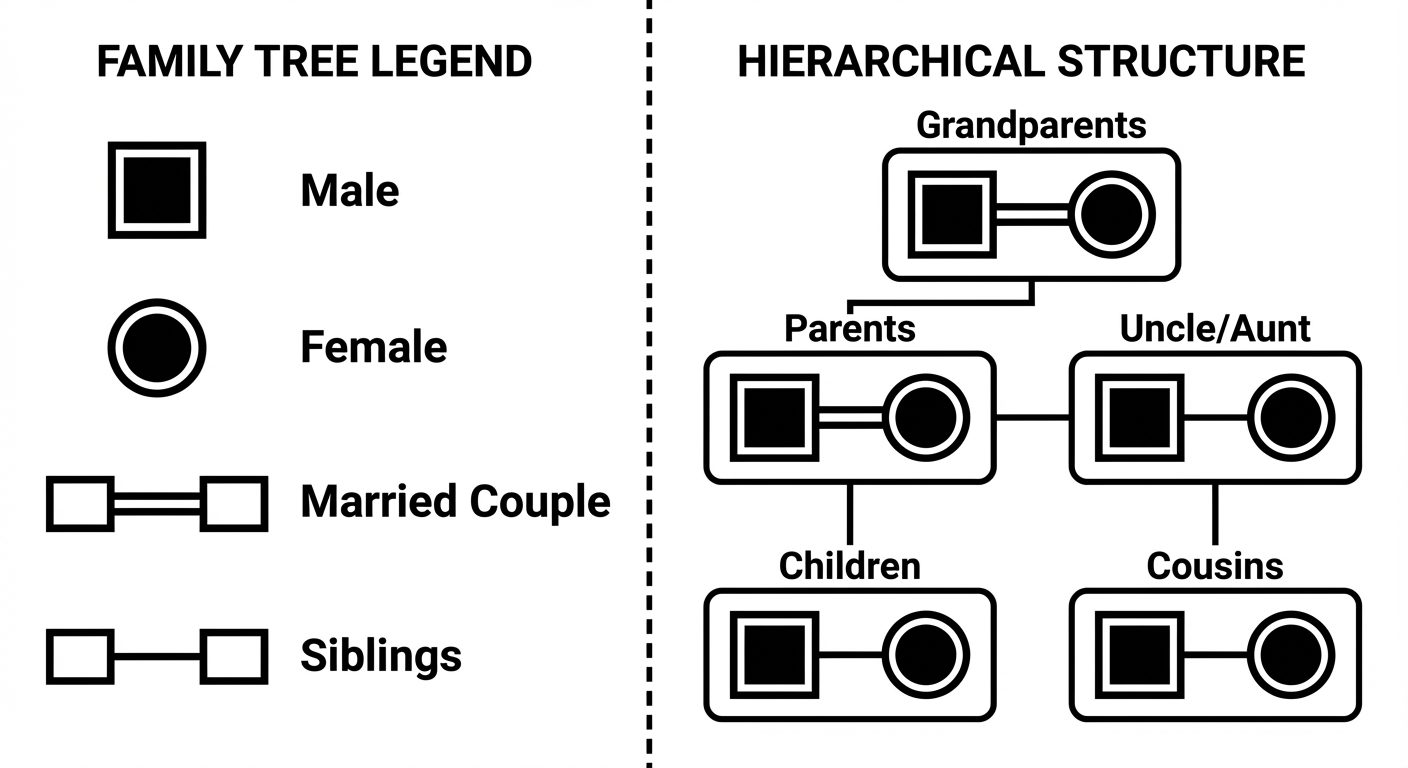
Family Tree Hierarchies
Solving these problems requires constructing a "Family Tree" to visualize generations.
- Generation 1 (Grandparents): Grandfather, Grandmother (Paternal = Father's side; Maternal = Mother's side).
- Generation 2 (Parents/Uncles): Father, Mother, Uncle, Aunt.
- Generation 3 (Self/Siblings): Self, Brother, Sister, Cousin, Brother-in-law, Sister-in-law.
- Generation 4 (Children): Son, Daughter, Nephew, Niece.
Standard Notation for Solving
To solve efficiently without confusion, standard symbols are used:
- Male: represented by a Box [ ] or (+) sign.
- Female: represented by a Circle ( ) or (-) sign.
- Siblings: Connected by a single horizontal line (A — B).
- Spouses: Connected by double lines (A = B).
- Generations: Connected by vertical lines.
Types of Problems
- Deciphering Jumbled Descriptions: E.g., "The father of the sister of my son." (Decode backwards: My son's sister = my daughter; My daughter's father = Me).
- Relationship based on Photography: "Pointing to a man, a woman said..."
- Coded Relations: "A + B means A is the father of B."
5. Analytical Reasoning: Direction Sense Test
These problems test the ability to conceptualize space, cardinal directions, and angular movement.
The 8 Cardinal Directions
- Main Directions: North (N), South (S), East (E), West (W).
- Sub-Directions (Ordinals): North-East (NE), North-West (NW), South-East (SE), South-West (SW).
Standard Map Assumption:
- Top: North
- Bottom: South
- Right: East
- Left: West
Concept of Turns and Angles
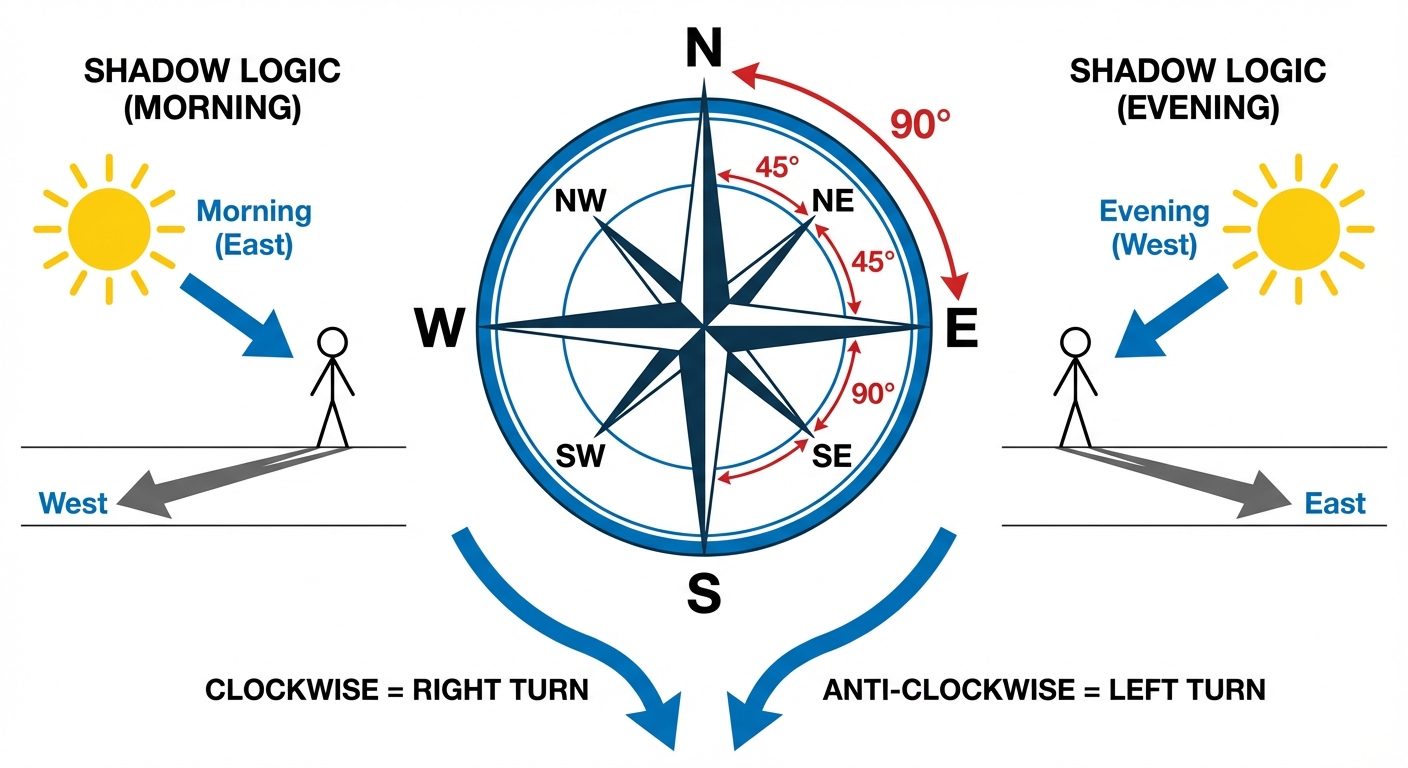
- Right Turn: Move 90° Clockwise.
- Left Turn: Move 90° Anti-clockwise.
- About Turn (Reverse): Move 180°.
Shadow Concept
Shadows are cast in the opposite direction of the light source.
| Time of Day | Sun Position | Shadow Position |
|---|---|---|
| Morning (Sunrise) | East | West (Left of North-facing person) |
| Noon (12:00 PM) | Overhead | No shadow / Vertical |
| Evening (Sunset) | West | East (Right of North-facing person) |
Minimum Distance (Displacement)
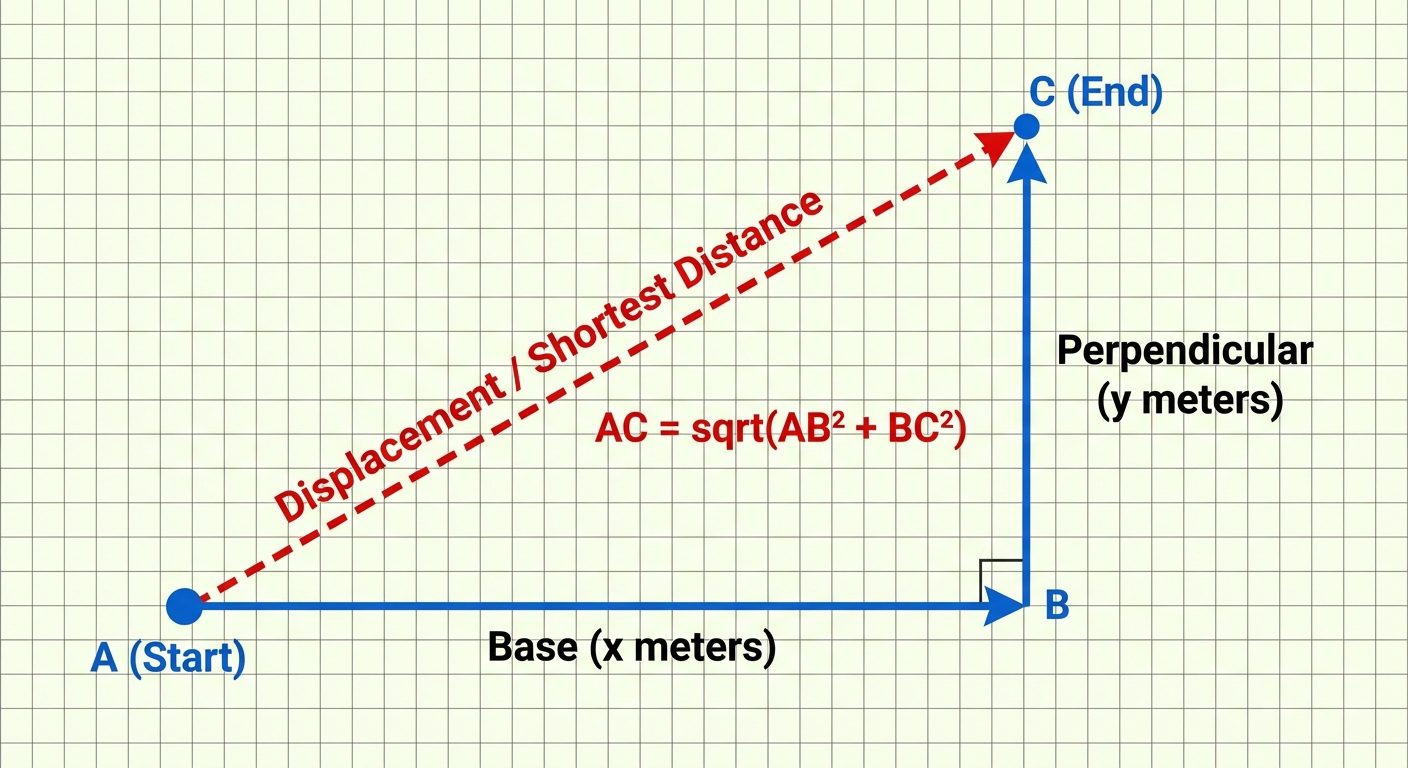
Often, problems ask for the "shortest distance" between the starting point and the end point, not the total distance travelled.
Pythagoras Theorem:
Used when the path forms a right-angled triangle.
Did this save you a night before the exam?
LPU Notes is free, and it stays free. Ads cover part of the server bill. The rest comes out of a student's own pocket: the domain, the storage, and keeping the site up through the weeks everyone needs it at once.
The payment button didn't load. An ad blocker or a filtered network is the usual reason. to try again.
Nothing here is ever locked, and nothing unlocks. Chip in only if it was worth it. What it pays for →