Unit 3: Inheritance and Polymorphism
1. Inheritance
Inheritance is a fundamental mechanism in object-oriented programming (OOP) that allows a new class to acquire the properties (fields) and behaviors (methods) of an existing class. It promotes code reusability and establishes an "IS-A" relationship between classes.
Key Terminology
- Superclass (Parent/Base Class): The class whose features are inherited.
- Subclass (Child/Derived Class): The class that inherits from the superclass.
- extends keyword: Used to establish inheritance in Java.
Types of Inheritance in Java
- Single Inheritance: A subclass inherits from only one superclass.
- Multilevel Inheritance: A chain of inheritance (e.g., Class C extends Class B, Class B extends Class A).
- Hierarchical Inheritance: Multiple subclasses inherit from a single superclass.
- Multiple Inheritance: Java does not support multiple inheritance with classes (to avoid the "Diamond Problem") but supports it via Interfaces.
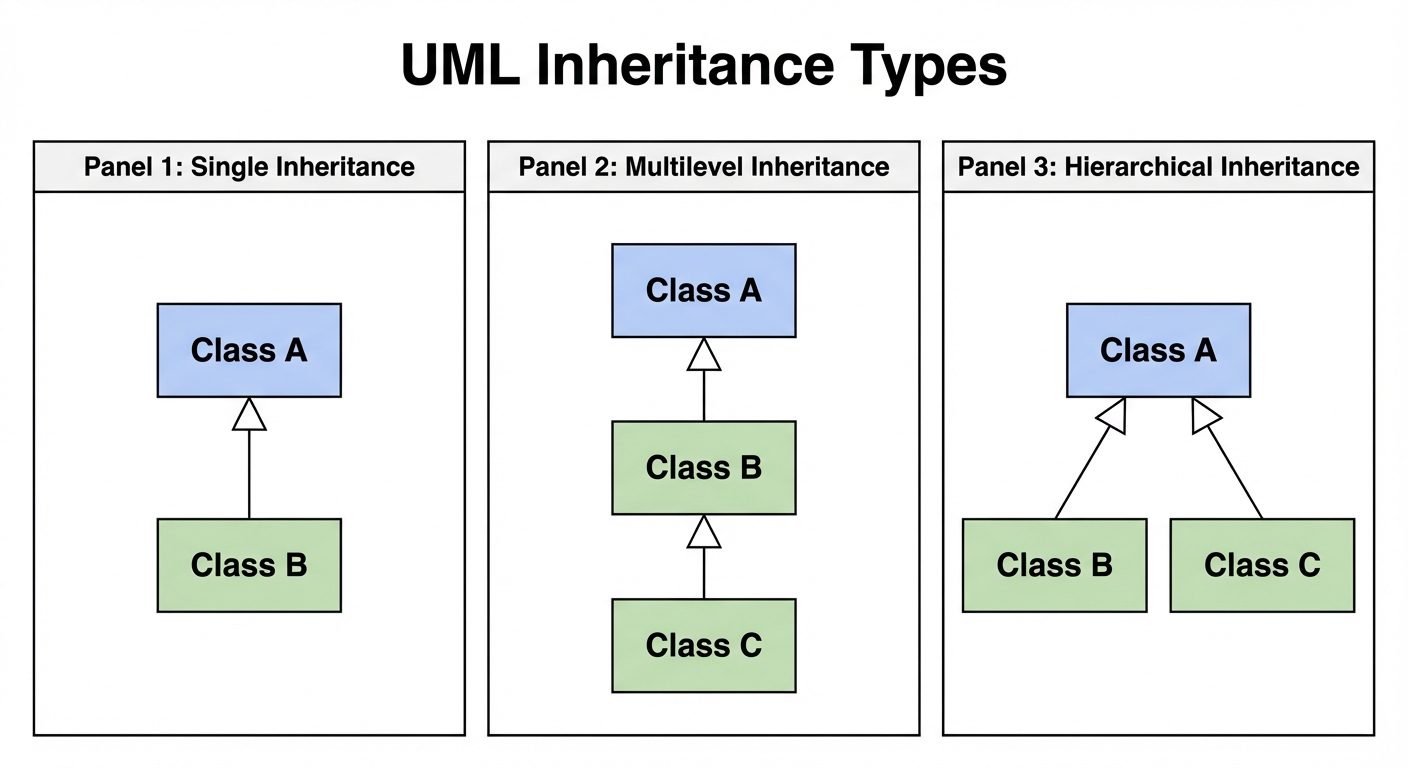
Syntax and Example
class Animal { // Superclass
    void eat() {
        System.out.println("This animal eats food.");
    }
}

class Dog extends Animal { // Subclass
    void bark() {
        System.out.println("The dog barks.");
    }
}

public class Main {
    public static void main(String[] args) {
        Dog myDog = new Dog();
        myDog.eat();  // Inherited method
        myDog.bark(); // Specialized method
    }
}
2. Method Overriding
Method overriding occurs when a subclass provides a specific implementation for a method that is already defined in its superclass. It is used to achieve Runtime Polymorphism.
Rules for Overriding
- The method name must be the same as in the parent class.
- The argument list (parameters) must be identical.
- The return type must be the same or a covariant type (a subclass of the original return type).
- Access modifiers cannot be more restrictive (e.g., if parent is
protected, child cannot beprivate). - Use the
@Overrideannotation to ensure compiler checks.
Overloading vs. Overriding
| Feature | Method Overloading | Method Overriding |
|---|---|---|
| Scope | Within the same class. | Across Parent-Child classes. |
| Signature | Must have different parameters. | Must have identical parameters. |
| Binding | Static (Compile-time). | Dynamic (Run-time). |
3. The super and final Keywords
The super Keyword
The super reference variable is used to refer to the immediate parent class object.
- Accessing Parent Methods:
super.methodName()(Useful when the child overrides the method but still needs the parent's logic). - Accessing Parent Variables:
super.variableName(Useful if the child hides the variable). - Invoking Parent Constructor:
super()must be the first statement in the child constructor.
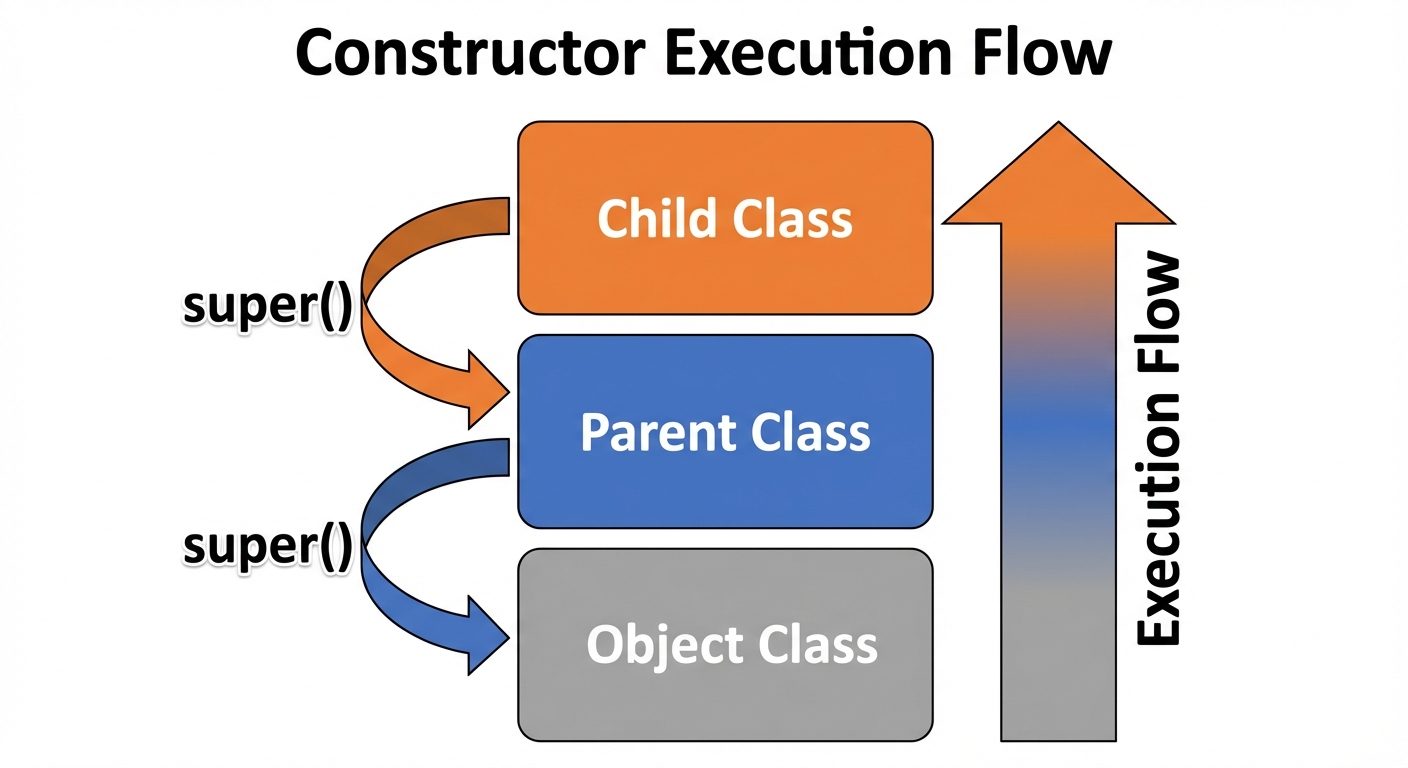
The final Keyword
The final keyword is used to restrict the user.
- Final Variable: Becomes a constant. Value cannot be changed once initialized.
- Final Method: Cannot be overridden by subclasses.
- Final Class: Cannot be inherited (cannot have subclasses).
class Parent {
    final void display() {
        System.out.println("Final method.");
    }
}

class Child extends Parent {
    // void display() { } // COMPILE ERROR: Cannot override final method
}
4. The Object Class
The java.lang.Object class is the root of the class hierarchy. Every class in Java has Object as a superclass.
Overriding toString()
- Default Behavior: Returns a string consisting of the class name, the
@symbol, and the hash code (e.g.,Student@15db9742). - Purpose of Override: To provide a meaningful string representation of the object (e.g., values of its fields).
@Override
public String toString() {
    return "Student [name=" + name + ", age=" + age + "]";
}
Overriding equals()
- Default Behavior: Compares object references (memory addresses), similar to
==. - Purpose of Override: To compare the contents (state) of objects.
Contract for equals():
- Check if
this == obj(Same reference). - Check if
objis null or classes mismatch. - Cast
objto the specific class type. - Compare significant fields.
5. Polymorphism and instanceof
Runtime Polymorphism (Dynamic Method Dispatch)
Polymorphism allows an object to take on many forms. In Java, this is most commonly seen when a Superclass reference holds a Subclass object. The method called is determined by the actual object instance at runtime, not the reference type.
Animal a = new Dog(); // Upcasting
a.makeSound(); // Calls Dog's version of makeSound
The instanceof Operator
Used to test whether an object is an instance of a specified type (class, subclass, or interface). It returns true or false. It is crucial when downcasting to avoid ClassCastException.
if (a instanceof Dog) {
    Dog d = (Dog) a; // Safe Downcasting
    d.bark();
}
6. Abstract Methods and Abstract Classes
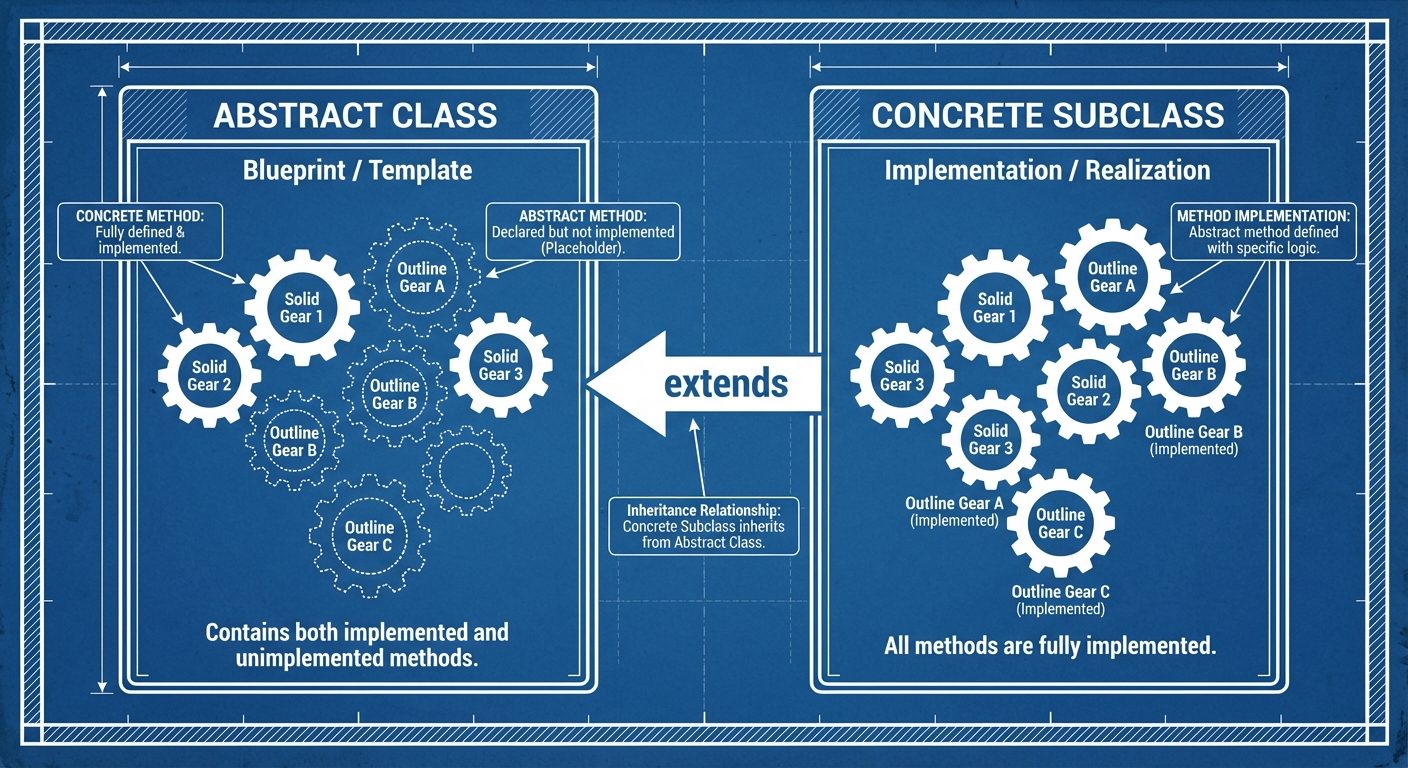
Abstraction is the process of hiding implementation details and showing only functionality to the user.
Abstract Class
- Declared using
abstractkeyword. - Cannot be instantiated (cannot do
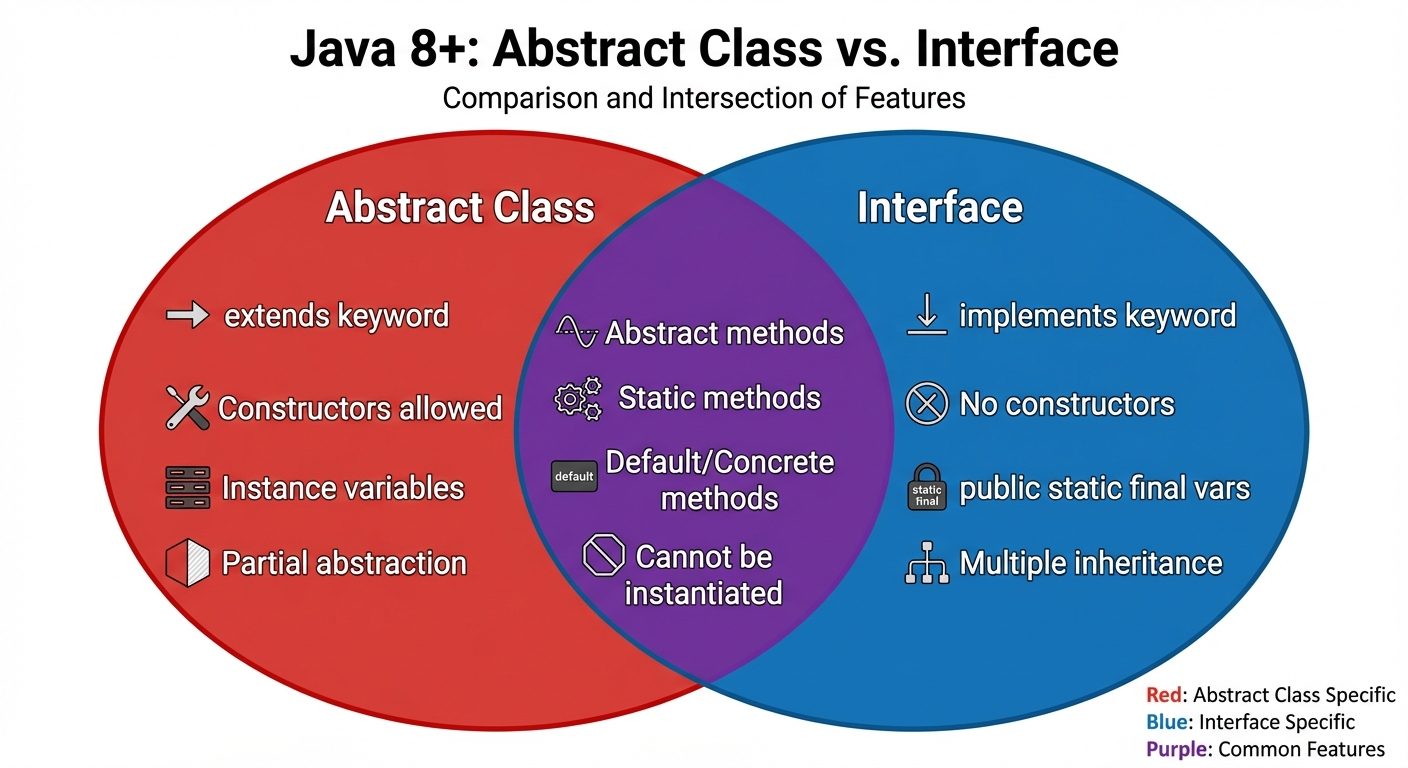
new AbstractClass()). - Can have constructors and static methods.
- Can contain both abstract methods (no body) and concrete methods (with body).
Abstract Method
- Declared without an implementation (no braces
{}). - Must be implemented by the first concrete subclass.
abstract class Shape {
    abstract void draw(); // Abstract method

    void info() { // Concrete method
        System.out.println("This is a shape.");
    }
}

class Circle extends Shape {
    void draw() {
        System.out.println("Drawing Circle");
    }
}
7. Interfaces
An interface is a reference type in Java, similar to a class, that can contain only constants, method signatures, default methods, static methods, and nested types. It is a blueprint of a class.
Key Characteristics
- Declared using the
interfacekeyword. - Variables are implicitly
public static final. - Methods are implicitly
public abstract(prior to Java 8). - A class uses
implementsto inherit an interface. - Multiple Inheritance: A class can implement multiple interfaces (
implements A, B).
Java 8 Enhancements: Static and Default Methods
Prior to Java 8, interfaces could not have method bodies. Java 8 introduced:
- Default Methods: Methods defined with the
defaultkeyword inside an interface.- Purpose: Allows adding new methods to interfaces without breaking existing classes that implement the interface.
- Can be overridden by the implementing class.
    interface Vehicle {
        void clean(); // Abstract

        default void start() { // Default method
            System.out.println("Vehicle starting...");
        }
}- Static Methods: Helper methods associated with the interface, not the object.
- Called using
InterfaceName.methodName().
- Called using
Did this save you a night before the exam?
LPU Notes is free, and it stays free. Ads cover part of the server bill. The rest comes out of a student's own pocket: the domain, the storage, and keeping the site up through the weeks everyone needs it at once.
The payment button didn't load. An ad blocker or a filtered network is the usual reason. to try again.
Nothing here is ever locked, and nothing unlocks. Chip in only if it was worth it. What it pays for →