Unit 2: Lasers and applications
1. Fundamentals of Lasers
LASER stands for Light Amplification by Stimulated Emission of Radiation. It is a device that generates an intense beam of coherent, monochromatic light.
Energy Levels in Atoms
According to quantum mechanics, electrons in an atom can only exist in discrete energy states (levels).
- Ground State (): The lowest energy state where the atom is most stable.
- Excited State (): Higher energy states. Atoms in these states are unstable and tend to return to the ground state.
Radiation-Matter Interaction
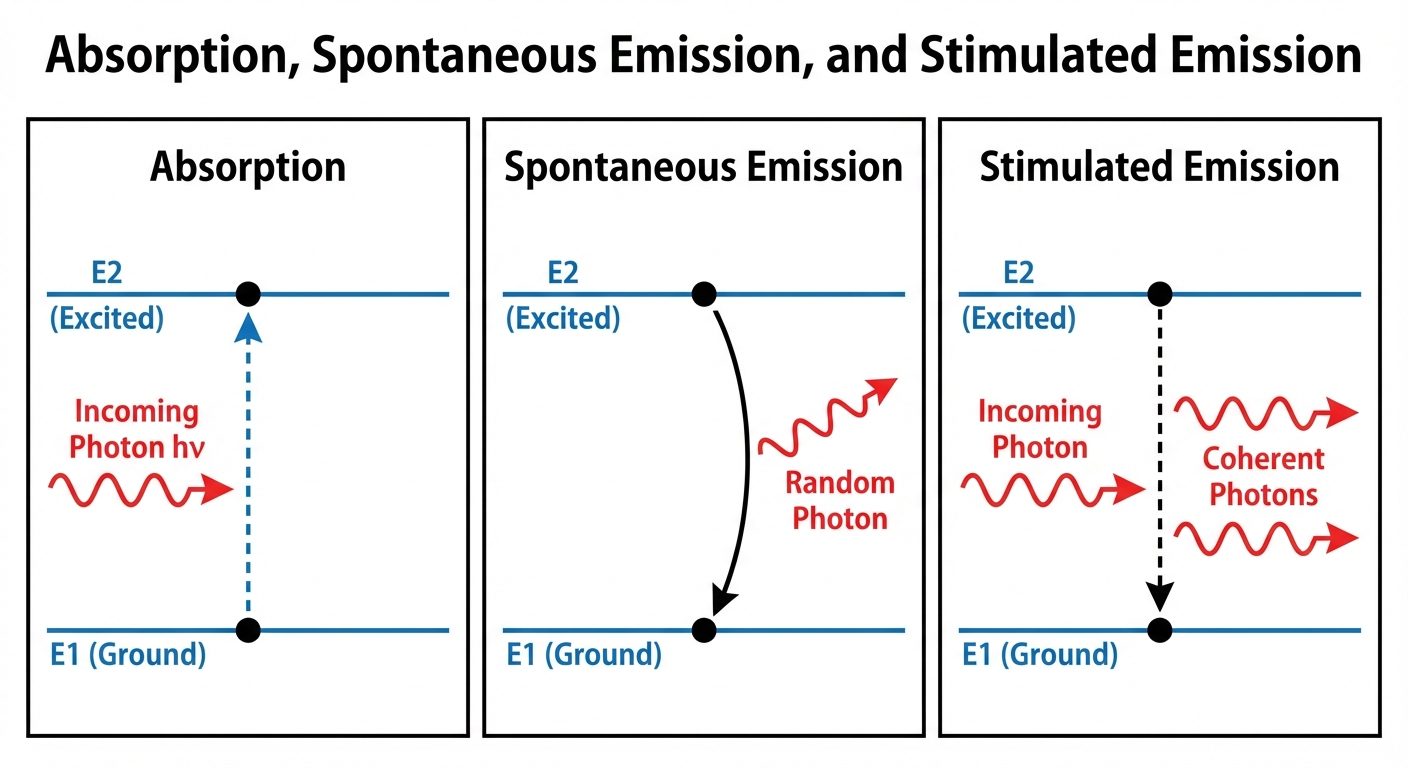
When electromagnetic radiation interacts with matter, three distinct processes occur involving the energy levels (lower) and (higher).
1. Stimulated Absorption
An atom in the ground state () absorbs a photon of energy and moves to the excited state ().
- Rate of Absorption (): Proportional to the number of atoms in the ground state () and the energy density of the field ().
(Where is the Einstein coefficient for stimulated absorption).
2. Spontaneous Emission
An atom in the excited state () decays to the ground state () on its own, without external influence, emitting a photon of energy .
- This is a random process. The emitted photons have random phase and direction (Incoherent light).
- Rate of Spontaneous Emission (): Proportional only to the number of atoms in the excited state ().
(Where is the Einstein coefficient for spontaneous emission).
3. Stimulated Emission
An atom in the excited state () is triggered by an incident photon of energy to drop to the ground state ().
- Result: Two photons are emitted (the incident one and the emitted one).
- Key Feature: The emitted photon has the exact same frequency, phase, and direction as the incident photon (Coherent light). This is the principle behind Laser amplification.
- Rate of Stimulated Emission ():
(Where is the Einstein coefficient for stimulated emission).
2. Einstein Coefficients (A and B)
Einstein derived the relationship between the probabilities of absorption and emission processes.
Consider a system in thermal equilibrium at temperature .
-
Relation 1 (Symmetry of probabilities):
The probability of stimulated absorption equals the probability of stimulated emission.
-
Relation 2 (Ratio of Spontaneous to Stimulated):
The ratio of spontaneous emission coefficient to stimulated emission coefficient is proportional to the cube of the frequency ().
Significance: To achieve laser action (where stimulated emission dominates), we need a high radiation density, but since , it is much harder to make lasers at high frequencies (like X-rays) than at lower frequencies (microwave/visible).
3. Conditions for Lasing Action
For a laser to work, Stimulated Emission must dominate over Absorption and Spontaneous Emission. This requires specific conditions.
Population of Energy Levels (Boltzmann Law)
Under thermal equilibrium, the population of atoms () in energy level is given by Boltzmann's factor:
Usually, . There are more atoms in the ground state than in the excited state. If light passes through this medium, absorption will dominate.
Population Inversion
This is a non-equilibrium state where the number of atoms in the higher energy state exceeds the number in the lower energy state ().
- Necessity: Required so that incoming photons are more likely to cause stimulated emission (amplification) than be absorbed.
Metastable State
An excited energy state where atoms stay for a longer time ( s) compared to ordinary excited states ( s).
- It acts as a "holding station" to accumulate atoms, facilitating population inversion.
Excitation Mechanisms (Pumping)
The process of supplying energy to the medium to transfer atoms from the lower level to the higher level to achieve population inversion. Common methods:
- Optical Pumping: Using a light source (flash lamp) - e.g., Ruby Laser, Nd:YAG.
- Electrical Discharge: passing current through gas - e.g., He-Ne Laser.
- Direct Conversion: Current through a semiconductor - e.g., Laser Diode.
Resonant Cavity (Optical Resonator)
The active medium is placed between two mirrors:
- High Reflectivity Mirror (): 100% reflective.
- Partial Reflectivity Mirror (): Partially transparent (e.g., 90-99% reflective) to allow the beam to exit.
- Function: Photons bounce back and forth, stimulating more emissions with every pass, building up intensity (gain).
4. Types of Lasers
A. Nd-YAG Laser (Neodymium-doped Yttrium Aluminum Garnet)
- Type: Solid-state, 4-level laser.
- Active Medium: YAG crystal doped with Nd ions.
- Pumping Source: Krypton Flash lamp (Optical Pumping).
- Working:
- Nd ions are pumped from ground state to absorption bands ().
- Non-radiative decay from to metastable state .
- Population inversion occurs at .
- Lasing Transition: From to emitting a photon of wavelength 1.064 m (Infrared).
- Rapid decay from to ground state .
- Output: Pulsed or Continuous Wave (CW).
B. He-Ne Laser (Helium-Neon)
- Type: Gas laser, 4-level system.
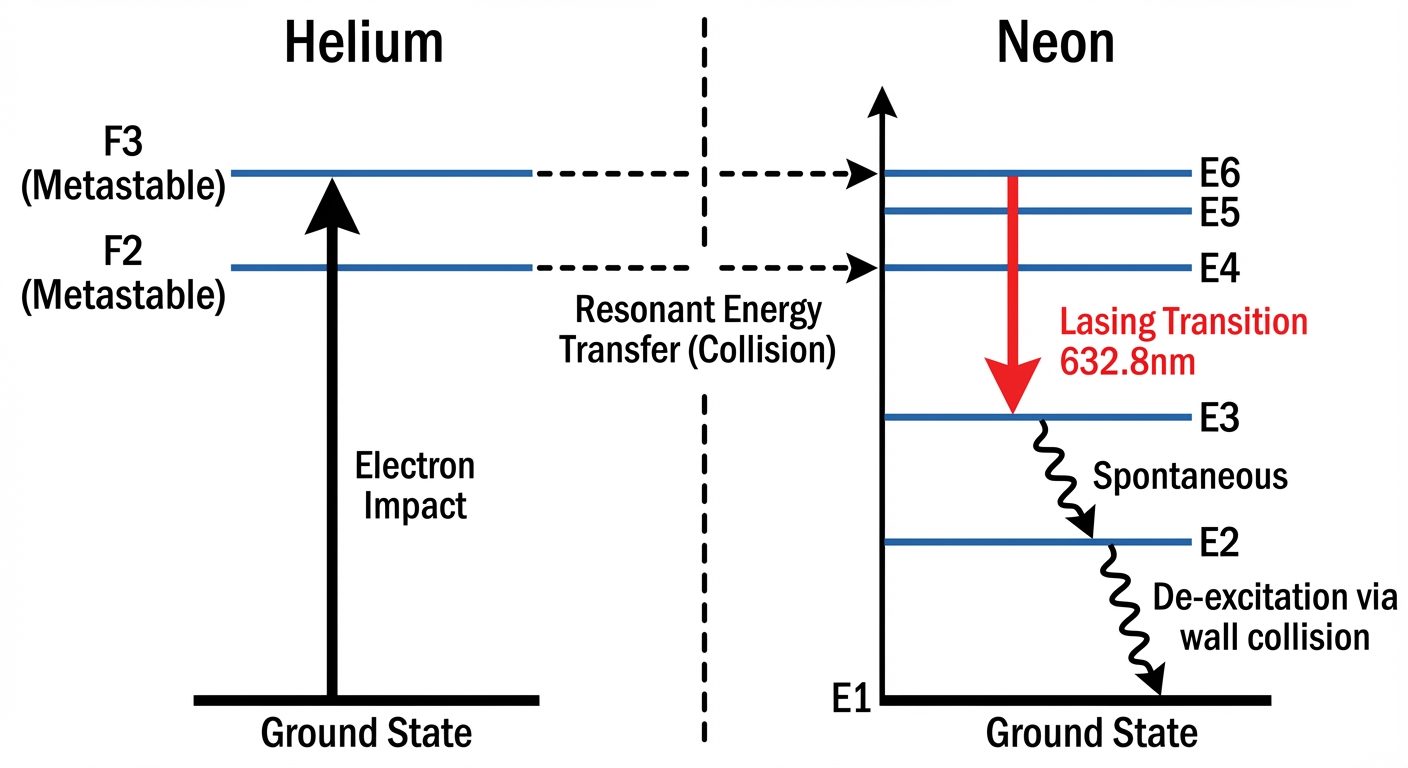
- Active Medium: Mixture of Helium and Neon gases (10:1 ratio). Neon is the active lasing element; Helium helps pump the Neon.
- Pumping Source: Electrical discharge.
- Working:
- Electrons from discharge collide with He atoms, exciting them to metastable states and .
- Resonant Energy Transfer: Excited He atoms collide with Ne atoms. Since He levels match Ne levels ( and ), energy is transferred to Ne.
- Population inversion is achieved in Ne levels and .
- Lasing Action: Transitions from (632.8 nm - Red light). Other transitions produce IR.
- Atoms in decay spontaneously to metastable (via wall collisions) and then to ground.
- Wavelength: 632.8 nm (Visible Red).
C. Semiconductor Laser (Diode Laser)
- Type: Solid-state semiconductor.
- Active Medium: P-N junction (e.g., Gallium Arsenide - GaAs).
- Pumping: Forward bias voltage (Direct pumping).
- Working:
- Heavily doped P and N regions are joined.
- When forward biased, electrons from N-side and holes from P-side are injected into the junction (depletion region/active region).
- High concentration of charge carriers creates population inversion.
- Electrons recombine with holes, releasing energy as photons (Bandgap energy ).
- Polished ends of the crystal act as the optical cavity.
- Applications: Laser pointers, CD/DVD players, Fiber optic communication.
5. Properties of Laser Light
- Monochromaticity: The light consists of a single specific wavelength (color). The spectral line width is extremely narrow.
- Coherence:
- Temporal Coherence: Constant phase relationship over time.
- Spatial Coherence: Constant phase relationship over different points in space.
- Directionality: The beam has very low divergence; it travels long distances without spreading significantly.
- High Intensity: Immense energy is concentrated in a very small spatial region.
6. Applications of Lasers: Holography
Holography (derived from Greek Holos meaning "whole" and Graphein meaning "writing") is a lens-less photography technique used to record and reconstruct a 3D image of an object.
Principle
It is based on the principle of Interference. Unlike photography, which records only amplitude (intensity) of light, holography records both the amplitude and phase of the light reflected from the object.
Process
1. Recording the Hologram (Construction)
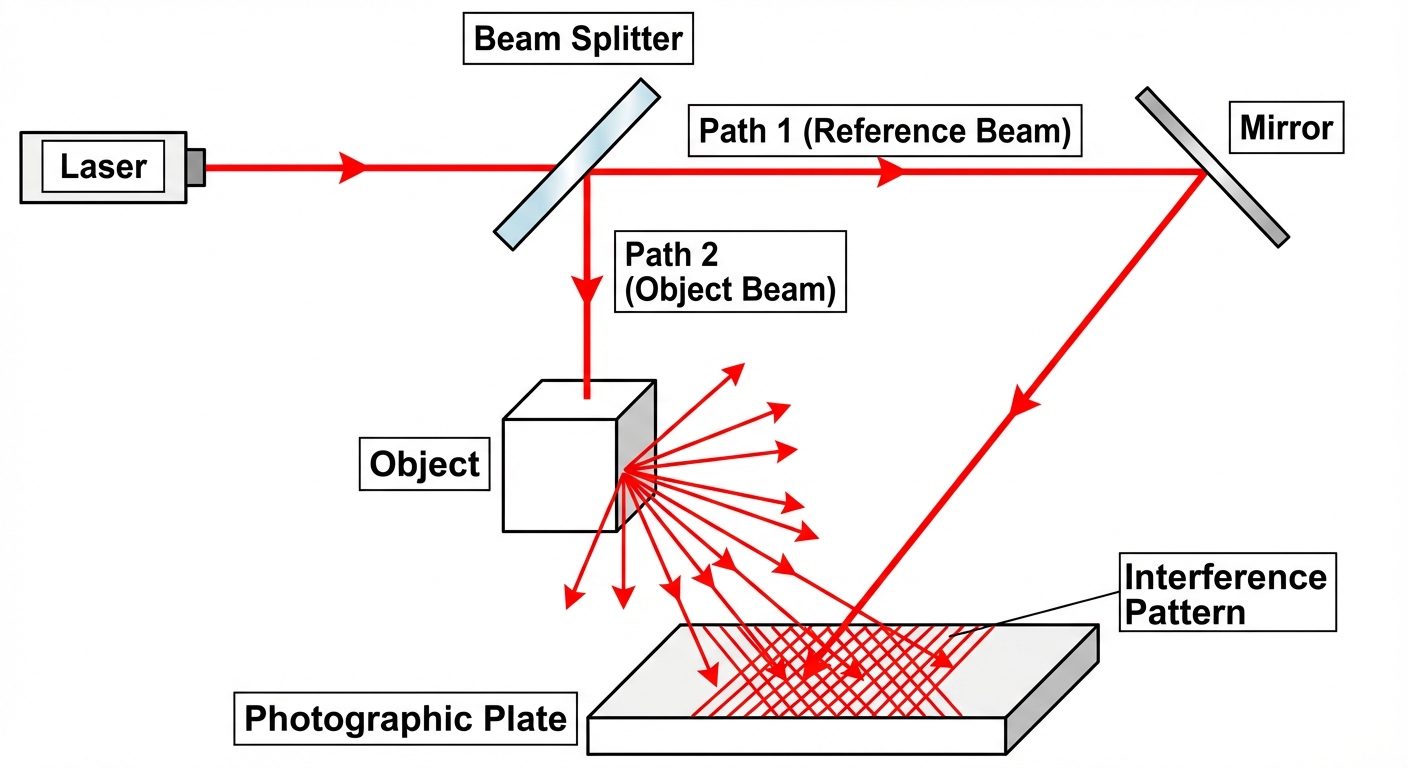
- A monochromatic laser beam is split into two parts by a beam splitter:
- Reference Beam: Travels directly to the photographic plate (film) via a mirror.
- Object Beam: Illuminates the object. The light scatters/reflects off the object and hits the photographic plate.
- These two beams interfere on the plate. The interference pattern (constructive and destructive zones) is recorded on the film.
- The developed film is called a Hologram. It looks like a random gray smudge to the naked eye.
2. Reconstruction of the Image
- To view the image, the hologram is illuminated by the Reference Beam (laser light of the same wavelength) at the same angle used during recording.
- The hologram acts as a diffraction grating.
- Result: The diffracted waves recreate the original wavefronts from the object. The observer sees a virtual, 3D image of the object behind the hologram plate.
Applications of Holography
- Data Storage: Holographic memory can store vast amounts of data in 3D volume.
- Security: Holograms on credit cards and currency notes to prevent counterfeiting.
- Medical: Interferometry for analyzing stress on bones or prosthetics.
- Art & Microscopy: High-resolution 3D imaging.
Did this save you a night before the exam?
LPU Notes is free, and it stays free. Ads cover part of the server bill. The rest comes out of a student's own pocket: the domain, the storage, and keeping the site up through the weeks everyone needs it at once.
The payment button didn't load. An ad blocker or a filtered network is the usual reason. to try again.
Nothing here is ever locked, and nothing unlocks. Chip in only if it was worth it. What it pays for →