Unit 6: Professional Vocabulary
1. Introduction
Professional vocabulary refers to the specific set of words, phrases, and terminologies used within a business or technical environment. Mastery of this vocabulary distinguishes a layperson from a professional. It ensures precision in communication, brevity in correspondence, and establishes credibility in a corporate setting. This unit focuses on three distinct pillars: One Word Substitution (brevity), Technical Jargons (specialization), and Business Idioms (cultural fluency).
2. One Word Substitution
One word substitution is the process of replacing a wordy phrase with a single, specific word. In professional communication, this aids in conciseness and avoids redundancy.
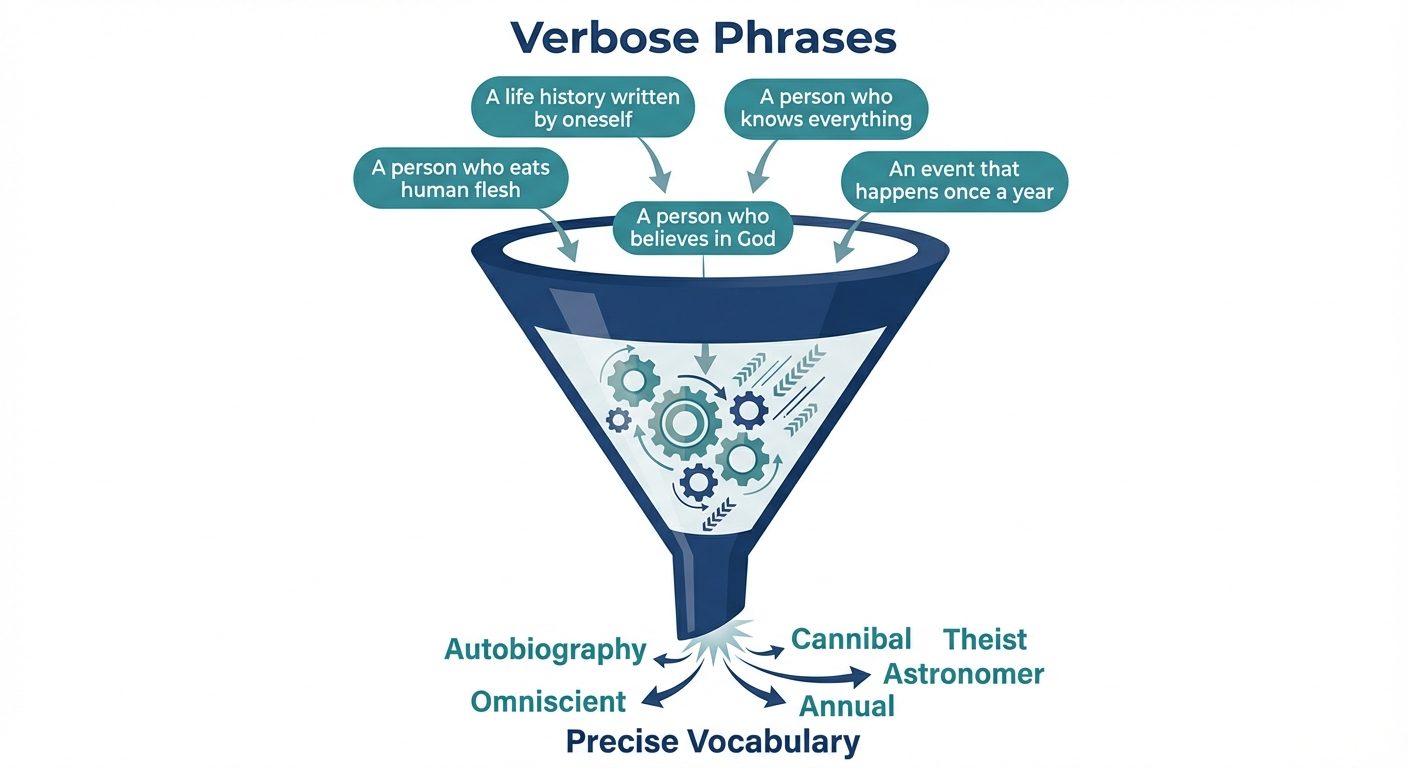
A. Professional & Personality Traits
- Ambidextrous: One who can use either hand with ease.
- Arbitrator: A person appointed by two parties to solve a dispute.
- Polyglot: A person who knows and speaks many languages.
- Versatile: Someone who possesses many talents.
- Introvert/Extrovert: A person who is reserved/outgoing in nature.
- Meticulous: Showing great attention to detail; very careful and precise.
B. Business & Administrative Terms
- Agenda: A list of items to be discussed at a meeting.
- Bankruptcy: The state of being unable to pay outstanding debts.
- Bureaucracy: A system of government/management in which most of the important decisions are taken by state officials rather than by elected representatives (often implies excessive red tape).
- Colleague: A person with whom one works in a profession or business.
- Hierarchy: A system in which members of an organization are ranked according to relative status or authority.
- Minutes: A written record of what was said at a meeting.
- Unanimous: Held or carried by everyone; full agreement.
C. Research & Academic Terms
- Bibliography: A list of books referred to in a scholarly work.
- Plagiarism: The practice of taking someone else's work or ideas and passing them off as one's own.
- Etymology: The study of the origin of words and the way in which their meanings have changed throughout history.
- Chronological: Arranging events in the order of their occurrence in time.
3. Basic Technical Jargons
Jargon refers to special words or expressions that are used by a particular profession or group and are difficult for others to understand. While excessive jargon can hinder communication with outsiders, it acts as a linguistic shorthand for professionals within the same field, increasing efficiency.
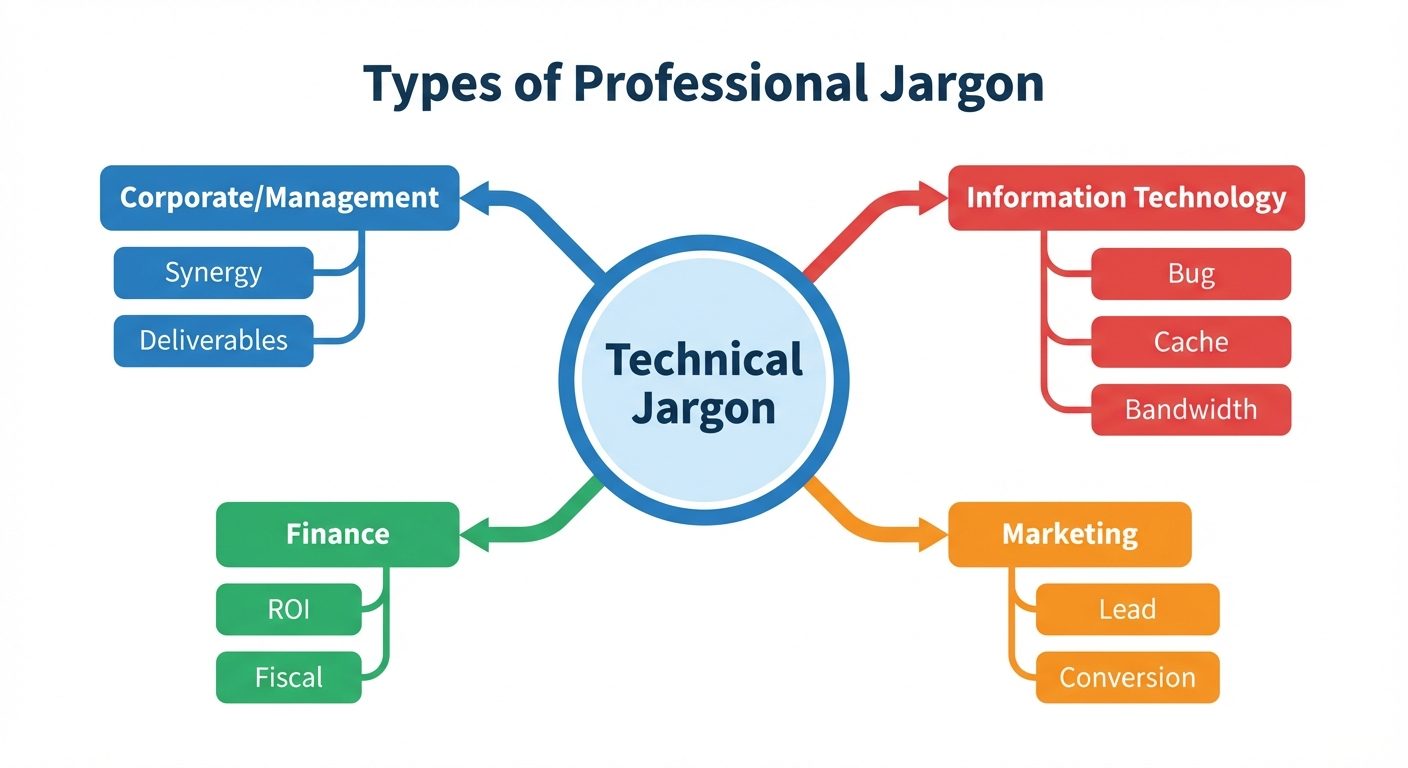
A. Corporate & Management Jargon
- Actionable: Capable of being done or acted upon; practical.
- Usage: "We need actionable insights from this data, not just theory."
- Bandwidth: (Metaphorical) The energy or mental capacity required to deal with a situation.
- Usage: "I don't have the bandwidth to take on another project this week."
- Deliverables: Quantifiable goods or services that must be provided upon the completion of a project.
- Usage: "The key deliverables for Phase 1 are due on Friday."
- Leverage: To use something to maximum advantage.
- Usage: "We need to leverage our social media presence to increase sales."
- Scalability: The capability of a system or company to grow or manage increased demand.
- Usage: "The software lacks scalability; it crashes when we add more than 50 users."
- Synergy: The interaction or cooperation of two or more organizations to produce a combined effect greater than the sum of their separate effects.
- Usage: " The merger created excellent synergy between the two departments."
B. Information Technology (IT) Jargon
- Algorithm: A process or set of rules to be followed in calculations or other problem-solving operations.
- Beta: A version of a product (usually software) sent to testers for feedback before the final release.
- Cache: A hardware or software component that stores data so that future requests for that data can be served faster.
- Cloud Computing: The practice of using a network of remote servers hosted on the internet to store, manage, and process data.
- Phishing: The fraudulent practice of sending emails purporting to be from reputable companies to induce individuals to reveal personal information.
C. Financial Jargon
- Assets: Resources owned by a business which have economic value.
- Equity: The value of the shares issued by a company; ownership interest.
- Fiscal Year: A one-year period used for financial reporting and budgeting (which may not match the calendar year).
- ROI (Return on Investment): A performance measure used to evaluate the efficiency of an investment.
- Formula: (Net Profit / Cost of Investment) x 100.
4. Business Idioms
Idioms are phrases where the meaning cannot be deduced from the literal definitions of the individual words. In business, idioms are frequently used to soften commands, describe complex situations quickly, or build rapport.
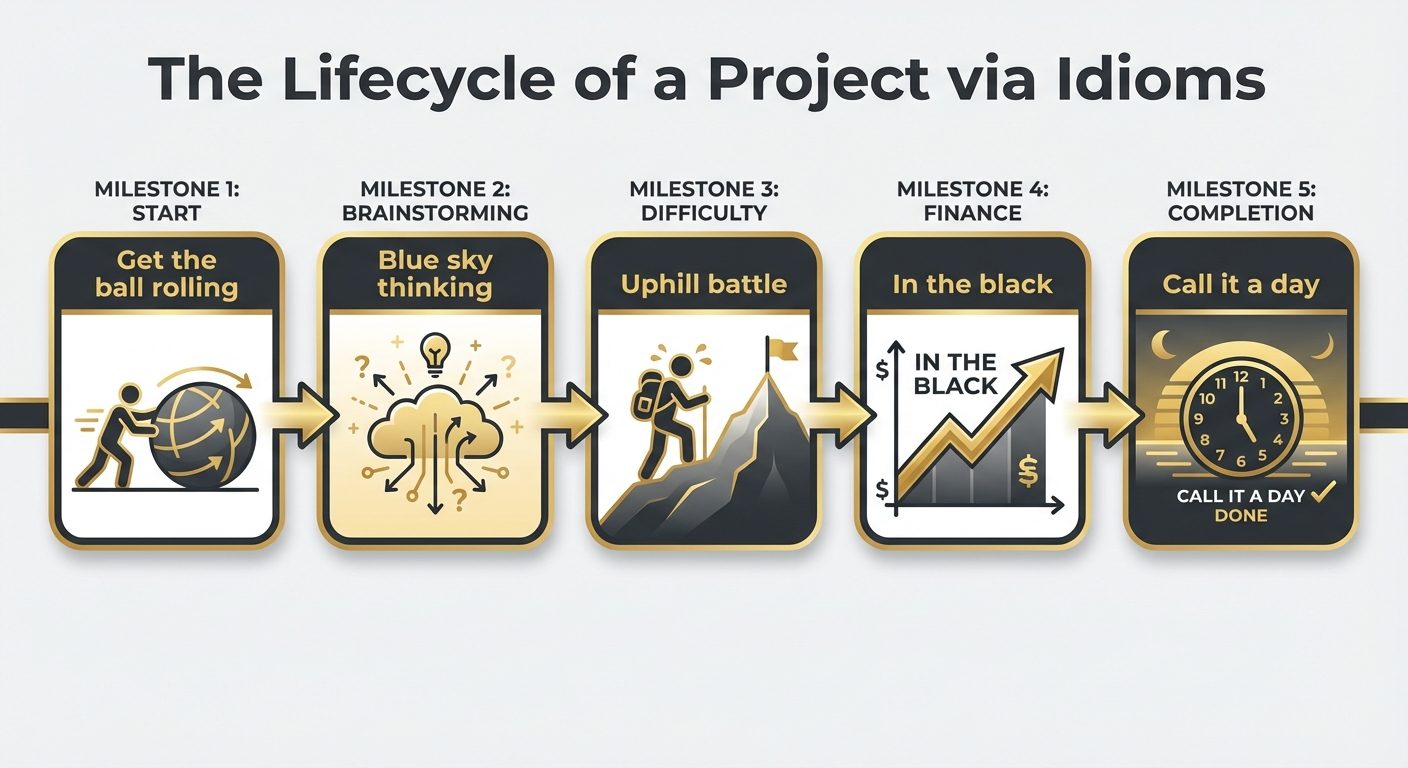
A. Project & Process Idioms
- Back to the drawing board: To start a task all over again because it failed.
- Example: "The client rejected the proposal, so it’s back to the drawing board."
- Get the ball rolling: To start something; to begin a process.
- Example: "Let’s get the ball rolling by introducing everyone."
- In the pipeline: Being planned or developed; underway.
- Example: "We have three new products in the pipeline for next year."
- Cut corners: To do something perfunctorily so as to save time or money (often negatively).
- Example: "We cannot afford to cut corners on safety regulations."
B. Communication & Negotiation Idioms
- Touch base: To make contact with someone briefly.
- Example: "I’ll touch base with you next week regarding the contract."
- On the same page: To have the same understanding or amount of knowledge.
- Example: "Let's have a quick meeting to ensure everyone is on the same page."
- Play hardball: To act strong and aggressive in a situation (usually negotiation).
- Example: "The suppliers are playing hardball regarding the price hike."
- Elephant in the room: An obvious problem or difficult issue that people are ignoring.
- Example: "The budget cut is the elephant in the room that no one wants to discuss."
C. Financial & Outcome Idioms
- In the red: Losing money; negative balance.
- Origin: Accountants traditionally used red ink for negative entries.
- In the black: Making a profit; positive balance.
- Ballpark figure: A rough numerical estimate.
- Example: "I don't need the exact cost yet, just give me a ballpark figure."
- Cash cow: A business, product, or service that generates a steady stream of income/profit.
- Example: "The subscription service has become the company's cash cow."
5. Summary Table
| Category | Definition | Key Example | Purpose in Communication |
|---|---|---|---|
| One Word Substitution | Replacing a phrase with a single word. | Agenda (List of items to discuss) | Brevity and precision. |
| Technical Jargon | Specialized industry terminology. | Scalability (Capacity to grow) | Efficiency among experts. |
| Business Idioms | Metaphorical expressions. | Touch base (Contact briefly) | Cultural fluency and rapport. |
Did this save you a night before the exam?
LPU Notes is free, and it stays free. Ads cover part of the server bill. The rest comes out of a student's own pocket: the domain, the storage, and keeping the site up through the weeks everyone needs it at once.
The payment button didn't load. An ad blocker or a filtered network is the usual reason. to try again.
Nothing here is ever locked, and nothing unlocks. Chip in only if it was worth it. What it pays for →