Unit 5: Reduced Clauses, Connectors and Focus Structures
1. Reduced Clauses
Reduced clauses are concise ways to express information by shortening full dependent clauses into phrases. This process involves omitting relative pronouns, auxiliary verbs, or conjunctions while changing the main verb form. Mastering reduced clauses creates more sophisticated, fluid, and academic writing.
1.1 Reduced Relative Clauses
Relative clauses (adjective clauses) modify nouns. Reduction turns them into participial phrases.
The Rules of Reduction
- Omit the Relative Pronoun: Delete who, which, or that.
- Omit the Verb "Be": Delete is, are, was, were if present.
- Modify the Main Verb:
- Active Voice: Change the verb to the Present Participle (-ing form).
- Passive Voice: Keep the Past Participle (-ed/V3 form).
Examples:
- Active Voice:
- Full: The girl who is sitting next to me is my cousin.
- Reduced: The girl sitting next to me is my cousin.
- Full: Anyone who wants to join must sign up today.
- Reduced: Anyone wanting to join must sign up today.
- Passive Voice:
- Full: The book which was written by Orwell is a classic.
- Reduced: The book written by Orwell is a classic.
- Full: The products that are sold here are organic.
- Reduced: The products sold here are organic.
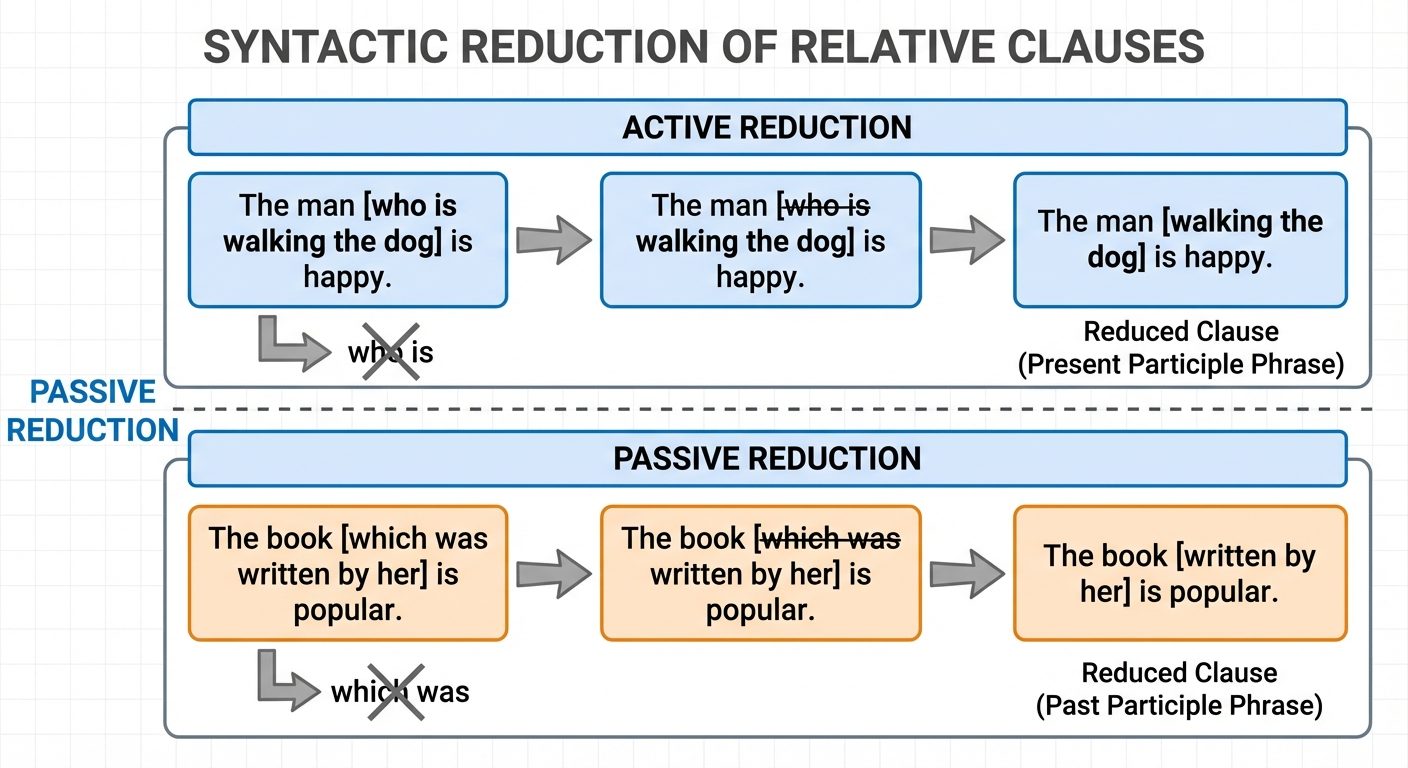 AI-generated image — may contain inaccuracies running -> The man running" with the deleted words crossed out in red and an arrow pointing to the reduced form. The Passive lane shows "The email [which was] sent -> The email sent". Use a whiteboard aesthetic with blue text for kept words, red strike-throughs for omitted words, and green boxes highlighting the resulting Participle phrases (-ing and -ed). Detailed annotations explaining the rule "Remove Pronoun + Be" should accompany the arrows.]
1.2 Reduced Adverbial Clauses
Adverbial clauses modify verbs, telling us when, why, or how. Reduction is only possible when the subject of the dependent clause is the same as the subject of the independent clause.
Types of Adverbial Reduction
-
Time Clauses (After, Before, While, Since):
- Full: After he finished his work, he went home.
- Reduced: After finishing his work, he went home.
- Full: While I was walking down the street, I saw a friend.
- Reduced: While walking down the street, I saw a friend.
-
Reason Clauses (Because/Since/As):
- Note: The conjunction is usually omitted entirely in reason clauses.
- Full: Because she didn't know the answer, she guessed.
- Reduced: Not knowing the answer, she guessed.
- Full: As I felt tired, I went to bed early.
- Reduced: Feeling tired, I went to bed early.
-
Perfect Participles (emphasizing completion):
- Use Having + V3 to show one action finished before another.
- Full: Because he had failed the test twice, he hired a tutor.
- Reduced: Having failed the test twice, he hired a tutor.
2. Connectors: Types, Prepositions, and Conjunctions
Connectors (or cohesive devices) link ideas, sentences, and paragraphs. Understanding the grammatical difference between connectors, conjunctions, and prepositions is vital for sentence structure accuracy.
2.1 Grammatical Distinction
| Category | Grammatical Rule | Examples | Structure Example |
|---|---|---|---|
| Coordinating Conjunctions | Connects two independent clauses (FANBOYS). | and, but, so, or, nor, for, yet | Clause 1, so Clause 2. |
| Subordinating Conjunctions | Connects a dependent clause to a main clause. | although, because, if, while | Although [Subject + Verb], [Subject + Verb]. |
| Transitions (Connectors) | Connects two separate sentences or independent clauses separated by a semicolon. | However, Therefore, Moreover, Consequently | Sentence 1. However, Sentence 2. |
| Prepositions | Followed by a Noun Phrase or Gerund (never a full clause). | despite, due to, because of, during | Due to [Noun Phrase], [Subject + Verb]. |
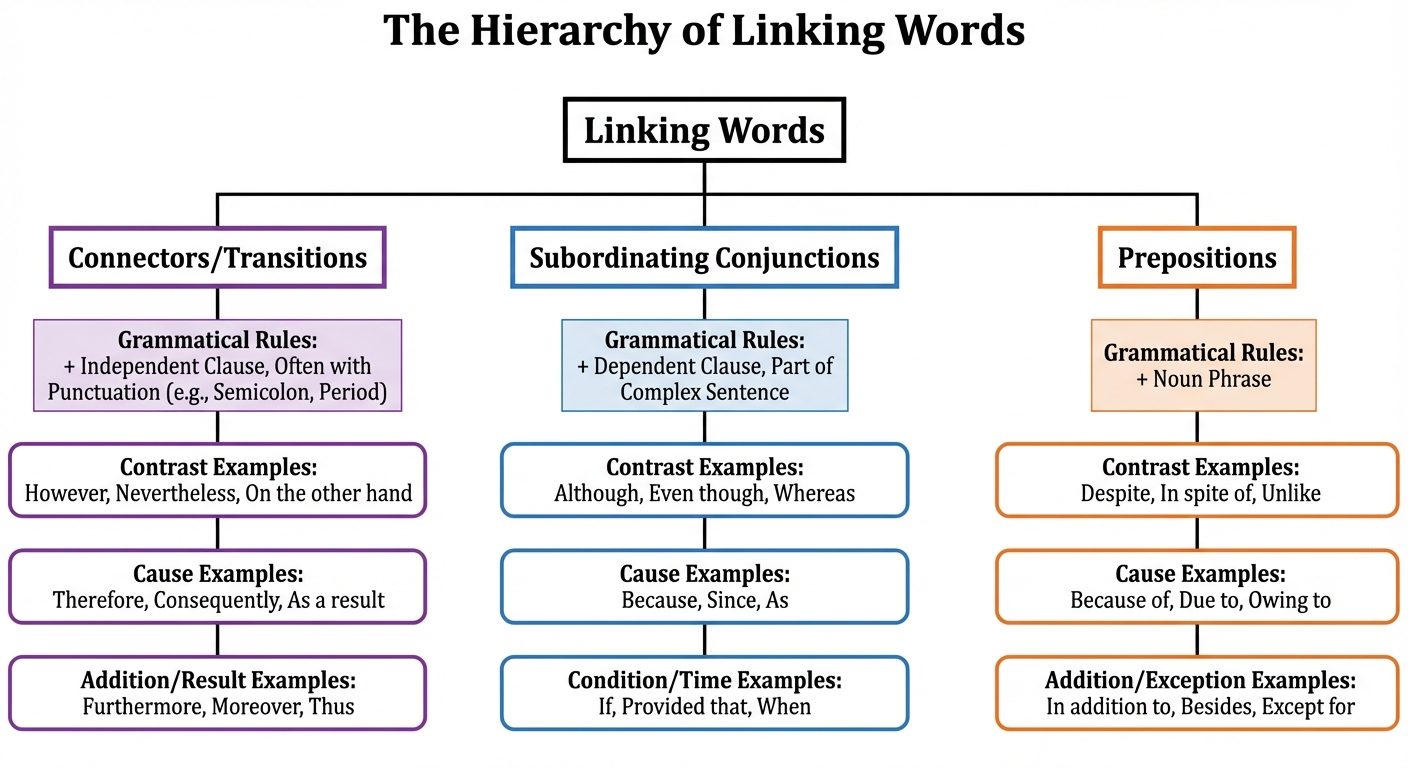
2.2 Functional Categories of Connectors
A. Adding (Addition)
Used to add information or reinforce a point.
- Connectors: Moreover, Furthermore, In addition, Additionally, Besides.
- Example: The study is comprehensive. Moreover, it is highly relevant.
- Conjunctions: And, not only... but also.
- Prepositions: In addition to, Besides.
- Example: In addition to playing tennis, he swims.
B. Contrasting (Opposition)
Used to show difference or unexpected results.
- Connectors: However, Nevertheless, Conversely, On the other hand, In contrast.
- Example: It was raining hard. However, we played the match.
- Conjunctions: Although, Even though, While, Whereas, But, Yet.
- Example: While I like coffee, my sister prefers tea.
- Prepositions: Despite, In spite of, Unlike.
- Example: Despite the rain, we played. (NOT: Despite it was raining).
C. Result and Cause
Used to explain reasons and consequences.
- Connectors (Result): Therefore, Consequently, As a result, Thus, Hence.
- Example: He forgot his keys; consequently, he was locked out.
- Conjunctions (Cause): Because, Since, As.
- Example: Since it is late, we should leave.
- Prepositions (Cause): Due to, Because of, Owing to, On account of.
- Example: The flight was cancelled due to bad weather.
D. Time and Sequence (Listing)
Used to order events or structure an argument.
- Listing: Firstly, Secondly, Finally, Subsequently, Next, Then.
- Simultaneity: Meanwhile, At the same time.
- Prepositions: During, Before, After.
3. Focus Structures
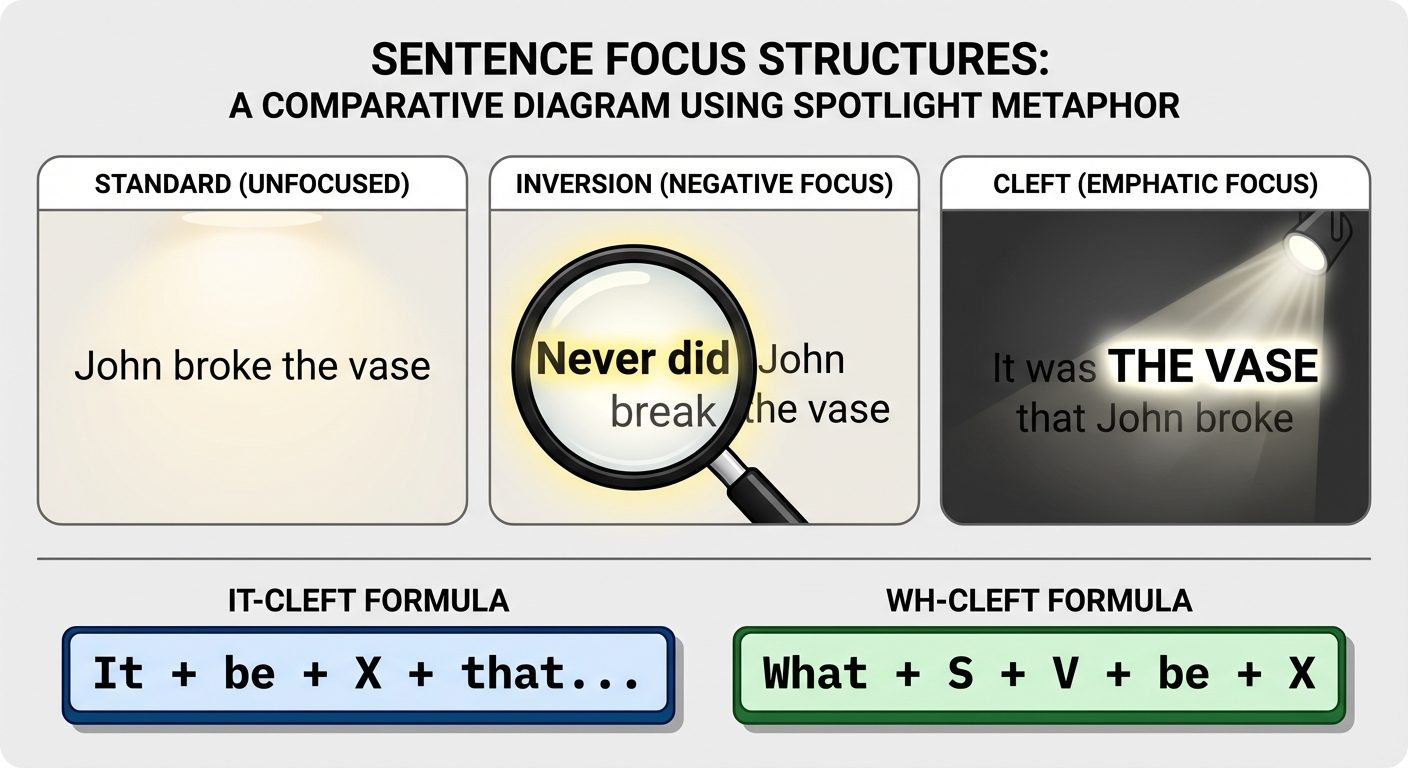
Focus structures involve manipulating standard word order (Subject-Verb-Object) to bring attention to specific parts of a sentence.
3.1 Fronting
Fronting moves elements (usually objects or adverbials) to the beginning of the sentence to link back to previous text or provide emphasis.
- Adverbial Fronting:
- Standard: A large cat sat in the middle of the bed.
- Fronted: In the middle of the bed sat a large cat.
- Object Fronting:
- Standard: I can’t believe that.
- Fronted: That I can’t believe.
3.2 Inversion
Inversion swaps the subject and the auxiliary verb. This is mandatory after certain negative or restrictive adverbials placed at the start of a sentence.
Formula: Negative Adverb + Auxiliary Verb + Subject + Main Verb
Common Negative Adverbials:
- Never / Rarely / Seldom
- Hardly... when / Scarcely... when / No sooner... than
- Under no circumstances / At no time
- Not only... but also
Examples:
- Standard: I have never seen such a mess.
- Inverted: Never have I seen such a mess.
- Standard: You should not open this door under any circumstances.
- Inverted: Under no circumstances should you open this door.
- Standard: He not only arrived late, but he also forgot his gift.
- Inverted: Not only did he arrive late, but he also forgot his gift.
3.3 Cleft Sentences
"Cleft" means "split." These sentences split a single clause into two parts to spotlight specific information.
A. It-Clefts
Formula: It + be + [FOCUSED ELEMENT] + that/who clause.
- Original: John stole the cake yesterday.
- Focus on Subject: It was John who stole the cake yesterday.
- Focus on Object: It was the cake that John stole yesterday.
- Focus on Time: It was yesterday that John stole the cake.
B. Wh-Clefts (Pseudo-clefts)
These usually use a "What" clause to focus on the action or the object.
Formula: Wh-clause + be + [FOCUSED ELEMENT].
- Original: I need a holiday.
- Wh-Cleft: What I need is a holiday.
- Original: She wants to scream.
- Wh-Cleft: What she wants to do is scream.
Did this save you a night before the exam?
LPU Notes is free, and it stays free. Ads cover part of the server bill. The rest comes out of a student's own pocket: the domain, the storage, and keeping the site up through the weeks everyone needs it at once.
The payment button didn't load. An ad blocker or a filtered network is the usual reason. to try again.
Nothing here is ever locked, and nothing unlocks. Chip in only if it was worth it. What it pays for →