Unit 4: Infinitives, Gerunds and Quantifiers
1. Simple Infinitives and Gerunds
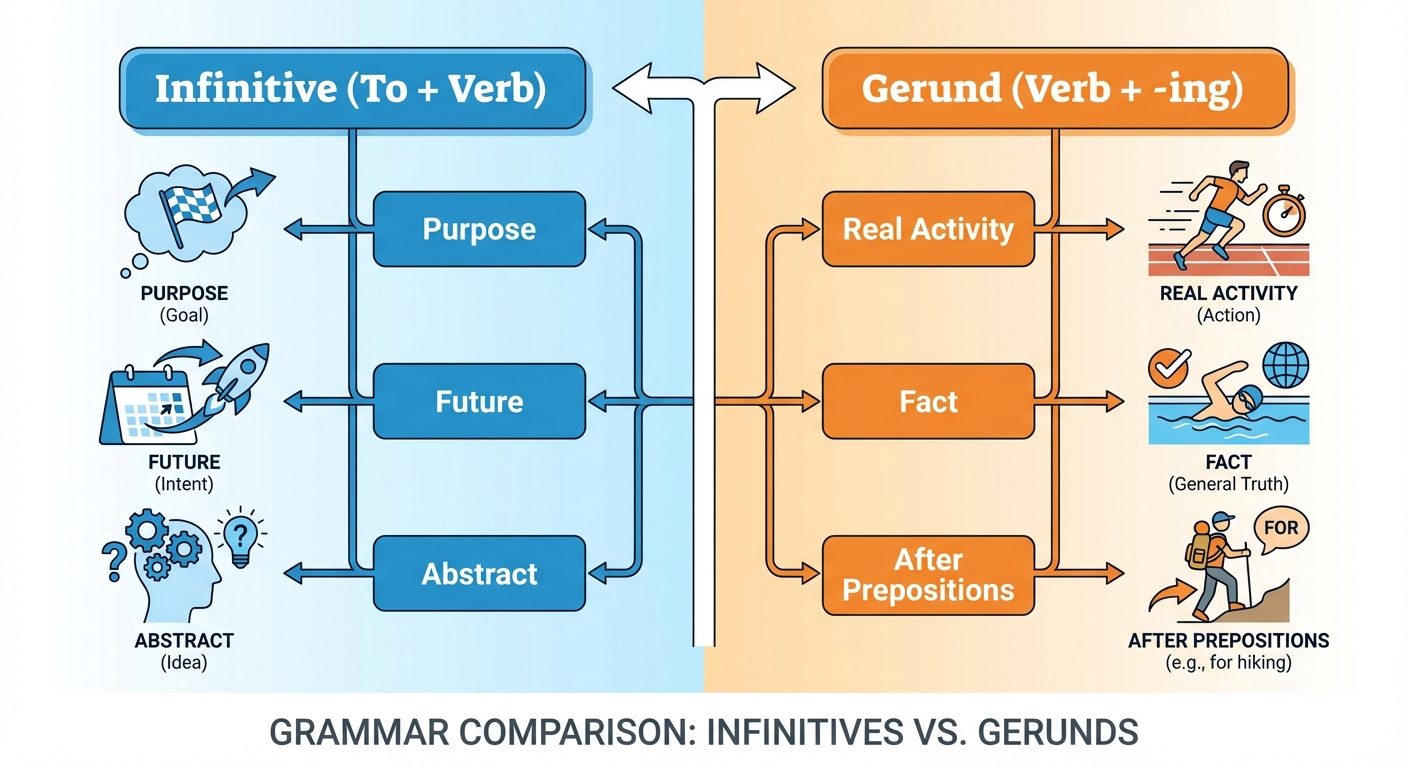
Infinitives and gerunds are verbals—words formed from verbs that function as other parts of speech (nouns, adjectives, or adverbs). Understanding the distinction is crucial for advanced communication accuracy.
1.1 The Simple Infinitive
Form: to + base form of verb (e.g., to study, to break)
Key Functions:
- Subject of a sentence: To err is human. (Formal/Poetic)
- Object of a verb: She agreed to help.
- Adjective (modifying a noun): I have a promise to keep.
- Adverb (indicating purpose): He left early to catch the train.
1.2 The Simple Gerund
Form: base form of verb + -ing (e.g., studying, breaking)
Function: Always acts as a Noun.
Key Functions:
- Subject of a sentence: Smoking is prohibited here.
- Object of a verb: I enjoy swimming.
- Object of a preposition: He is fond of reading.
- Subject Complement: My favorite hobby is gardening.
2. Complex Infinitives and Gerunds
Advanced communication requires expressing timing and voice within verbals. These are known as complex forms.
2.1 Complex Infinitives
| Form | Structure | Usage | Example |
|---|---|---|---|
| Passive Infinitive | to be + past participle |
Action received by the subject | The work needs to be done by noon. |
| Perfect Infinitive | to have + past participle |
Action happened before the main verb | I seem to have lost my keys. |
| Continuous Infinitive | to be + -ing |
Action is happening right now | You seem to be crying. |
| Perfect Continuous | to have been + -ing |
Action started in past and continues | He appears to have been waiting for hours. |
2.2 Complex Gerunds
| Form | Structure | Usage | Example |
|---|---|---|---|
| Passive Gerund | being + past participle |
Action received by the subject | I appreciate being told the truth. |
| Perfect Gerund | having + past participle |
Action completed before main verb | He denied having stolen the money. |
| Perfect Passive | having been + past participle |
Completed passive action | She complained of having been fired unfairly. |
3. Interaction with Nouns, Pronouns, Verbs, and Adjectives
The most challenging aspect of this unit is memorizing which words trigger an infinitive versus a gerund.
3.1 Verbs + Infinitives vs. Gerunds
Group A: Verbs followed ONLY by Infinitives
- List: Agree, decide, hope, learn, plan, promise, refuse, want, would like.
- Example: We decided to leave. (NOT: decided leaving)
Group B: Verbs followed ONLY by Gerunds
- List: Admit, avoid, consider, deny, enjoy, finish, keep (continue), mind, miss, practice, suggest.
- Example: He finished eating. (NOT: finished to eat)
Group C: Verbs followed by Object + Infinitive
- List: Advise, allow, convince, encourage, force, invite, remind, tell.
- Example: She encouraged him to apply for the job.
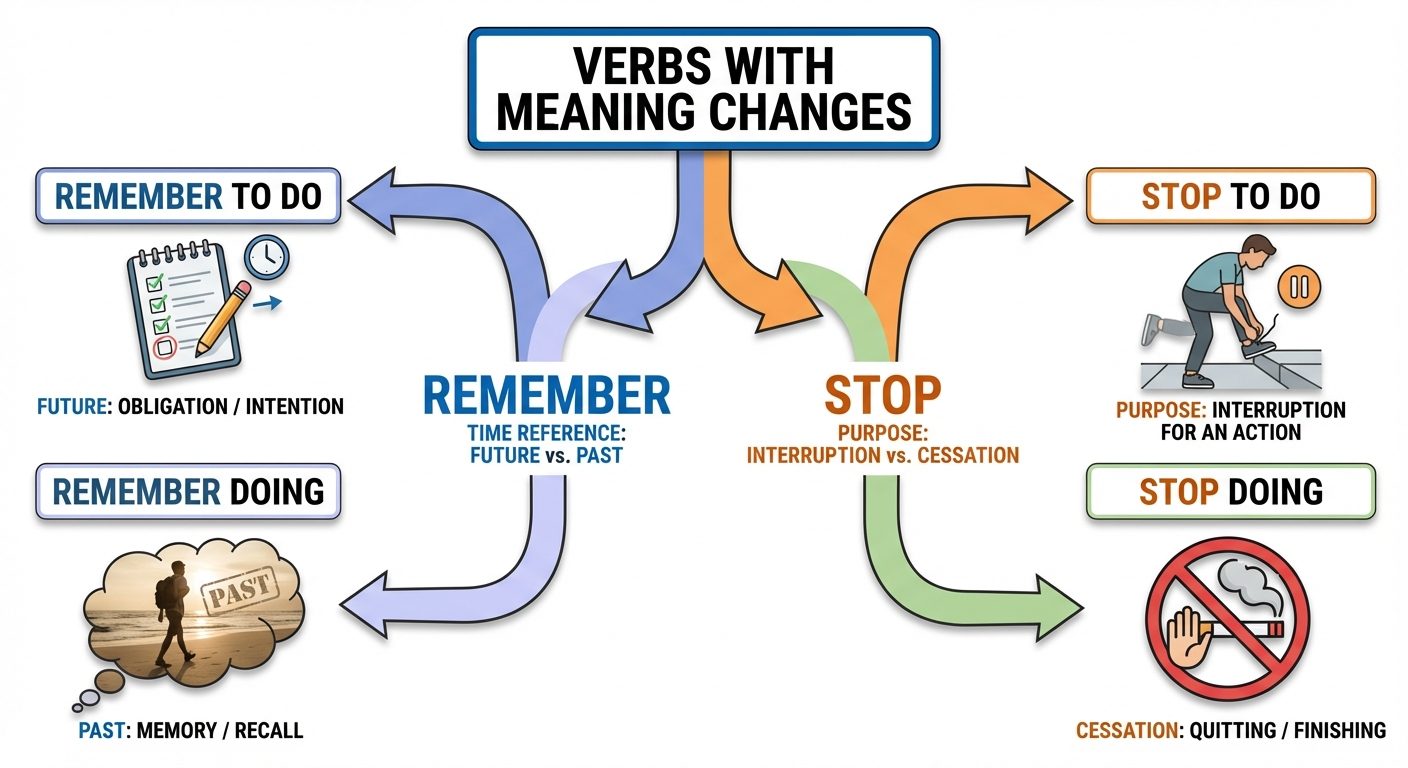
3.2 Verbs with Change in Meaning
Some verbs take both but the meaning changes drastically. This is a critical distinction in advanced English.
- Stop
- Stop to do: Pause one action to do another (purpose). -> He stopped to smoke. (He ceased walking in order to smoke).
- Stop doing: Quit an action entirely. -> He stopped smoking. (He is no longer a smoker).
- Remember
- Remember to do: Don't forget a task (future). -> Remember to lock the door.
- Remember doing: Recall a memory (past). -> I remember locking the door.
- Try
- Try to do: Attempt with effort (might fail). -> I tried to lift the box.
- Try doing: Experiment with a method. -> Try adding salt to the soup.
3.3 Adjectives and Nouns with Infinitives
- Adjectives: Generally followed by infinitives.
- Pattern: It is + adj + infinitive.
- Example: It is hard to say goodbye. / She is anxious to start.
- Nouns: Abstract nouns often take infinitives.
- Example: Her ability to sing is amazing. / The decision to quit was tough.
4. Quantifiers: Countable and Uncountable
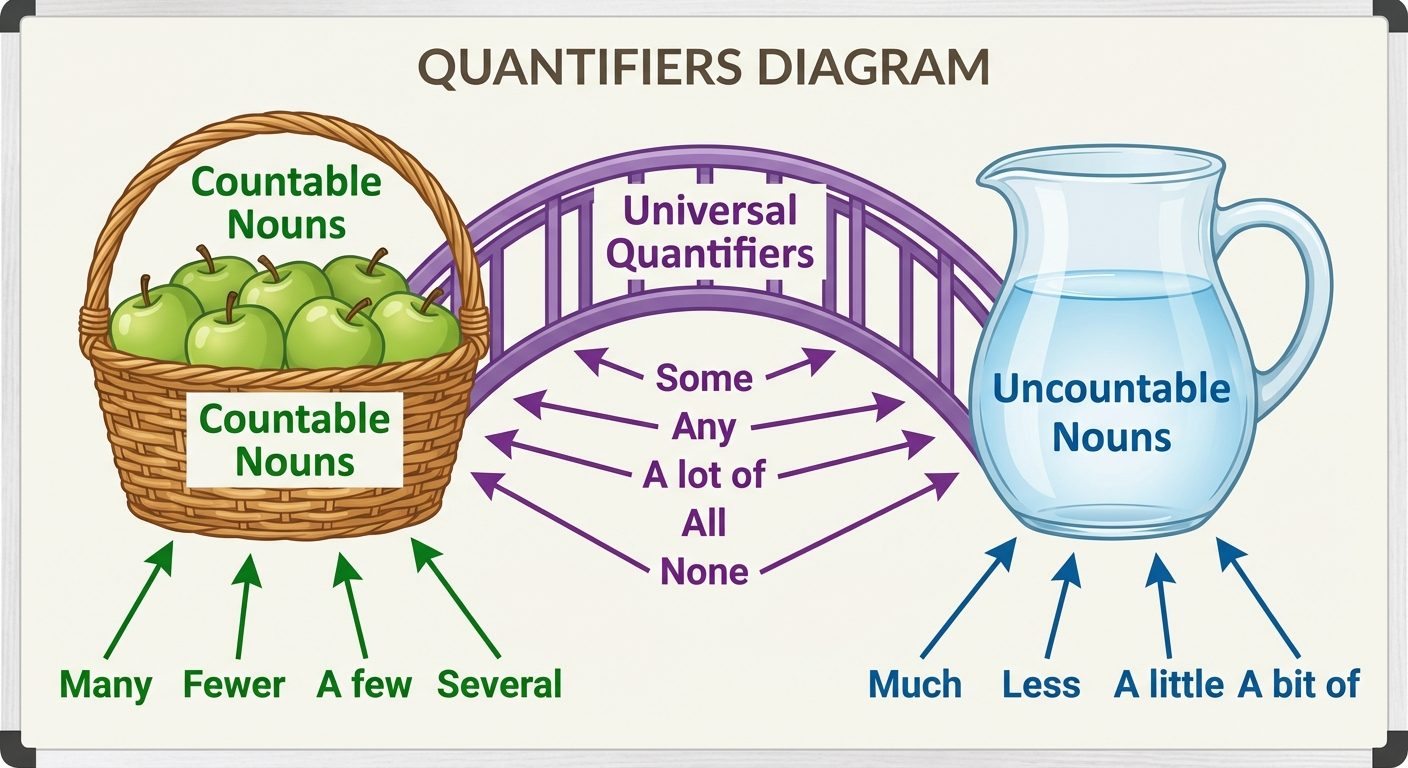
Quantifiers indicate the amount or quantity of a noun. The choice of quantifier depends strictly on whether the noun is Countable (can take a plural, e.g., apples, ideas) or Uncountable (mass nouns, e.g., water, information, rice).
4.1 The Spectrum of Quantity
| Quantity | Countable Nouns | Uncountable Nouns | Shared (Both) |
|---|---|---|---|
| Large Amount | Many | Much | A lot of / Lots of / Plenty of |
| Some Amount | Several / A number of | A great deal of | Some / Any (questions/negatives) |
| Small Amount (Positive) | A few (I have a few friends = good) | A little (I have a little money = good) | |
| Small Amount (Negative) | Few (I have few friends = lonely) | Little (I have little money = poor) | |
| Zero | Not any / None | Not any / None | No |
4.2 Important Rules
-
Some vs. Any:
- Some: Positive sentences. (I have some water.)
- Any: Negative sentences and questions. (Do you have any water?)
- Exception: Use "some" in questions when offering or requesting. (Would you like some coffee?)
-
Much vs. Many:
- "Much" is rarely used in positive sentences in modern English. We prefer "a lot of."
- Awkward: I have much money.
- Natural: I have a lot of money. / I don't have much money.
5. Multipliers
Multipliers are words or phrases used to express how many times a quantity is increased.
5.1 Common Multipliers
- Twice (x2)
- Double (x2)
- Triple / Three times (x3)
- Quadruple / Four times (x4)
5.2 Syntactic Placement
Multipliers have very specific placement rules in a sentence. They generally come before determiners (articles, possessives, or other quantifiers).
Formula 1: Multiplier + Determiner + Noun
- Correct: I earn twice my previous salary.
- Incorrect: I earn my previous salary twice.
- Correct: She has three times the experience I have.
Formula 2: Multiplier + as + Adjective/Quantifier + as
- Correct: This house is twice as big as yours.
- Correct: He has three times as many books as the library.
5.3 Fractions and Percentages
Fractions and percentages act similarly to multipliers regarding agreement.
- Rule: The verb agrees with the noun closest to it (after the "of").
- Example (Countable): 50% of the students are absent.
- Example (Uncountable): 50% of the water is polluted.
Did this save you a night before the exam?
LPU Notes is free, and it stays free. Ads cover part of the server bill. The rest comes out of a student's own pocket: the domain, the storage, and keeping the site up through the weeks everyone needs it at once.
The payment button didn't load. An ad blocker or a filtered network is the usual reason. to try again.
Nothing here is ever locked, and nothing unlocks. Chip in only if it was worth it. What it pays for →