Unit 3: Conditionals
1. Introduction to Conditionals
Conditional sentences describe the result of something that might happen (in the present or future) or might have happened but didn't (in the past). They are typically made up of two clauses:
- The If-clause (Condition): Starts with if or a similar word.
- The Main clause (Result): Describes what happens if the condition is met.
2. Real and Unreal Conditionals
Conditionals are categorized by whether the situation is real (likely/possible) or unreal (hypothetical/impossible).
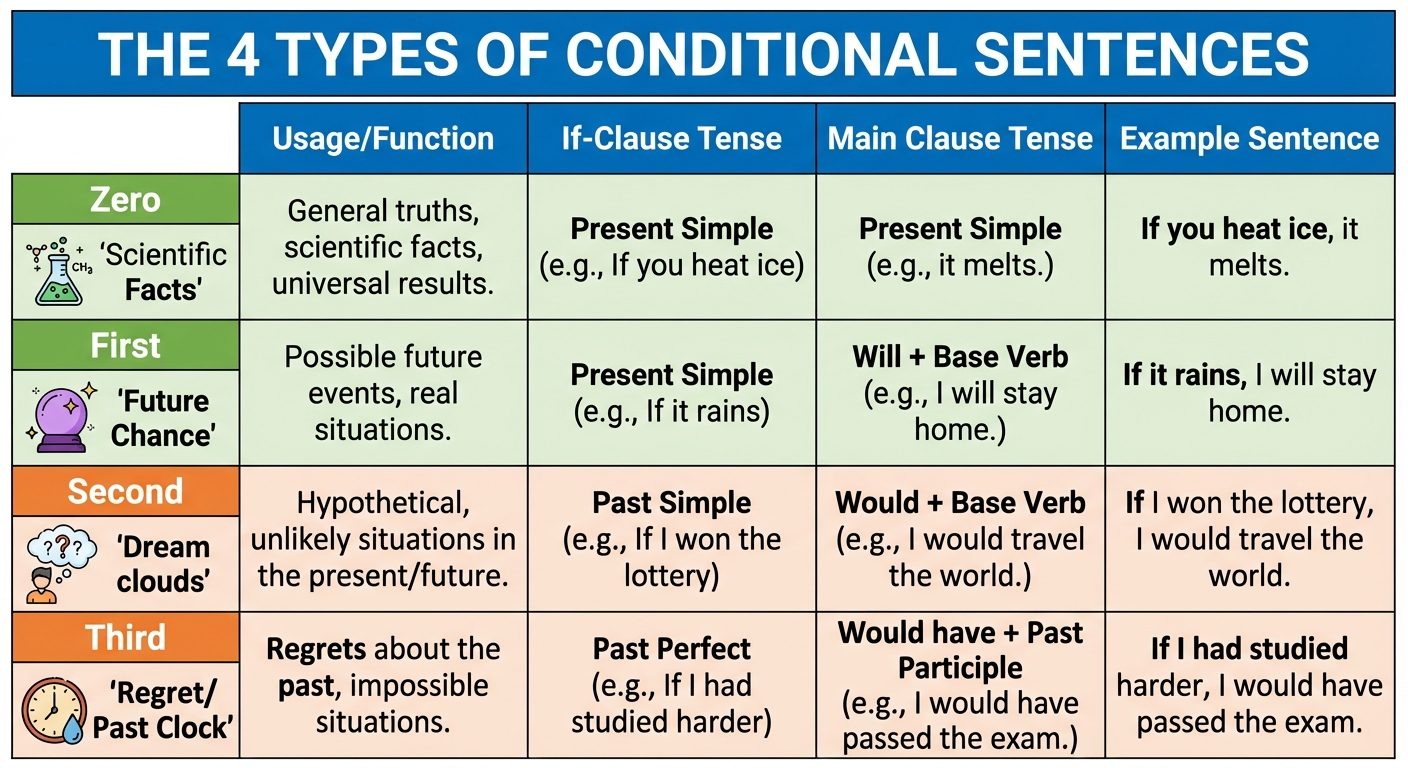
A. Real Conditionals
These express factual implications or situations that are possible/likely to happen.
The Zero Conditional (Facts and Truths)
- Usage: General truths, scientific facts, habits, and instructions. The result always happens if the condition is met.
- Structure:
If + Present Simple, ... Present Simple - Examples:
- If you heat ice, it melts.
- If the red light blinks, press the reset button.
The First Conditional (Real Possibility)
- Usage: Specific situations in the present or future that are likely to happen.
- Structure:
If + Present Simple, ... Will + Base Verb- Note: You can also use modal verbs (can, may, might, should) instead of will in the result clause.
- Examples:
- If it rains tomorrow, I will take an umbrella.
- If you finish your homework, you can go to the park.
B. Unreal Conditionals
These express hypothetical, imaginary, or impossible situations.
The Second Conditional (Hypothetical Present/Future)
- Usage: Imaginary situations in the present or unlikely events in the future.
- Structure:
If + Past Simple, ... Would + Base Verb - The "Be" Verb Rule: In formal English, use were for all subjects (I, he, she, it) in the if-clause.
- Examples:
- If I had a million dollars, I would travel the world. (I do not have the money now).
- If I were you, I would accept the offer. (NOT "If I was you").
The Third Conditional (Unreal Past/Regrets)
- Usage: Situations in the past that did not happen. Used to express regret or criticism.
- Structure:
If + Past Perfect, ... Would Have + Past Participle (V3) - Examples:
- If I had studied harder, I would have passed the exam. (I didn't study, so I didn't pass).
- If they had left earlier, they wouldn't have missed the train.
3. Mixed Conditionals
Mixed conditionals occur when the time in the If-clause is different from the time in the Main clause.
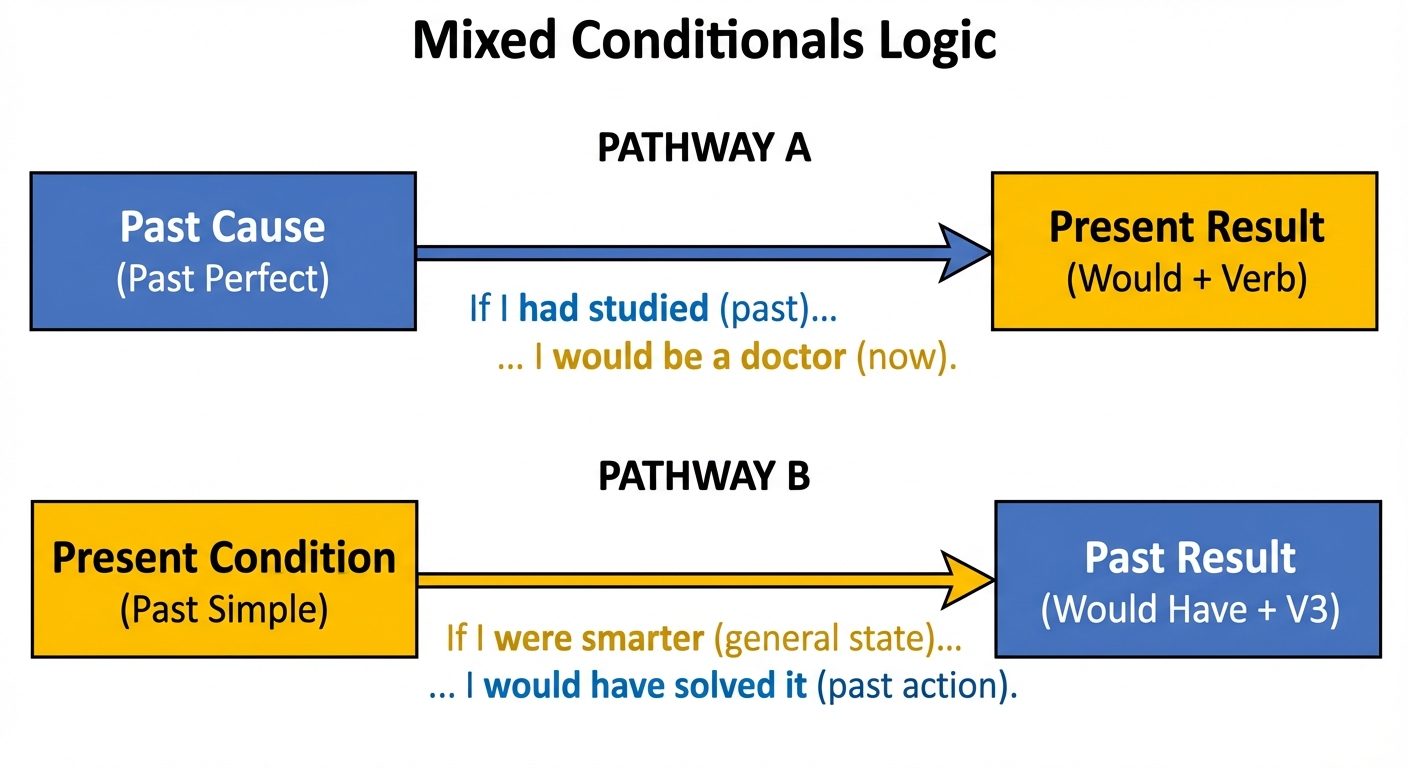
Type 1: Past Condition / Present Result
- Scenario: Something happened (or didn't happen) in the past, and it has a consequence in the present.
- Structure:
If + Past Perfect, ... Would + Base Verb - Example:
- If I had eaten breakfast (past action), I wouldn't be hungry now (present state).
Type 2: Present Condition / Past Result
- Scenario: A permanent state or general truth (present reality) affected a past event.
- Structure:
If + Past Simple, ... Would Have + Past Participle - Example:
- If I were a good cook (general truth), I would have invited them to dinner yesterday (past event).
4. Order and Punctuation
The order of the clauses determines the punctuation. The meaning remains exactly the same regardless of order.
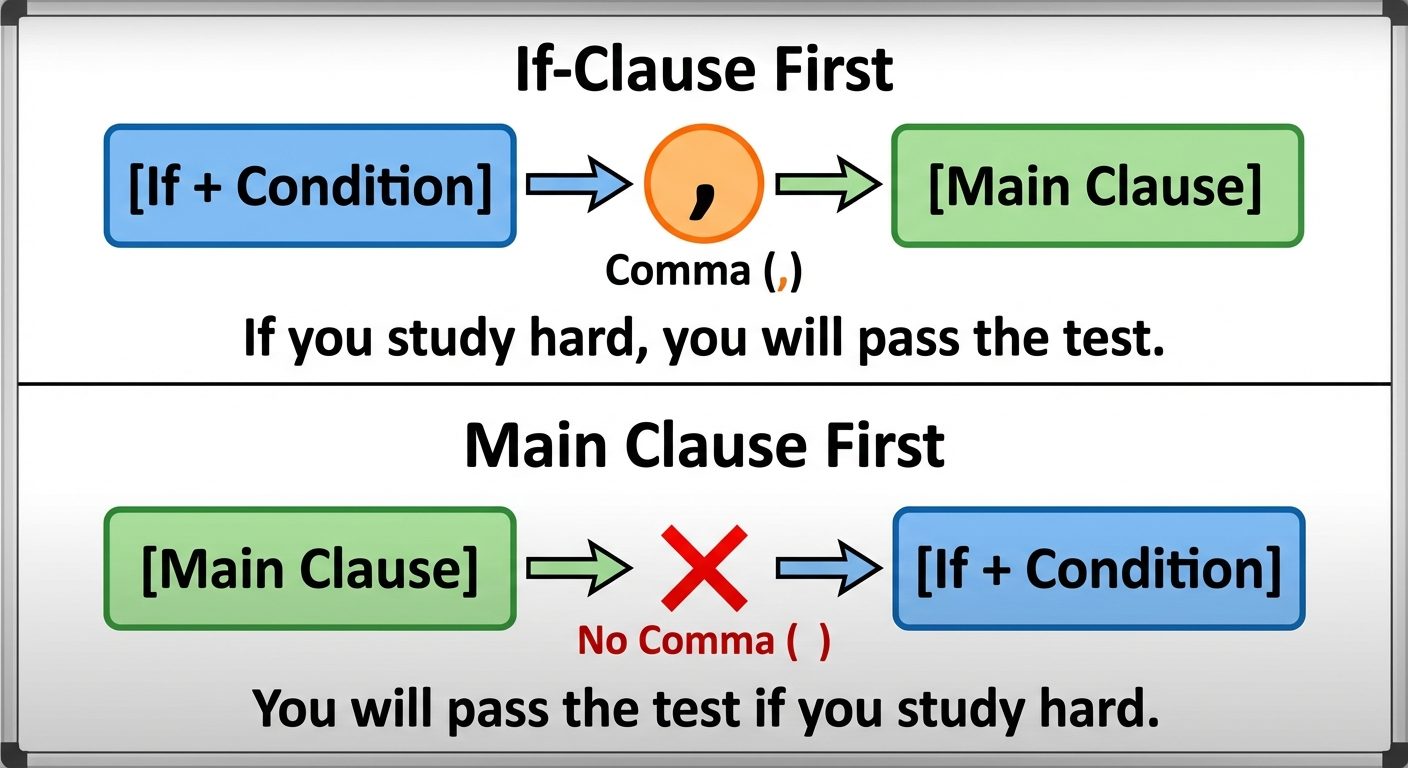 AI-generated image — may contain inaccuracies -> [Large Red COMMA icon] -> [Result Clause]. Bottom half shows "Result-Clause First": [Result Clause] -> [No Comma/STOP sign icon] -> [if + Condition]. Arrows show the flow of reading. Background needs to be clean white with high-contrast text. Example sentences included clearly: "If it rains, I will stay." vs "I will stay if it rains."]
Rule 1: If-clause First
- If the sentence begins with the conditional clause, you must use a comma after it.
- Example: If you see him, please tell him to call me.
Rule 2: Main Clause First
- If the sentence begins with the result clause, do not use a comma.
- Example: Please tell him to call me if you see him.
5. Advanced Connectors and Variations
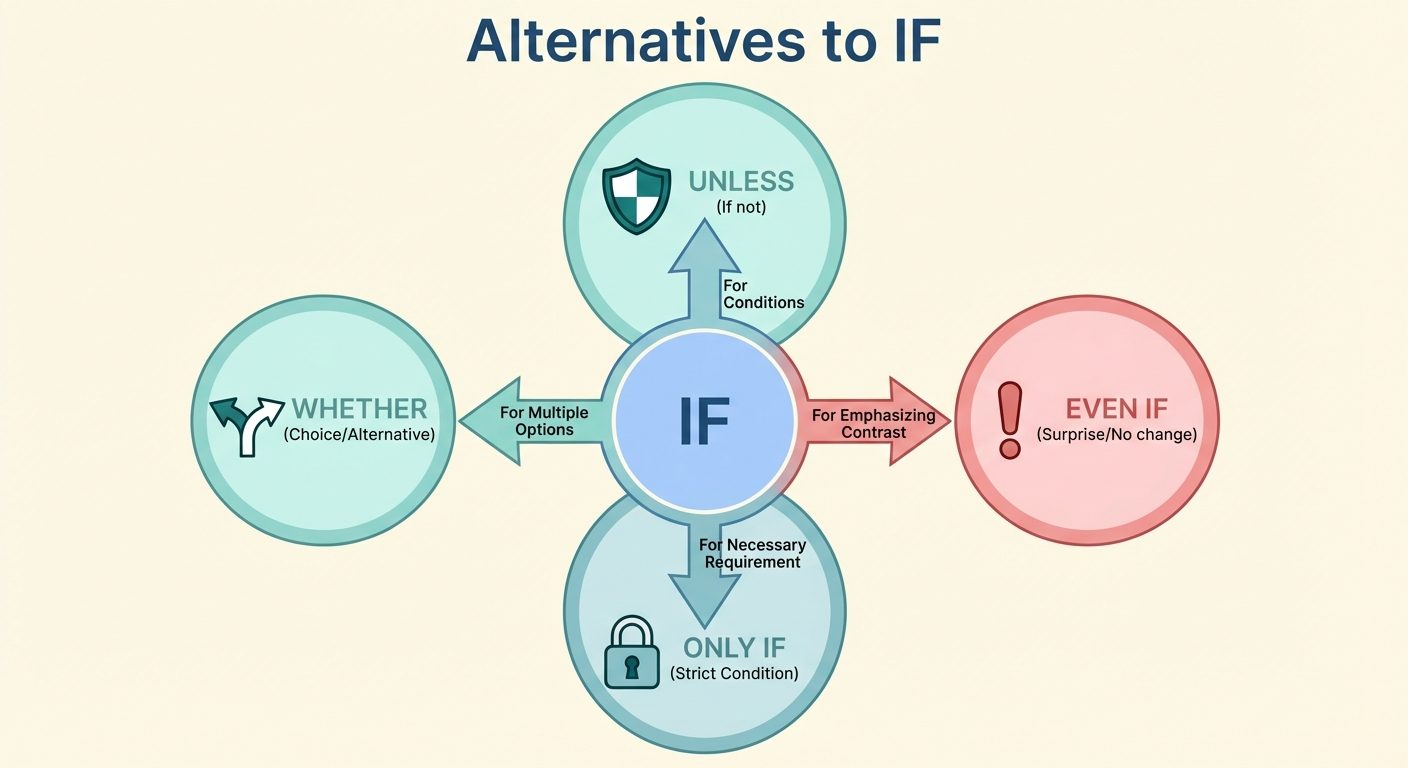
While "if" is the most common conjunction, other words add specific nuances to the condition.
A. Unless
- Meaning: "If... not" or "Except on the condition that."
- Usage: Used to express a negative condition.
- Rule: Because unless already carries a negative meaning, do not use a negative verb immediately after it (avoid double negatives).
- Examples:
- Unless you hurry, you will be late. (= If you do not hurry...)
- I won't pay unless you provide a receipt.
B. Only if
- Meaning: Expresses a very strong, restrictive condition.
- Inversion Rule: When a sentence starts with Only if, the subject and auxiliary verb in the main clause are inverted (Question order).
- Examples:
- I will come only if you promise to help. (Standard order)
- Only if you promise to help will I come. (Inverted order)
C. Even if
- Meaning: The result remains the same regardless of the condition. It emphasizes that the condition does not matter.
- Examples:
- Even if it rains, we will play football. (Rain typically stops football, but in this case, it won't).
- I wouldn't buy that car even if I had the money.
D. Whether
- Meaning: Used when there are two alternatives, or when the condition does not determine the outcome. often followed by "or not".
- Examples:
- I am going to the party whether you come or not.
- We need to decide whether to buy it now or wait.
E. If so / If not
- Usage: These are elliptical structures used to avoid repetition. They refer back to a complete idea mentioned in the previous sentence.
- If so: If the previous statement is positive/true.
- If not: If the previous statement is negative/false.
- Examples:
- Are you free tonight? If so, let's go for dinner. (If so = If you are free)
- There might be a delay. If not, we will arrive on time. (If not = If there is no delay)
Did this save you a night before the exam?
LPU Notes is free, and it stays free. Ads cover part of the server bill. The rest comes out of a student's own pocket: the domain, the storage, and keeping the site up through the weeks everyone needs it at once.
The payment button didn't load. An ad blocker or a filtered network is the usual reason. to try again.
Nothing here is ever locked, and nothing unlocks. Chip in only if it was worth it. What it pays for →