Unit 2: Sentence Structure
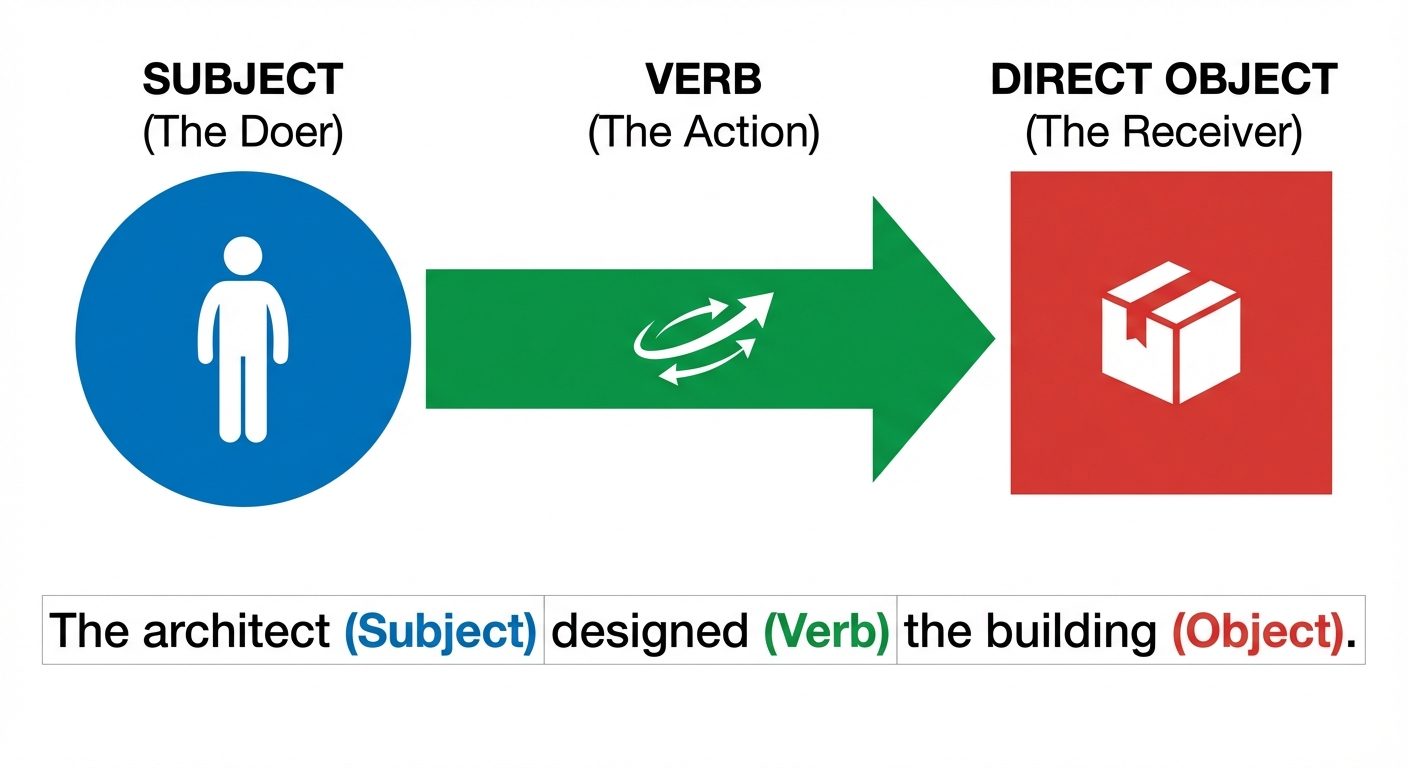
1. Core Components: Subject and Object
Understanding sentence structure begins with identifying the two primary components of a sentence: the Subject and the Predicate. Within the predicate, the Object plays a crucial role in completing the meaning of transitive verbs.
1.1 The Subject
The subject is the "who" or "what" that performs the action or is being described in the sentence.
- Simple Subject: The main noun or pronoun (e.g., "The large dog barked").
- Complete Subject: The noun plus all its modifiers (e.g., "The large dog barked").
- Compound Subject: Two or more subjects joined by a conjunction (e.g., "Jack and Jill went up the hill").
1.2 The Object
An object is a noun, pronoun, or noun phrase that receives the action of a verb. Objects only occur with transitive verbs.
- Direct Object (DO): Answers the question "What?" or "Whom?" after the verb.
- Example: "She plays the guitar." (She plays what? The guitar.)
- Position: Typically follows the verb in English syntax (S-V-O order).
2. Verbs with Indirect Objects and Clauses
While a Direct Object receives the action directly, many sentences are more complex, involving beneficiaries of actions or using entire clauses as objects.
2.1 Indirect Objects (IO)
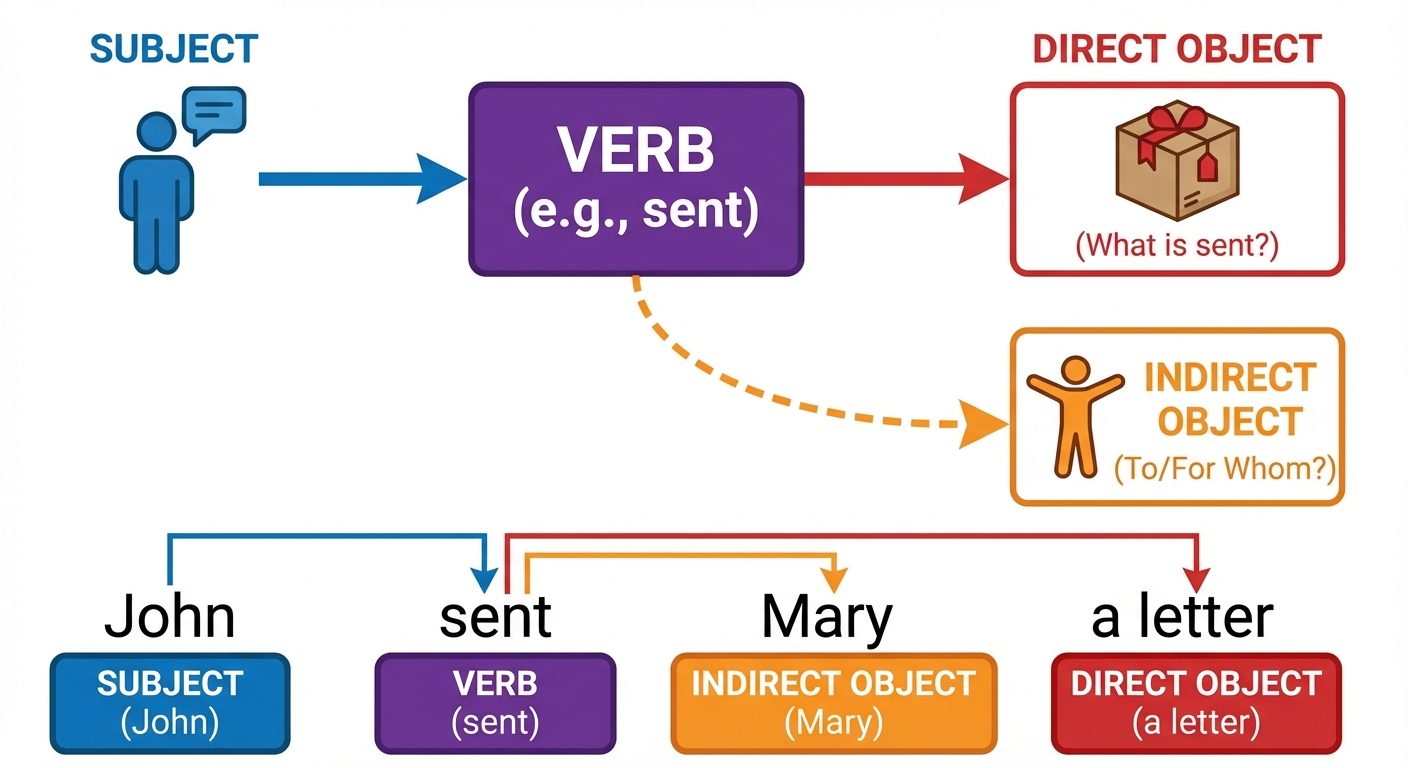
The Indirect Object identifies to whom or for whom the action is performed. It only appears in sentences that also contain a Direct Object.
-
Rule: An indirect object always comes before the direct object when no preposition is used.
-
Structure: Subject + Verb + Indirect Object + Direct Object.
- Example: "He gave me the book."
- Verb: Gave
- Direct Object: Book (What was given?)
- Indirect Object: Me (To whom was it given?)
- Example: "He gave me the book."
-
Alternative Structure (Prepositional Phrase): If the indirect object is placed after the direct object, it requires a preposition (to or for).
- Example: "He gave the book to me." (Here, "me" is the object of the preposition, effectively functioning as the recipient).
2.2 Verbs with Object Clauses
Some verbs take an entire clause (a group of words with a subject and a verb) as their object, rather than a single noun. This is common with verbs of cognition, communication, or perception (e.g., know, believe, think, say, suggest).
- Noun Clauses as Objects: These often begin with that, who, what, where, why, or how.
- Example: "I know that he is lying."
- Subject: I
- Verb: Know
- Direct Object: "that he is lying" (The entire clause functions as the noun).
- Example: "She explained how the engine works."
- Example: "I know that he is lying."
3. Linking Verbs
Not all verbs express action. Linking verbs (copular verbs) connect the subject to additional information about the subject, rather than describing an action performed by the subject.
3.1 Function
Linking verbs act like an "equals sign" (=) between the subject and the Subject Complement.
- Subject: The topic.
- Linking Verb: The connector.
- Subject Complement: An adjective or noun that renames or describes the subject.
3.2 Common Linking Verbs
- Forms of "To Be": am, is, are, was, were, be, been, being.
- Example: "The professor is intelligent." (Professor = Intelligent)
- Sensory Verbs: look, sound, smell, taste, feel.
- Example: "The soup smells delicious." (Soup = Delicious)
- State/Change Verbs: seem, become, remain, appear, grow, turn.
- Example: "He became a doctor." (He = Doctor)
3.3 The Substitution Test
To determine if a verb is a linking verb or an action verb, substitute it with a form of "to be" (is/are/was). If the sentence still makes sense, it is likely a linking verb.
- Linking: "The food tasted bad." -> "The food was bad." (Makes sense).
- Action: "She tasted the soup." -> "She was the soup." (Does not make sense; therefore, this use of 'tasted' is an action verb).
4. Sentence Types: Simple, Compound, and Complex
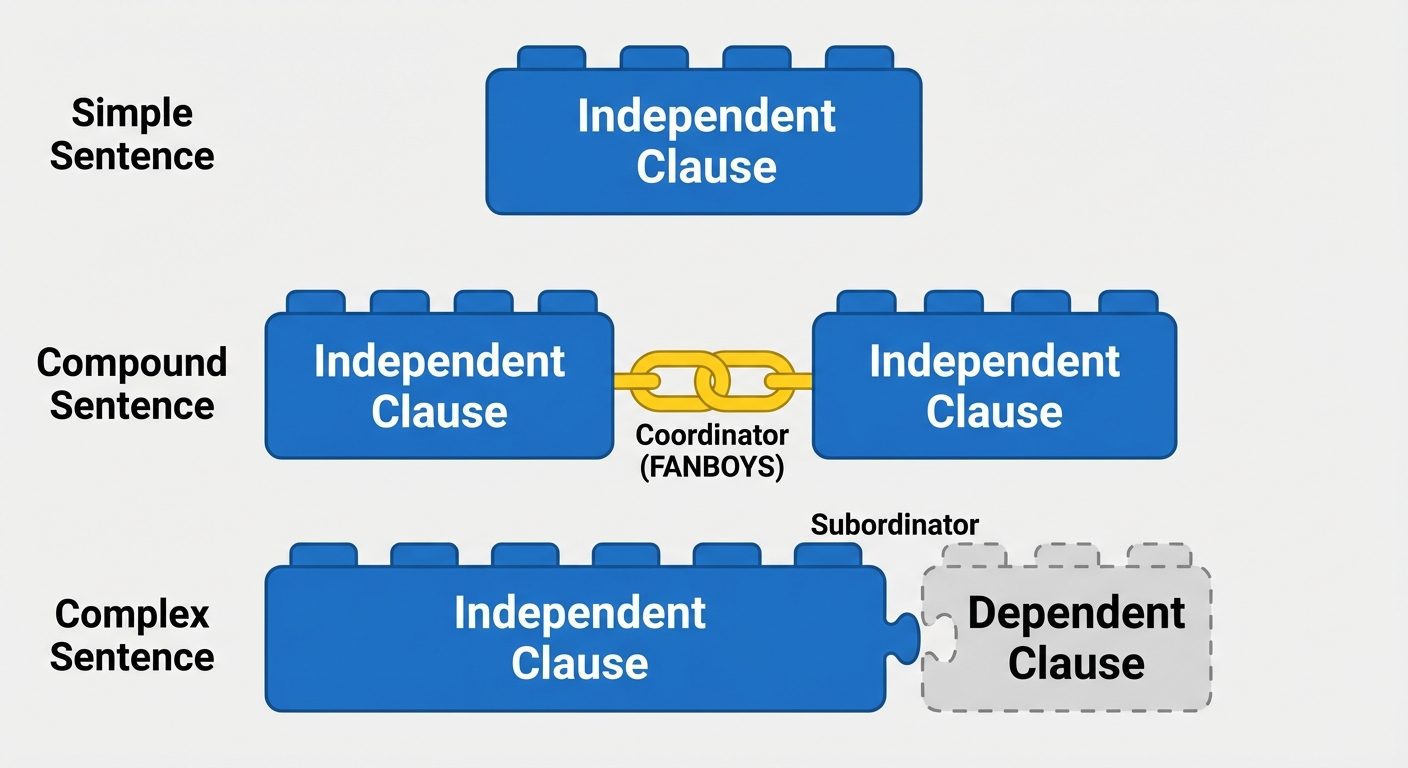
Sentence structure is classified based on the number and type of clauses contained within the sentence.
4.1 Simple Sentences
A simple sentence consists of one independent clause. It contains a subject and a verb and expresses a complete thought.
- Formula: 1 Independent Clause.
- Example: "The company launched a new product."
- Note: It can have a compound subject or compound verb but still be a simple sentence.
- Example: "John and Mary [Compound Subject] debated and voted [Compound Verb]."
4.2 Compound Sentences
A compound sentence consists of two or more independent clauses joined together. Both clauses are of equal importance (coordinate).
Ways to connect Compound Sentences:
- Coordinating Conjunction (FANBOYS): For, And, Nor, But, Or, Yet, So.
- Formula: Indep. Clause + , + FANBOYS + Indep. Clause.
- Example: "I wanted to go to the party, but I was too tired."
- Semicolon: Used when the ideas are closely related.
- Formula: Indep. Clause + ; + Indep. Clause.
- Example: "The sky is clear; the stars are bright."
- Conjunctive Adverb:
- Formula: Indep. Clause + ; + Adverb + , + Indep. Clause.
- Example: "It rained heavily; therefore, the match was canceled."
4.3 Complex Sentences
A complex sentence consists of one independent clause and at least one dependent (subordinate) clause.
- Function: Shows a relationship where one idea is more important (independent) than the other (dependent).
- Connectors: Subordinating Conjunctions (because, although, if, since, when, while, after).
Structures:
- Dependent first (requires comma):
- Example: "Although it was raining, we played soccer."
- Independent first (no comma usually):
- Example: "We played soccer although it was raining."
Summary Table of Sentence Types
| Type | Independent Clauses | Dependent Clauses | Connector Type |
|---|---|---|---|
| Simple | 1 | 0 | None |
| Compound | 2+ | 0 | Coordinating Conjunction (FANBOYS) or Semicolon |
| Complex | 1 | 1+ | Subordinating Conjunction |
Did this save you a night before the exam?
LPU Notes is free, and it stays free. Ads cover part of the server bill. The rest comes out of a student's own pocket: the domain, the storage, and keeping the site up through the weeks everyone needs it at once.
The payment button didn't load. An ad blocker or a filtered network is the usual reason. to try again.
Nothing here is ever locked, and nothing unlocks. Chip in only if it was worth it. What it pays for →