Unit 1: Substitution and Ellipsis
This unit explores how to improve cohesion and avoid unnecessary repetition in advanced communication. By using "dummy" subjects, substitution markers, and ellipsis, speakers and writers can create more natural, fluid, and efficient texts.
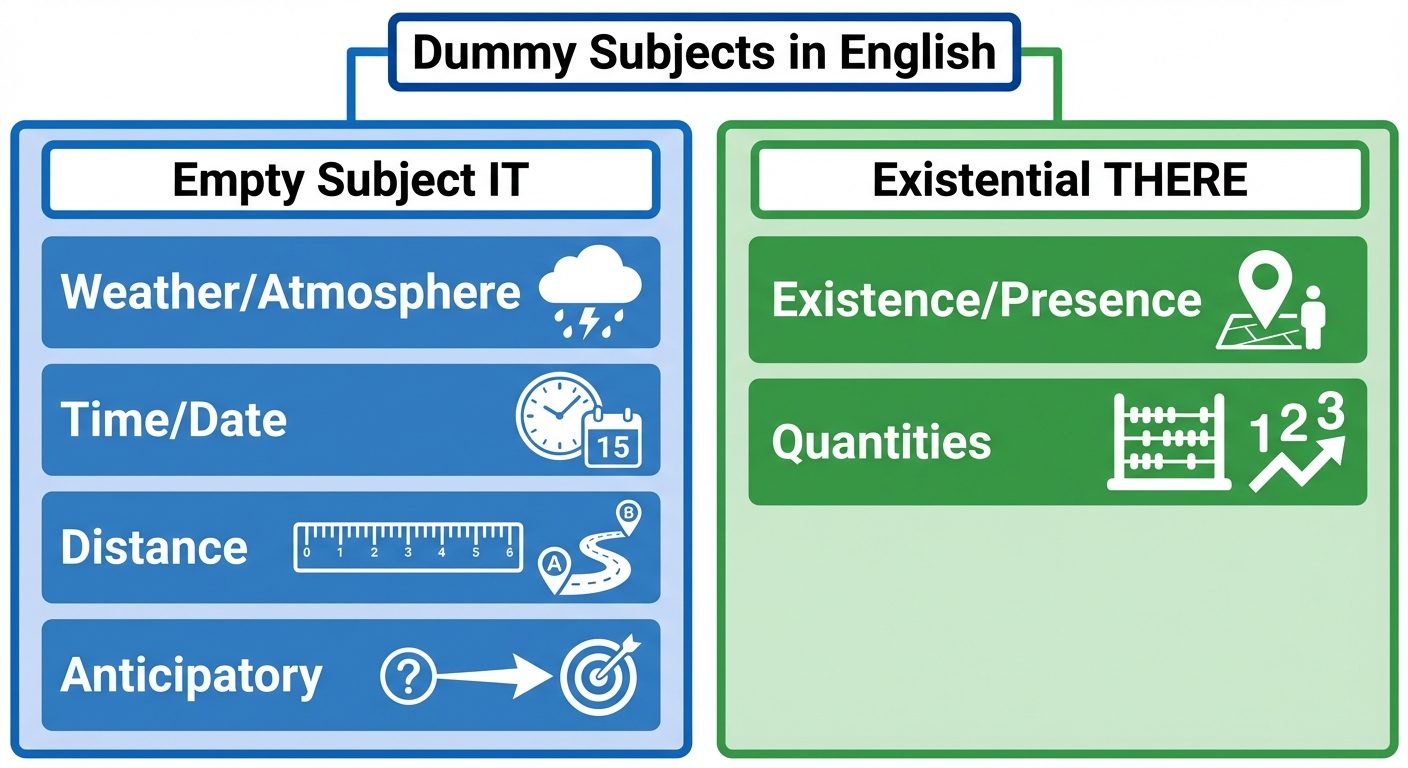
1. Empty Subject: 'It' and 'There'
In English syntax, every sentence (except imperatives) generally requires a subject. Sometimes, we need a grammatical subject even when there is no meaningful agent performing an action. These are called "empty" or "dummy" subjects.
The Empty 'It'
The pronoun it is used as an empty subject in specific contexts where no specific noun is being referred to.
- Weather and Atmosphere:
- It is raining.
- It is getting dark.
- Time and Date:
- It is half-past six.
- It is my birthday today.
- Distance:
- It is five miles to the nearest station.
- Anticipatory 'It': Used to shift a long subject (usually an infinitive phrase or a that-clause) to the end of the sentence for better balance.
- Sentence: To learn a new language is difficult. It is difficult to learn a new language.
- Sentence: That he lied is obvious. It is obvious that he lied.
The Empty 'There' (Existential)
There is used as a dummy subject to express the existence or presence of something. It introduces a new topic.
- Existence:
- There is a fly in my soup.
- There are many reasons to study syntax.
- With numbers/quantities:
- There were twenty people in the room.
2. Substitution: 'One' and 'Ones'
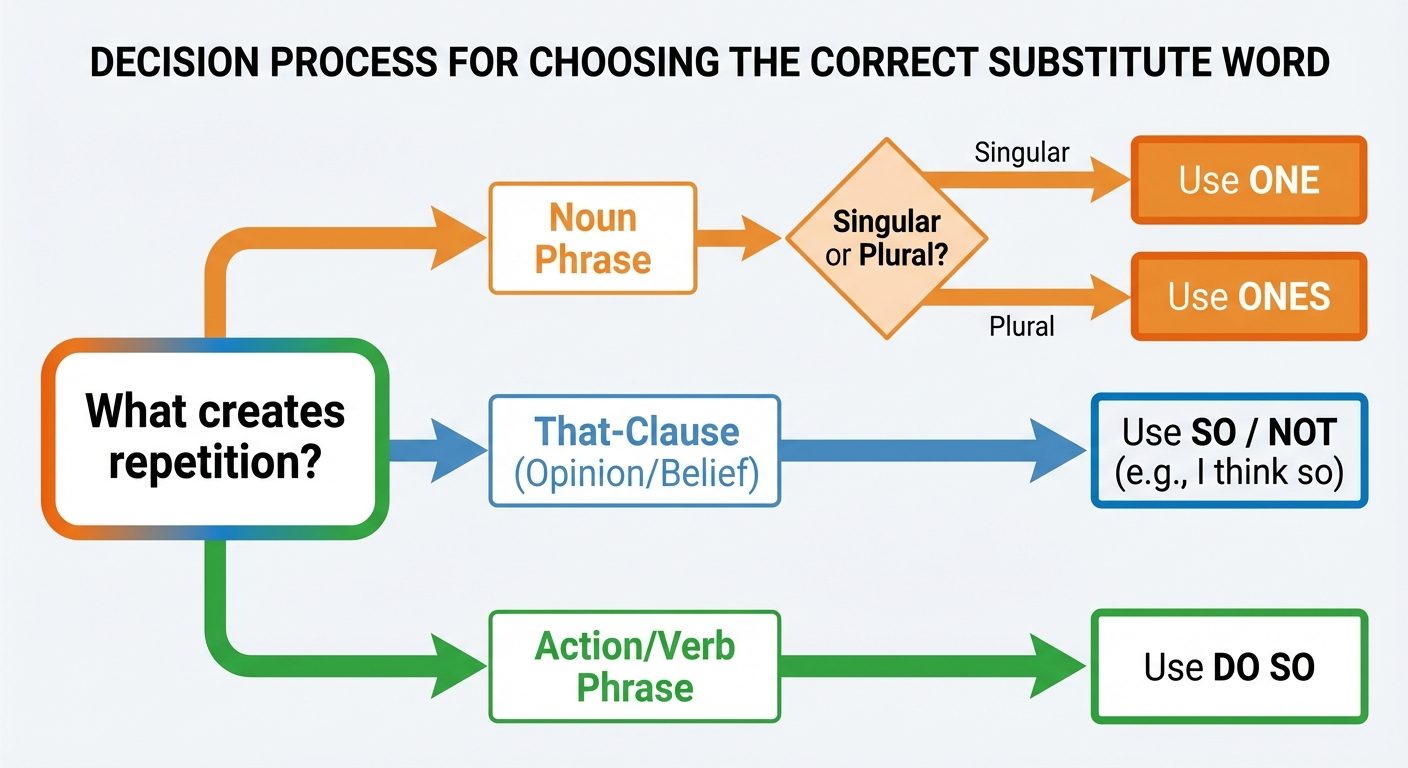
Substitution involves replacing a word or phrase with a "filler" word to avoid repetition. One and ones are nominal substitutes (they replace nouns).
Using 'One' (Singular)
We use one to replace a singular countable noun that has already been mentioned.
- Example: "I need a pen. Do you have one?" (one = a pen)
- With adjectives: "I don't like the red shirt, I prefer the blue one."
Using 'Ones' (Plural)
We use ones to replace a plural countable noun.
- Example: "I checked the documents. The ones on the table are signed." (ones = documents)
- Example: "Which shoes do you like? The black ones."
Limitations (When NOT to use One/Ones)
- Uncountable Nouns: You cannot use one/ones for uncountable nouns. You must repeat the noun or use no noun at all.
- Incorrect: I like fresh water, but this one is dirty.
- Correct: I like fresh water, but this is dirty.
- Possessives: After my, your, his, etc., we usually drop the noun or use 'own', not 'one'.
- Example: This is my car. That is hers. (Not: her one)
3. Substitution: 'So' and 'Do So'
These are verbal and clausal substitutes. They replace verbs, verb phrases, or entire clauses.
Using 'So' (Clausal Substitution)
So is often used to replace a that-clause after verbs of thinking, hoping, expecting, or supposing.
- Affirmative Contexts:
- A: "Is the exam canceled?"
- B: "I think so." (so = that the exam is canceled)
- Negative Contexts:
- "I hope not." (Preferable to "I don't hope so")
- "I don't think so."
Using 'Do So' (Verbal Substitution)
Do so replaces a verb and its object or complement to describe an action. It is more formal than just using "do" or "did".
- Structure: Subject + Do/Did/Does + So.
- Example: "He asked me to submit the report, and I did so immediately." (did so = submitted the report)
- Example: "Those who wish to smoke must do so in the designated area."
4. Ellipsis: Leaving Words Out
Ellipsis is the omission of words that are grammatically required but can be understood from the context. Unlike substitution, no word is put in place of the omitted text; the slot is left empty.
Textual Ellipsis
Occurs usually after and, but, or or to avoid repeating the subject or auxiliary verb.
- Example: "She opened the door and [she] entered the room."
- Example: "He can sing and [he can] dance."
Situational Ellipsis
Occurs in speech when the context makes the missing words obvious.
- Example: "[Do you] Want a coffee?"
- Example: "[I'll] See you later."
5. Leaving Out Subjects and Objects
In advanced communication, particularly in coordinate clauses and informal speech, subjects and objects are frequently omitted.
Leaving Out the Subject
- Coordinate Clauses: When two clauses share the same subject and are connected by and, but, or, the subject is dropped in the second clause.
- Full: He got up, he washed his face, and he had breakfast.
- Elliptical: He got up, washed his face, and had breakfast.
- Imperatives: The subject 'You' is almost always implied.
- "[You] Stop talking!"
Leaving Out the Object
Generally, transitive verbs require objects. However, in coordinate structures where the object is the same, it can sometimes be omitted in the first clause (Cataphoric ellipsis) or the second (Anaphoric ellipsis).
- Example: "She washed [the dishes] and dried the dishes." (Less common)
- Example (Verbal Ellipsis): "Is she coming?" "She might [come]." (The object/complement of the auxiliary is omitted).
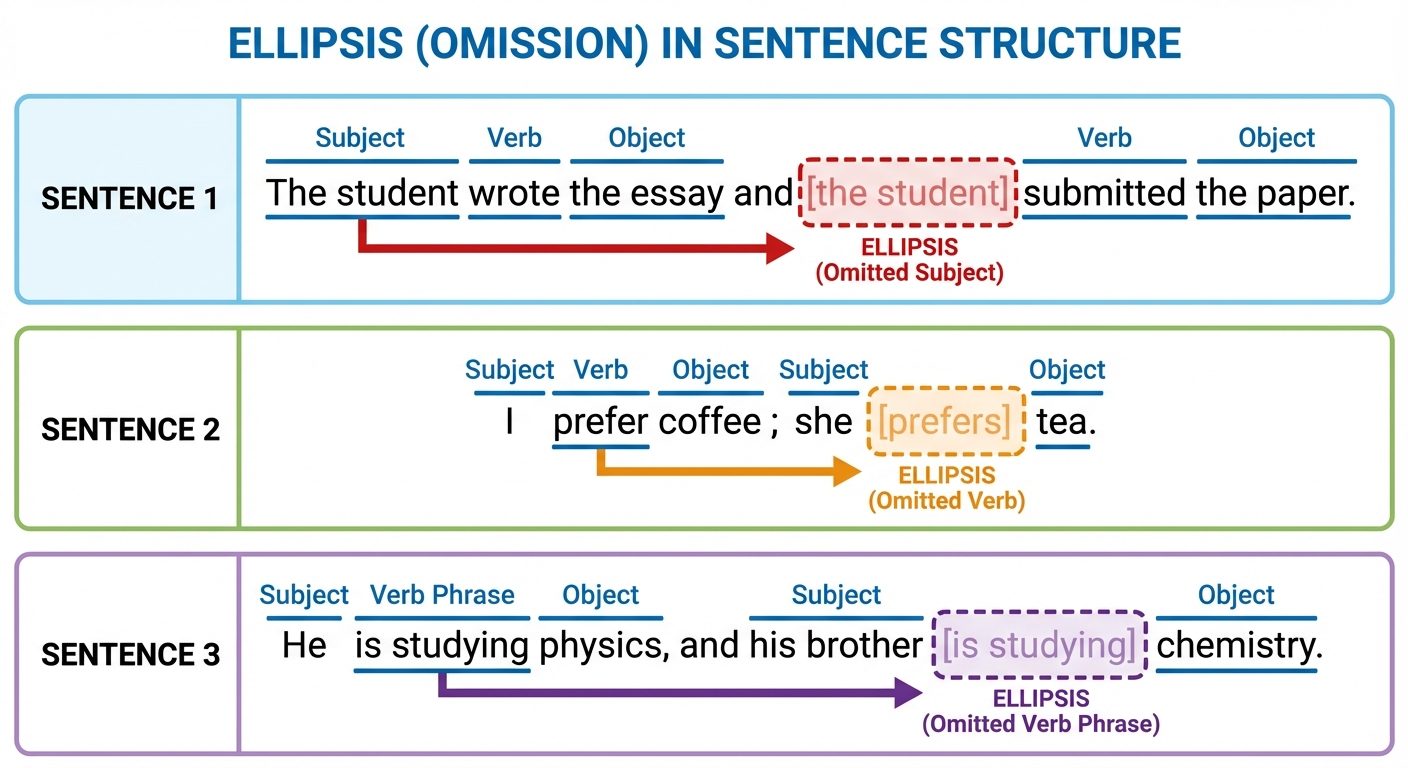 AI-generated image — may contain inaccuracies submitted it." -> The words "[the student]" should be shown in a dotted outline box with 'ghost' text to indicate they are removed.
Sentence 2: "[Have you] Got a minute?" -> The words "[Have you]" in a dotted outline box at the start.
Sentence 3: "I haven't met him, but Sarah has [met him]." -> The words "[met him]" in a dotted outline box at the end.
Include arrows pointing to the omitted parts labeled "Ellipsis Gap". Use a clean white background with black text and red annotations for the labels.]
Comparison: Substitution vs. Ellipsis
| Feature | Substitution | Ellipsis |
|---|---|---|
| Mechanism | Replaces a word with a filler (one, do, so). | Removes the word entirely. |
| Purpose | Avoid repetition while maintaining grammatical structure. | Conciseness; speeds up communication. |
| Example | I'll have the red one. | I'll have the red [ ]. |
Study Summary
- Empty Subjects: Use It for time/weather/anticipation. Use There for existence.
- Noun Substitution: Use One/Ones for countable nouns. Never for uncountables.
- Clause Substitution: Use So (I think so) or Do so (He did so) for actions.
- Ellipsis: Leaving words out is grammatically acceptable in coordinate clauses ("He laughed and [he] cried") and informal speech ("[Are you] Ready?").
Did this save you a night before the exam?
LPU Notes is free, and it stays free. Ads cover part of the server bill. The rest comes out of a student's own pocket: the domain, the storage, and keeping the site up through the weeks everyone needs it at once.
The payment button didn't load. An ad blocker or a filtered network is the usual reason. to try again.
Nothing here is ever locked, and nothing unlocks. Chip in only if it was worth it. What it pays for →