Unit 3: Tenses Review
1. Introduction to Aspect and Time
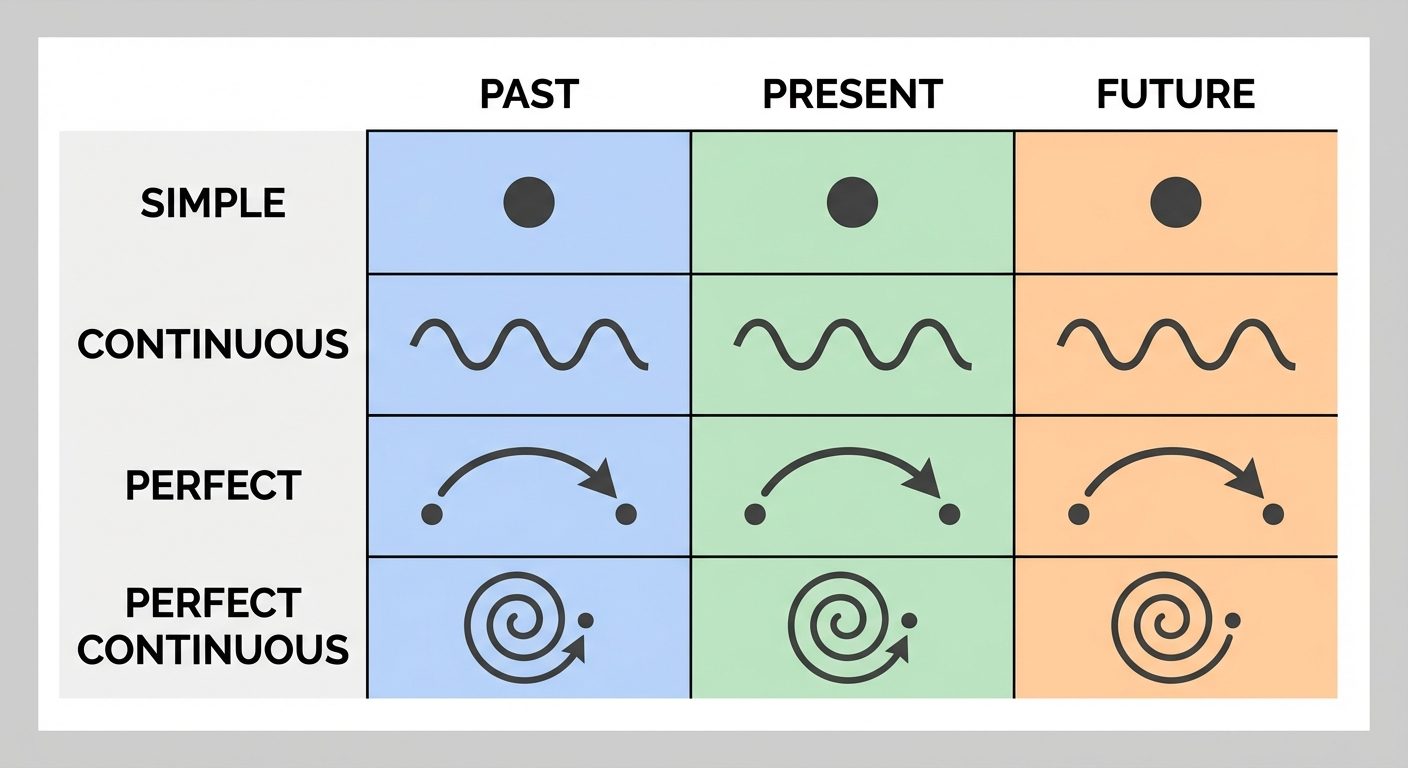
In English communication, conveying precise meaning requires understanding not just time (Past, Present, Future) but also aspect (Simple, Continuous, Perfect, Perfect Continuous).
- Simple: Facts, habits, completed actions.
- Continuous (Progressive): Actions in progress, temporary situations.
- Perfect: Actions connecting two time periods (e.g., past to present).
- Perfect Continuous: Focus on the duration of an activity leading up to a point.
2. The Present Tenses
This section compares how we discuss current realities, habits, and actions connecting the past to the now.
Present Simple vs. Present Continuous
| Feature | Present Simple | Present Continuous |
|---|---|---|
| Usage | General truths, habits, permanent situations, timetables. | Actions happening now, temporary situations, annoying habits (with "always"). |
| Key Words | Always, usually, every day, often. | Now, at the moment, currently, this week. |
| Structure | Subject + V1 (+s/es) | Subject + am/is/are + V-ing |
| Example | She works in London. (Permanent) | She is working in Paris this month. (Temporary) |
Present Perfect vs. Past Simple
This is often the most challenging comparison for Upper Intermediate learners.
- Past Simple: The action is finished, and the time period is finished.
- Present Perfect: The action is past, but it has a result in the present, or the time period is unfinished.
Rule of Thumb: If you can ask "When?" and get a specific past time (yesterday, in 1999), use Past Simple. If the specific time doesn't matter or is unknown, use Present Perfect.
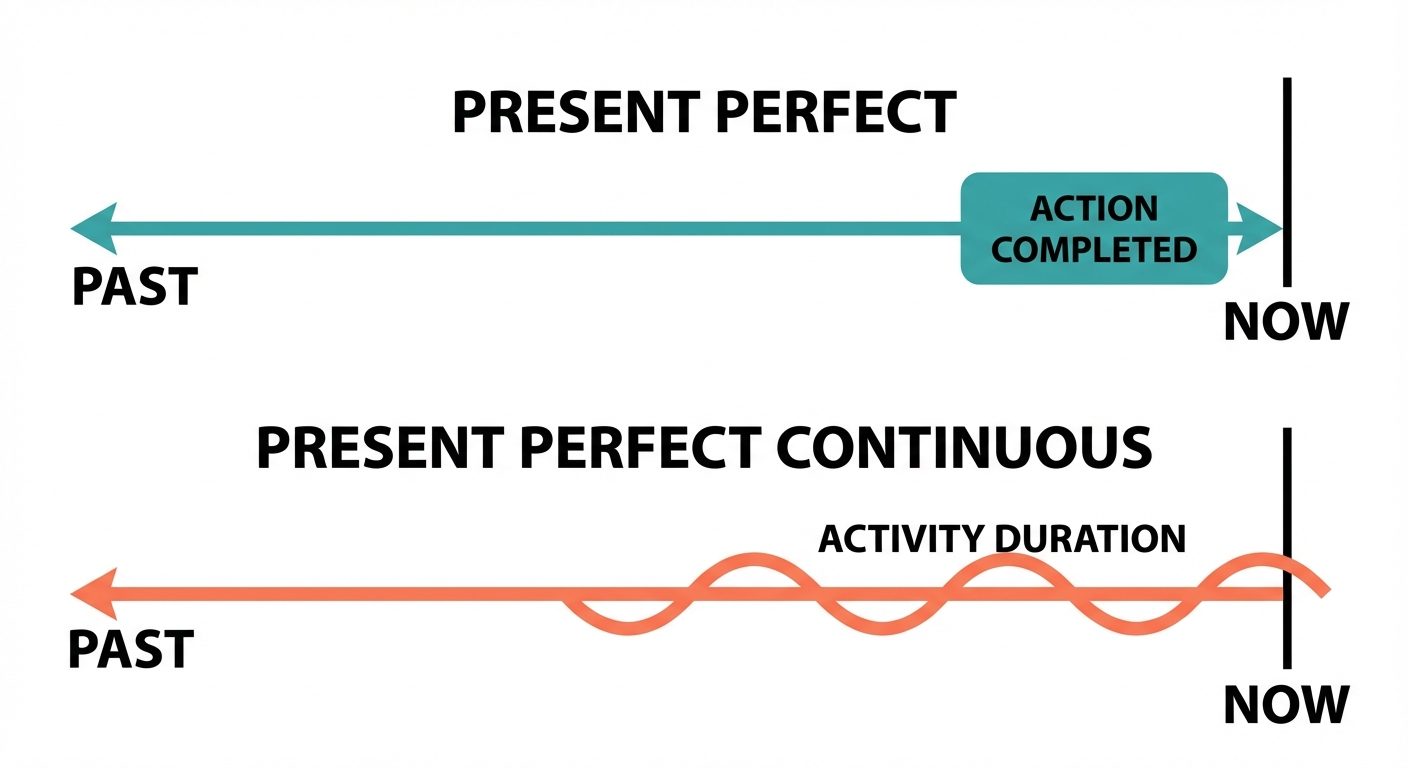
Present Perfect Continuous
Focuses on the activity and its duration, rather than the result.
- Example: "I have been painting the room." (I might not be finished; I have paint on my clothes).
- Contrast with Present Perfect: "I have painted the room." (The job is done; the room is blue).
3. The Past Tenses
Narrative tenses allow us to sequence events correctly in the past.
Past Simple vs. Past Continuous
- Past Simple: Main events in a story; completed actions.
- Past Continuous: Background information; actions interrupted by the main event.
- Example: "I was walking (background/long action) down the street when I slipped (main event/short action)."
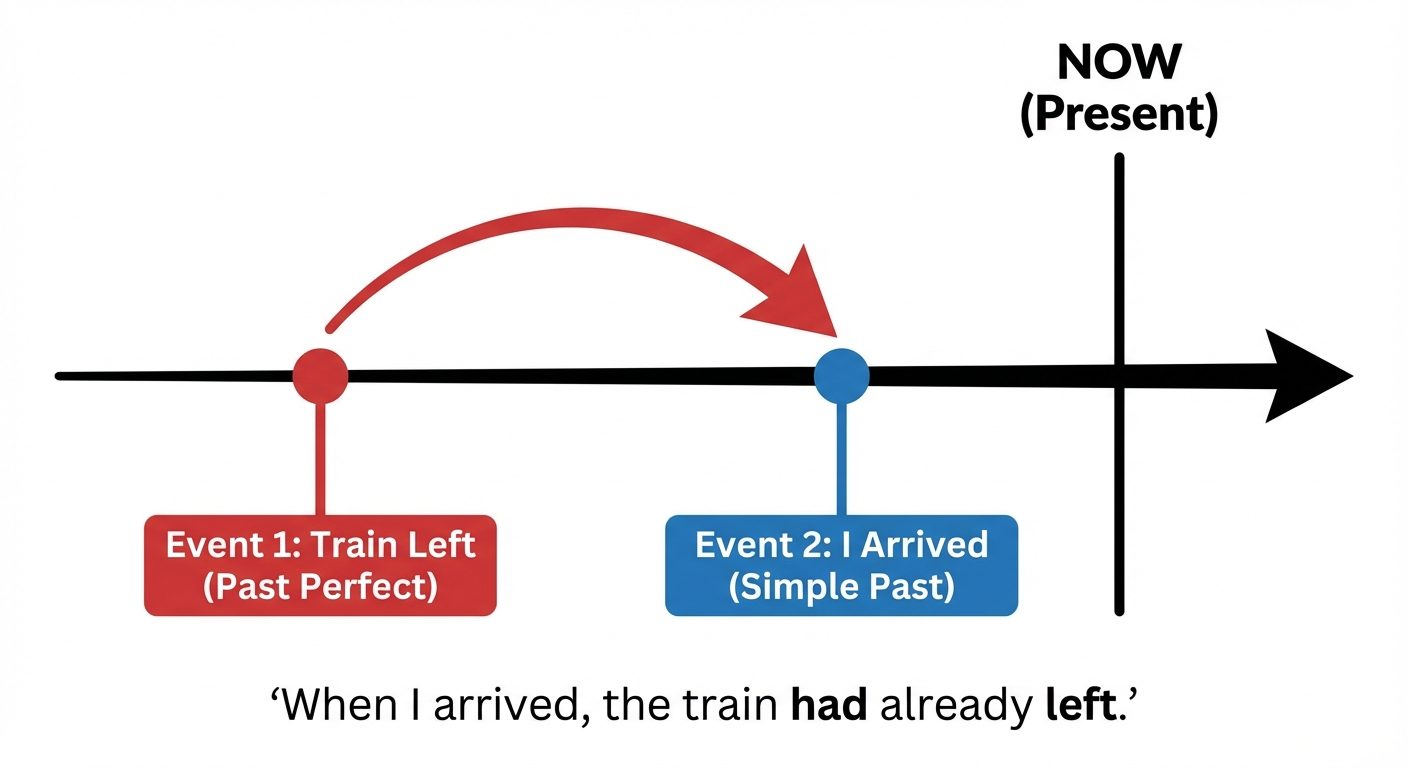
Past Perfect: The "Past Before the Past"
Used to clarify the order of two past events. If the sequence is clear (e.g., using "before" or "after"), Past Perfect is optional. If the sequence is not clear, it is mandatory.
- Structure: Subject + had + V3 (Past Participle).
- Scenario:
- Event A happens (Train leaves at 8:00).
- Event B happens (I arrive at 8:05).
- Sentence: "When I arrived, the train had left."
Past Perfect Continuous
Emphasizes the duration of an activity before another past event.
- Example: "He had been driving for six hours when the car broke down." (Focus on the fatigue/duration).
4. The Future Tenses
Future forms in English express intention, prediction, and scheduling rather than just time.
Will vs. Going To vs. Present Continuous
- Will (Future Simple):
- Instant decisions: "I'll answer the phone."
- Predictions based on opinion: "I think he will win."
- Promises/Offers: "I will help you."
- Going To:
- Plans/Intentions made before speaking: "I'm going to buy a car next year."
- Predictions based on evidence: "Look at those clouds; it's going to rain."
- Present Continuous for Future:
- Fixed arrangements (time and place usually set): "I am meeting the dentist at 3 PM tomorrow."
Future Continuous
Describes an action that will be in progress at a specific moment in the future.
- Structure: Will + be + V-ing.
- Example: "Don't call me at 8 PM. I will be watching the movie."
Future Perfect
Describes an action that will be completed before a specific time in the future.
- Structure: Will + have + V3.
- Signal Word: By (e.g., By next year, By 5 PM).
- Example: "By the time you arrive, I will have finished the report."
5. Comprehensive Tense Comparison Summary
Stative vs. Dynamic Verbs
A crucial upper-intermediate concept is that Stative Verbs (verbs of state, feeling, possession, or sense) are rarely used in Continuous tenses.
- Stative: Know, like, believe, belong, consist, seem.
- Incorrect: I am knowing him.
- Correct: I know him.
- Mixed Verbs: Some verbs change meaning.
- State: "I think it's a good idea." (Opinion)
- Action: "I am thinking about buying a bike." (Mental process)
Summary of "Perfect" Aspect Across Time
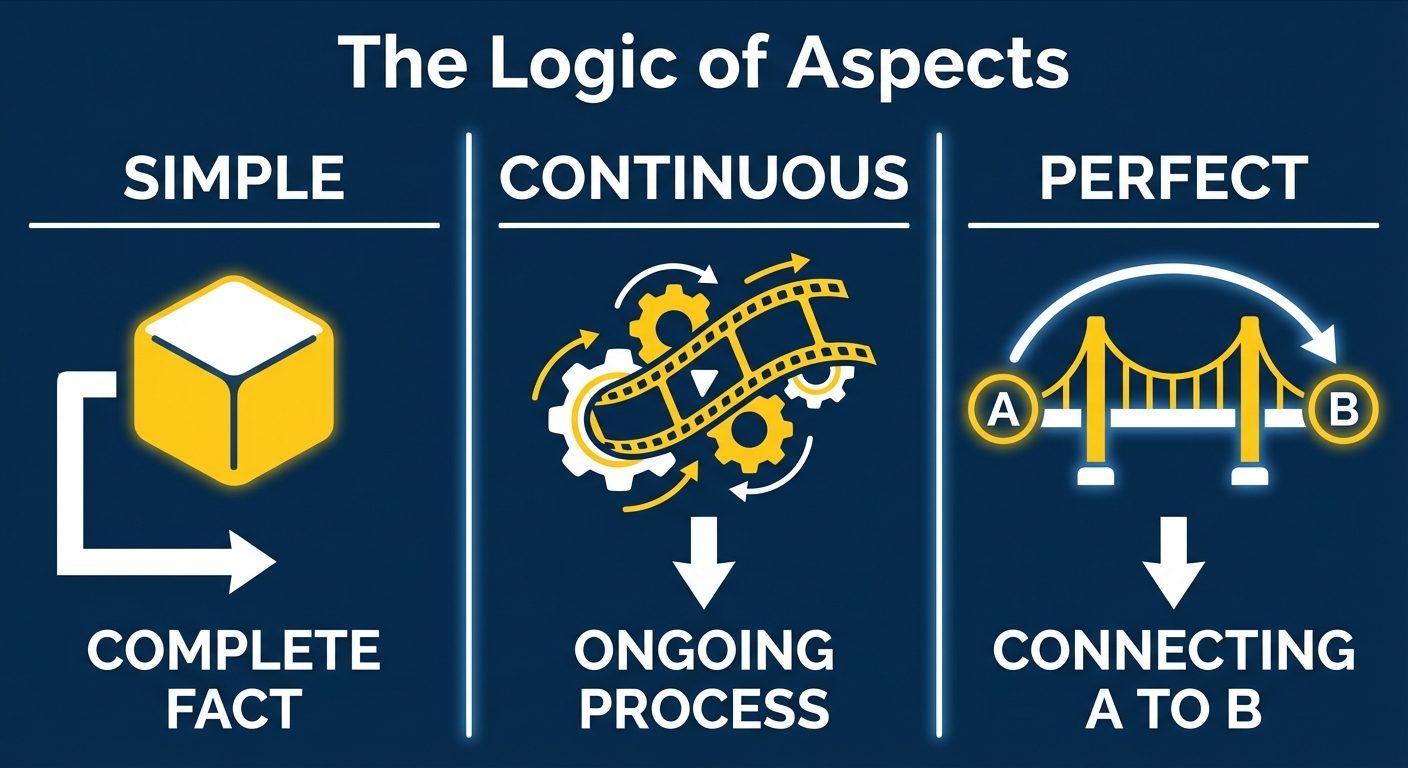
The "Perfect" aspect always implies a bridge or relationship between two times.
- Present Perfect: Past Present (Result/Life Experience).
- Past Perfect: Past (Earlier) Past (Later).
- Future Perfect: Now Future Deadline.
6. Study Exercises & Application
To master these tenses for Upper Intermediate communication:
- Narrate a story: Try to tell a story using Past Simple (events), Past Continuous (background), and Past Perfect (backstory).
- Predictions: Look at a photo and make predictions using "Going to" (evidence) and "Will" (opinion).
- Timelines: Draw personal timelines for your life achievements using Present Perfect (for indefinite times) and Past Simple (for specific dates).
Did this save you a night before the exam?
LPU Notes is free, and it stays free. Ads cover part of the server bill. The rest comes out of a student's own pocket: the domain, the storage, and keeping the site up through the weeks everyone needs it at once.
The payment button didn't load. An ad blocker or a filtered network is the usual reason. to try again.
Nothing here is ever locked, and nothing unlocks. Chip in only if it was worth it. What it pays for →