Unit 2: Statements & Questions
1. Direct & Indirect Objects
In English sentence structure, understanding the relationship between verbs and objects is crucial for clear communication. Transitive verbs often require objects to complete their meaning.
Definitions
- Direct Object (DO): The person or thing that directly receives the action of the verb. It answers the question "What?" or "Who?".
- Indirect Object (IO): The person or thing that receives the direct object. It answers the question "To whom?", "For whom?", "To what?", or "For what?".
Sentence Patterns
There are two main ways to structure sentences containing both direct and indirect objects.
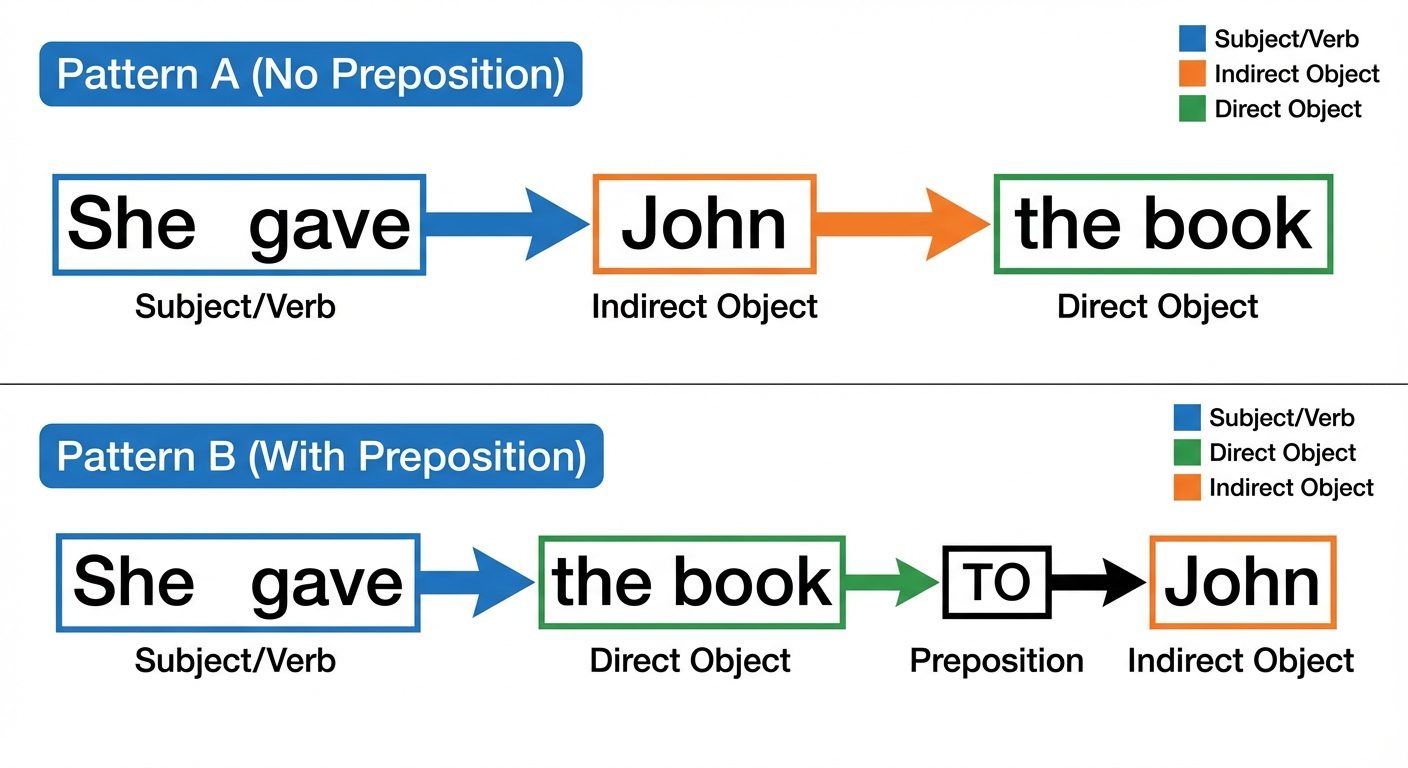
Pattern A: Verb + Indirect Object + Direct Object
In this pattern, no preposition is used. The indirect object comes immediately after the verb.
- Structure: Subject + Verb + IO + DO
- Example: She sent her mother flowers.
- Verb: Sent
- IO (Receiver): Her mother
- DO (Item sent): Flowers
Pattern B: Verb + Direct Object + Preposition + Indirect Object
In this pattern, the direct object comes first, followed by a preposition (usually "to" or "for") and then the indirect object.
- Structure: Subject + Verb + DO + to/for + IO
- Example: She sent flowers to her mother.
Common Verbs
- Verbs taking "to": give, lend, offer, pass, post, read, sell, send, show, teach, tell, write.
- Verbs taking "for": buy, cook, find, get, make, order, save.
2. Types of Questions
Yes/No Questions
These are closed-ended questions that ask for confirmation or denial.
- Structure: Auxiliary Verb (be/do/have) or Modal Verb + Subject + Main Verb
- Intonation: Typically requires rising intonation at the end of the sentence.
| Tense | Auxiliary/Modal | Subject | Main Verb | Example |
|---|---|---|---|---|
| Present Simple | Do / Does | you / she | work? | Do you work here? |
| Past Simple | Did | they | call? | Did they call yesterday? |
| Present Perfect | Have / Has | you / he | eaten? | Has he eaten lunch? |
| Future / Modal | Will / Can | we | go? | Can we go now? |
Wh- Questions (Information Questions)
These are open-ended questions that require specific information. They begin with interrogative words: Who, What, Where, When, Why, Which, How, How much/many.
- General Structure: Wh- Word + Auxiliary Verb + Subject + Main Verb
- Example: Where (Wh) did (Aux) you (Sub) go (Verb)?
3. Subject vs. Object Questions
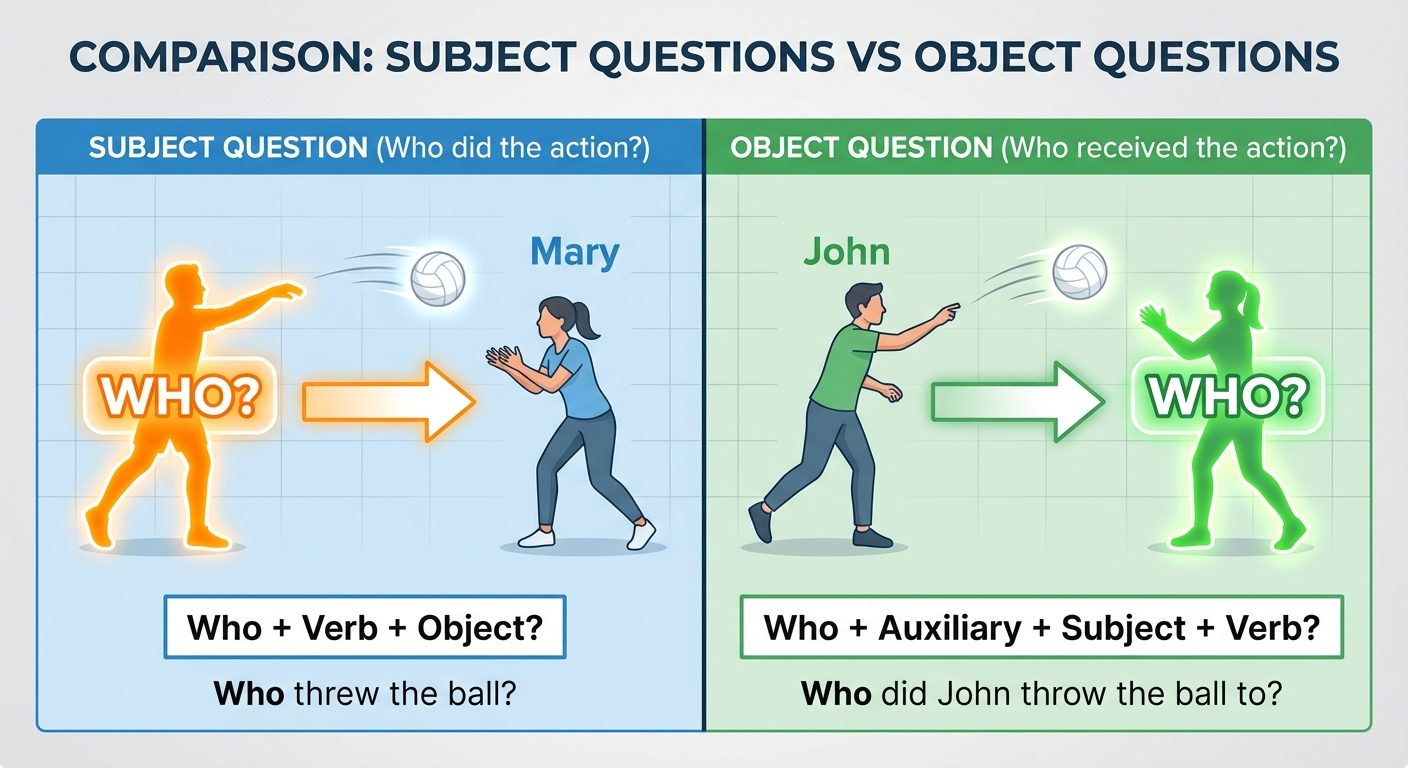
A critical distinction in upper-intermediate grammar is understanding who performs the action versus who receives it. The grammatical structure changes depending on what is being asked.
Object Questions
These ask about the object (receiver) of the action. This is the standard question format requiring an auxiliary verb (do, does, did).
- Scenario: You called someone. We want to know who.
- Structure: Wh- Word + Auxiliary + Subject + Verb?
- Example: Who did you call?
- Answer: I called John. (John is the object).
Subject Questions
These ask about the subject (doer) of the action. When Who or What is the subject of the sentence, do not use "do/does/did." The word order is the same as a positive statement.
- Scenario: Someone called you. We want to know who.
- Structure: Wh- Word (Subject) + Verb (conjugated for 3rd person singular)?
- Example: Who called you? (NOT: Who did call you?)
- Answer: John called me. (John is the subject).
4. Prepositions in Wh- Questions
When a question involves a prepositional verb (wait for, listen to, talk about), the placement of the preposition determines the formality of the sentence.
Informal / Neutral (End Placement)
In modern English, it is standard to place the preposition at the very end of the question.
- Example: Who are you waiting for?
- Example: What are they talking about?
Formal (Front Placement)
In very formal contexts (academic or legal English), the preposition is placed before the question word. Note that "Who" must change to "Whom" when preceded by a preposition.
- Example: For whom are you waiting?
- Example: About what are they talking?
5. Negative Statements & Questions
Negative Statements
Standard negation uses "not" after the auxiliary verb.
- Present Simple: He does not (doesn't) like coffee.
- Perfect Tense: They have not (haven't) finished.
Negative Questions
Negative questions are used for two specific purposes rather than asking for unknown information:
- Confirmation/Expectation: You expect the answer to be "Yes" and want confirmation.
- Example: "Didn't you go to the party?" (I thought you went; I am surprised you might not have).
- Exclamation/Opinion: Expressing an opinion politely or persuasively.
- Example: "Isn't it a beautiful day?" (I think it is beautiful).
Answering Negative Questions:
In English, "Yes" always means the positive action occurred, and "No" means it didn't, regardless of how the question is phrased.
- Q: Don't you like pizza?
- A: Yes, I do. (I like it).
- A: No, I don't. (I dislike it).
6. Agreement & Disagreement: So / Neither / I think so
Short responses are essential for fluid communication. They allow speakers to agree or disagree without repeating the full sentence.
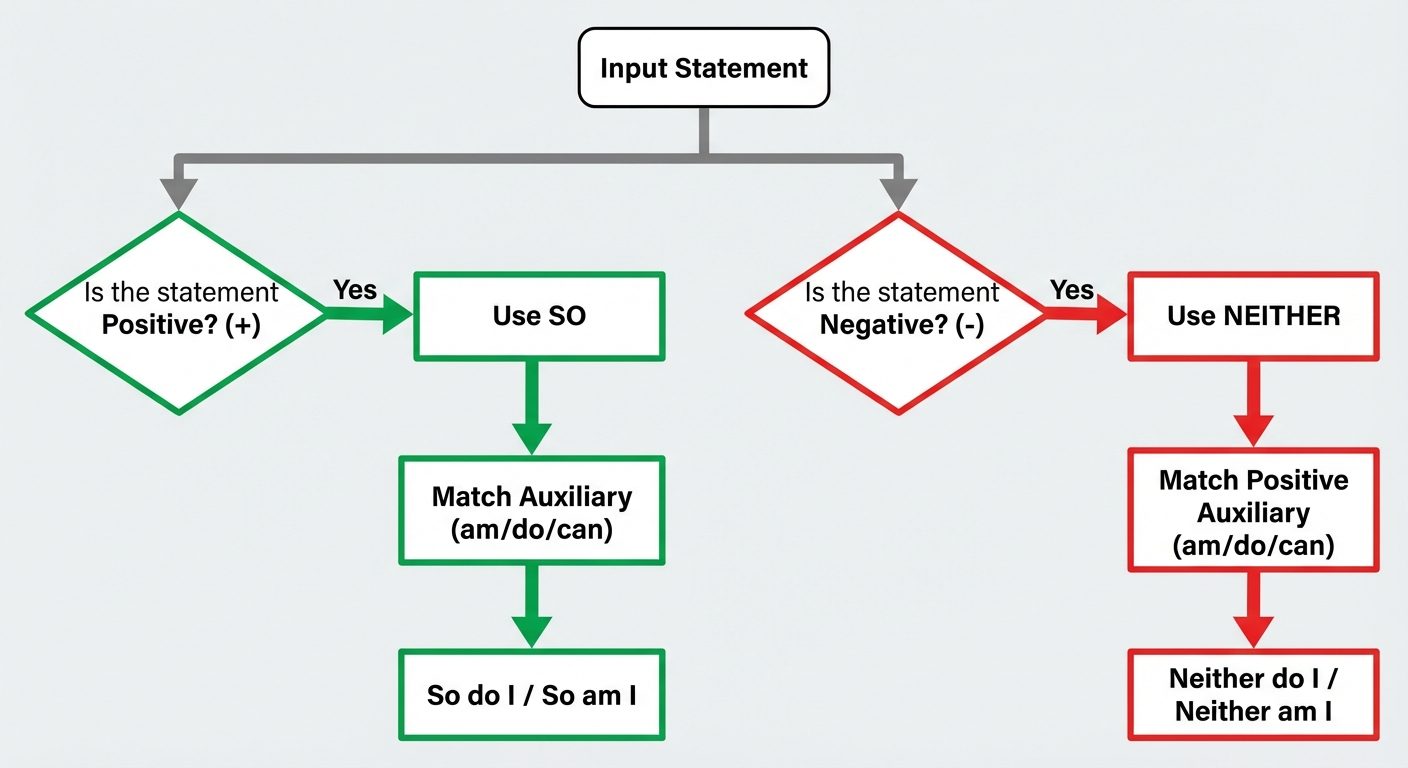
"So" and "Neither" (Parallel Additions)
This structure is used to say that a second person is the same as the first.
1. Agreeing with Positive Statements (Use "So")
- Structure: So + Auxiliary Verb + Subject
- Logic: Match the tense of the original statement.
- A: "I am hungry." -> B: "So am I."
- A: "I work hard." -> B: "So do I." (Use 'do' for simple present verbs).
- A: "I can swim." -> B: "So can I."
2. Agreeing with Negative Statements (Use "Neither")
- Structure: Neither + Auxiliary Verb + Subject
- Logic: Match the tense. Do NOT add "not" again (Neither is already negative).
- A: "I don't like rain." -> B: "Neither do I."
- A: "I haven't finished." -> B: "Neither have I."
- A: "I can't drive." -> B: "Neither can I."
"I think so" / "I hope so" (Hedged Responses)
These are used to answer Yes/No questions when you are not 100% certain or want to express a wish.
- Positive: "I think so" / "I hope so" / "I believe so" / "I suppose so".
- Q: Is the shop open? A: I think so.
- Negative:
- Think/Believe/Suppose: Move the negative to the main verb -> "I don't think so."
- Hope: Keep hope positive and make "so" negative -> "I hope not." (NOT: I don't hope so).
Did this save you a night before the exam?
LPU Notes is free, and it stays free. Ads cover part of the server bill. The rest comes out of a student's own pocket: the domain, the storage, and keeping the site up through the weeks everyone needs it at once.
The payment button didn't load. An ad blocker or a filtered network is the usual reason. to try again.
Nothing here is ever locked, and nothing unlocks. Chip in only if it was worth it. What it pays for →