Unit 1: Parts of Speech & their impact on Errors and Pronunciation
1. Classification of Pronouns
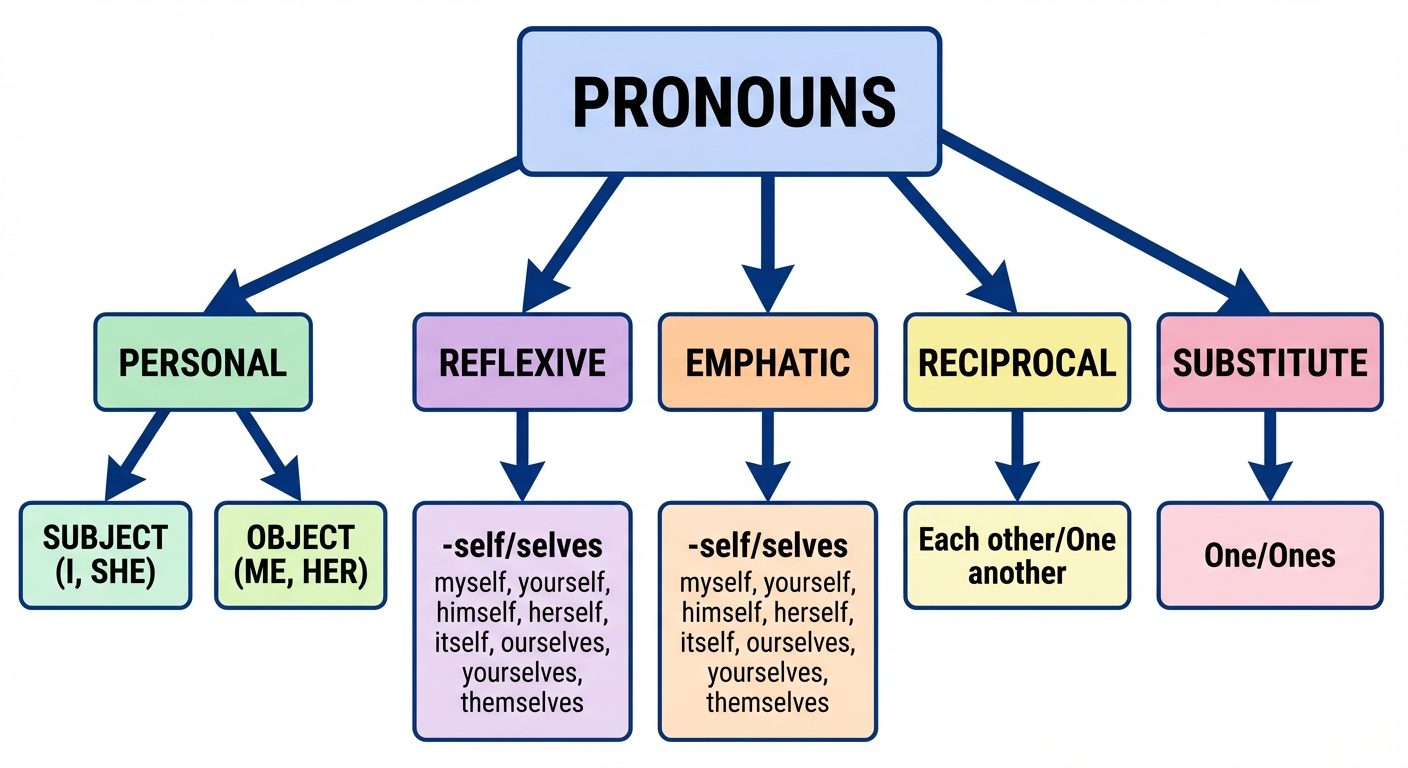
Pronouns are words used to replace nouns or noun phrases to avoid repetition. Understanding their specific categories is crucial for grammatical accuracy and fluency.
A. Personal Pronouns
Personal pronouns represent specific people or things. They change form depending on their grammatical function (case).
- Subject Case: Used when the pronoun performs the action (I, you, he, she, it, we, they).
- Object Case: Used when the pronoun receives the action (me, you, him, her, it, us, them).
Common Errors:
- Incorrect: Him and me went to the store. (Subject needed)
- Correct: He and I went to the store.
- Incorrect: The gift is for she. (Object needed)
- Correct: The gift is for her.
Pronunciation Impact:
- Weak vs. Strong Forms: Personal pronouns often use "weak forms" (schwa sound /ə/) in connected speech unless emphasized.
- Example: "Tell them to come" /tel ðəm/ (weak) vs. "Tell THEM, not him" /ðem/ (strong/stressed).
B. Reflexive Pronouns
These end in -self (singular) or -selves (plural). They are used when the subject and the object of the sentence are the same entity. The action reflects back on the doer.
- Forms: myself, yourself, himself, herself, itself, ourselves, yourselves, themselves.
- Example: "She cut herself while cooking."
Common Error: Using reflexive pronouns where personal pronouns are required.
- Error: Please contact John or myself.
- Correction: Please contact John or me.
C. Emphatic Pronouns
These have the same physical form as reflexive pronouns but a different function. They are used solely to emphasize a noun or pronoun. They can be removed from the sentence without changing the grammatical completeness.
- Example: "I myself baked the cake." (Emphasis on the fact that I did it, not someone else).
- Test: If you remove the pronoun and the sentence still makes sense, it is emphatic.
- Reflexive: He killed himself. (Remove "himself" "He killed." Incomplete meaning).
- Emphatic: He spoke to the boss himself. (Remove "himself" "He spoke to the boss." Complete meaning).
D. Reciprocal Pronouns
Used to indicate a mutual relationship or action.
- Each other: Generally used for two people/things.
- Example: Romeo and Juliet loved each other.
- One another: Generally used for more than two people/things.
- Example: The team members supported one another.
Pronunciation: Stress is usually on the second word (each OTHER, one anOTHER).
E. Substitute Pronouns
Used to replace a countable noun mentioned earlier to avoid repetition.
- One: Singular substitute.
- Example: "I lost my pen. I need to buy a new one."
- Ones: Plural substitute.
- Example: "I don't like green apples. I prefer red ones."
2. Adverbs: Types and Positions
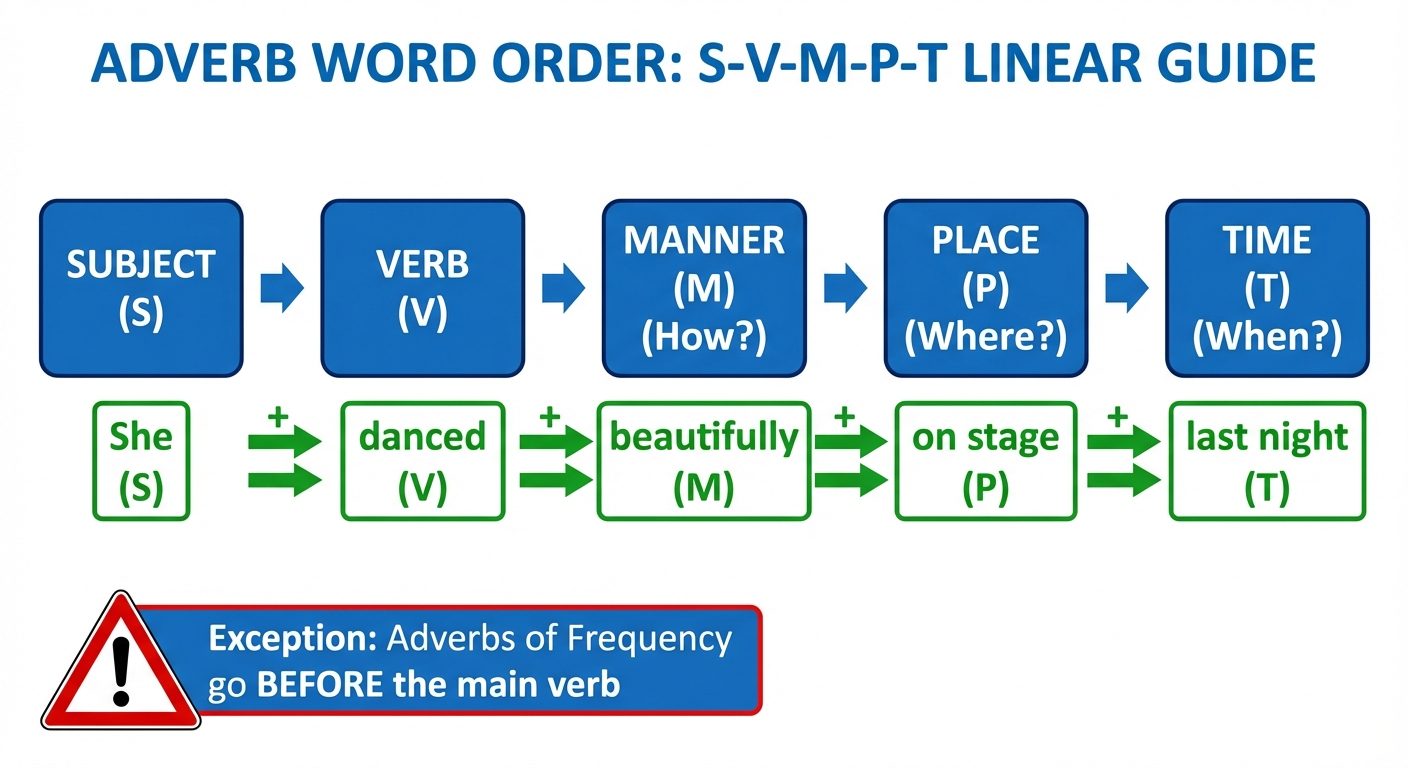
Adverbs modify verbs, adjectives, or other adverbs. The placement of adverbs is a frequent source of syntax errors in upper-intermediate communication.
A. Types of Adverbs
- Manner: How an action is done (e.g., slowly, carefully, well).
- Place: Where an action happens (e.g., here, there, nearby).
- Time: When an action happens (e.g., yesterday, now, soon).
- Frequency: How often an action happens (e.g., always, never, often).
- Degree: Intensity of a quality (e.g., very, quite, too).
B. Position of Adverbs
The meaning of a sentence can shift drastically based on adverb placement.
1. Front Position
Used for emphasis or setting the context.
- Example: "Yesterday, I met him." (Emphasis on the time).
2. Mid Position (The "Frequency" Rule)
Adverbs of frequency (always, never, usually) typically go:
- Before the main verb: "I always drink coffee."
- After the verb 'to be': "She is always late."
- Between auxiliary and main verb: "I have never seen it."
3. End Position (Order of Adverbs)
When multiple adverbs appear at the end of a sentence, the standard order is Manner Place Time.
- Correct: He played brilliantly (Manner) in the match (Place) yesterday (Time).
- Error: He played yesterday brilliantly in the match.
C. Sentence Adverbs
These modify the entire sentence rather than just the verb. They express the speaker's attitude or viewpoint. usually placed at the beginning.
- Examples: Fortunately, Surprisingly, Obviously, Frankly.
- Usage: "Frankly, I don't care."
Pronunciation Impact:
Sentence adverbs act as separate tone units. They are usually followed by a slight pause (comma in writing) and have their own intonation contour.
- Pronunciation: Fortunately (falling tone + pause), we arrived on time.
3. Linking Words (Connectors)
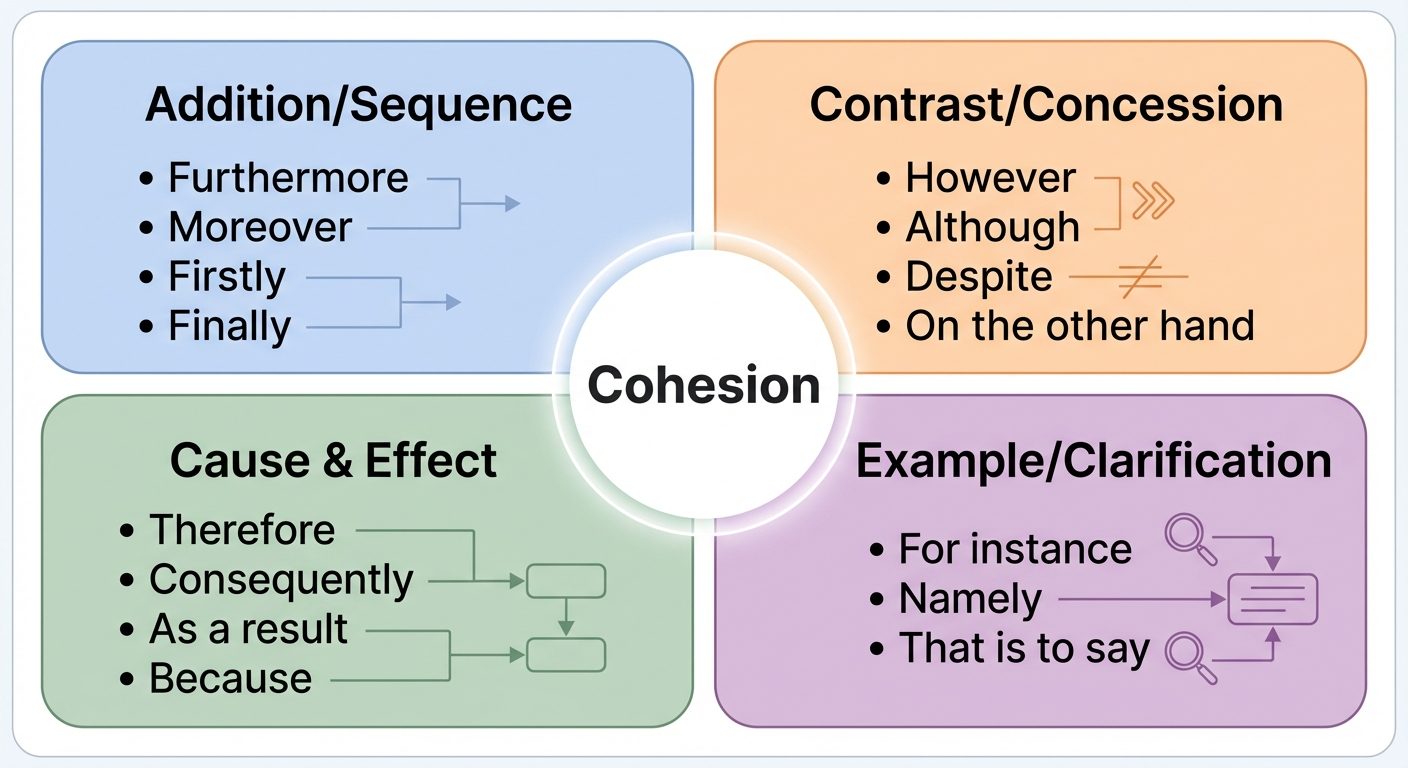
Linking words connect ideas, sentences, or clauses, providing cohesion to speech and writing.
Categories and Usage
1. Addition & Sequence
- Words: Furthermore, Moreover, Additionally, Firstly, Next.
- Usage: Adding information or ordering points.
- Common Error: Using "And" to start every sentence in formal writing. Use "In addition" or "Moreover" instead.
2. Contrast & Concession
- Words: However, Although, Despite, In spite of, Whereas.
- Grammar Rule:
- Although/Even though + Clause (Subject + Verb): "Although it rained, we played."
- Despite/In spite of + Noun/Gerund (-ing): "Despite the rain, we played." or "Despite raining, we played."
3. Cause & Effect
- Words: Therefore, Consequently, As a result, Due to.
- Usage: "It was raining heavy; consequently, the match was canceled."
Impact on Pronunciation
Linking words are "signposts" for the listener.
- Pausing: Speakers generally pause slightly after a linking word at the start of a sentence.
- Intonation: A rise-fall tone is often used on words like "However" or "Therefore" to signal that more information is coming.
- Example: "However (pause/pitch change), the data was incorrect."
4. Summary of Common Errors & Correction Strategies
| Part of Speech | Common Error Example | Correction | Explanation |
|---|---|---|---|
| Pronoun | "Me and John went out." | "John and I went out." | Subject case is required. Polite order places others first. |
| Reflexive | "He dressed hisself." | "He dressed himself." | "Hisself" is non-standard dialect; avoid in formal use. |
| Adverb | "I run fastly." | "I run fast." | "Fast" is an irregular adverb; it does not take "-ly". |
| Adverb Order | "I go often there." | "I often go there." | Adverbs of frequency go before the main verb. |
| Linking Word | "Despite he is old, he runs." | "Although he is old..." or "Despite his age..." | "Despite" cannot be followed immediately by a clause. |
Note on Pronunciation Nuances
- Schwa (/ə/): In fluent speech, pronouns (us, them, her) often reduce to the schwa sound. Mastering this reduction makes speech sound more natural (Upper Intermediate level skill).
- Stress Shift: Changing the stress on reflexive pronouns changes meaning.
- "I did it MYself" (I did it alone/without help).
- "I did it mySELF" (Rare, usually implies emphasis on the person).
Did this save you a night before the exam?
LPU Notes is free, and it stays free. Ads cover part of the server bill. The rest comes out of a student's own pocket: the domain, the storage, and keeping the site up through the weeks everyone needs it at once.
The payment button didn't load. An ad blocker or a filtered network is the usual reason. to try again.
Nothing here is ever locked, and nothing unlocks. Chip in only if it was worth it. What it pays for →