Unit 3: Tenses
Tenses are grammatical forms of verbs that indicate the time of an action, event, or state of being. They generally relate the time of the action to the moment of speaking.
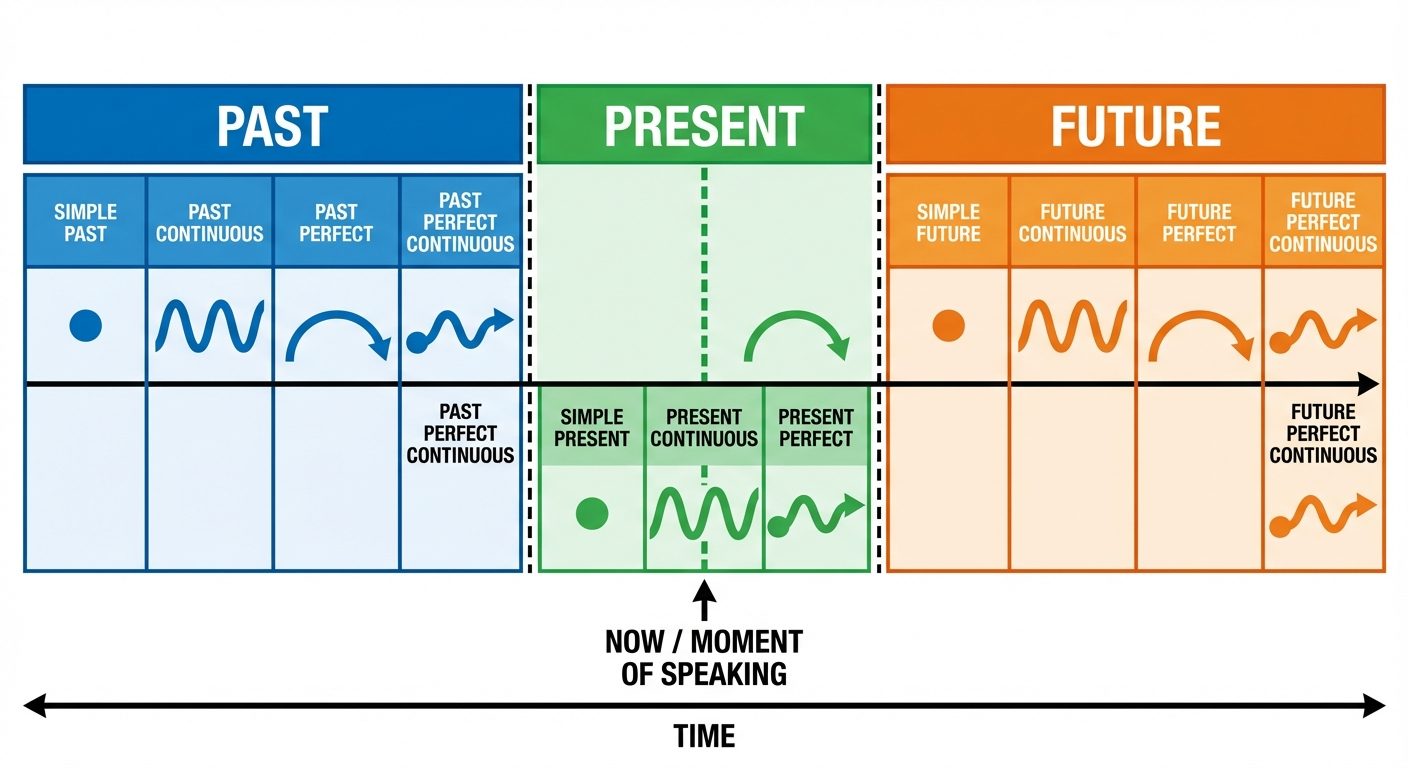
1. The Present Tense
The Present Tense indicates an action occurring now, occurring habitually, or stating a general truth.
A. Simple Present Tense
Used for habits, general truths, repeated actions, or unchanging situations.
- Formation:
- Affirmative: Subject + V1 (s/es for He/She/It) + Object
- Negative: Subject + do/does + not + V1 + Object
- Interrogative: Do/Does + Subject + V1 + Object?
- Examples:
- She writes a letter.
- The sun rises in the east.
- Question Tags:
- Positive statement Negative tag: "She likes coffee, doesn't she?"
- Negative statement Positive tag: "You don't smoke, do you?"
B. Present Continuous Tense
Used for actions happening exactly at the moment of speaking or temporary situations.
- Formation:
- Affirmative: Subject + is/am/are + V1 + ing + Object
- Negative: Subject + is/am/are + not + V1 + ing + Object
- Interrogative: Is/Am/Are + Subject + V1 + ing + Object?
- Examples:
- I am reading a book now.
- They are playing football.
- Question Tags:
- "He is coming, isn't he?"
- "I am late, aren't I?" (Note: "amn't I" is not standard; "aren't I" is the correct tag for "I am").
C. Present Perfect Tense
Used for actions completed recently or actions where the time is not specific, linking the past to the present.
- Formation:
- Affirmative: Subject + has/have + V3 (Past Participle) + Object
- Negative: Subject + has/have + not + V3 + Object
- Interrogative: Has/Have + Subject + V3 + Object?
- Examples:
- I have finished my work.
- She has visited Paris.
- Question Tags:
- "They have left, haven't they?"
D. Present Perfect Continuous Tense
Used for actions that started in the past and are continuing in the present. Emphasis is on duration.
- Formation:
- Affirmative: Subject + has/have + been + V1 + ing + Object
- Usage Keywords: Since (point of time), For (duration of time).
- Examples:
- It has been raining since morning.
- We have been waiting for two hours.
2. The Past Tense
The Past Tense indicates actions that have already happened or states of being in the past.
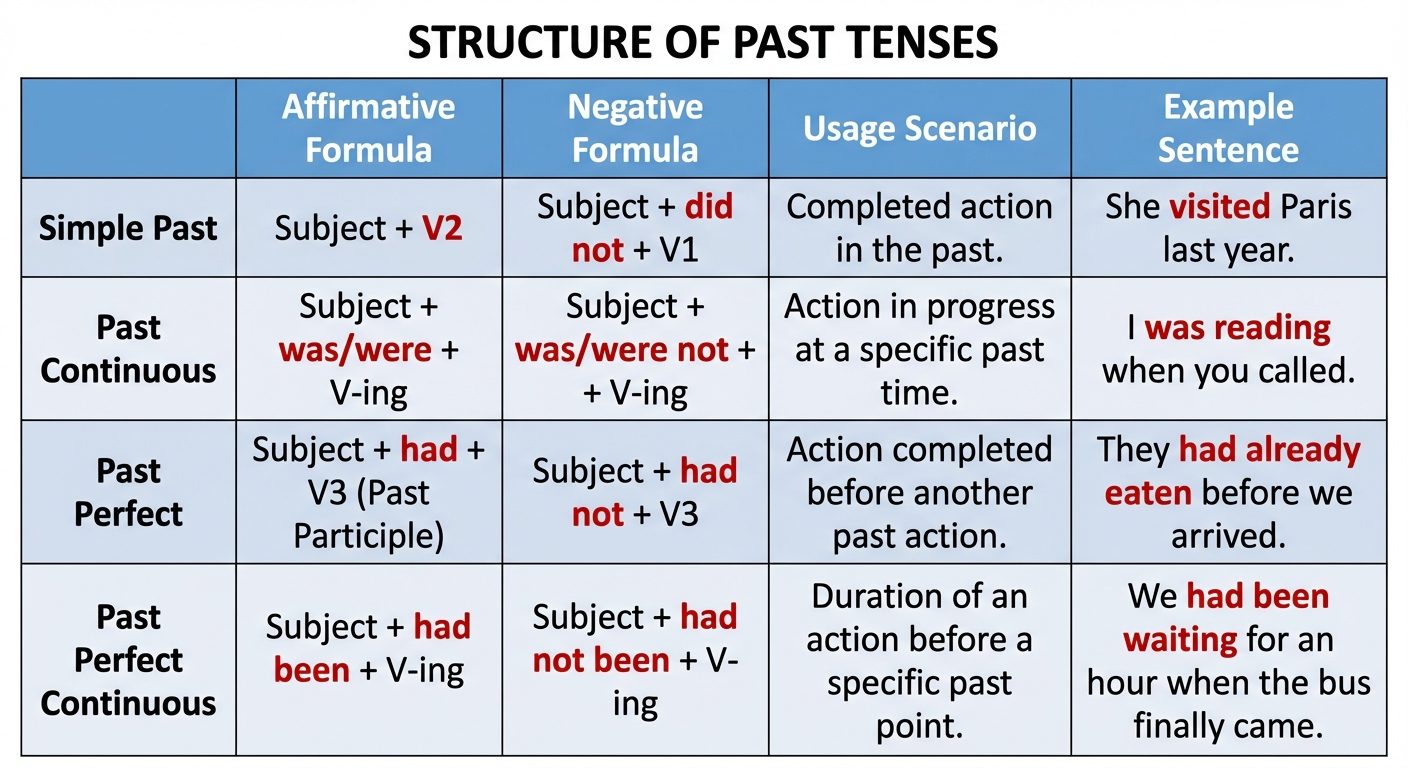
A. Simple Past Tense
Used for actions completed in the past at a definite time.
- Formation:
- Affirmative: Subject + V2 + Object
- Negative: Subject + did + not + V1 + Object
- Interrogative: Did + Subject + V1 + Object?
- Examples:
- I met him yesterday.
- She bought a car last year.
- Question Tags:
- Uses 'did'.
- "You saw the movie, didn't you?"
- "He didn't call, did he?"
B. Past Continuous Tense
Used for actions going on at a specific time in the past or an action interrupted by another.
- Formation:
- Affirmative: Subject + was/were + V1 + ing + Object
- Negative: Subject + was/were + not + V1 + ing + Object
- Examples:
- I was sleeping when you called.
- They were watching TV all evening.
- Question Tags:
- "She was cooking, wasn't she?"
C. Past Perfect Tense
Used to describe an action completed before a certain moment in the past or before another past action.
- Formation:
- Affirmative: Subject + had + V3 + Object
- Rule: When two actions happen in the past, the earlier action is in Past Perfect, and the later action is in Simple Past.
- Example:
- The train had left before I reached the station.
- Question Tags:
- "He had gone, hadn't he?"
D. Past Perfect Continuous Tense
Used for an action that began before a certain point in the past and continued up to that time.
- Formation:
- Affirmative: Subject + had + been + V1 + ing + Object
- Example:
- He had been working there for ten years when the company closed.
3. The Future Tense
The Future Tense expresses actions that have not yet happened or will happen later.
A. Simple Future Tense
Used for predictions, instant decisions, or future facts.
- Formation:
- Affirmative: Subject + will/shall + V1 + Object
- Negative: Subject + will/shall + not + V1 + Object
- Examples:
- I will help you.
- It will rain tomorrow.
- Question Tags:
- Note: The negative tag for "will" is "won't". The negative tag for "shall" is "shan't".
- "You will come, won't you?"
- "He won't mind, will he?"
B. Future Continuous Tense
Used for an action that will be in progress at a specific time in the future.
- Formation:
- Affirmative: Subject + will + be + V1 + ing + Object
- Example:
- At this time tomorrow, I will be flying to London.
C. Future Perfect Tense
Used to indicate an action that will be completed by a specific future time.
- Formation:
- Affirmative: Subject + will + have + V3 + Object
- Example:
- I will have finished the project by Monday.
- Question Tags:
- "He will have arrived by then, won't he?"
D. Future Perfect Continuous Tense
Used to express a continued action that will be completed at some point in the future.
- Formation:
- Affirmative: Subject + will + have + been + V1 + ing + Object
- Example:
- By next year, we will have been living here for a decade.
4. Imperative Negative Sentences
Imperative sentences give orders, commands, instructions, or advice. The negative form prohibits an action.
Formation Rules
- Structure:
Do not(or contractionDon't) +Base Form of Verb (V1)+Object/Complement. - The subject "You" is always implied and hidden.
Usage and Examples
- Strict Command: Do not enter the room.
- Instruction: Don't press the red button.
- Advice: Do not eat too much sugar.
- Request (with 'please'): Please do not smoke here.
5. Question Tags: Comprehensive Rules
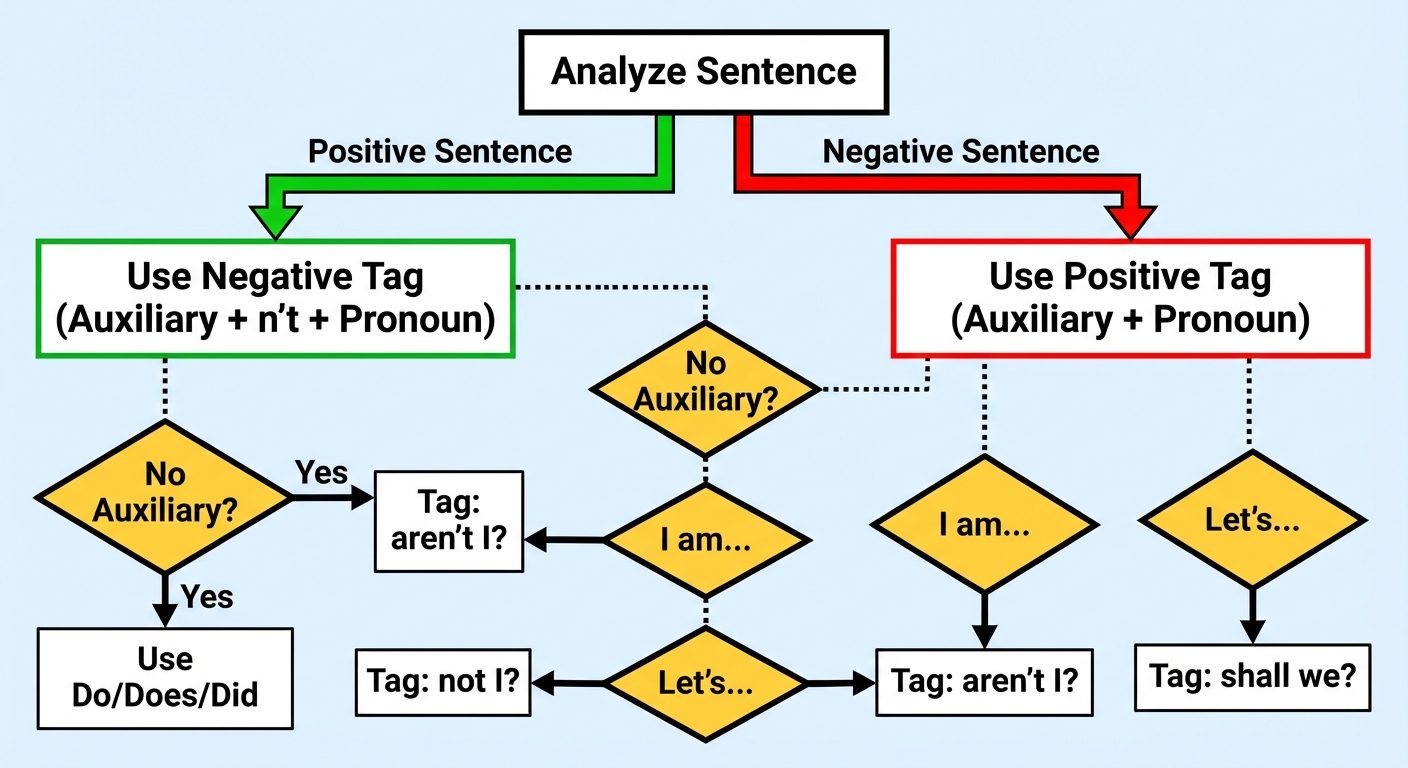
A question tag is a short question added to the end of a declarative sentence to seek confirmation.
General Rules
- Opposite Polarity:
- Positive Statement Negative Tag.
- Negative Statement Positive Tag.
- Auxiliary Verbs: Use the same auxiliary verb (is, are, was, were, has, have, will, can) as in the main sentence.
- No Auxiliary: If there is no auxiliary (Simple Present/Simple Past), use do/does/did.
- Pronouns: Always use a personal pronoun (he, she, it, they, we, I) in the tag, never the noun.
Specific Tense Applications
| Tense | Sentence Example | Tag Construction | Final Tag |
|---|---|---|---|
| Simple Present | She eats apples. | (Positive Negative, does) | doesn't she? |
| Simple Present | They don't study. | (Negative Positive, do) | do they? |
| Simple Past | He went home. | (Positive Negative, did) | didn't he? |
| Present Perfect | You have seen it. | (Positive Negative, have) | haven't you? |
| Future | They will win. | (Positive Negative, will) | won't they? |
| Imperative | Open the door. | (Command/Request) | will you? / won't you? |
| Suggestion | Let's go out. | (Suggestion) | shall we? |
Did this save you a night before the exam?
LPU Notes is free, and it stays free. Ads cover part of the server bill. The rest comes out of a student's own pocket: the domain, the storage, and keeping the site up through the weeks everyone needs it at once.
The payment button didn't load. An ad blocker or a filtered network is the usual reason. to try again.
Nothing here is ever locked, and nothing unlocks. Chip in only if it was worth it. What it pays for →