Unit 2: Building Sentences
This unit focuses on the syntax and logical flow of English communication. Building effective sentences requires the correct use of conjunctions, connectors, and relative clauses to join ideas, show relationships, and add detail.
1. Coordinating and Correlative Conjunctions
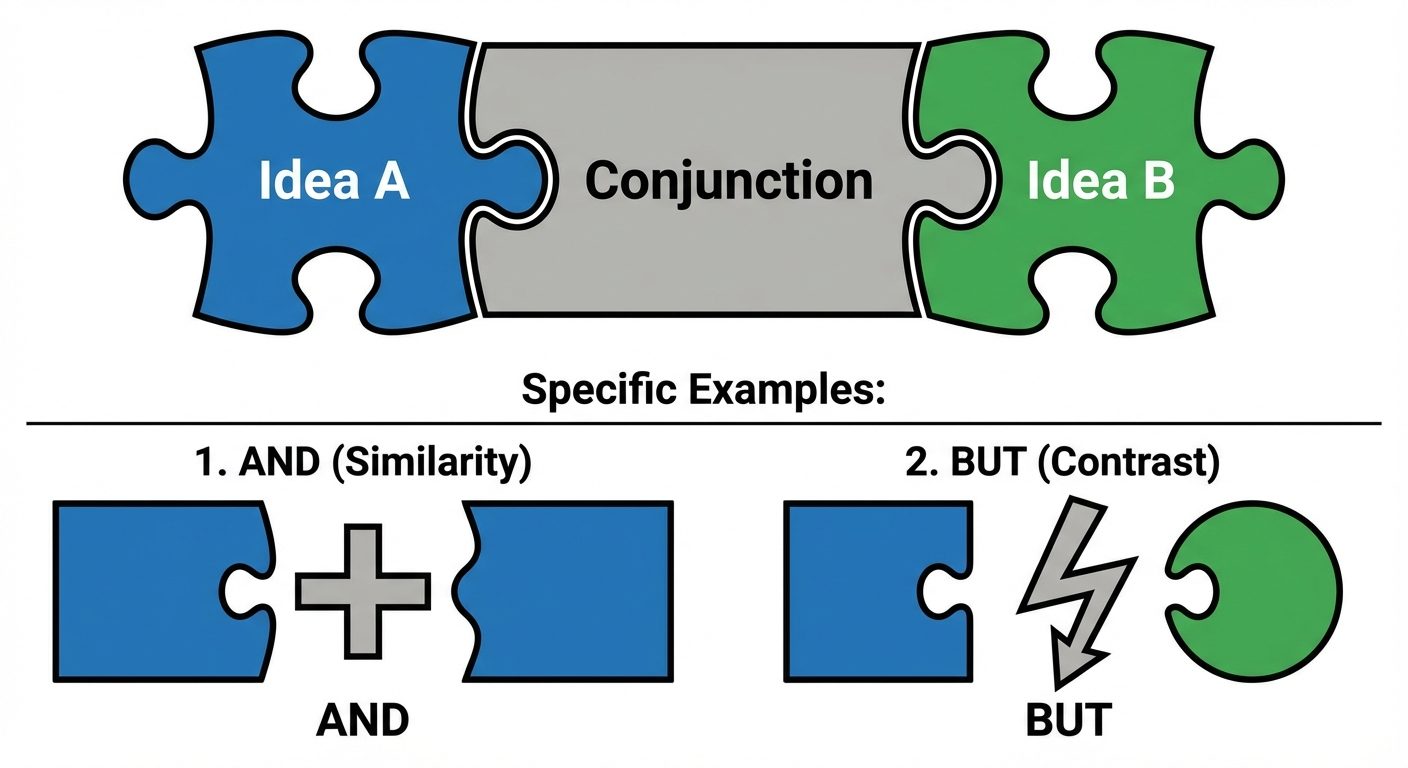
These connectors join words, phrases, or independent clauses of equal grammatical importance.
Usage of 'And'
- Function: Used to add information or join similar ideas.
- Structure: Clause + , + and + Clause (comma is used if both clauses are independent).
- Examples:
- She studied hard, and she passed the exam.
- I need bread, milk, and eggs.
Usage of 'But'
- Function: Used to introduce a contrast or an exception to the previous statement.
- Structure: Clause + , + but + Clause.
- Examples:
- The car is old, but it runs perfectly.
- He wanted to go, but he was too tired.
Usage of 'Both... And'
- Function: A correlative conjunction used to emphasize that two distinct items or facts are true. It stresses the inclusion of both parts.
- Structure: Both + [Item A] + and + [Item B].
- Subject-Verb Agreement: The subject formed by "both...and" is always plural.
- Examples:
- Both the manager and the assistant are absent today.
- She is both intelligent and hardworking.
Usage of 'Either'
- Function: Used to indicate a choice between two possibilities. Often paired with "or".
- Structure: Either + [Option A] + or + [Option B].
- Note: When used alone at the end of a negative sentence, it means "also" (e.g., "I don't like it either").
- Examples:
- You can either call me or send an email.
- Either the blue shirt or the red one looks good.
2. Expressing Cause, Reason, and Result
These connectors explain why something happened or the consequence of an action.
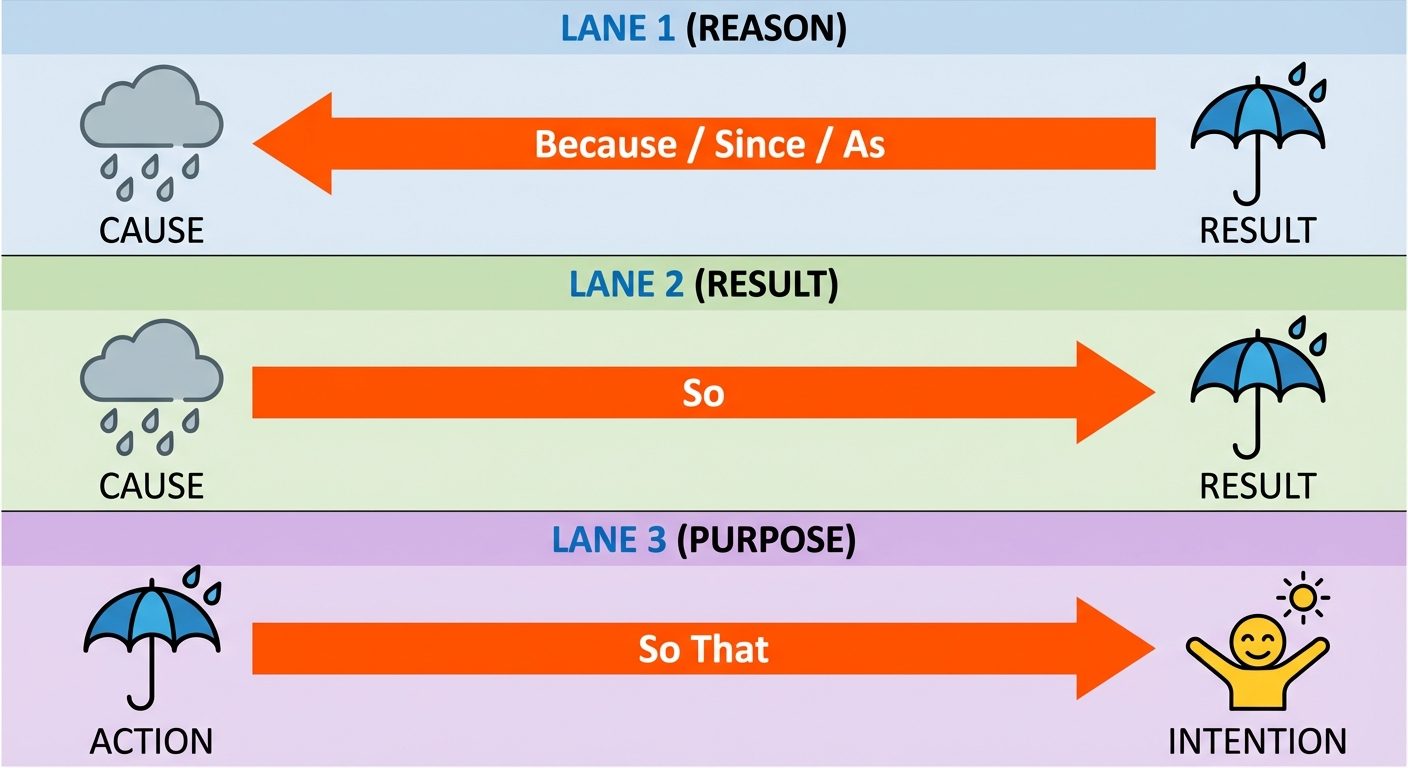
Usage of 'Because', 'Since', 'As', 'For' (Reason)
These words introduce the cause or reason.
| Connector | Nuance | Position | Example |
|---|---|---|---|
| Because | Strongest focus on the reason. | Usually mid-sentence; can start sentence. | I stayed home because it was raining. |
| Since | Focus is more on the result; the reason is often already known. | Often starts the sentence. | Since we have no money, we cannot buy it. |
| As | Similar to 'since'; less emphatic than 'because'. | Beginning or middle. | As you are busy, I will leave. |
| For | Formal/Literary usage. Introduces new information as a reason. | Always comes after the main clause (preceded by a comma). | He felt guilty, for he had lied to his friend. |
Usage of 'So' (Result)
- Function: Shows the consequence or effect of the previous statement.
- Structure: [Reason], + so + [Result].
- Example: It was raining, so we stayed home.
Usage of 'So that' (Purpose)
- Function: Explains the purpose or intention of an action (to make something possible). Usually followed by can/could/will/would.
- Example: I woke up early so that I wouldn't miss the bus.
3. Condition and Precaution
Usage of 'In case'
- Function: Used to express precaution. It means "because it is possible that something might happen."
- Distinction from 'If':
- If: Action happens only when the condition is met. (I will buy an umbrella if it rains.)
- In case: Action happens before to prepare for a possibility. (I will buy an umbrella in case it rains.)
- Examples:
- Take a map in case the GPS fails.
- Keep the window closed in case of mosquitoes.
4. Contrast and Concession
These words join ideas that seem contradictory or unexpected.
Usage of 'Although' and 'While' (Subordinating Conjunctions)
- Function: Connect a dependent clause of concession to a main clause.
- Structure: Although/While + [Subject + Verb].
- Examples:
- Although it rained, we enjoyed the picnic.
- While I understand your point, I disagree with the conclusion.
Usage of 'However' (Conjunctive Adverb)
- Function: Introduces a contrast in a new sentence or independent clause.
- Punctuation: Usually starts a sentence followed by a comma, or follows a semicolon.
- Structure: [Sentence A]. However, [Sentence B].
- Example: The prices are high. However, the quality is excellent.
Usage of 'Despite' (Preposition)
- Function: Shows contrast but must be followed by a noun, pronoun, or gerund (-ing form), NOT a full clause (Subject + Verb).
- Structure: Despite + [Noun Phrase / -ing].
- Examples:
- Despite the rain, we went out. (Correct)
- Despite it was raining... (Incorrect)
- Despite being tired, he finished the work.
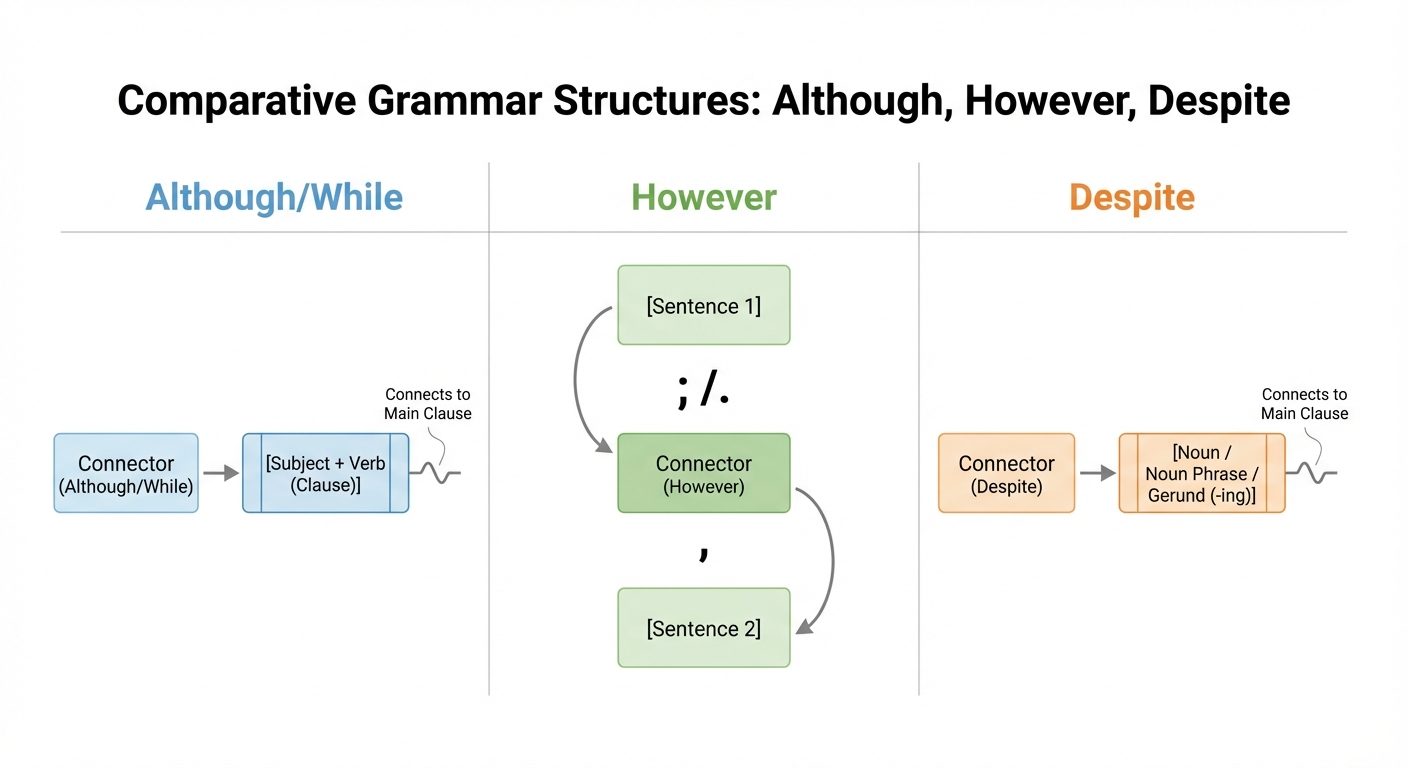 AI-generated image — may contain inaccuracies + [Subject] + [Verb].
Column 2 Header: "However" -> Visual block showing: [Sentence A] . [Connector] , [Sentence B]. Highlight the punctuation (period and comma).
Column 3 Header: "Despite" -> Visual block showing: [Connector] + [Noun Phrase / -ing]. Show a "No" symbol over a box labeled "Subject + Verb".
Use soft pastel background colors (blue, yellow, pink) for the columns. Text should be dark grey.]
5. Relative Clauses
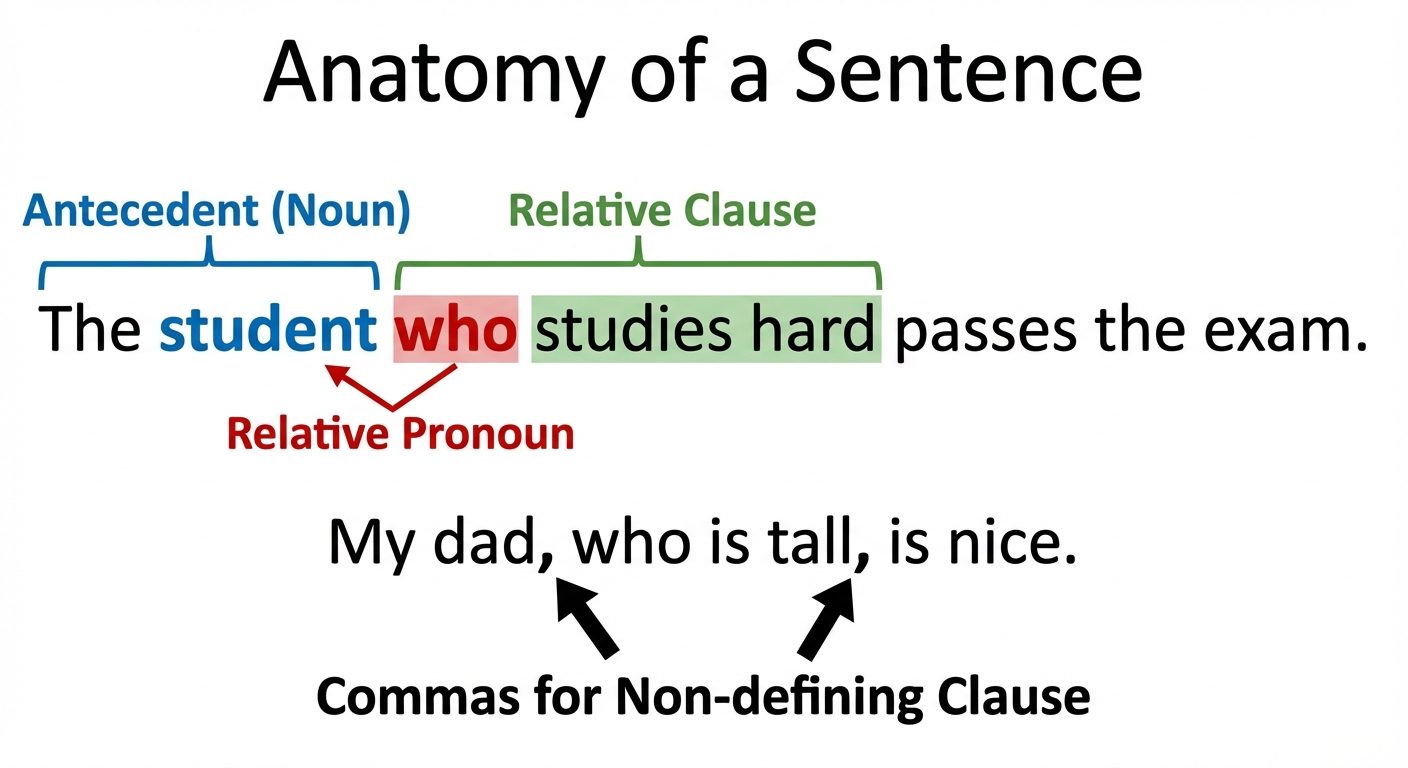
Relative clauses give information about a noun (people, things, places, or times). They function like adjectives.
Relative Pronouns
- Who: For people (subject).
- Which: For things/animals.
- That: For people, things, or animals (mostly in defining clauses).
- Whose: Possession.
- Where: Places.
- When: Time.
Defining vs. Non-Defining Relative Clauses
1. Defining Relative Clauses
- Function: Provide essential information needed to identify who or what is being talked about. Without this clause, the sentence loses its core meaning.
- Punctuation: NO commas are used.
- Example:
- The book that is on the table is mine. (Specifies which book).
- The man who called yesterday is here.
2. Non-Defining Relative Clauses
- Function: Provide extra, non-essential information. The sentence makes sense without it.
- Punctuation: Commas ARE used to separate the clause.
- Constraint: You cannot use 'that' in non-defining clauses.
- Example:
- My brother, who lives in London, is a doctor. (Fact: My brother is a doctor; where he lives is extra detail).
- The car, which was bought last year, broke down.
Did this save you a night before the exam?
LPU Notes is free, and it stays free. Ads cover part of the server bill. The rest comes out of a student's own pocket: the domain, the storage, and keeping the site up through the weeks everyone needs it at once.
The payment button didn't load. An ad blocker or a filtered network is the usual reason. to try again.
Nothing here is ever locked, and nothing unlocks. Chip in only if it was worth it. What it pays for →