Unit 1: Role of parts of speech in common errors and pronunciation
1. Types of Nouns
Nouns serve as the fundamental building blocks of sentences, functioning as the names of people, places, things, ideas, or qualities. Understanding noun types is essential for subject-verb agreement and article usage.
1.1 Classification of Nouns
Nouns are broadly classified into five specific categories based on what they represent:
- Proper Nouns: Specific names of people, places, or organizations. They always start with a capital letter.
- Examples: London, Microsoft, Sarah, Jupiter.
- Common Error: Using articles unnecessarily (e.g., "The India" is incorrect) or failing to capitalize.
- Common Nouns: General names for a class of people, places, or things.
- Examples: city, company, woman, planet.
- Collective Nouns: Names given to a group of people or things regarded as a unit.
- Examples: team, jury, committee, herd, fleet.
- Usage Note: In American English, these usually take a singular verb (The team is winning). In British English, they can take a plural verb if the members act individually.
- Material Nouns: Names of substances or materials out of which things are made.
- Examples: gold, wood, sugar, water, iron.
- Common Error: Using indefinite articles (a/an) with material nouns (e.g., "a gold" is incorrect; "a piece of gold" is correct).
- Abstract Nouns: Names of qualities, ideas, emotions, or states that cannot be touched or seen.
- Examples: happiness, bravery, childhood, honesty.
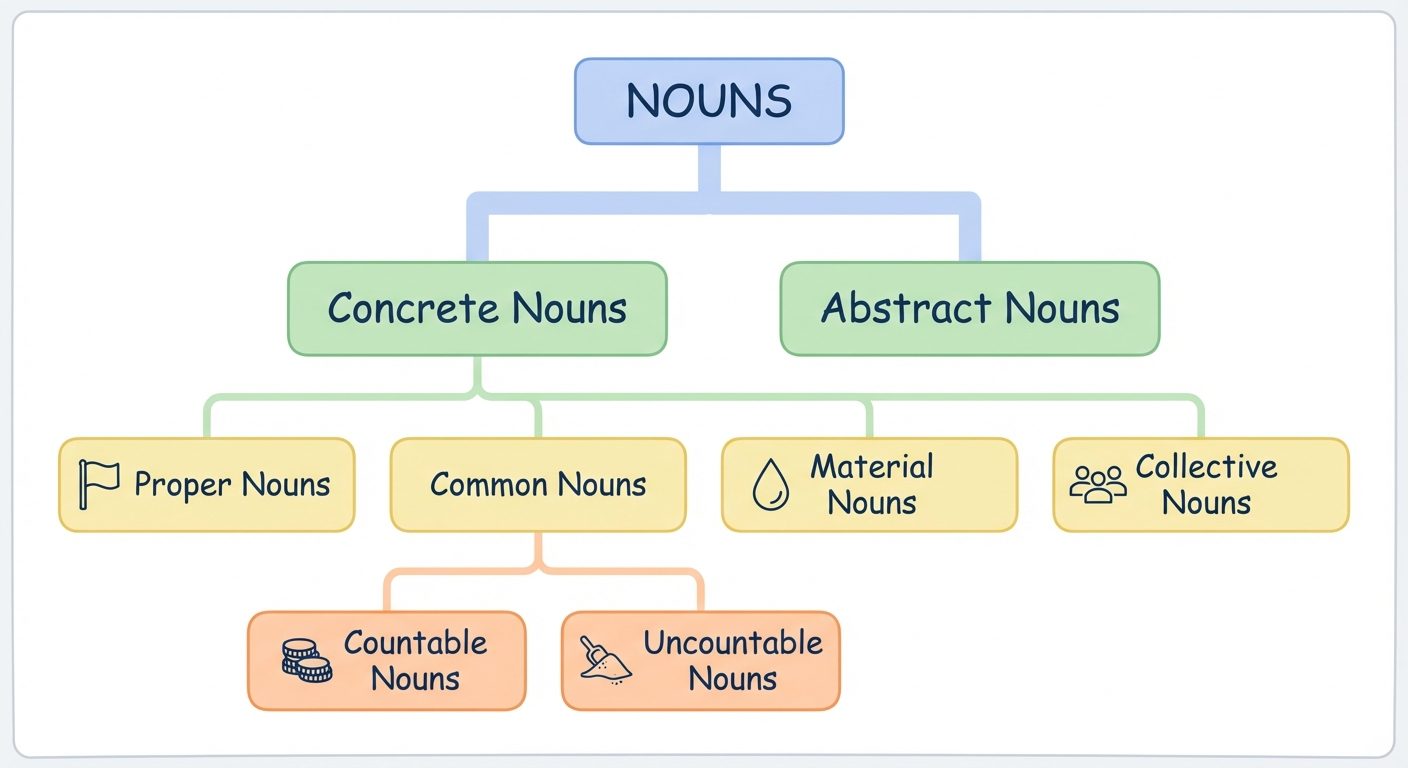
1.2 Countable vs. Uncountable Nouns
This distinction is the source of frequent grammatical errors regarding quantifiers (much/many, little/few).
| Feature | Countable Nouns | Uncountable Nouns |
|---|---|---|
| Definition | Can be counted (one, two, three). | Cannot be counted individually; treated as a mass. |
| Plural Form | Has a plural form (Book -> Books). | No plural form (Information -> Informations is wrong). |
| Articles | Can use a/an/the. | Cannot use a/an; use "some" or "the". |
| Quantifiers | Many, Few, A number of. | Much, Little, An amount of. |
| Examples | Pen, Student, Idea, Liter. | Water, Advice, Furniture, Equipment, Bread. |
Common Errors & Pronunciation:
- Error: "He gave me some advices." -> Correction: "He gave me some advice" or "pieces of advice."
- Pronunciation Note: Plural countable nouns ending in voiceless sounds (p, k, t, f) are pronounced /s/ (cats). Those ending in voiced sounds (b, g, d, v, m, n, l, r) are pronounced /z/ (dogs).
2. Usage of Apostrophe ‘s’ with Nouns (Possessives)
The apostrophe indicates possession or ownership. Misplacement of the apostrophe is one of the most common errors in written English.
2.1 Rules for Forming Possessives
- Singular Nouns: Add ’s (apostrophe + s).
- Example: The boy’s bag; The boss’s cabin.
- Plural Nouns ending in ‘s’: Add only ’ (apostrophe).
- Example: The boys’ school (school for many boys); The ladies’ room.
- Irregular Plural Nouns (not ending in ‘s’): Add ’s.
- Example: Children’s park; Women’s rights.
- Compound Nouns: Add ’s to the last word.
- Example: My father-in-law’s car; The Commander-in-Chief’s orders.
- Joint vs. Separate Possession:
- Joint Possession (Shared ownership): Add ’s only to the last name.
- Example: "Rahul and Priya’s house" (They share one house).
- Separate Possession (Individual ownership): Add ’s to each name.
- Example: "Rahul’s and Priya’s offices" (They have two different offices).
- Joint Possession (Shared ownership): Add ’s only to the last name.
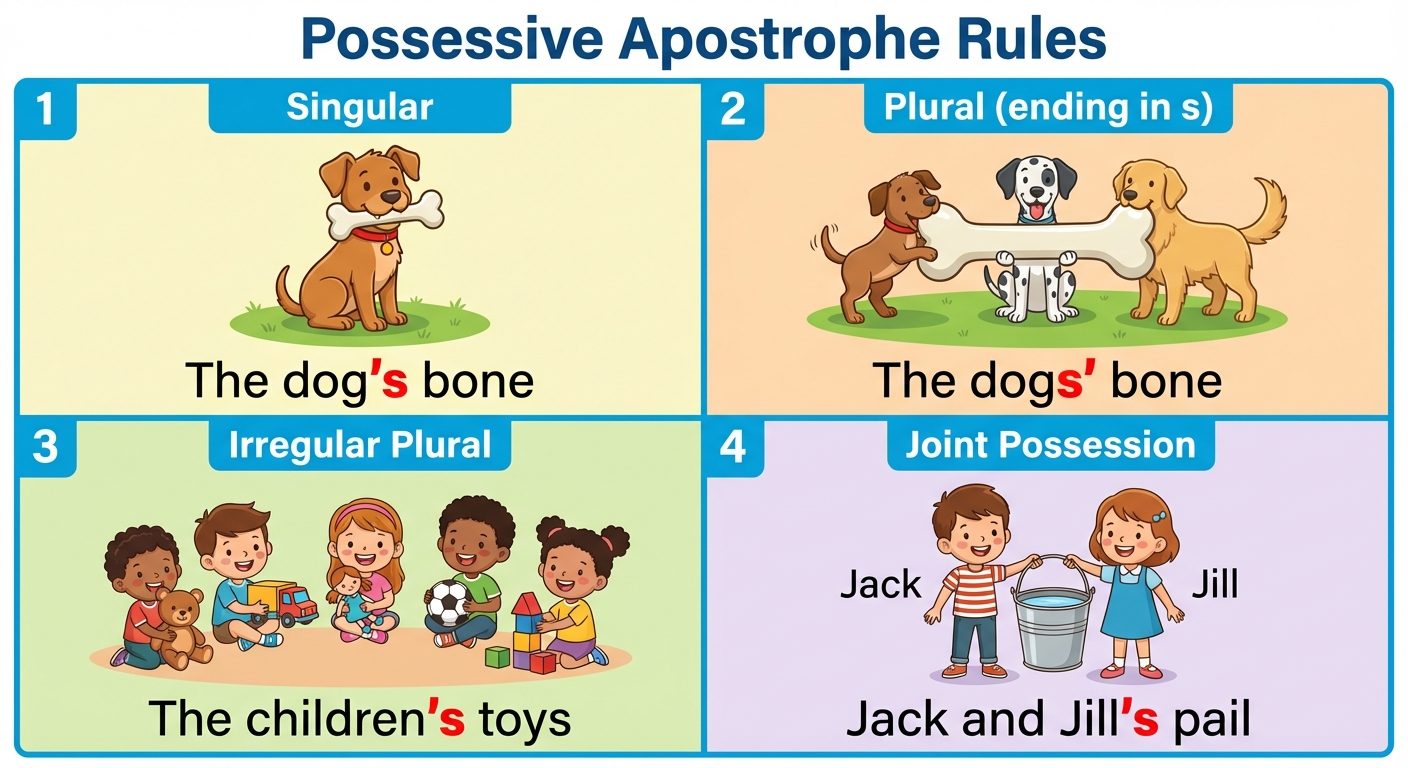
2.2 Pronunciation of Possessives
The ending 's is pronounced differently depending on the final sound of the noun:
- /s/: After voiceless sounds (p, t, k, f, th). Example: Cat’s (/kæts/).
- /z/: After voiced sounds (b, d, g, v, l, m, n, vowels). Example: Dog’s (/dɒgz/).
- /ɪz/: After sibilant sounds (s, z, sh, ch, j). Example: Bus’s (/bʌsɪz/).
3. Order of Adjectives and Degrees of Adjectives
Adjectives modify nouns. Errors occur when multiple adjectives are used in the wrong sequence or when degrees of comparison are formed incorrectly.
3.1 Degrees of Comparison
There are three degrees of adjectives used to compare nouns.
- Positive Degree: Describes a quality without comparison. (e.g., tall).
- Comparative Degree: Compares two items. (e.g., taller).
- Superlative Degree: Compares three or more items. (e.g., tallest).
Formation Rules:
- One-syllable words: Add -er/-est (Fast -> Faster -> Fastest).
- Two+ syllables: Use more/most (Beautiful -> More beautiful -> Most beautiful).
- Irregular Adjectives:
- Good -> Better -> Best
- Bad -> Worse -> Worst
- Little -> Less -> Least
Common Error (Double Comparatives): Never use "-er" and "more" together.
- Incorrect: He is more smarter than John.
- Correct: He is smarter than John.
3.2 Order of Adjectives
When multiple adjectives describe a single noun, they must follow a specific order. The mnemonic OSASCOMP is used to remember this order.
O.S.A.S.C.O.M.P.
- Opinion (Beautiful, ugly, delicious)
- Size (Big, small, tall)
- Age (Old, young, new)
- Shape (Round, square, flat)
- Color (Red, blue, pale)
- Origin (Indian, American, Chinese)
- Material (Wooden, plastic, silk)
- Purpose (Running [shoes], sleeping [bag])
- Example: "A beautiful small old Indian wooden chair." (Opinion -> Size -> Age -> Origin -> Material).
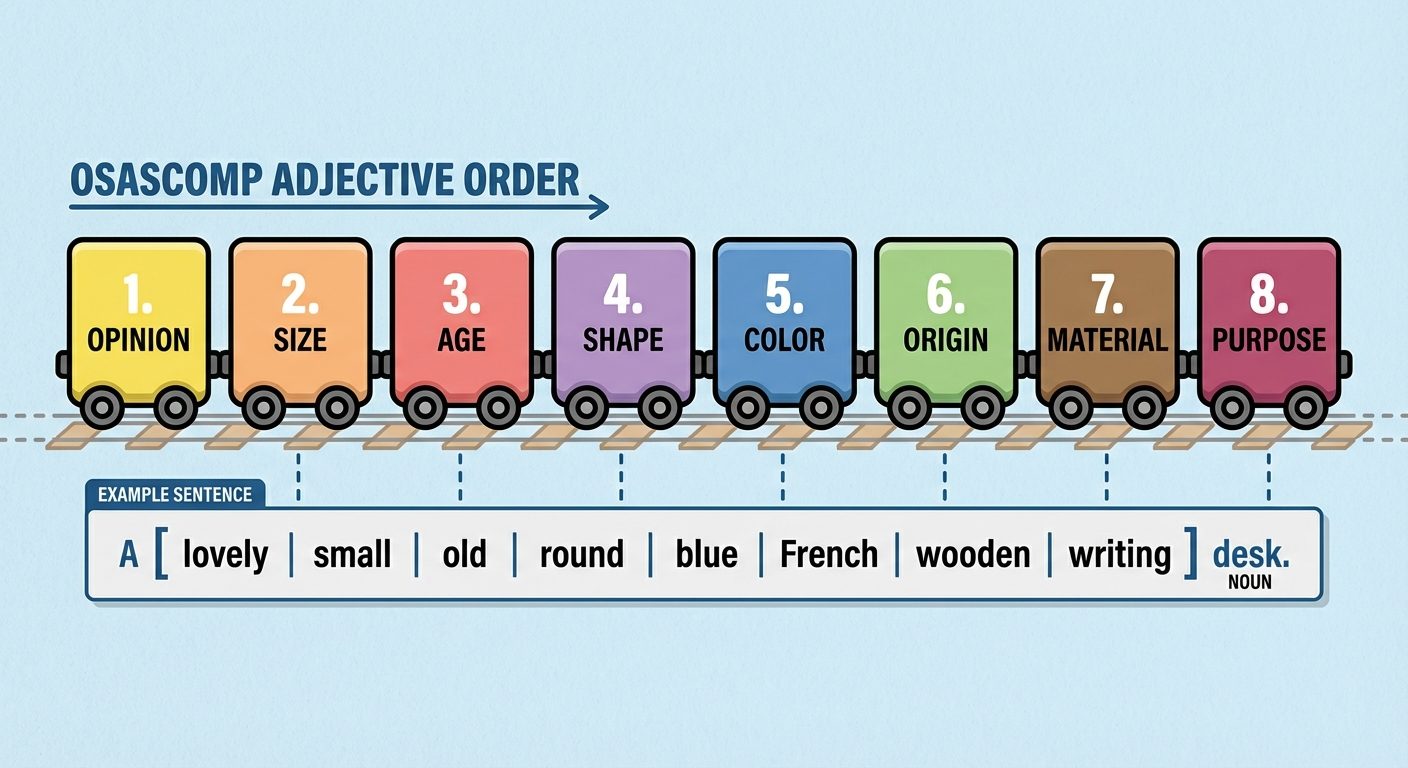 AI-generated image — may contain inaccuracies [little] [old] [rectangular] [red] [French] [wooden] [dining] table". Use arrows to connect the specific words to the corresponding train carriage category. White background, educational style.]
4. Prepositions
Prepositions show the relationship between a noun (or pronoun) and other words in a sentence. They indicate time, place, direction, or method.
4.1 Prepositions of Time and Place (The IN-ON-AT Triangle)
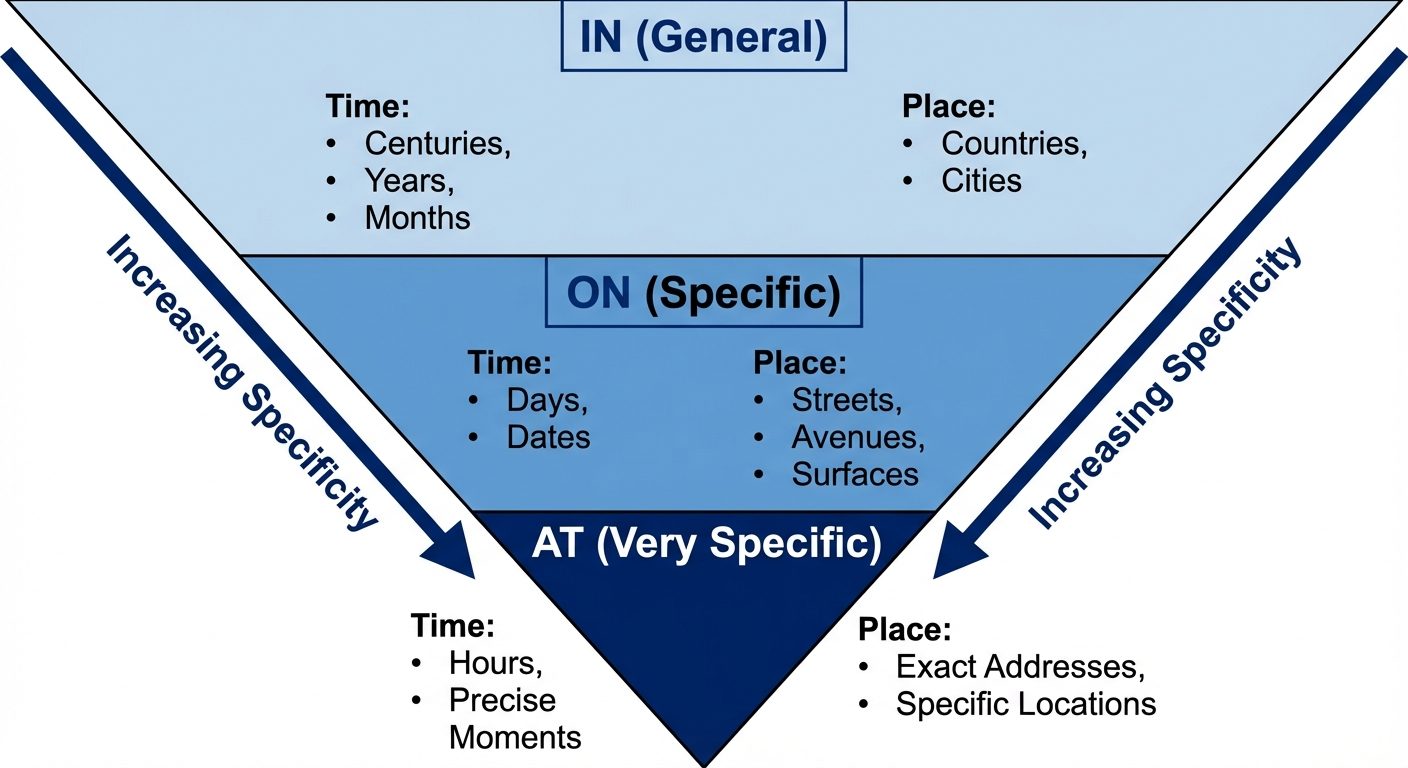
The usage of In, On, and At follows a logic of specificity, moving from general to specific.
- IN (General/Largest):
- Time: Centuries, Years, Months, Seasons (In 1990, In July, In summer).
- Place: Countries, Cities, Neighborhoods, Enclosed spaces (In India, In Paris, In the room).
- ON (More Specific):
- Time: Days, Dates (On Monday, On 15th August).
- Place: Streets, Surfaces, Means of transport (On Oxford Street, On the table, On the bus).
- AT (Very Specific):
- Time: Precise time (At 5:00 PM, At noon).
- Place: Specific addresses, Specific locations (At 24 Main Street, At the station).
4.2 Common Errors with Prepositions
Prepositions cannot be directly translated from native languages to English; they are fixed by usage.
- Discuss vs. Discuss about:
- Incorrect: We need to discuss about the project.
- Correct: We need to discuss the project. (Discuss implies talking about).
- Married with vs. Married to:
- Incorrect: She is married with a doctor.
- Correct: She is married to a doctor.
- Good in vs. Good at:
- Incorrect: He is good in mathematics.
- Correct: He is good at mathematics.
- Enter into vs. Enter:
- Incorrect: He entered into the room.
- Correct: He entered the room. (However, "entered into an agreement" is correct).
- Superior/Inferior/Senior/Junior:
- These adjectives are always followed by to, not than.
- Correct: He is senior to me.
4.3 Pronunciation of Prepositions (Weak Forms)
In fluent speech, prepositions are usually unstressed (weak forms).
- To: Pronounced /tə/ (He went /tə/ school) rather than /tuː/.
- At: Pronounced /ət/ (Meet me /ət/ five) rather than /æt/.
- For: Pronounced /fə/ (This is /fə/ you) rather than /fɔːr/.
- Note: If the preposition is at the end of the sentence, the strong form is used. (What are you looking at? -> /æt/).
Did this save you a night before the exam?
LPU Notes is free, and it stays free. Ads cover part of the server bill. The rest comes out of a student's own pocket: the domain, the storage, and keeping the site up through the weeks everyone needs it at once.
The payment button didn't load. An ad blocker or a filtered network is the usual reason. to try again.
Nothing here is ever locked, and nothing unlocks. Chip in only if it was worth it. What it pays for →