Unit 2: Recurrence Relations
1. Introduction to Recurrence Relations
Definition
A recurrence relation for a sequence is an equation that relates the -th term, , to one or more of its predecessors ().
- Order: The difference between the highest and lowest subscripts of the terms present in the relation.
- Solution: A sequence that satisfies the recurrence relation.
- Initial Conditions: Specific values given for the first few terms (e.g., ) required to find a unique solution.
Modelling with Recurrence Relations
Recurrence relations are used to model problems where the state at step depends on the state at previous steps.
- Compound Interest:
- Fibonacci Sequence: (modelling rabbit populations).
- Tower of Hanoi: .
2. Homogeneous Linear Recurrence Relations (Constant Coefficients)
Standard Form
A linear homogeneous recurrence relation of degree with constant coefficients is:
Where are real constants and .
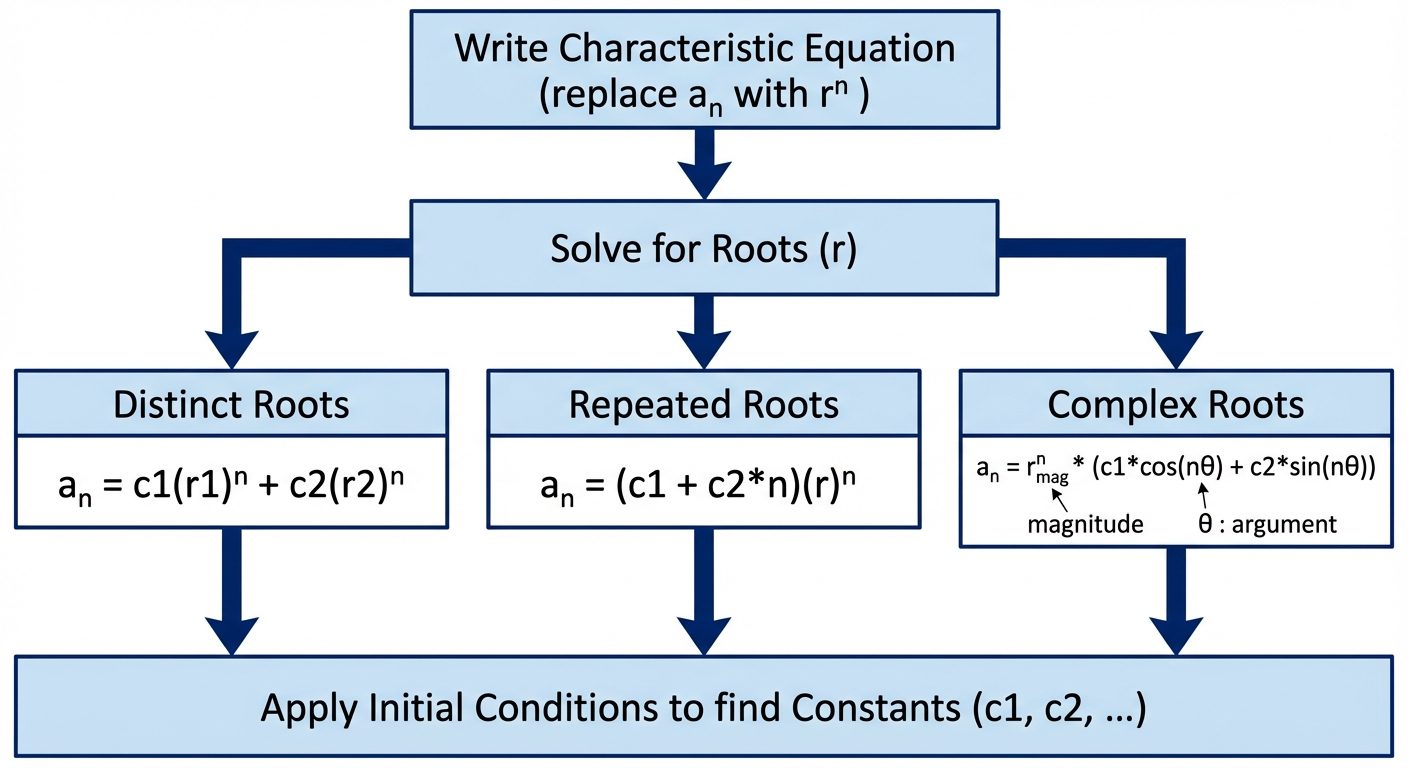
Method of Solution (Characteristic Roots)
-
Form the Characteristic Equation: Replace with .
-
Find the Roots: Solve for .
-
Write the General Solution:
Nature of Roots Form of Solution () Distinct Real Roots () Repeated Real Roots ( repeated times) Complex Roots () <br> where -
Find Constants: Use initial conditions to solve for .
3. Non-Homogeneous Relations: Method of Inverse Operator
Standard Form
Where is the shift operator such that and .
General Solution structure
- (Homogeneous Solution): Solved by setting (see section 2).
- (Particular Solution): Calculated as .
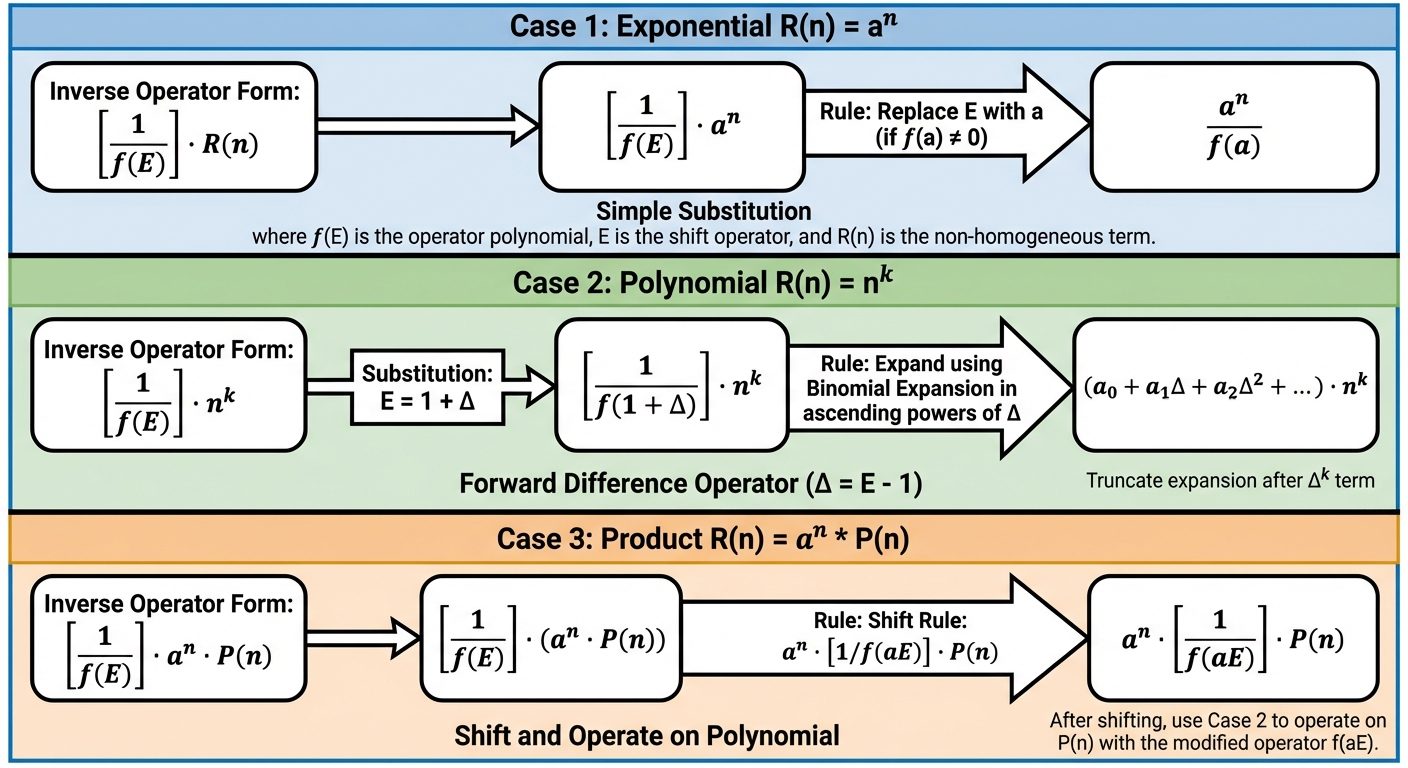
Inverse Operator Rules for Particular Solutions
The particular solution depends on the form of :
Case 1: Exponential Form
- If :
- If (Case of failure): Differentiate with respect to .
(typically approximated as )
Case 2: Polynomial Form
- Convert to terms of (where ).
- Expand using Binomial expansion up to term .
- Apply the expanded operator to .
Case 3: Product Form
- This shifts out and changes to in the denominator.
 AI-generated image — may contain inaccuracies * P(n)". Use distinct colors for each case (e.g., green, orange, purple) with mathematical formulas clearly rendered in bold black text.]
4. Generating Functions
Definition
The generating function for a sequence is the infinite series:
Important Series Expansions
Memorizing these is crucial for solving recurrences:
- Geometric Series:
- Binomial (Negative exponent):
- Specific Case ():
5. Solving Recurrence Relations using Generating Functions
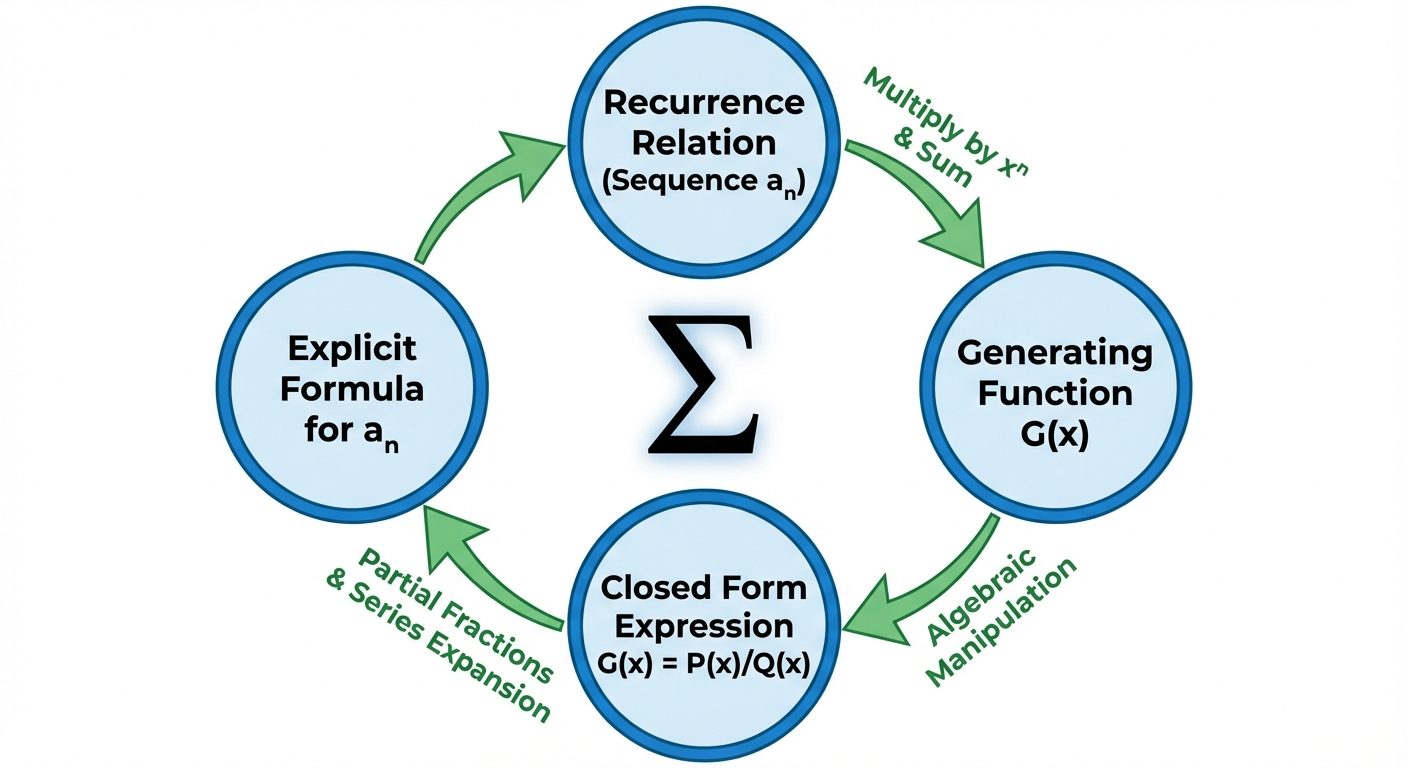
This method converts the recurrence relation into an algebraic equation.
The Algorithm
- Multiply & Sum: Multiply the recurrence relation by and sum from (where is the order) to .
- Substitute G(x):
- Replace with .
- Shift indices for terms like to express them in terms of .
- Example: .
- Solve Algebraically: Rearrange the equation to solve explicitly for . The result is usually a rational function (fraction of polynomials).
- Extract Coefficients: Use Partial Fraction Decomposition and known series expansions to find the coefficient of , which is .
Example Setup
Given: .
- Multiply by : .
- Shift: .
- Solve: .
- Expand: .
- Result: .
Did this save you a night before the exam?
LPU Notes is free, and it stays free. Ads cover part of the server bill. The rest comes out of a student's own pocket: the domain, the storage, and keeping the site up through the weeks everyone needs it at once.
The payment button didn't load. An ad blocker or a filtered network is the usual reason. to try again.
Nothing here is ever locked, and nothing unlocks. Chip in only if it was worth it. What it pays for →