Unit 6: Vector calculus II
1. Line Integrals
1.1 Definition
A line integral generalizes the concept of a definite integral to a curve in a plane or in space. It integrates a function (scalar or vector) along a curve .
Vector Line Integral (Work Integral):
If is a vector field defined on a curve given by the position vector , the line integral of along is:
Where:
- varies from to .
- .
- Physical Interpretation: This integral represents the Work Done by the force field moving a particle along curve .
1.2 Evaluation Methods
- Parametric Form: Convert into functions of a single parameter (e.g., ), substitute into the integral, and integrate with respect to .
- Explicit Form: If , substitute and to integrate with respect to .
1.3 Path Independence and Conservative Fields
A vector field is conservative if the line integral depends only on the endpoints of the path, not the path itself.
- Condition: (F is the gradient of a scalar potential ).
- Test for Conservatism: .
- Fundamental Theorem for Line Integrals:
2. Green's Theorem
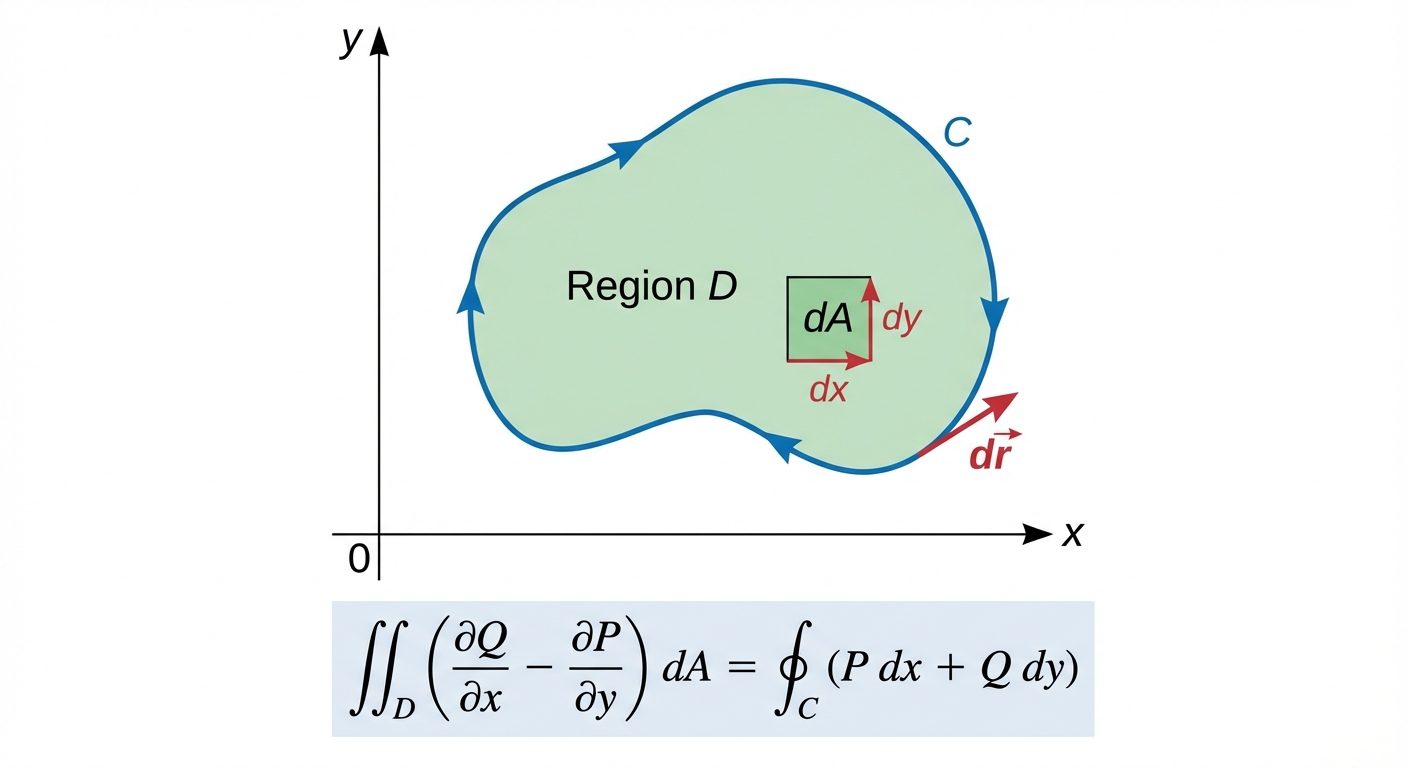
Green's Theorem relates a line integral along a simple closed curve to a double integral over the plane region bounded by .
2.1 Statement
Let be a positively oriented (counter-clockwise), piecewise smooth, simple closed curve in the plane, and let be the region bounded by . If and have continuous partial derivatives on an open region containing , then:
2.2 Applications
- Simplifying Integration: Converting difficult line integrals into easier area integrals (or vice-versa).
- Area Calculation: The area of region can be found using line integrals:
3. Surface Area and Surface Integrals
3.1 Surface Area
If a smooth surface is defined by over a region in the -plane, the surface area is:
3.2 Surface Integrals
1. Scalar Surface Integral:
Used to calculate mass of a shell with variable density.
2. Vector Surface Integral (Flux):
Measures the flow of a vector field across a surface .
Where:
- is the unit normal vector to the surface.
- For a surface , (for upward orientation).
4. Stokes' Theorem
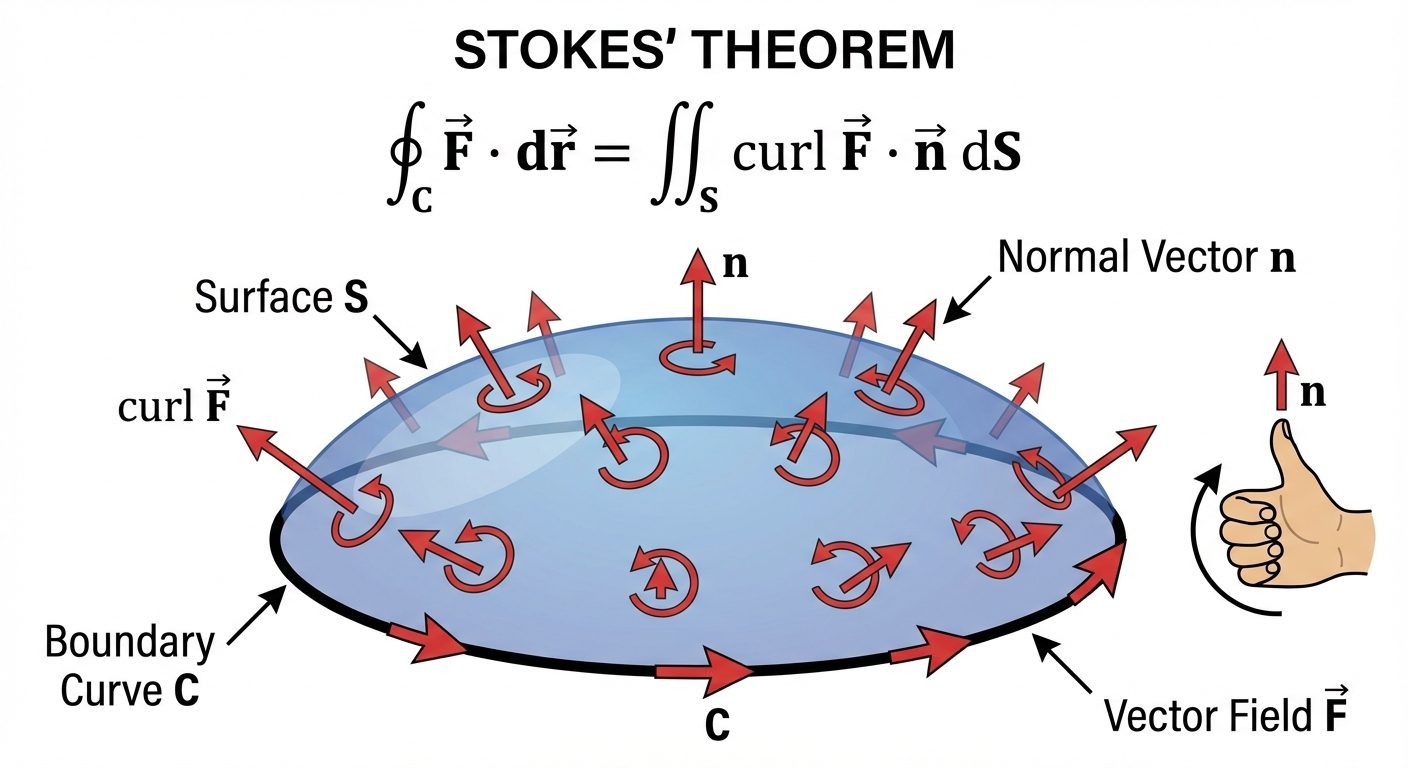
Stokes' Theorem generalizes Green's Theorem to 3D surfaces. It relates the surface integral of the curl of a vector field to the line integral around the boundary of that surface.
4.1 Statement
Let be an oriented smooth surface bounded by a simple, closed, smooth boundary curve with positive orientation. If is a vector field, then:
4.2 Key Concepts
- Orientation (Right-Hand Rule): If the fingers of your right hand curl in the direction of integration around , your thumb points in the direction of the normal vector .
- Independence of Surface: The flux of the curl depends only on the boundary curve . Any surface sharing the same boundary yields the same result.
5. Gauss's Divergence Theorem
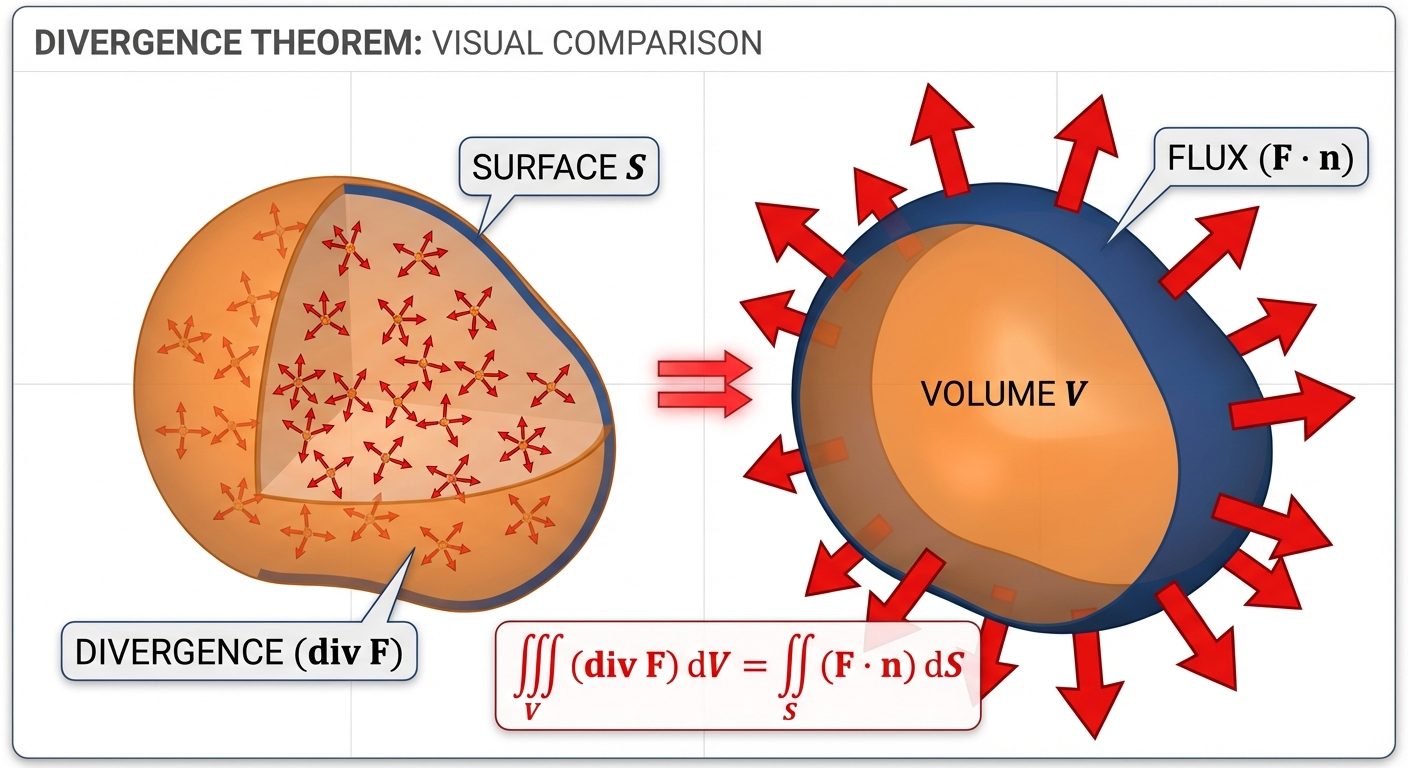
The Divergence Theorem relates the flow (flux) across a closed surface to the sum of sources and sinks (divergence) inside the volume.
5.1 Statement
Let be a solid region bounded by a closed surface oriented by outward unit normals . If is a vector field defined on , then:
5.2 Physical Interpretation
- Left Side (Surface Integral): Represents the total net flux of the fluid/field leaving the closed surface .
- Right Side (Volume Integral): Represents the sum of the expansion or contraction of the fluid at every point inside the volume.
- If , net flow is outward (Source).
- If , net flow is inward (Sink).
- If , the field is Solenoidal (Incompressible).
5.3 Comparison of Integral Theorems
| Theorem | Relates | Dimension | Formula |
|---|---|---|---|
| Fund. Thm. Line Int. | Line Endpoints | 1D | |
| Green's Theorem | Line Plane Area | 2D (Plane) | |
| Stokes' Theorem | Line Surface | 3D (Surface) | |
| Divergence Theorem | Surface Volume | 3D (Solid) |
Did this save you a night before the exam?
LPU Notes is free, and it stays free. Ads cover part of the server bill. The rest comes out of a student's own pocket: the domain, the storage, and keeping the site up through the weeks everyone needs it at once.
The payment button didn't load. An ad blocker or a filtered network is the usual reason. to try again.
Nothing here is ever locked, and nothing unlocks. Chip in only if it was worth it. What it pays for →