Unit 5: Vector Calculus I
1. Vector Functions: Limit, Continuity, and Differentiability
A vector-valued function is a rule that assigns a vector to each element in a domain (usually a set of real numbers representing time or a parameter).
1.1 Definition and Component Form
If , , and are real-valued functions of the parameter , then a vector function in 3D space is defined as:
1.2 Limits
The limit of a vector function is defined component-wise. If , then:
Condition: The limit exists only if the limits of all constituent component functions exist.
1.3 Continuity
A vector function is continuous at if:
- is defined.
- exists.
- .
1.4 Differentiability
The derivative of a vector function , denoted by , is defined as:
In component form:
Geometric Interpretation: The vector represents the tangent vector to the curve defined by at point , pointing in the direction of increasing parameter .
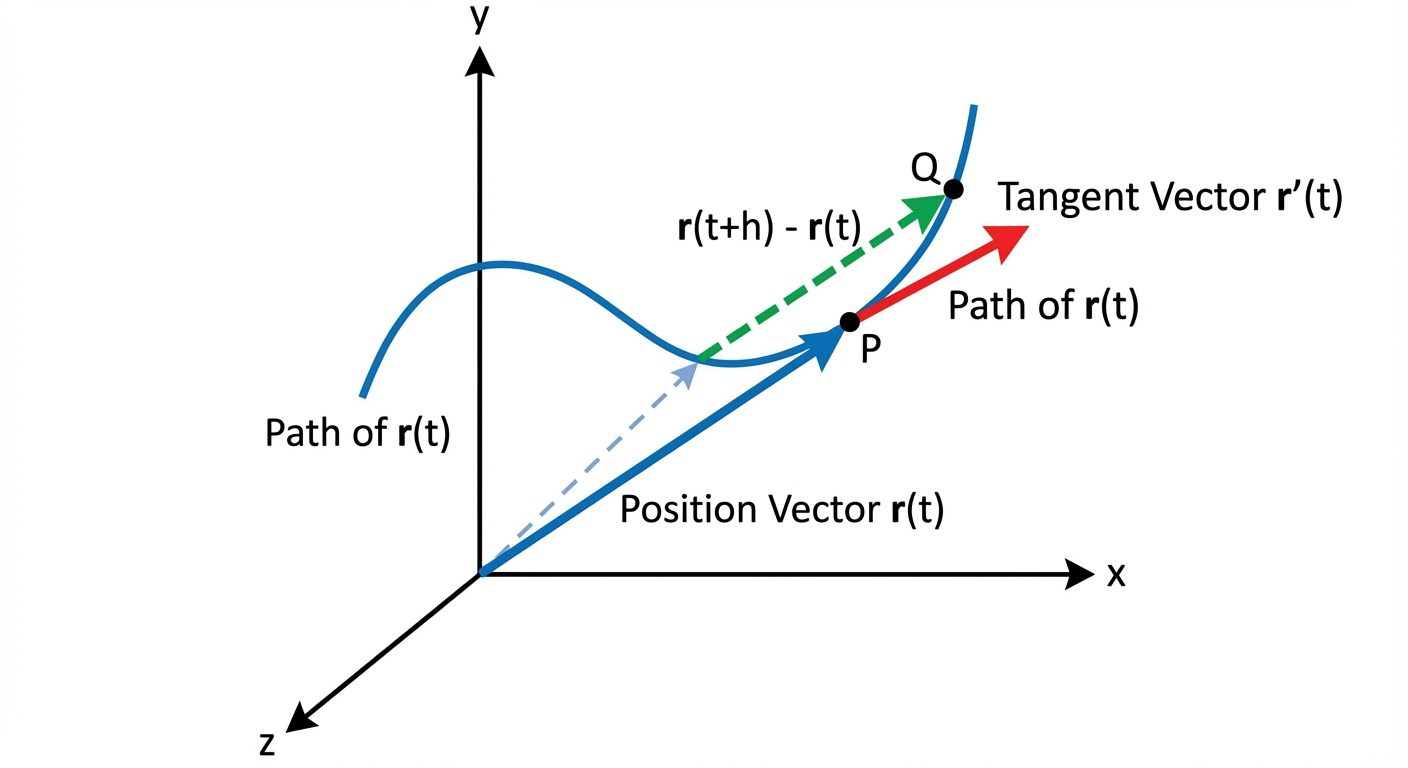
2. Length of a Space Curve (Arc Length)
If a curve is defined by for , and the derivatives are continuous, the length of the curve is the integral of the magnitude of the tangent vector.
Formula
Arc Length Function
The arc length function , which measures distance from a fixed starting point , is:
From this, we derive the relationship , which represents speed.
3. Motion of a Body or Particle on a Curve
In physics, if represents the position of a particle at time , we define the kinematic quantities as follows:
3.1 Kinematic Vectors
- Position Vector:
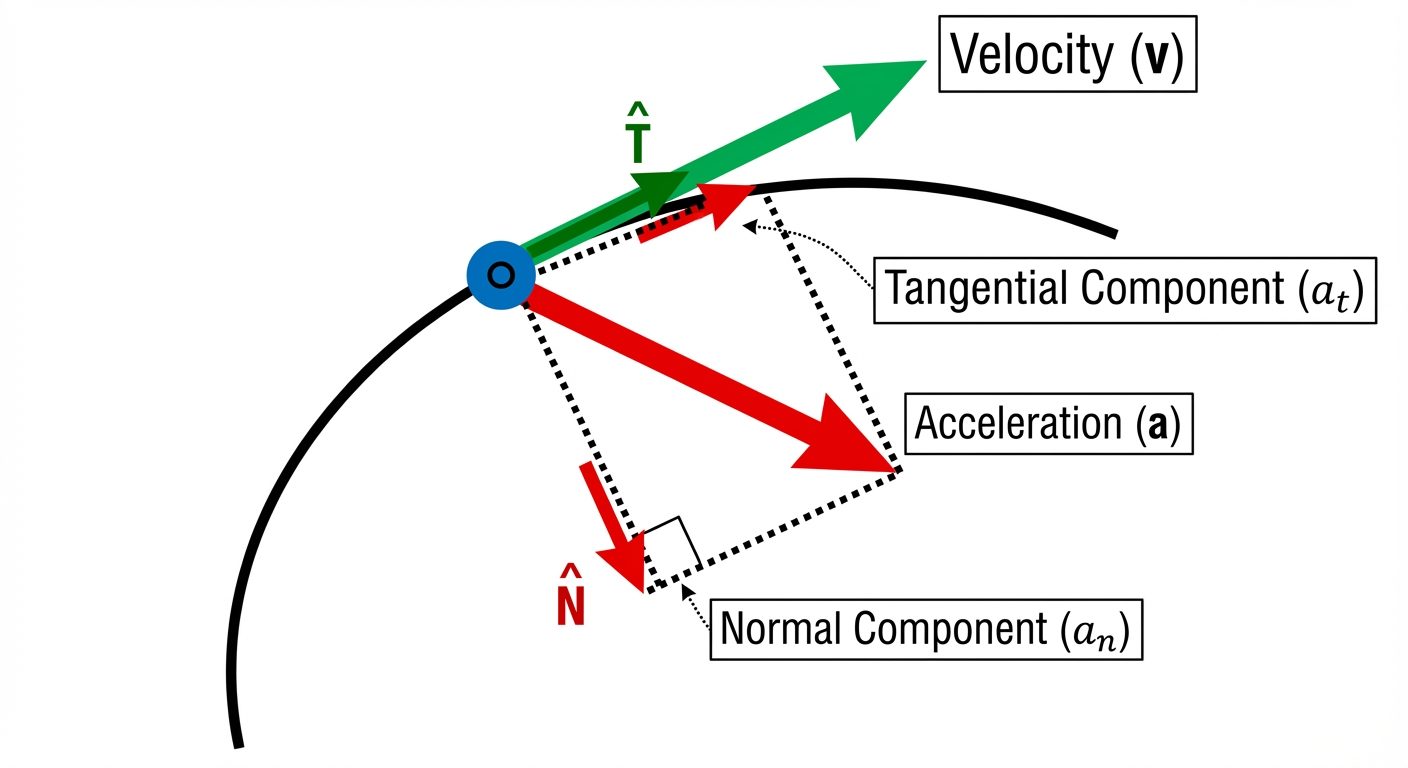
- Velocity Vector: (Always tangent to the path)
- Speed: (Scalar quantity)
- Acceleration Vector:
3.2 Components of Acceleration
Acceleration does not always point in the direction of motion. It can be resolved into two orthogonal components:
- Tangential Component (): Responsible for changing the speed of the particle.
- Normal Component (): Responsible for changing the direction of the particle.
(Where is the curvature)
4. Scalar and Vector Fields
Before discussing derivatives in fields, we distinguish between two types of functions in region :
- Scalar Field: Assigns a real number (scalar) to every point in space. Examples: Temperature , Pressure .
- Vector Field: Assigns a vector to every point in space. Example: Velocity of fluid flow , Gravitational field.
The Del Operator ()
The vector differential operator "del" or "nabla" is defined as:
5. Gradient and Directional Derivative
5.1 Gradient of a Scalar Field
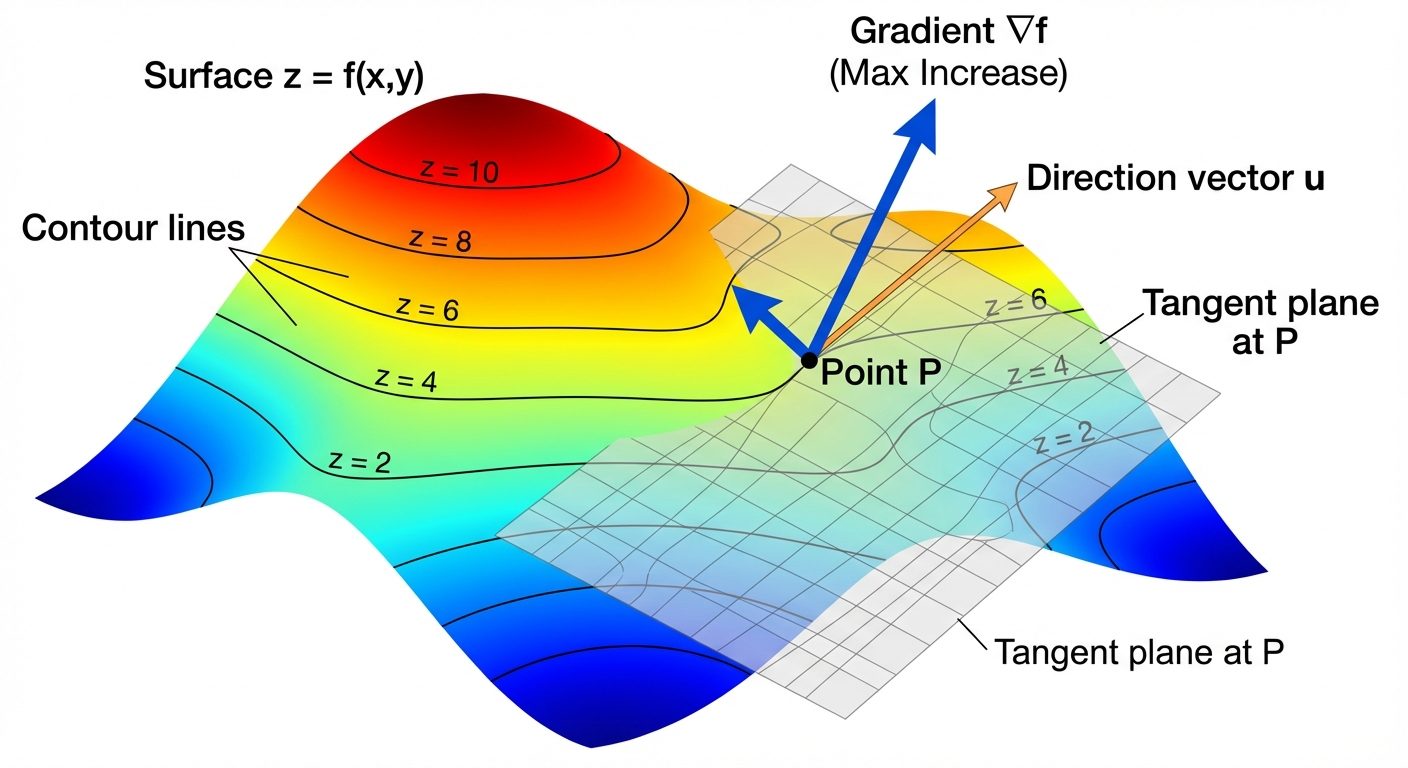
If is a scalar field, the gradient of , denoted or grad , is a vector field:
Physical Significance of Gradient:
- points in the direction of the maximum rate of increase of the function .
- The magnitude is the maximum rate of change.
- is normal (perpendicular) to the level surface .
5.2 Directional Derivative
The rate of change of at a point in the direction of a specific unit vector is the directional derivative :
If given a direction vector that is not a unit vector, normalize it first: .
6. Divergence and Curl of a Vector Field
Let be a vector field.
6.1 Divergence ()
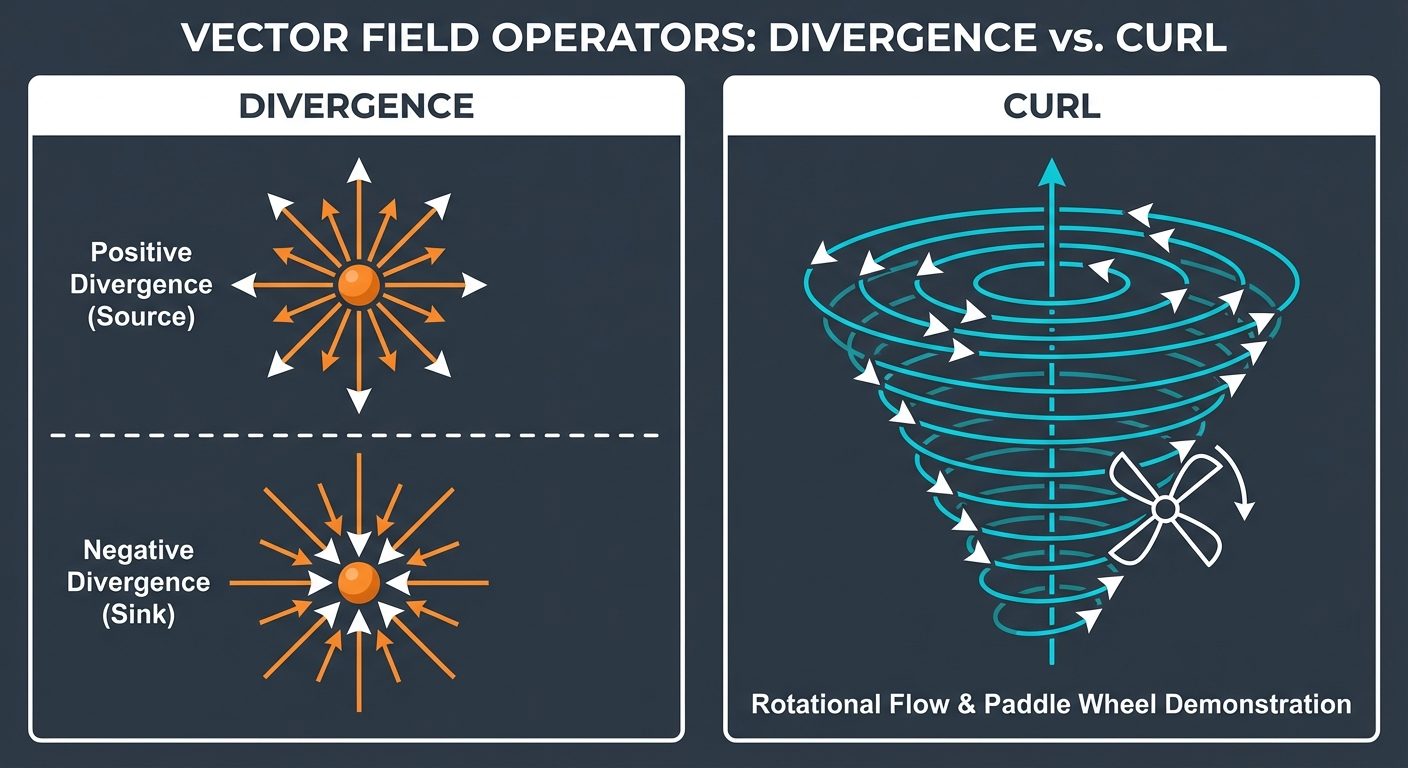
Divergence is the dot product of the Del operator and the vector field. It results in a scalar.
Physical Interpretation:
- Measures the net expansion or compression of a fluid at a point.
- Source: If , fluid is flowing out (expanding).
- Sink: If , fluid is flowing in (compressing).
- Solenoidal: If , the fluid is incompressible (no source or sink).
6.2 Curl ()
Curl is the cross product of the Del operator and the vector field. It results in a vector.
Expansion:
Physical Interpretation:
- Measures the rotation or angular velocity of the field at a point.
- The direction of the Curl vector represents the axis of rotation.
- Irrotational: If , the field is conservative (no rotation).
6.3 Important Vector Identities
- (Curl of a Gradient is zero).
- (Divergence of a Curl is zero).
- (Laplacian of a scalar).
Did this save you a night before the exam?
LPU Notes is free, and it stays free. Ads cover part of the server bill. The rest comes out of a student's own pocket: the domain, the storage, and keeping the site up through the weeks everyone needs it at once.
The payment button didn't load. An ad blocker or a filtered network is the usual reason. to try again.
Nothing here is ever locked, and nothing unlocks. Chip in only if it was worth it. What it pays for →