Unit 4: Partial Differential Equation
1. Introduction to Partial Differential Equations (PDE)
A Partial Differential Equation is an equation involving an unknown function of two or more independent variables and its partial derivatives with respect to those variables.
1.1 Fundamental Concepts
Let be a function of two independent variables and .
Common notation for partial derivatives:
Order: The order of the highest derivative occurring in the equation.
Degree: The power of the highest order derivative after the equation is cleared of radicals and fractions.
1.2 Classification of Second Order Linear PDEs
The general form of a linear second-order PDE in two variables is:
Where are functions of and or constants. The classification depends on the discriminant .
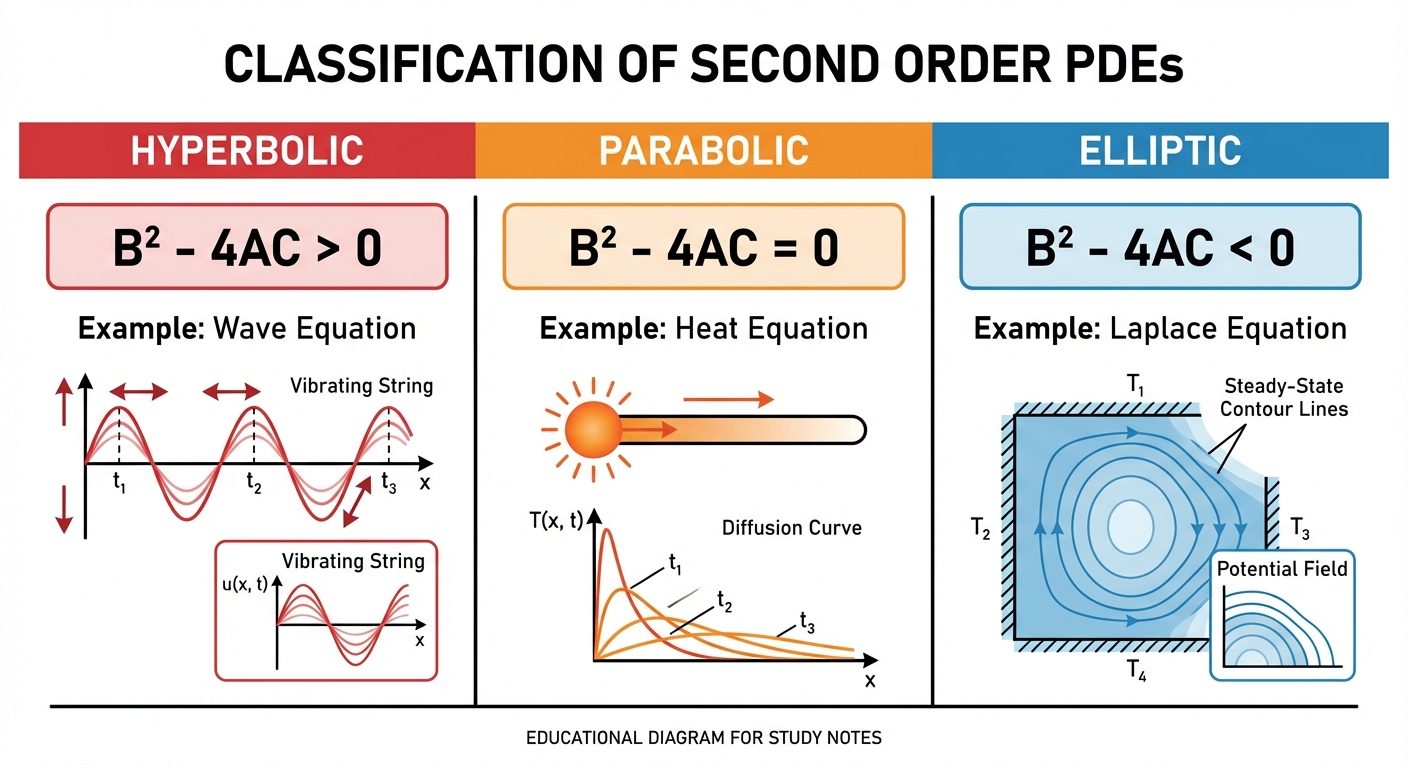
| Discriminant | Classification | Prototype Equation | Physical Application |
|---|---|---|---|
| Hyperbolic | Wave Equation | Vibrations, Sound waves | |
| Parabolic | Heat Equation | Diffusion, Heat conduction | |
| Elliptic | Laplace Equation | Steady-state fields, Potential theory |
2. Method of Separation of Variables
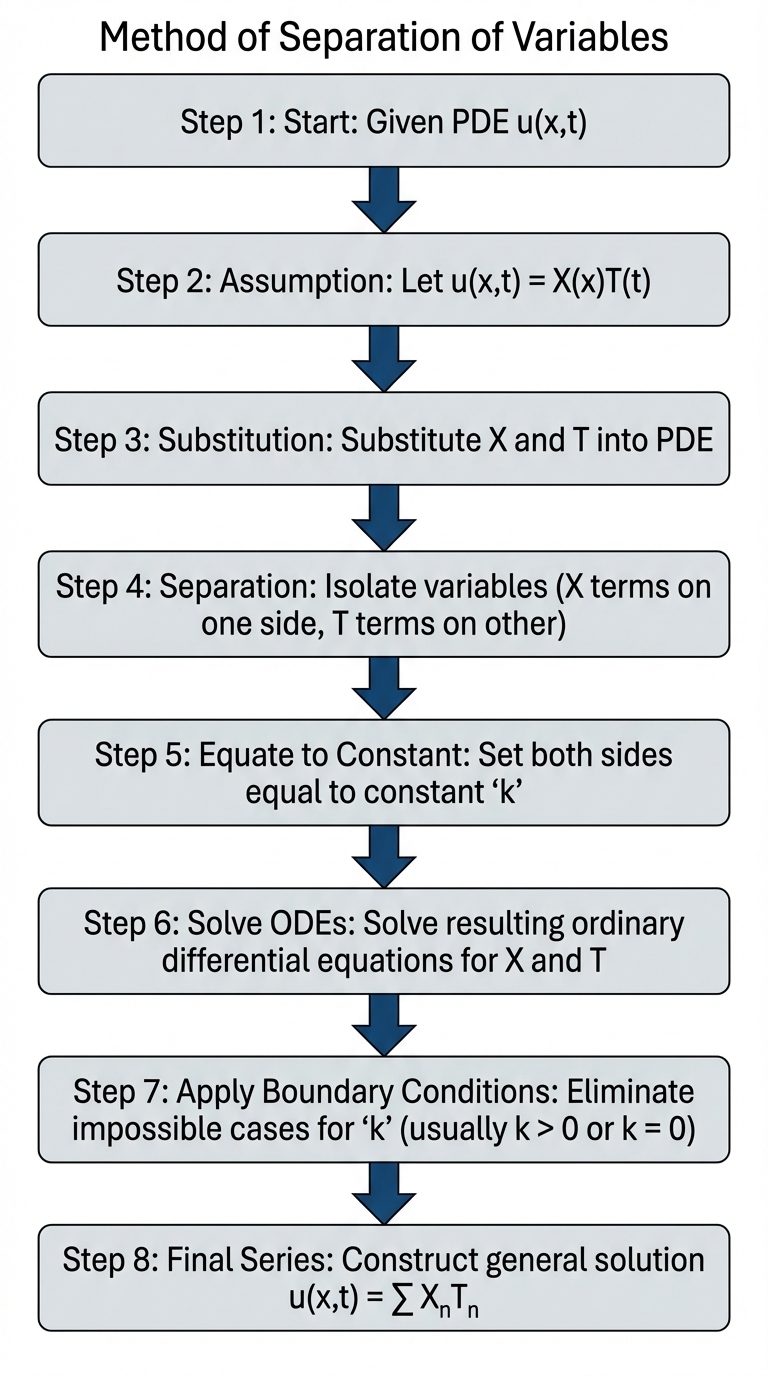
The method of Separation of Variables is the most common technique for solving linear homogeneous PDEs with specific boundary conditions. It reduces a PDE into a set of Ordinary Differential Equations (ODEs).
2.1 The General Procedure
2.2 Mathematical Steps
- Assume a solution: If dependent variable depends on and , assume .
- Differentiate: Calculate , , , etc.
- Substitute and Separate: Plug derivatives into the PDE and move all terms to one side and all terms to the other.
- Introduce Separation Constant: Since and are independent, both sides must equal a constant, say .
- Case 1: (Positive) — usually leads to exponential growth (rejected in physical problems requiring stability).
- Case 2: — leads to linear solutions.
- Case 3: (Negative) — leads to oscillatory (trigonometric) solutions. Most common for Wave/Heat equations.
3. Solution of The Wave Equation
The one-dimensional wave equation describes the transverse vibrations of a stretched string.
Equation:
Where (Tension / mass per unit length).
3.1 Boundary and Initial Conditions
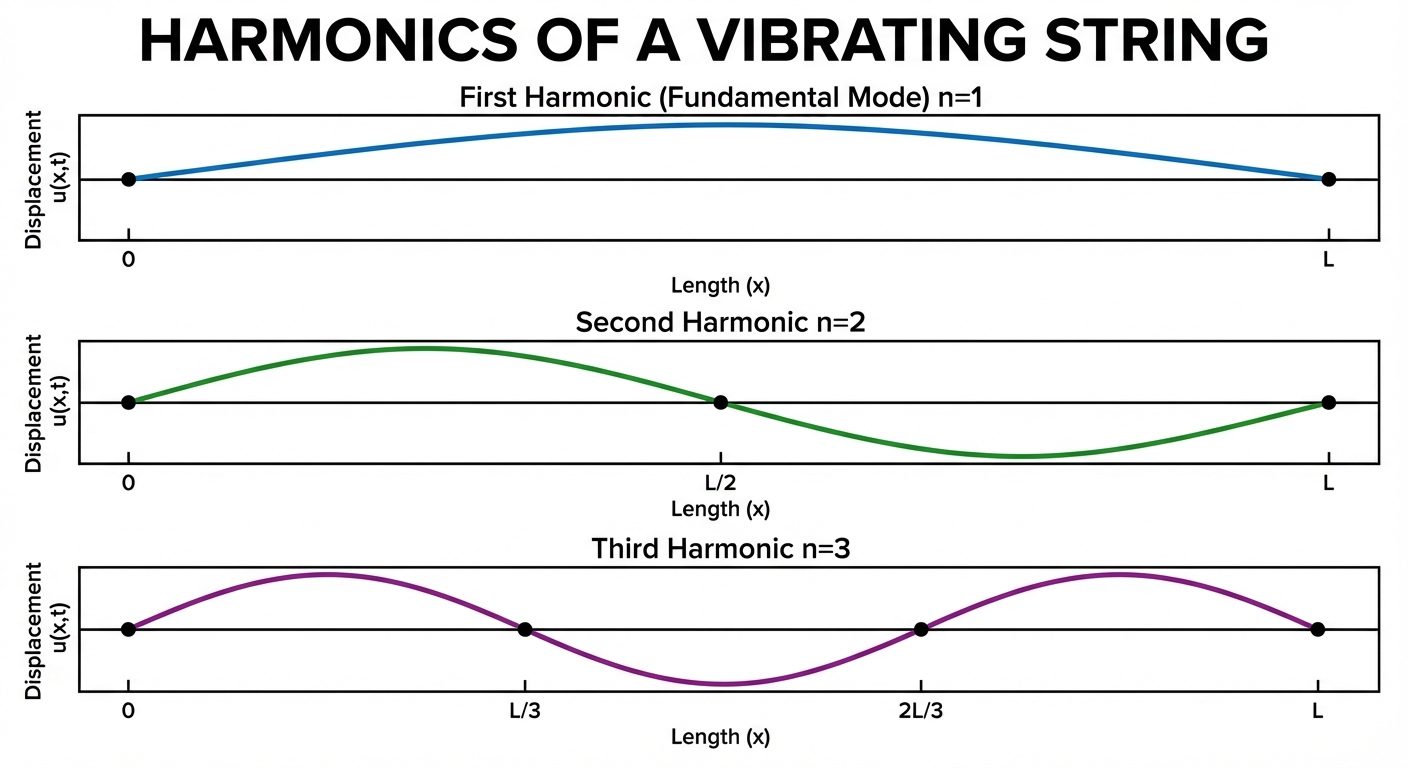
For a string of length fixed at both ends:
- Boundary Conditions (BCs):
- (Left end fixed)
- (Right end fixed)
- Initial Conditions (ICs):
- (Initial shape/displacement)
- (Initial velocity)
3.2 Solving Process
Using Separation of Variables with constant :
- ODEs:
- Applying BCs:
- .
- . Since (trivial solution), .
- Therefore, for (Eigenvalues).
- General Solution:
4. Solution of The Heat Equation
The one-dimensional heat equation describes the distribution of temperature in a given region over time.
Equation:
Where is the thermal diffusivity.
4.1 Boundary Conditions
For a rod of length with ends kept at zero temperature:
- BCs: and for all .
- IC: (Initial temperature distribution).
4.2 Solving Process
- Separation: leads to and .
- Note: The time equation is First Order.
- Solutions:
- (Exponential decay).
- Applying BCs:
- Similar to the wave equation, and implies and .
- General Solution:
- Note: As , (Steady state temperature is 0).
5. Solution of The Laplace Equation
The Laplace equation describes steady-state phenomena (does not depend on time ). It typically involves two spatial dimensions.
Equation:
5.1 Physical Context
Used for solving steady-state heat flow in a rectangular plate or electrostatic potential distributions.
5.2 Solving Process
Using Separation of Variables :
There are three distinct solution types depending on the sign of . The correct form is chosen based on which direction has zero boundary conditions.
| Constant () | Solution for | Solution for | Usage Heuristic |
|---|---|---|---|
| Use if BCs on are 0 | |||
| Use if BCs on are 0 | |||
| Rarely used alone |
5.3 Example: Finite Plate
Consider a rectangular plate , .
- BCs: .
- Since and are zero, we need sinusoidal behavior in . We choose .
- Solution Form:
(Note: Hyperbolic sine/cosine are preferred for the non-sinusoidal direction in finite plates).
Did this save you a night before the exam?
LPU Notes is free, and it stays free. Ads cover part of the server bill. The rest comes out of a student's own pocket: the domain, the storage, and keeping the site up through the weeks everyone needs it at once.
The payment button didn't load. An ad blocker or a filtered network is the usual reason. to try again.
Nothing here is ever locked, and nothing unlocks. Chip in only if it was worth it. What it pays for →