Unit 2: Differential equations of higher order
1. Introduction to Linear Differential Equations
A Linear Differential Equation (LDE) is a differential equation in which the dependent variable () and its derivatives appear only in the first degree and are not multiplied together.
General Form of Linear Differential Equation of Order
The general form of an -th order linear differential equation is:
Where:
- are constants or functions of only.
- .
- is a function of (or a constant).
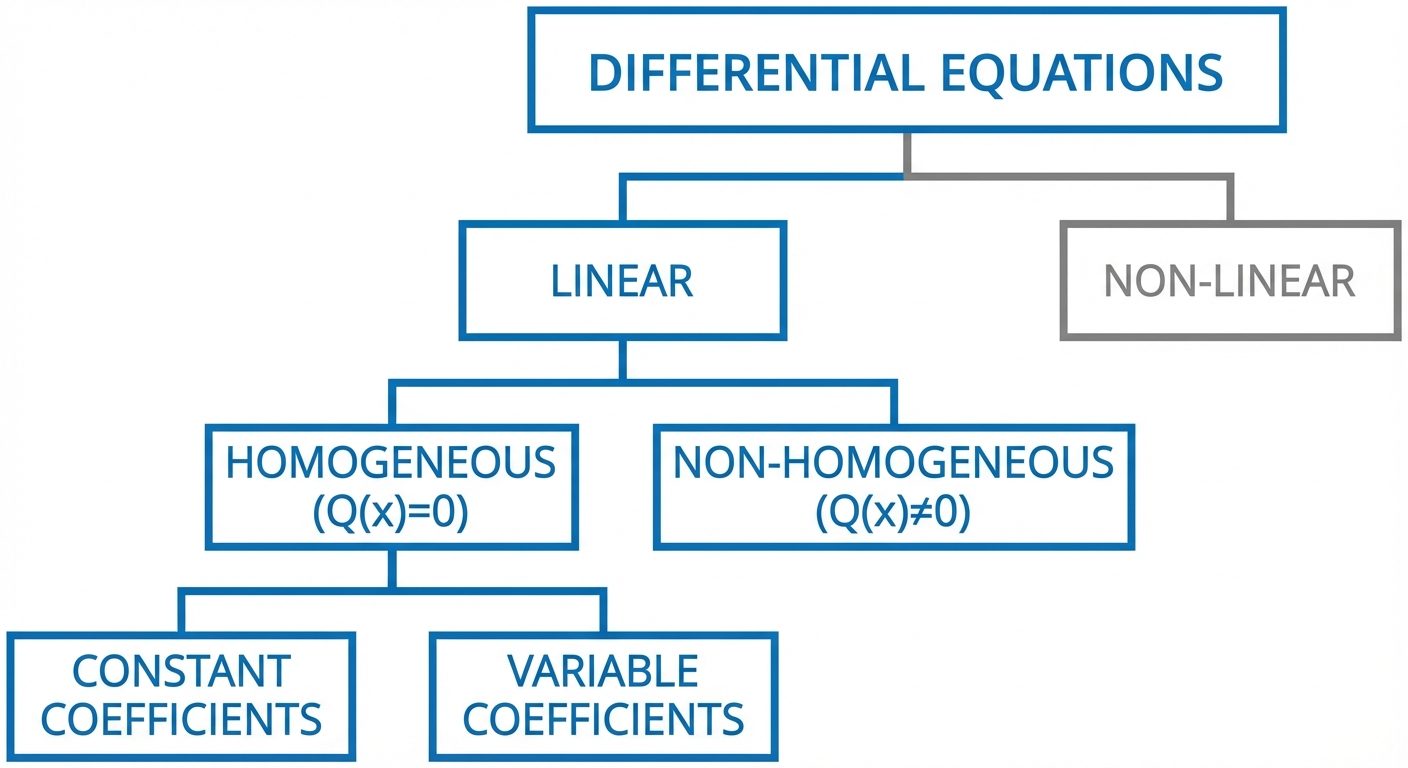
Classification
- Homogeneous Linear Differential Equation: If .
- Non-Homogeneous Linear Differential Equation: If .
- Constant Coefficients: If are real constants.
- Variable Coefficients: If any of are functions of .
2. Linear Dependence and Linear Independence of Solutions
When solving higher-order differential equations, the general solution is constructed from a set of "basis" solutions. It is crucial to determine if these solutions are distinct enough to form a general solution.
Definitions
Let be functions defined on an interval .
-
Linearly Dependent (LD): The functions are linearly dependent if there exist constants , not all zero, such that:
for all in . (Essentially, one function can be written as a combination of others). -
Linearly Independent (LI): The functions are linearly independent if the equation:
implies that every constant is zero ().
The Wronskian ()
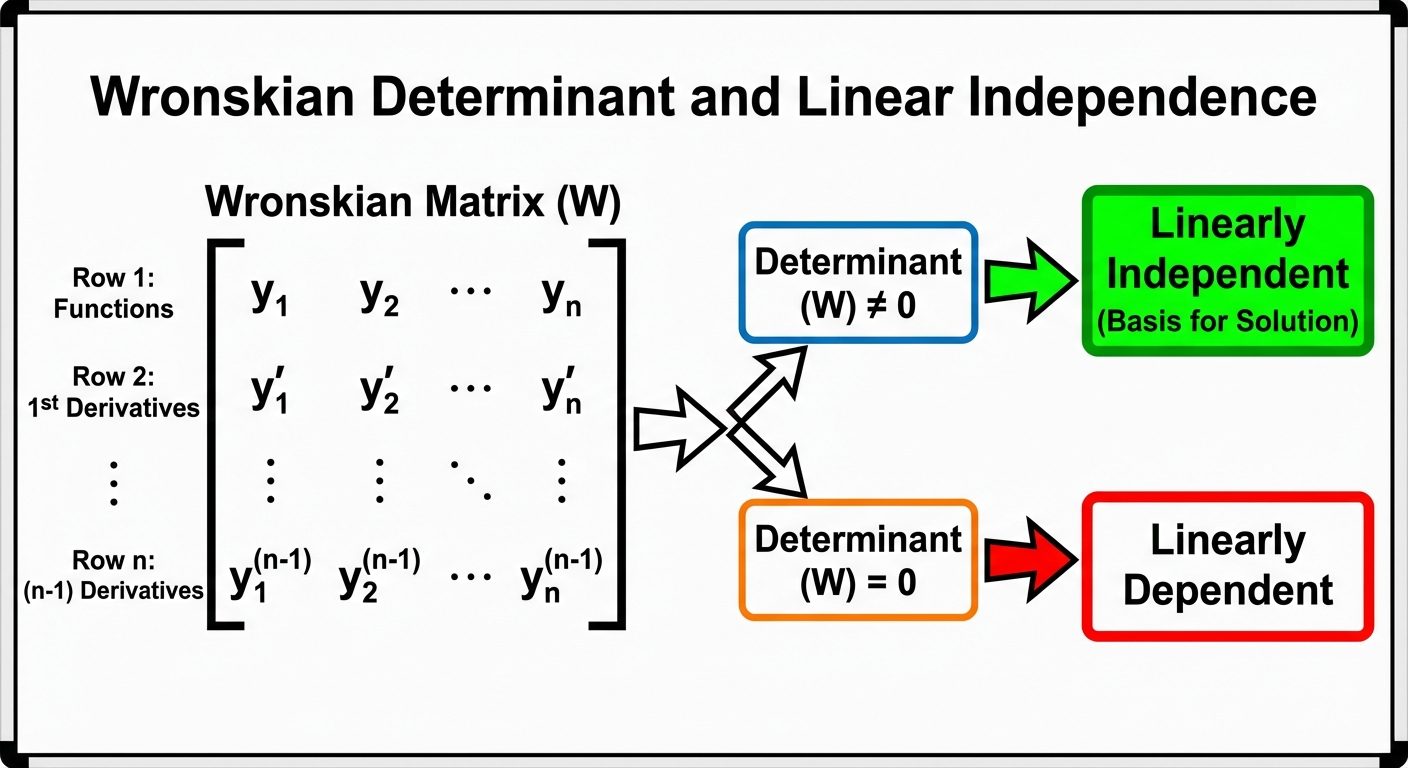
The Wronskian determinant is a tool used to test linear independence. For functions :
Theorem:
- If for at least one point in the interval, the functions are Linearly Independent.
- If the functions are solutions to a homogeneous LDE and over the interval, the functions are Linearly Dependent.
3. Method of Solution: The Differential Operator ()
To simplify the process of solving linear differential equations with constant coefficients, we introduce the Differential Operator notation.
Definition of Operator
Let denote the operation of differentiation with respect to :
Similarly, represents integration:
Rewriting the Equation
The differential equation:
Can be written as:
Or simply:
Where is a polynomial in .
4. Solution of Homogeneous Linear Differential Equations with Constant Coefficients
A homogeneous linear differential equation with constant coefficients has the form:
In operator form: .
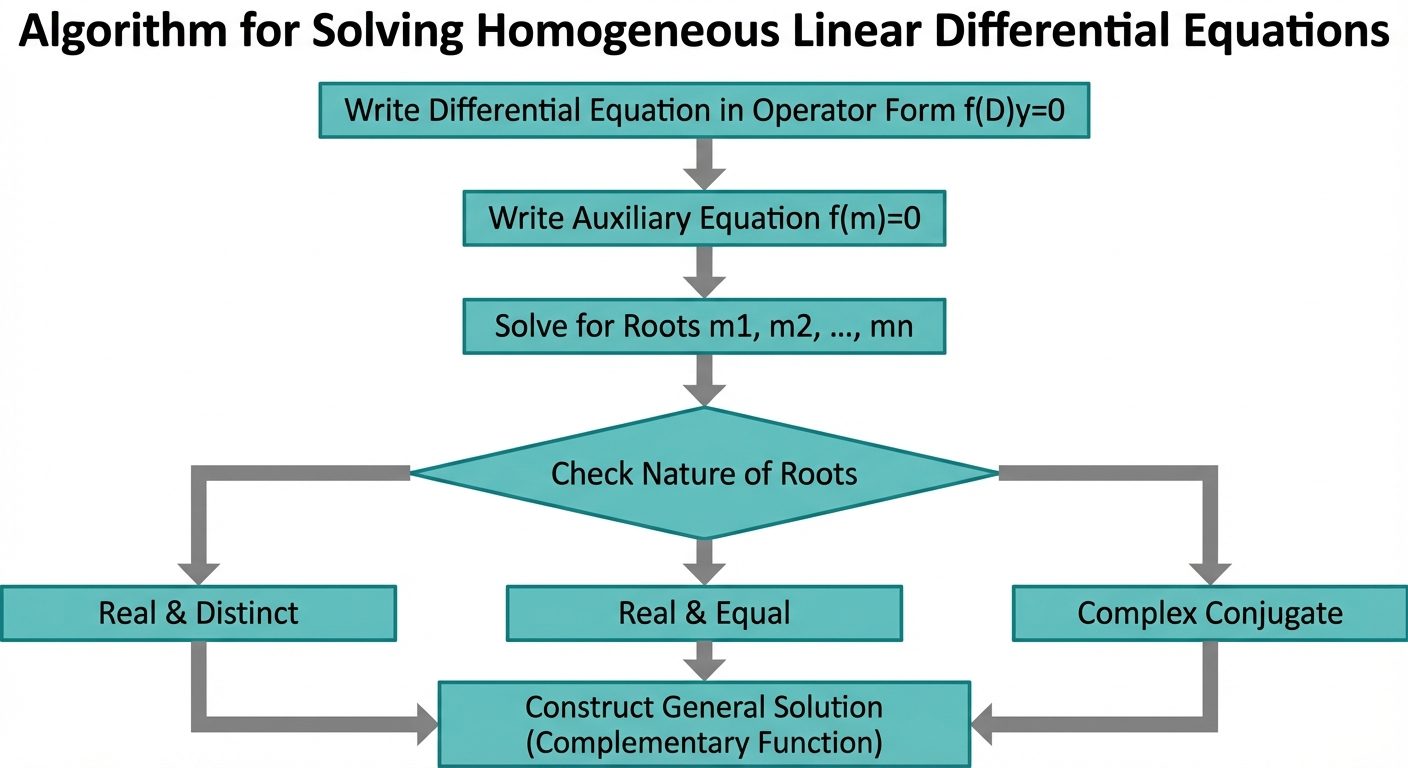
The General Procedure
To solve , we rely on the property that exponential functions () reproduce themselves upon differentiation.
- Assume a trial solution: .
- Substitute into the equation to get the Auxiliary Equation (A.E.).
- Replacing with , we get .
- .
- Find the roots of the Auxiliary Equation ().
- Write the General Solution based on the nature of the roots.
5. Solution of Second Order Homogeneous LDE
Consider the second-order equation:
Auxiliary Equation: .
Let the roots be and .
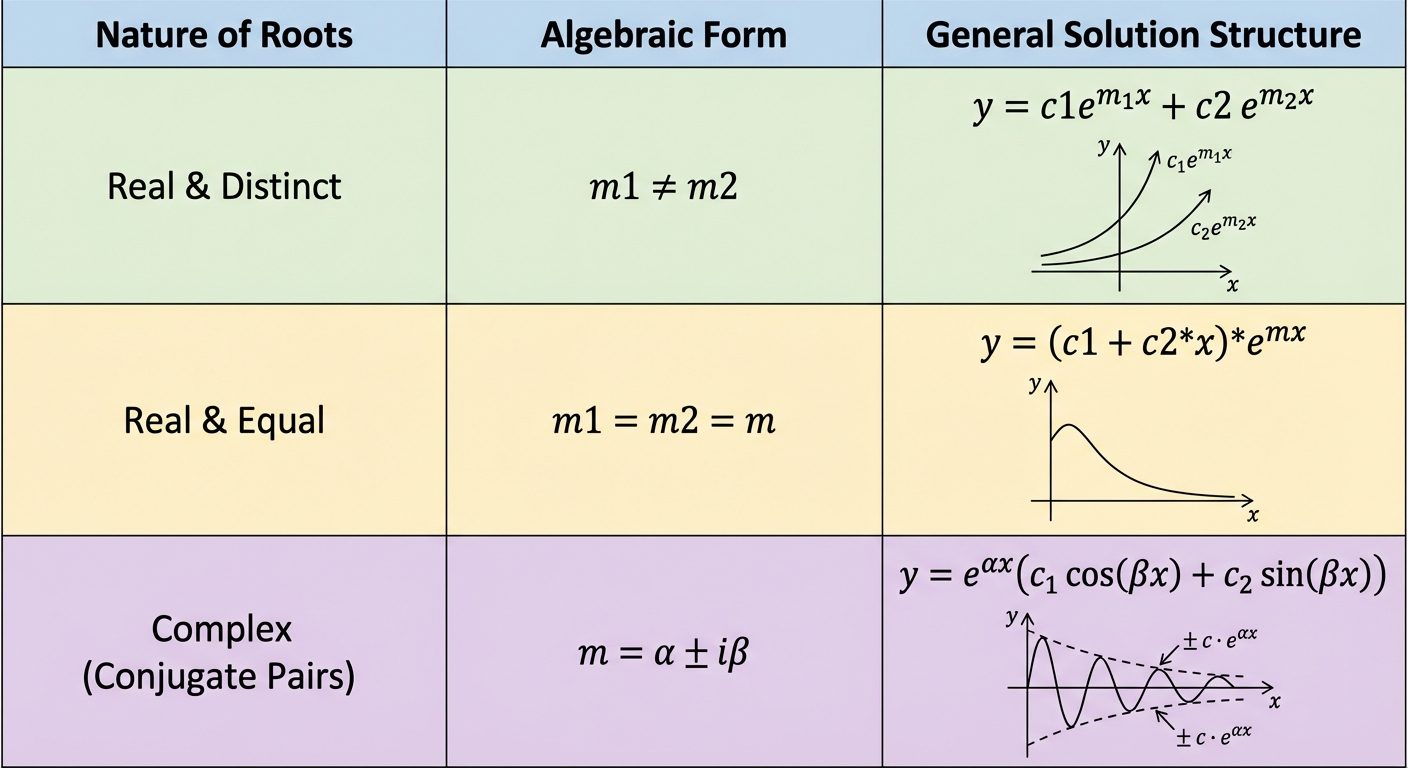
There are three distinct cases for the roots of this quadratic equation:
Case 1: Roots are Real and Distinct ()
If the roots are real numbers and not equal, the linearly independent solutions are and .
General Solution:
Case 2: Roots are Real and Equal ()
If the discriminant is zero, we have a repeated root . The first solution is . Through reduction of order, the second independent solution is found to be .
General Solution:
Case 3: Roots are Complex Conjugates ()
If the discriminant is negative, roots appear as a pair and .
Using Euler's formula (), the solution simplifies to trigonometric forms.
General Solution:
- is the real part (governs growth/decay).
- is the imaginary part (governs oscillation frequency).
6. Solution of Higher Order Homogeneous LDE with Constant Coefficients
The rules for the second order extend naturally to -th order equations. We solve the polynomial auxiliary equation of degree to find roots.
Rules for Generalization
-
Distinct Real Roots:
For each distinct real root , add a term .
-
Repeated Real Roots:
If a real root repeats times ( ( times)):
-
Distinct Complex Pair:
For a pair :
-
Repeated Complex Pair:
If the pair repeats twice (roots are ):
Example Problem Structure
Problem: Solve .
- Auxiliary Equation: .
- Factorize: .
- Roots:
- (Real)
- (Real)
- (Complex conjugate, )
- Solution:
Combine the rules:
Did this save you a night before the exam?
LPU Notes is free, and it stays free. Ads cover part of the server bill. The rest comes out of a student's own pocket: the domain, the storage, and keeping the site up through the weeks everyone needs it at once.
The payment button didn't load. An ad blocker or a filtered network is the usual reason. to try again.
Nothing here is ever locked, and nothing unlocks. Chip in only if it was worth it. What it pays for →