Unit 1: Ordinary differential equations
1. Introduction
An Ordinary Differential Equation (ODE) is an equation involving an independent variable (), a dependent variable (), and its derivatives with respect to the independent variable. Unit 1 focuses on first-order differential equations, specifically exact equations, methods to make equations exact, equations of higher degree, and the special case of Clairaut's equation.
2. Exact Differential Equations
Definition
A differential equation of the form:
is said to be exact if it can be obtained directly by differentiating a primitive function without any subsequent multiplication, elimination, or reduction.
Necessary and Sufficient Condition
The necessary and sufficient condition for the differential equation to be exact is:
Where:
- and are functions of and .
- is the partial derivative of with respect to (treating as constant).
- is the partial derivative of with respect to (treating as constant).
Method of Solution
If the condition of exactness is satisfied, the general solution is given by:
- Step 1: Integrate with respect to , treating as a constant.
- Step 2: Integrate only those terms in that do not contain , with respect to .
- Step 3: Sum the results and equate to a constant .
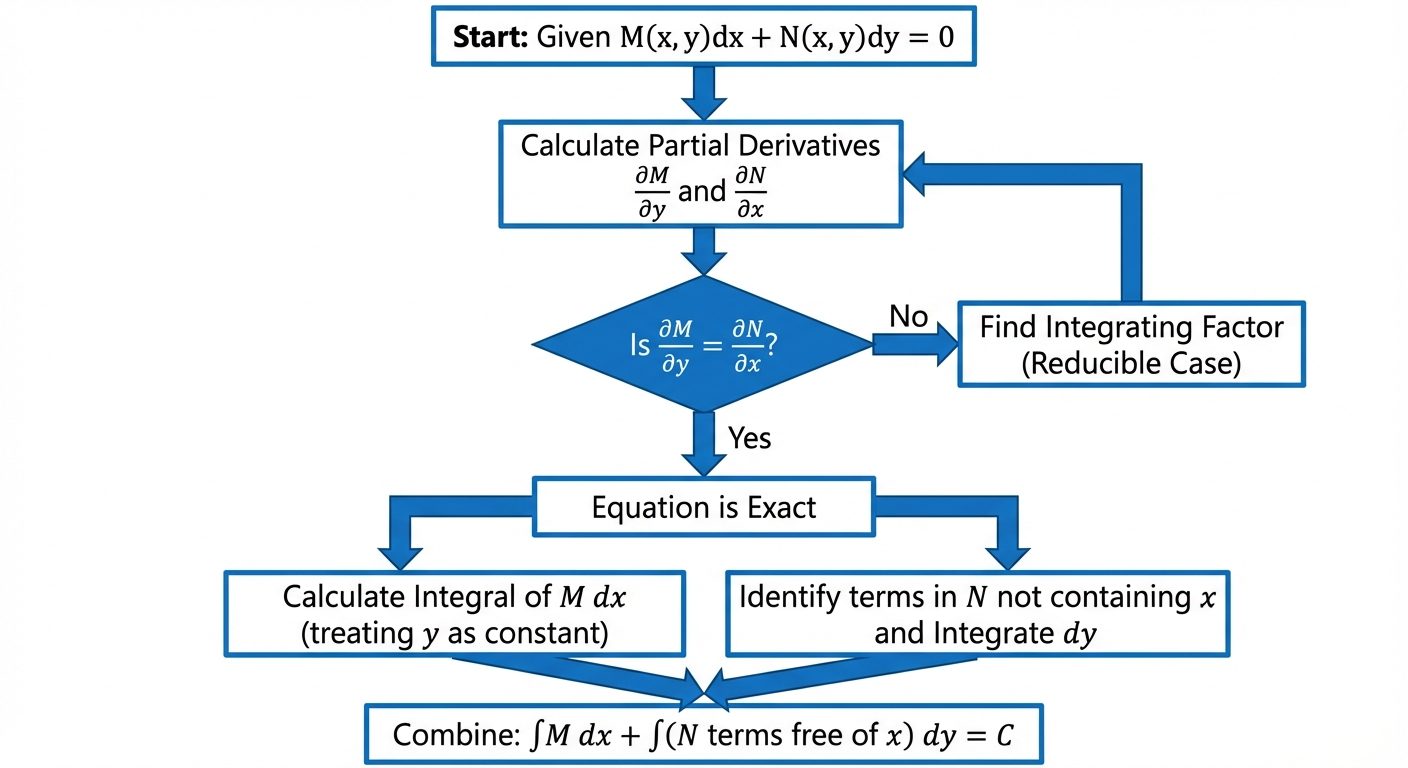
3. Equations Reducible to Exact Equations (Integrating Factors)
If , the equation is not exact. However, it can often be made exact by multiplying it by a function of and/or called an Integrating Factor (I.F.).
Rule 1: Homogeneous Equations
If is a homogeneous equation in and (i.e., and are homogeneous functions of the same degree), and , then:
Rule 2: Function of product
If the equation is of the form:
and , then:
Rule 3: Function of alone
If is a function of only, say , then:
Rule 4: Function of alone
If is a function of only, say , then:
Rule 5: Equations of the form
For equations reducible to the form , the integrating factor is assumed to be . The values of and are found by applying the condition of exactness to the new equation.
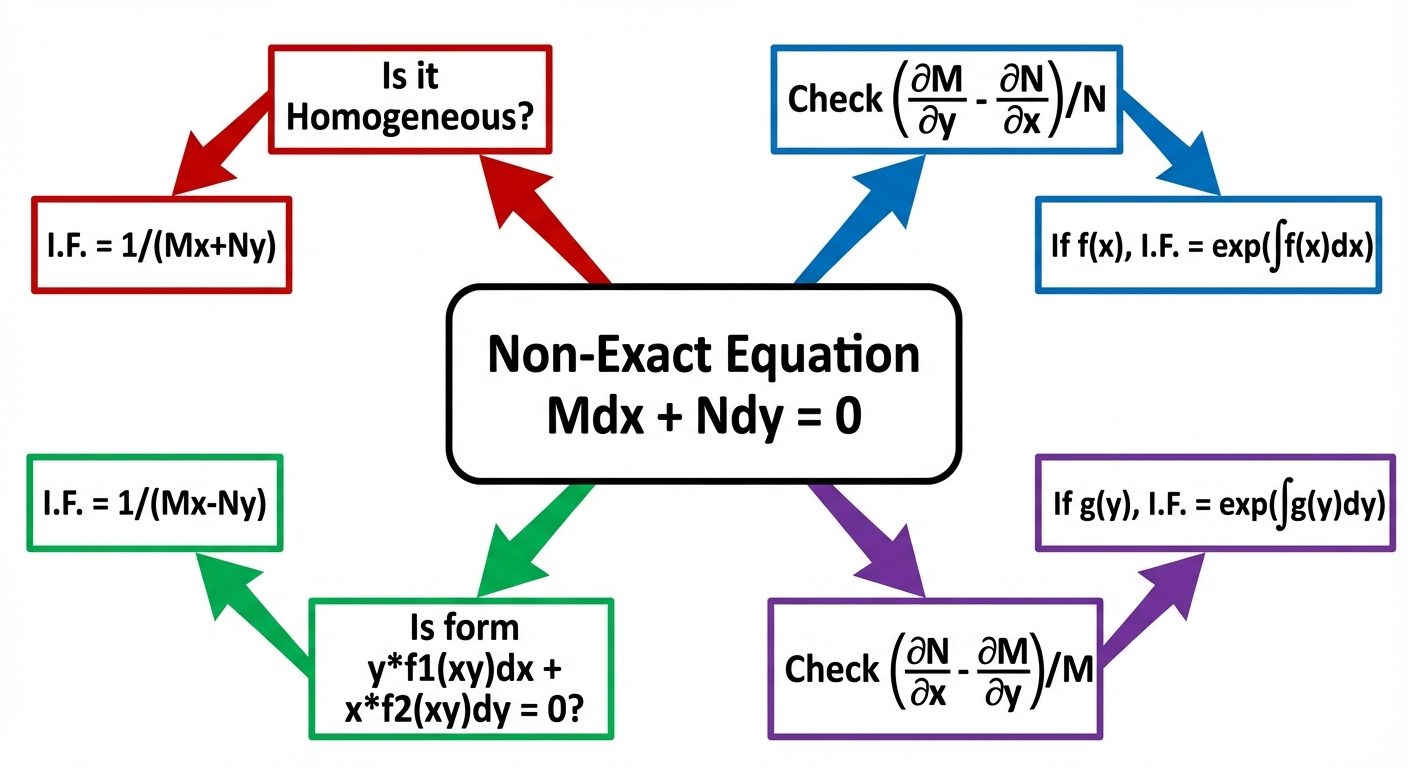
4. Equations of the First Order and Higher Degree
These are differential equations where the highest derivative is of the first order (), but it appears with a power (degree) greater than 1.
Standard Notation: Let . The general form is:
where are functions of and .
Case I: Equations Solvable for
If the equation can be resolved into linear factors of :
Method:
- Equate each factor to zero: , etc.
- Solve each first-order ODE individually to get solutions , , etc.
- The general solution is the product of these solutions:
Case II: Equations Solvable for
The equation can be expressed as .
Method:
- Differentiate the equation with respect to .
- This results in a differential equation in variables and .
- Solve to find a relation between .
- Eliminate between the original equation and the result. If elimination is difficult, express and as parametric functions of .
Case III: Equations Solvable for
The equation can be expressed as .
Method:
- Differentiate the equation with respect to .
- This results in a differential equation in variables and .
- Solve to find a relation between .
- Eliminate between the original equation and the result to get the solution in and .
5. Clairaut's Equation
Clairaut's equation is a specific type of first-order, higher-degree differential equation.
Standard Form
Where .
General Solution
The general solution is obtained simply by replacing with an arbitrary constant .
Proof Concept:
- Differentiate with respect to :
- Ignoring the factor , we set .
- Integrating gives .
- Substituting back:
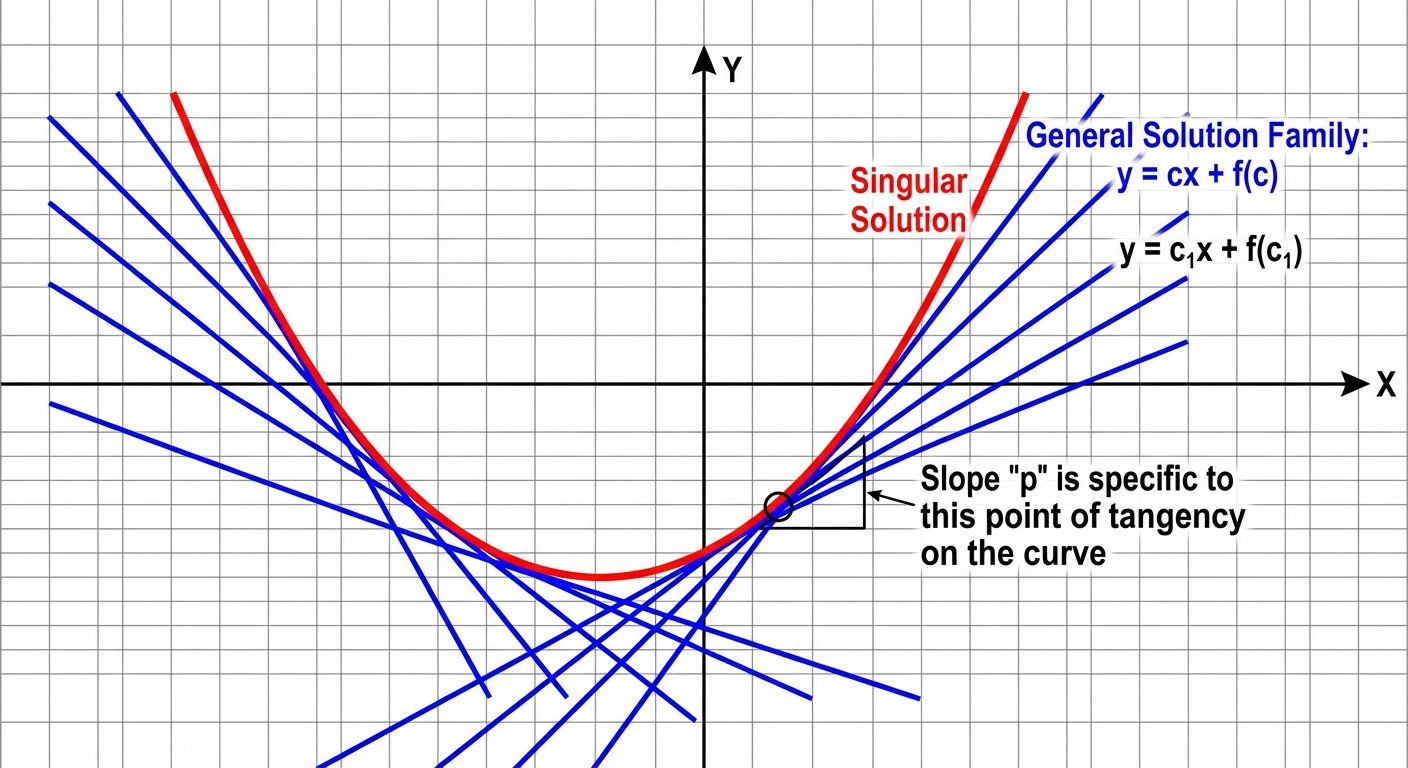
This represents a family of straight lines.
Singular Solution
The singular solution is a solution that cannot be obtained from the general solution by assigning a value to the constant . Geometrically, it represents the envelope of the family of straight lines defined by the general solution.
Method to find Singular Solution:
- Start with the General Solution: .
- Differentiate partially with respect to :
- Eliminate between the General Solution equation and the differentiated equation.
- The resulting relation between and is the singular solution.
6. Summary of Key Formulas
| Type | Form | Solution Method |
|---|---|---|
| Exact | where | |
| Homogeneous | same degree | |
| Linear in | , where | |
| Clairaut's | General: ; Singular: Eliminate |
Did this save you a night before the exam?
LPU Notes is free, and it stays free. Ads cover part of the server bill. The rest comes out of a student's own pocket: the domain, the storage, and keeping the site up through the weeks everyone needs it at once.
The payment button didn't load. An ad blocker or a filtered network is the usual reason. to try again.
Nothing here is ever locked, and nothing unlocks. Chip in only if it was worth it. What it pays for →