Unit 1: Foundations & Applications of AI / AI Problem Modeling & Search Concepts
1. Introduction to Intelligence and AI
What is Intelligence?
Intelligence is the computational part of the ability to achieve goals in the world. In humans, it encompasses the ability to:
- Learn from experience.
- Reason to solve problems and make decisions.
- Perceive the environment (vision, hearing).
- Understand and generate language.
- Adapt to new situations.
What is Artificial Intelligence (AI)?
AI is the branch of computer science concerned with building smart machines capable of performing tasks that typically require human intelligence.
- Turing's Definition: Acting indistinguishably from a human (The Turing Test).
- McCarthy's Definition: "The science and engineering of making intelligent machines."
- Modern Definition: The study of agents that receive percepts from the environment and perform actions to maximize their chances of achieving a specific goal (Rational Agent approach).
Characteristics of Artificial Intelligence
- Automation: reducing human intervention in repetitive tasks.
- Adaptability: modifying behavior based on changes in data or environment.
- Data Ingestion: processing vast amounts of structured and unstructured data.
- Pattern Recognition: identifying trends and correlations humans might miss.
- Probabilistic Reasoning: making decisions based on uncertainty and statistical likelihoods.
2. Foundations and Evolution of AI
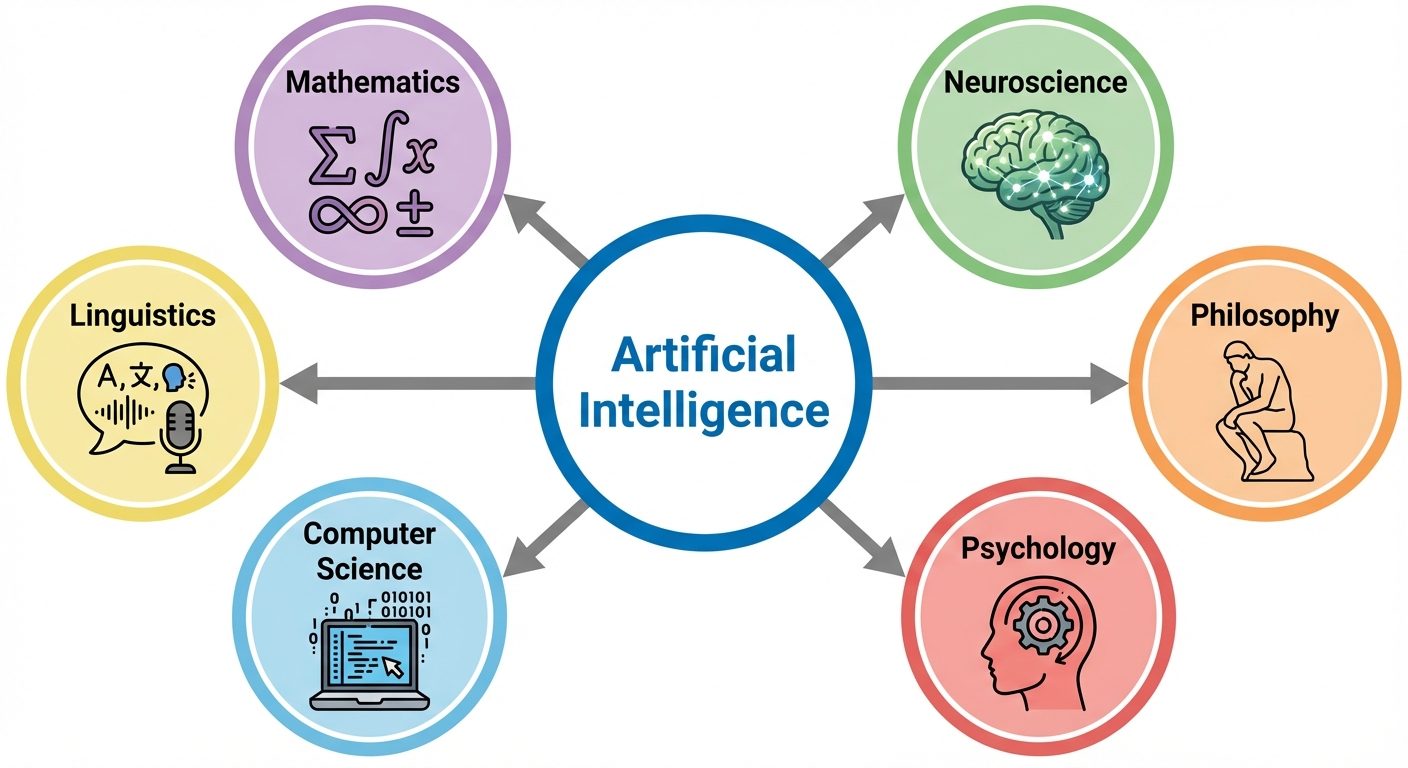
AI is multidisciplinary, drawing from several fields to replicate cognitive processes.
Disciplinary Foundations
- Philosophy: Logic, reasoning, mind-body connection.
- Mathematics: Logic, probability, calculus, optimization theory.
- Neuroscience: Understanding how the biological brain functions (neurons/synapses).
- Psychology: Cognitive science, behaviorism.
- Computer Engineering: Hardware efficiency (GPUs/TPUs) needed for computation.
- Linguistics: Syntax and semantics for Natural Language Processing (NLP).
The Evolution of AI
- 1950s (The Birth): Alan Turing proposes the Turing Test. 1956 Dartmouth Conference coins the term "Artificial Intelligence."
- 1960s-70s (Symbolic AI): Rule-based systems, logic theorists. First chatbots (ELIZA).
- 1980s (Expert Systems): Knowledge-based systems for specific domains. Start of commercial AI.
- 1990s-2000s (Machine Learning): Shift from rules to data-driven statistical models. IBM Deep Blue defeats Kasparov.
- 2010s-Present (Deep Learning & GenAI): Neural networks, Big Data, GPUs. AlphaGo, Transformer models, ChatGPT.
3. Types of AI
Based on Capability
- Narrow AI (ANI - Artificial Narrow Intelligence):
- Specialized in one specific task.
- Cannot transfer knowledge to other domains.
- Examples: Siri, Google Search, Face Recognition, Chess engines.
- Status: Current state of AI.
- General AI (AGI - Artificial General Intelligence):
- Machine intelligence comparable to a human brain.
- Can apply intelligence to any problem.
- Status: Theoretical/Hypothetical.
- Super AI (ASI - Artificial Super Intelligence):
- Intellect that is much smarter than the best human brains in practically every field.
- Status: Science Fiction/Futuristic.
4. Key AI Problems and Techniques
Key Problems (Goals)
- Knowledge Representation: How to store what the AI knows (ontologies, semantic networks).
- Reasoning/Planning: determining the sequence of actions to reach a goal.
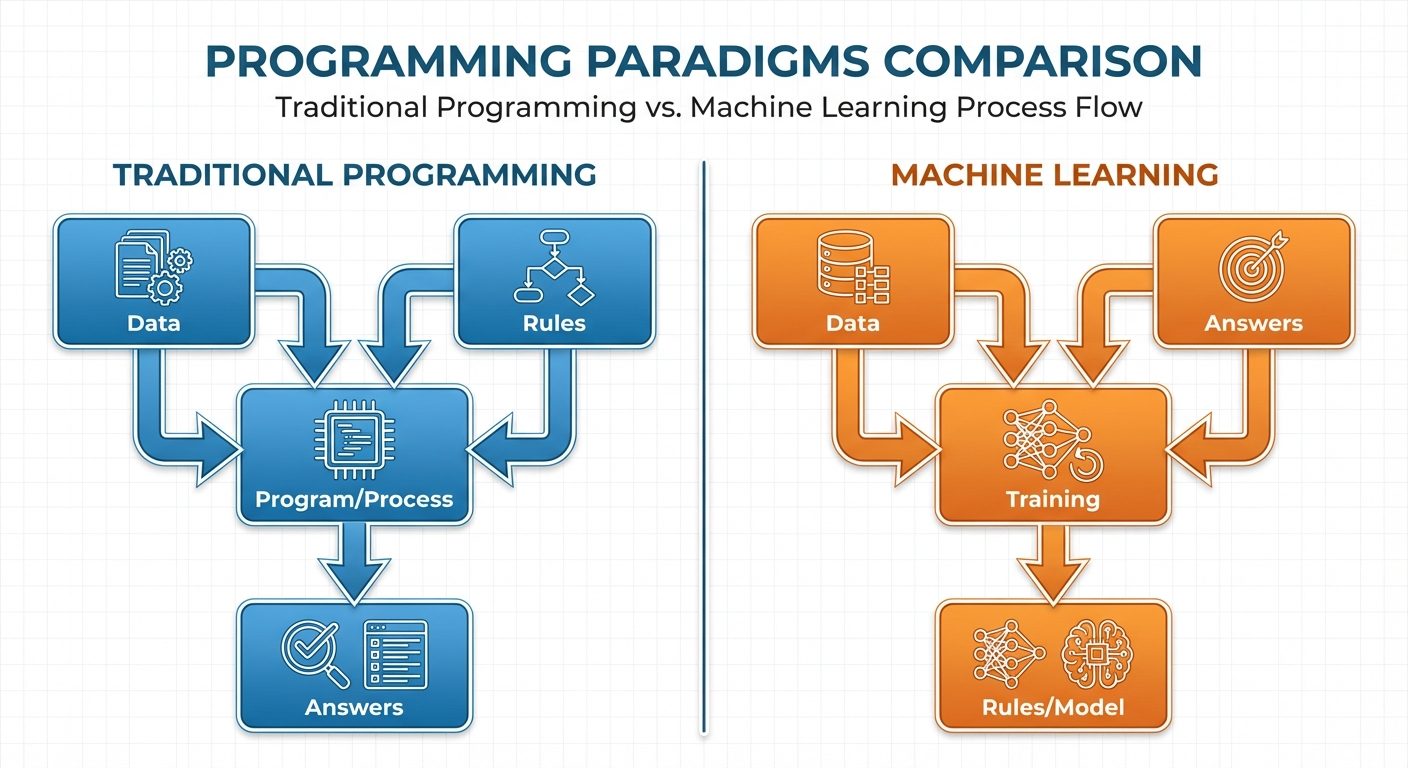
- Learning: Improving performance based on data (Machine Learning).
- Natural Language Processing (NLP): Interacting via human language.
- Perception: Computer vision and audio processing.
Key Techniques
- Search Algorithms: BFS, DFS, A* (finding paths in a grid).
- Logic: Propositional and First-Order Logic.
- Probabilistic Methods: Bayesian Networks.
- Neural Networks: Layers of nodes mimicking the brain (Deep Learning).
5. Applications Across Domains
| Domain | Application Examples |
|---|---|
| Business | Customer segmentation, algorithmic trading, fraud detection, chatbots (RPA). |
| Healthcare | Disease diagnosis (radiology AI), drug discovery, personalized medicine, robotic surgery. |
| Automation | Industrial robots, predictive maintenance, supply chain optimization. |
| Computer Vision | Facial recognition security, self-driving cars (object detection), satellite image analysis. |
| NLP | Language translation (Google Translate), Sentiment Analysis, Virtual Assistants (Alexa). |
6. Modern AI Toolkits
To implement AI, developers use specialized frameworks.
- TensorFlow (Google):
- Comprehensive, flexible ecosystem.
- Great for production deployment (TF Serving, TF Lite).
- Uses data flow graphs.
- PyTorch (Meta/Facebook):
- Pythonic and dynamic computational graph.
- Preferred by researchers for rapid prototyping.
- Gaining massive traction in industry.
- Scikit-Learn: Good for traditional ML algorithms (Regression, Clustering).
- Keras: High-level API running on top of TensorFlow.
7. Responsible AI
As AI becomes powerful, ethical considerations are paramount.
- Fairness & Bias: Ensuring AI does not discriminate against race, gender, or age due to biased training data.
- Explainability (XAI): Understanding why an AI made a decision (Black Box problem).
- Privacy: Protecting user data (Federated Learning).
- Safety & Robustness: AI should not be easily fooled by adversarial attacks.
- Accountability: Determining who is responsible for AI errors.
8. AI Problem Modeling & Search Concepts
To solve a problem using AI, it must be mathematically modeled.
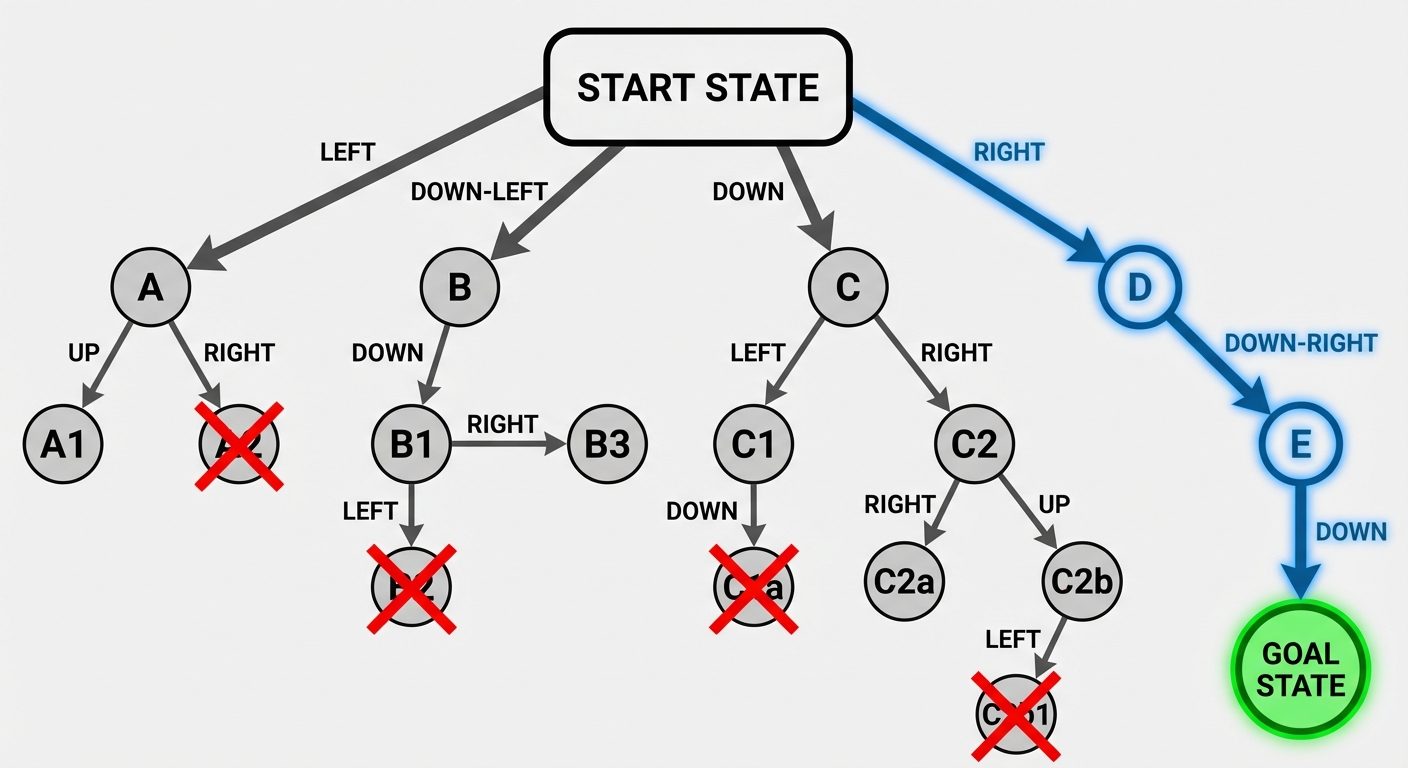
Defining Problems as State Space Search
A problem is defined by four components:
- Initial State: Where the agent starts.
- Actions: What the agent can do.
- Transition Model: If action is done in state , what is the new state ?
- Goal Test: Determines if the current state is the goal.
- Path Cost: The numerical cost associated with the path (e.g., distance, time).
State Space: The set of all reachable states.
Characteristics of AI Problem Spaces
- Fully vs. Partially Observable: Can the agent see the whole state? (Chess = Fully; Poker = Partially).
- Deterministic vs. Stochastic: Does the next state depend only on the current state and action? (Chess = Deterministic; Self-driving = Stochastic/Uncertain).
- Discrete vs. Continuous: Are the states/actions distinct or smooth? (Chess = Discrete; driving steering angle = Continuous).
- Static vs. Dynamic: Does the environment change while the agent is thinking? (Crossword = Static; Taxi driving = Dynamic).
9. AI Workflows & Data-Centric Modeling
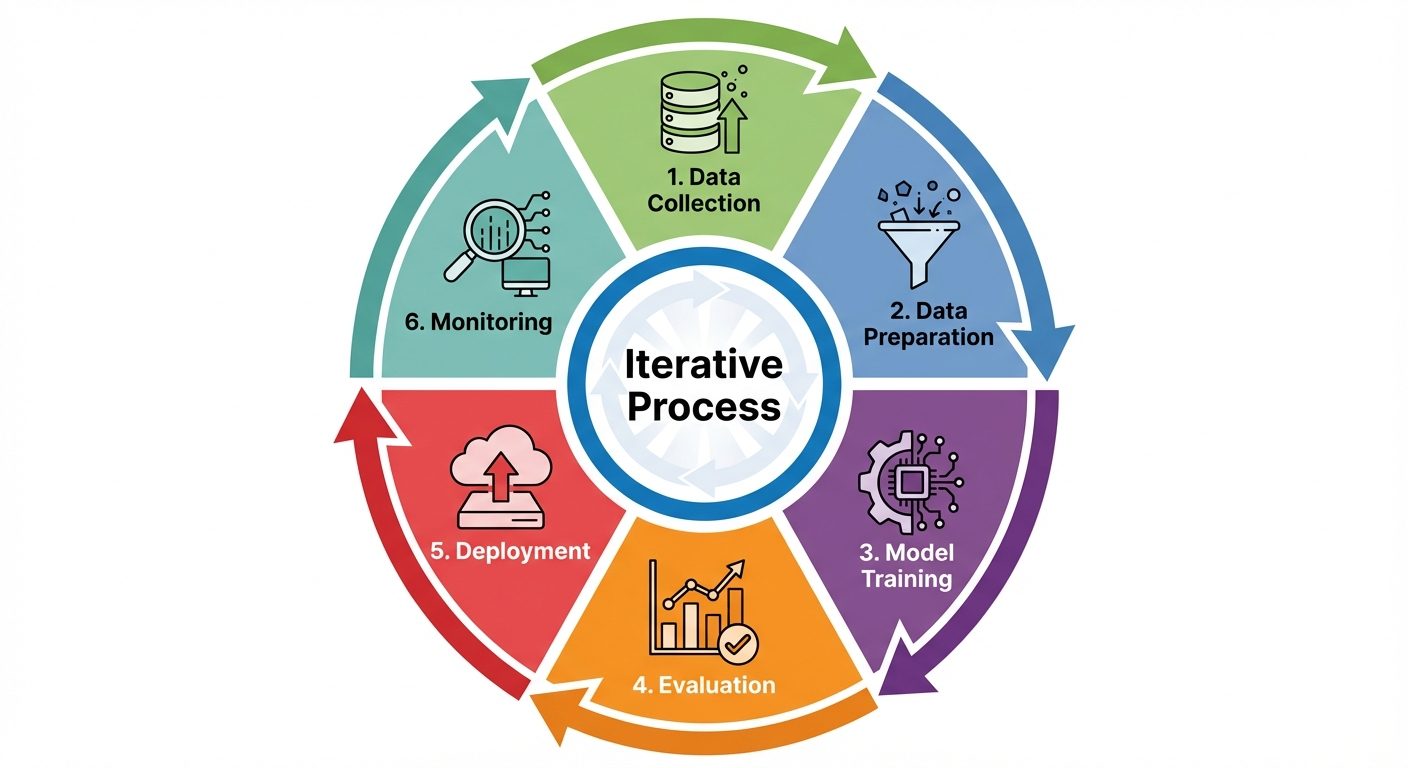
The AI Workflow Cycle
- Problem Definition: What are we trying to solve?
- Data Collection: Gathering raw data (sensors, databases).
- Data Preparation: Cleaning, labeling, and normalizing data.
- Model Selection & Training: Choosing an algorithm and feeding it data.
- Evaluation: Testing accuracy using validation sets.
- Deployment: Integrating the model into an application.
- Monitoring: Watching for "drift" (performance degradation).
Data-Centric AI
Historically, AI focused on improving models (Model-Centric). Modern "Data-Centric AI" emphasizes improving the quality of data (clean labels, reducing noise) as the most effective way to improve performance.
10. Challenges in AI Problem Solving
- Data Scarcity & Quality: "Garbage in, Garbage out." Lack of labeled data for supervised learning.
- Computational Cost: Training large models (like LLMs) requires expensive hardware and electricity.
- Overfitting: The model memorizes training data but fails on new, unseen data.
- Curse of Dimensionality: As the number of features increases, the amount of data needed grows exponentially.
- Interpretability: Deep learning models act as "black boxes," making it hard to trust them in critical fields like medicine or law.
Did this save you a night before the exam?
LPU Notes is free, and it stays free. Ads cover part of the server bill. The rest comes out of a student's own pocket: the domain, the storage, and keeping the site up through the weeks everyone needs it at once.
The payment button didn't load. An ad blocker or a filtered network is the usual reason. to try again.
Nothing here is ever locked, and nothing unlocks. Chip in only if it was worth it. What it pays for →