Unit 5: Ethereum Basics
1. Ethereum and Smart Contracts
Overview of Ethereum
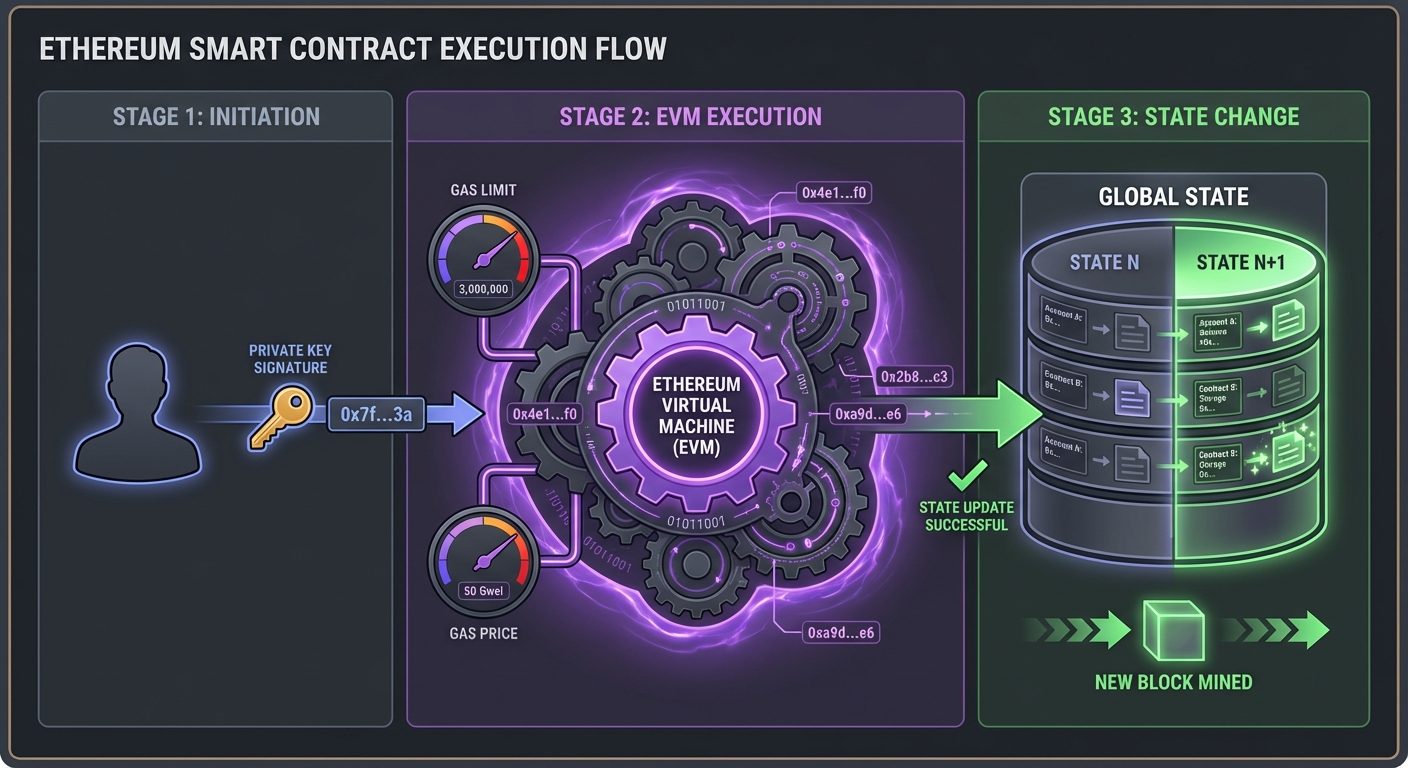
Ethereum is an open-source, distributed computing platform based on blockchain technology. Unlike Bitcoin, which was designed primarily as a peer-to-peer electronic cash system, Ethereum was designed to be a general-purpose programmable blockchain. It introduces the concept of the Ethereum Virtual Machine (EVM), which serves as a global, decentralized computer.
- The World Computer: Every node in the Ethereum network runs the EVM and maintains the current state of the ledger.
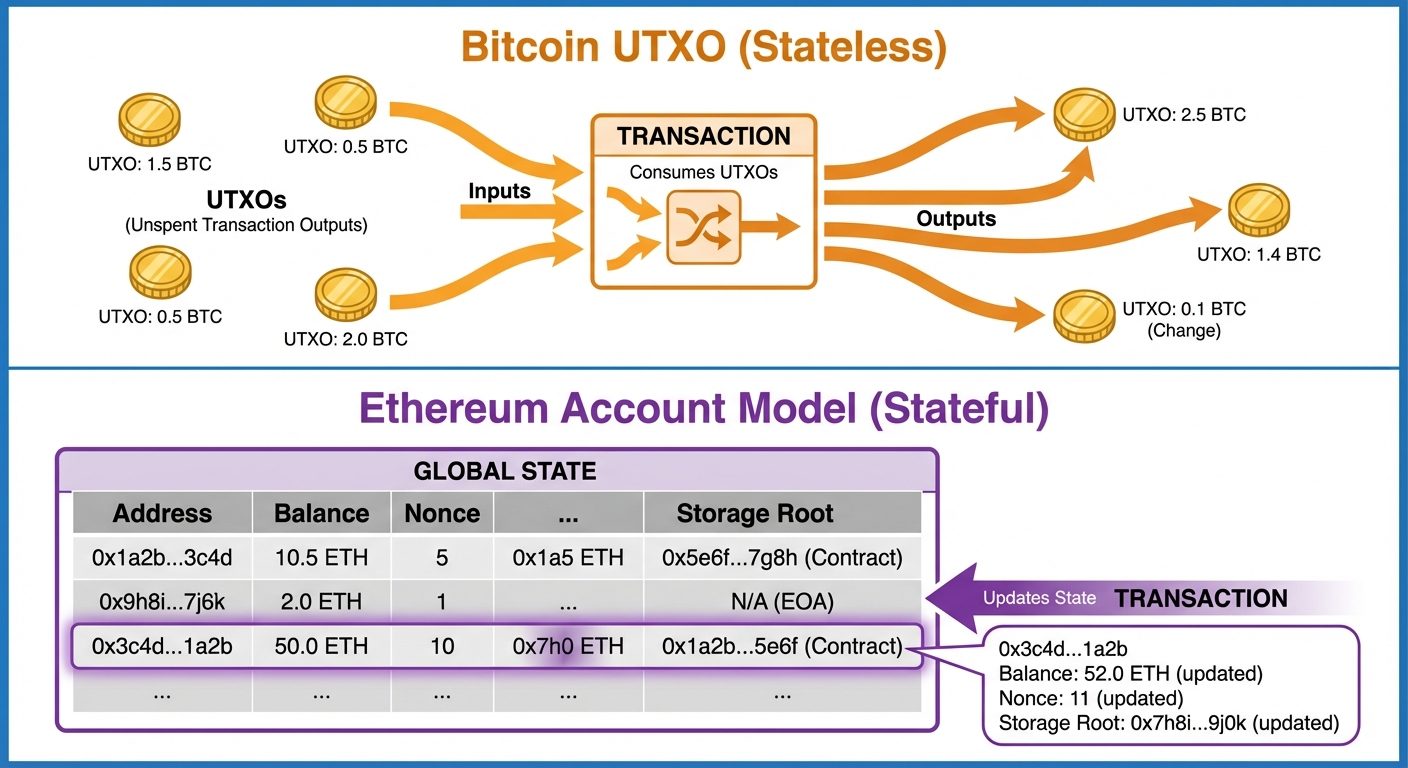
- State-Based Architecture: While Bitcoin uses a UTXO (Unspent Transaction Output) model, Ethereum uses an Account-Based Model. This tracks the current state (balances, storage, code) of every account.
Smart Contracts Defined
A Smart Contract is a self-executing contract with the terms of the agreement between buyer and seller being directly written into lines of code. The code and the agreements exist across a distributed, decentralized blockchain network.
- Origin: The term was coined by computer scientist Nick Szabo in 1994, long before blockchain technology existed.
- Mechanism: They act like "cryptographic vending machines." If you input the required cryptocurrency (money) and select a product (function), the machine automatically releases the item (executes logic) without a cashier (middleman).
- Immutability: Once deployed to the Ethereum blockchain, the code cannot be changed (unless specific upgradeability patterns are programmed in advance).
2. Turing Completeness and Verification Challenges
Turing Completeness
Ethereum is Turing Complete, meaning its programming language (Solidity, compiling to EVM bytecode) can theoretically solve any computational problem, provided it has enough resources (time and memory).
- Loops and Logic: Unlike Bitcoin’s scripting language, Ethereum supports complex features like
whileloops,forloops, and recursive function calls. - The Halting Problem: A fundamental problem in computer science is that it is impossible to predict if a program will run forever (infinite loop) or eventually stop.
- The Solution - Gas: To prevent infinite loops from crashing the network, Ethereum introduces Gas. Every operation costs a specific amount of gas. If a transaction runs out of gas, execution halts, and changes are reverted. This limits the execution time, effectively making it "Quasi-Turing Complete" in practice.
Verification Challenges
Because smart contracts handle significant financial assets, bugs are catastrophic. The flexibility of Turing completeness introduces vulnerabilities.
- Re-entrancy Attacks: A vulnerability where a malicious contract calls back into the calling contract before the first invocation is finished (e.g., The DAO Hack).
- Integer Overflow/Underflow: Arithmetic operations reaching the maximum capacity of a variable type and wrapping around.
- Formal Verification: The mathematical proof that code acts exactly as specified. This is difficult in Ethereum due to the complexity of the EVM and interaction between different contracts.
3. Using Smart Contracts to Enforce Legal Contracts
Smart contracts allow for the automation of contractual performance, but they differ significantly from traditional legal contracts.
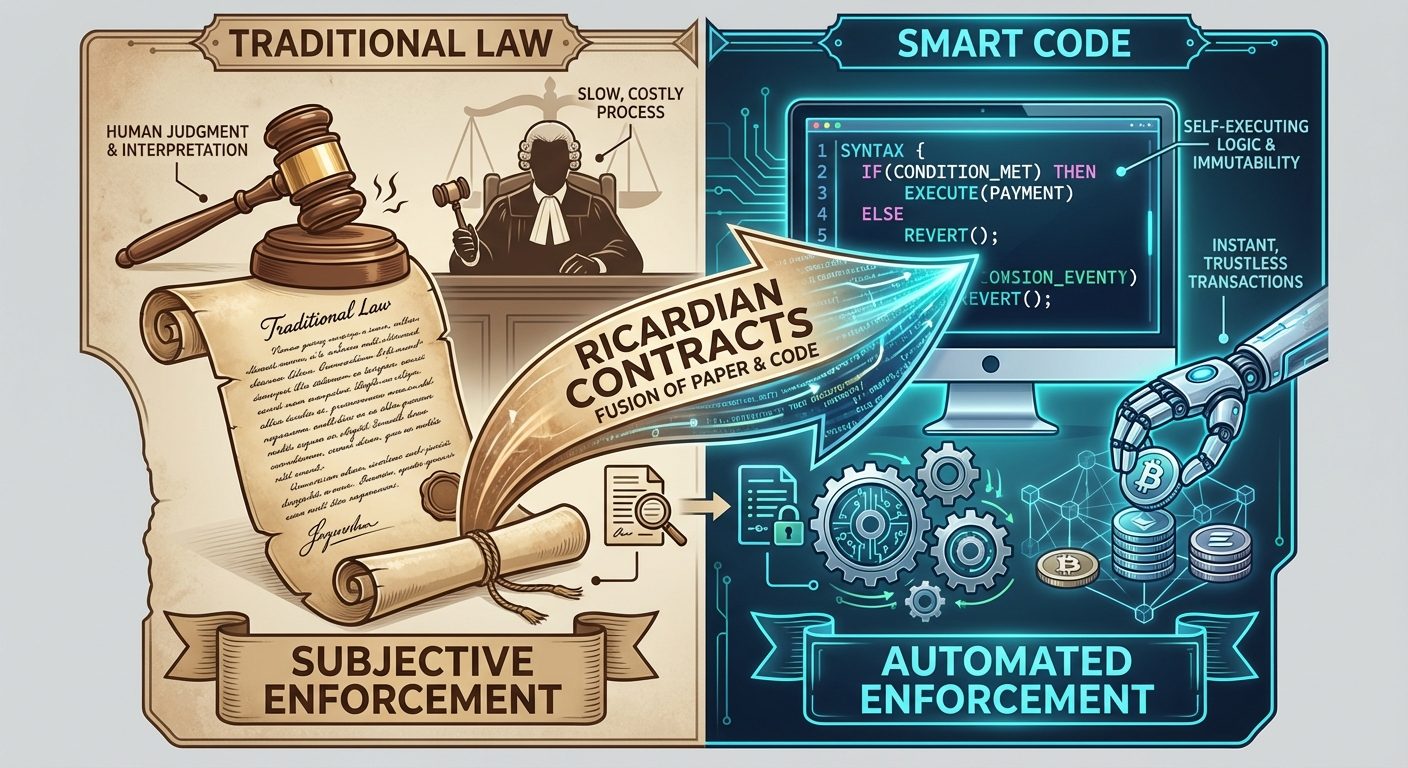
Comparison: Code vs. Law
| Feature | Traditional Legal Contract | Smart Contract |
|---|---|---|
| Language | Natural Language (English, etc.) | Programming Language (Solidity) |
| Ambiguity | High (Subject to interpretation) | None (Deterministic execution) |
| Enforcement | Courts, Law Enforcement, Arbitrators | Cryptographic Code Execution |
| Cost | High (Lawyers, administrative fees) | Low (Gas fees, deployment costs) |
| Scope | Broad (Subjective human behavior) | Narrow (On-chain data/logic) |
Ricardian Contracts
A bridge between legal and smart contracts. A Ricardian contract records the agreement in a format that is both:
- Human-readable: A legal text document.
- Machine-readable: Parsable code that executes the terms.
The cryptographic hash of the legal document is often embedded in the smart contract to bind the two.
4. Comparing Bitcoin Scripting vs. Ethereum Smart Contracts
While both utilize blockchain, their capabilities differ fundamentally based on their design goals.
Bitcoin Scripting
- Stack-Based Language: Bitcoin uses a language called Script. It functions using a stack data structure (Last-In, First-Out).
- Not Turing Complete: It intentionally lacks loops (
for,while) to avoid infinite execution and Denial of Service (DoS) attacks. - Stateless: Scripts usually verify a specific transaction spending condition (UTXO). They do not see the "global state" or balances of other users.
- Focus: Security and simplicity for monetary transactions.
Ethereum Smart Contracts
- Turing Complete: capable of complex logic.
- Stateful: Contracts have persistent memory (storage) that stays on the blockchain between transactions.
- Account Model: Operates on accounts (User accounts and Contract accounts).
- Focus: Decentralized Applications (DApps), DAOs, and complex financial instruments (DeFi).
Comparative Architecture
5. Writing Smart Contracts: Solidity & JavaScript
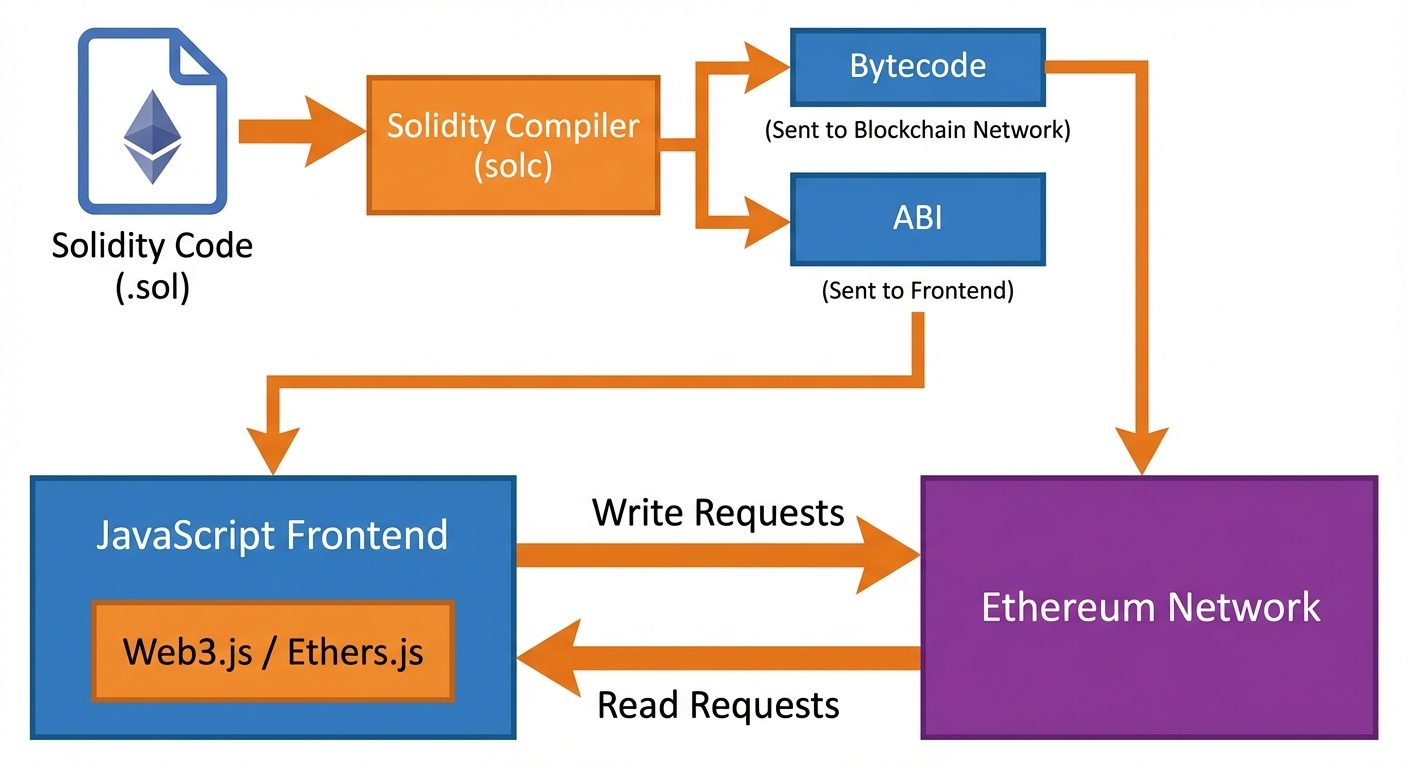
Developing on Ethereum typically involves writing the contract in Solidity (backend) and interacting with it using JavaScript (frontend/testing).
Solidity (The Contract Language)
Solidity is an object-oriented, high-level language for implementing smart contracts. It is statically typed and supports inheritance.
Key Components of a Solidity File:
- Pragma: Specifies the compiler version.
- State Variables: Variables whose values are permanently stored in contract storage.
- Functions: Executable units of code.
- Events: Way to log activity on the blockchain for the frontend to listen to.
Example: Simple Storage Contract
// SPDX-License-Identifier: MIT
pragma solidity ^0.8.0;

contract SimpleStorage {
    // State variable to store a number
    uint256 private storedData;

    // Event to emit when value changes
    event DataChanged(uint256 newValue);

    // Function to set the value
    function set(uint256 x) public {
        storedData = x;
        emit DataChanged(x);
    }

    // Function to retrieve the value
    // 'view' means it reads state but doesn't modify it (no gas cost for local call)
    function get() public view returns (uint256) {
        return storedData;
    }
}
JavaScript (The Interaction Layer)
JavaScript is used to test contracts, deploy them, and build user interfaces (websites) that talk to the blockchain. Libraries like Web3.js or Ethers.js are used as bridges.
How JS Interacts with Ethereum:
- JSON-RPC: JavaScript sends requests to an Ethereum node via JSON-RPC.
- ABI (Application Binary Interface): A JSON file generated by the Solidity compiler that tells JavaScript what functions exist in the contract and what parameters they accept.
Example: Interacting via Ethers.js
const { ethers } = require("ethers");

// 1. Connect to a Provider (e.g., MetaMask or Infura)
const provider = new ethers.providers.Web3Provider(window.ethereum);

// 2. The Contract Address and ABI
const contractAddress = "0x123...";
const contractABI = [ /* ABI array from compilation */ ];

// 3. Create a Contract Instance
const storageContract = new ethers.Contract(contractAddress, contractABI, provider.getSigner());

// 4. Calling the Smart Contract Functions
async function updateValue() {
    // Write operation (requires gas and wallet signature)
    const tx = await storageContract.set(42);
    await tx.wait(); // Wait for block confirmation
    console.log("Value updated!");
}

async function readValue() {
    // Read operation (free, no signature required)
    const value = await storageContract.get();
    console.log("Stored value is: " + value.toString());
}
Did this save you a night before the exam?
LPU Notes is free, and it stays free. Ads cover part of the server bill. The rest comes out of a student's own pocket: the domain, the storage, and keeping the site up through the weeks everyone needs it at once.
The payment button didn't load. An ad blocker or a filtered network is the usual reason. to try again.
Nothing here is ever locked, and nothing unlocks. Chip in only if it was worth it. What it pays for →