Unit 6: Introduction to engineering materials
1. Dielectric Materials
1.1 Definition
Dielectric materials are non-conducting materials (insulators) that can be polarized by an external electric field. Unlike conductors, they do not have free charge carriers (electrons) that can drift through the material. Instead, the positive and negative charges are bound within the atoms or molecules. When an external field is applied, these charges shift slightly from their equilibrium positions—positive charges in the direction of the field and negative charges opposite to it—creating microscopic electric dipoles.
Key Characteristics:
- High electrical resistivity.
- Negative temperature coefficient of resistance.
- Ability to store electrical energy in the form of charge separation.
- Examples: Ceramics, mica, glass, plastics, distilled water.
1.2 Dielectric Constant ( or )
The dielectric constant (also known as relative permittivity) is a measure of a material's ability to store electrical energy in an electric field. It quantifies how much the material reduces an external electric field within itself.
Mathematically, it is defined as the ratio of the permittivity of the medium () to the permittivity of free space ():
It can also be defined in terms of capacitance. If is the capacitance of a capacitor with a vacuum between plates, and is the capacitance with a dielectric material filling the space:
- Vacuum:
- Air:
- Water: (at room temperature)
- Significance: A higher dielectric constant indicates a material is highly polarizable and can store more charge for a given voltage.
2. Magnetic Materials
Magnetic materials are classified based on their response to an external magnetic field (). The degree of magnetization () and the magnetic susceptibility () are the primary parameters for classification.
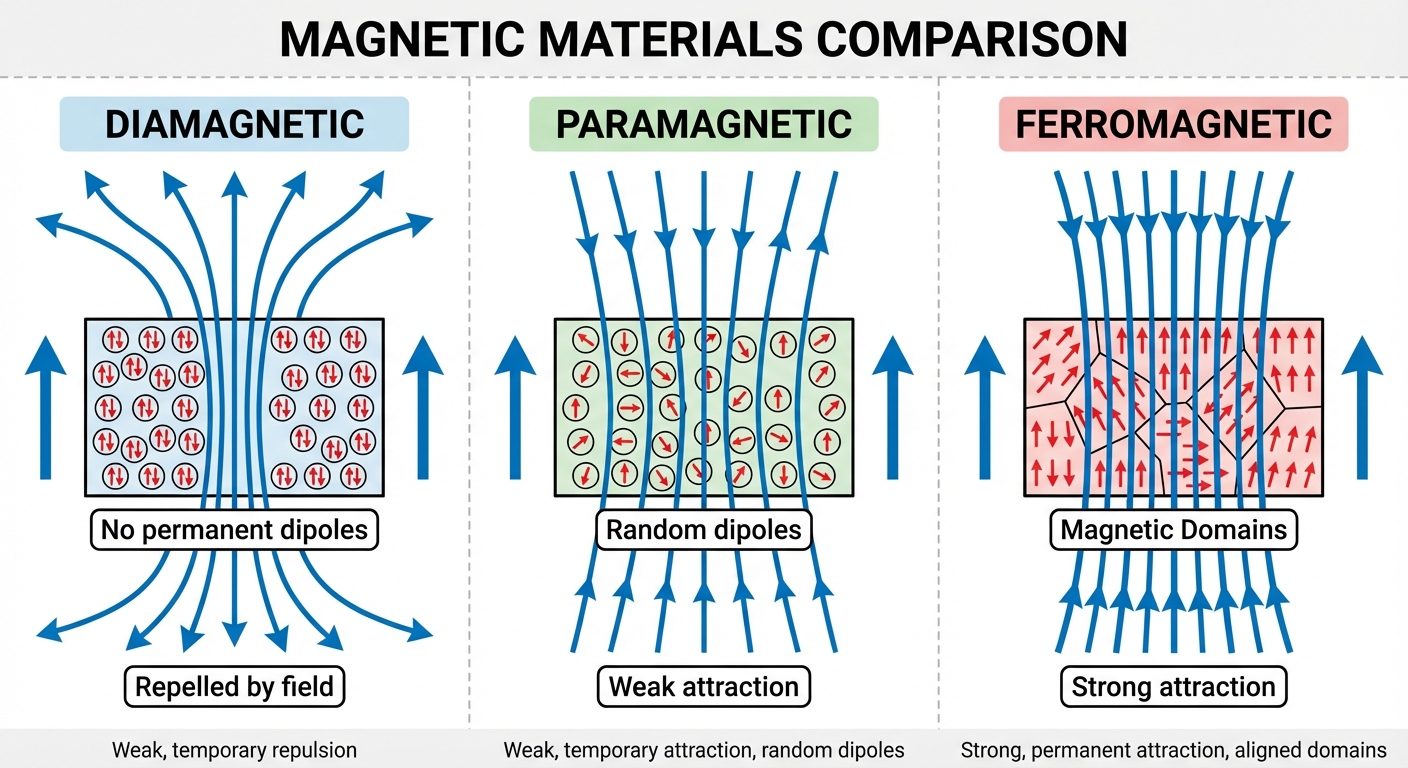
2.1 Diamagnetic Materials
- Definition: Materials that are weakly repelled by a magnetic field.
- Mechanism: The atoms have paired electrons. When a field is applied, the orbital motion of electrons changes, inducing a magnetic moment opposite to the applied field (Lenz’s Law).
- Properties:
- Magnetic susceptibility () is negative and small.
- Relative permeability () is slightly less than 1.
- Magnetization () is opposite to the applied field ().
- Effect is independent of temperature.
- Examples: Bismuth, Copper, Gold, Water, Superconductors.
2.2 Paramagnetic Materials
- Definition: Materials that are weakly attracted to a magnetic field.
- Mechanism: Atoms have unpaired electrons resulting in permanent magnetic dipoles. In the absence of a field, thermal agitation randomizes their orientation. In a field, they align partially.
- Properties:
- Magnetic susceptibility () is positive and small.
- Relative permeability () is slightly greater than 1.
- Adheres to Curie’s Law: Susceptibility is inversely proportional to temperature ().
- Examples: Aluminum, Platinum, Oxygen, Manganese.
2.3 Ferromagnetic Materials
- Definition: Materials that are strongly attracted to magnetic fields and retain magnetism even after the field is removed.
- Mechanism (Domain Theory): The material is divided into small regions called domains. Within a domain, all magnetic dipoles are aligned parallel due to strong exchange interactions. Without an external field, domains are randomly oriented (net ). With a field, domain walls move, and domains aligned with the field grow.
- Properties:
- Magnetic susceptibility () is positive and extremely large.
- Exhibits Hysteresis: The relationship between and is non-linear and depends on the history of magnetization.
- Curie Temperature (): The temperature above which ferromagnetic materials lose their ordered magnetic state and become paramagnetic.
- Examples: Iron, Nickel, Cobalt, Gadolinium.
2.4 Magnetic Data Storage
Magnetic storage devices (Hard Disk Drives - HDD, Magnetic Tapes) utilize the properties of ferromagnetic materials to store binary data (0s and 1s).
- Principle: The storage medium is coated with a thin film of ferromagnetic material.
- Write Process: An electromagnet (Write Head) generates a localized magnetic field that magnetizes a tiny spot on the disk in a specific direction (representing a bit).
- Read Process: A Read Head (often using Giant Magnetoresistance - GMR sensors) detects the direction of the magnetic field from the passing spots on the disk and converts it back into an electrical signal.
- Hysteresis Requirement: The material must have high retentivity (to keep data without power) and high coercivity (to prevent accidental erasure by stray fields).
3. Piezoelectric Materials
3.1 Definition
Piezoelectricity is the phenomenon where electric polarization is produced in certain materials in response to applied mechanical stress. It occurs only in crystals that lack a center of symmetry (non-centrosymmetric crystals).
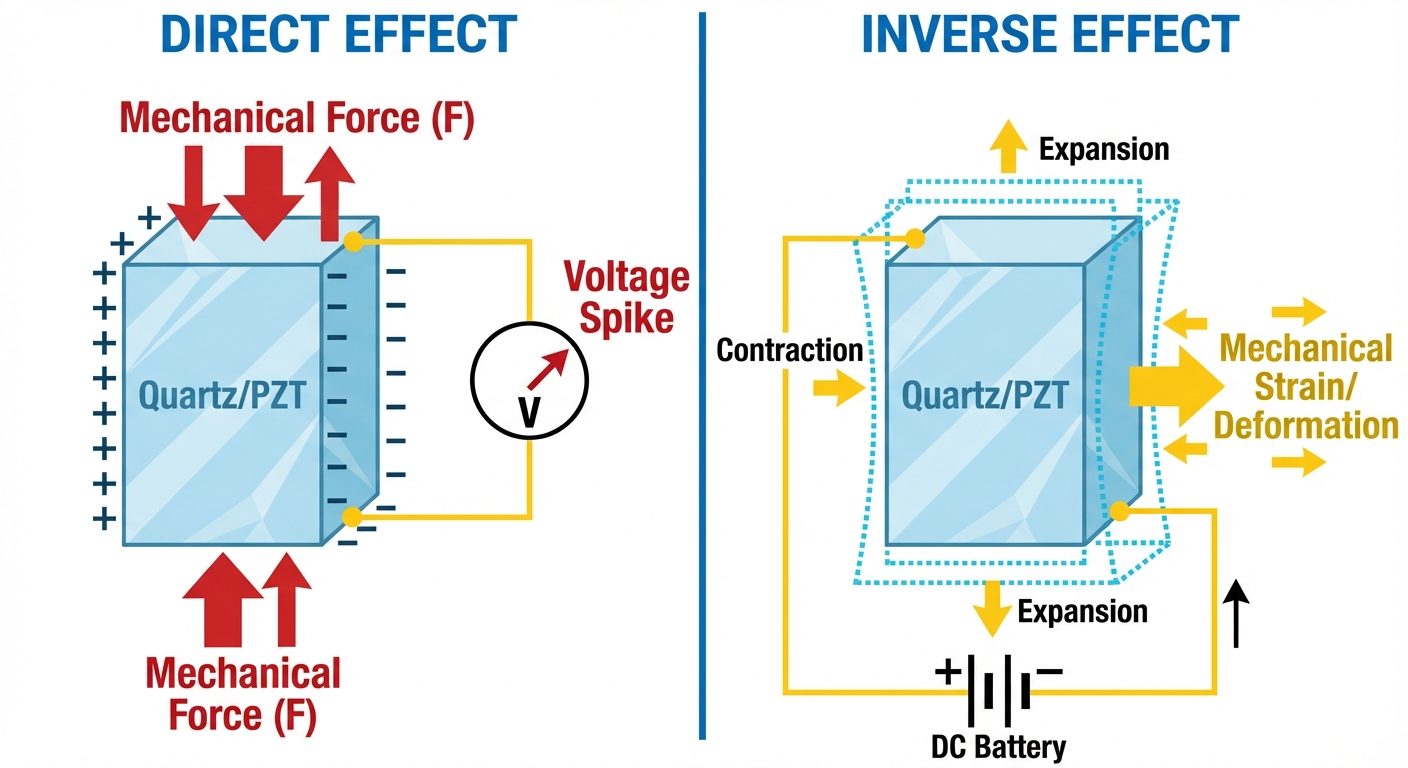
3.2 Direct Piezoelectric Effect
- Process: Mechanical Stress Electrical Potential.
- Mechanism: When the crystal lattice is compressed or stretched, the centers of positive and negative charges are displaced, creating a net dipole moment and a voltage across the material faces.
- Applications: Sensors, microphones, cigarette lighters, pressure gauges.
3.3 Inverse Piezoelectric Effect
- Process: Electrical Potential Mechanical Strain.
- Mechanism: When a voltage is applied across the crystal, the electric field exerts forces on the charges within the lattice, causing the physical shape of the crystal to deform (expand or contract).
- Applications: Actuators, quartz watches (oscillators), ultrasonic cleaners, sonar.
4. Superconducting Materials
4.1 Definition and Properties
Superconductivity is a phenomenon observed in certain materials where electrical resistance vanishes completely below a characteristic critical temperature ().
Key Properties:
- Zero Electrical Resistance: at . A current induced in a superconducting loop can persist indefinitely without a power source.
- Critical Magnetic Field (): Superconductivity is destroyed if the external magnetic field exceeds a specific limit.
- Critical Current Density (): The maximum current density a superconductor can carry before reverting to a normal state.
4.2 The Meissner Effect
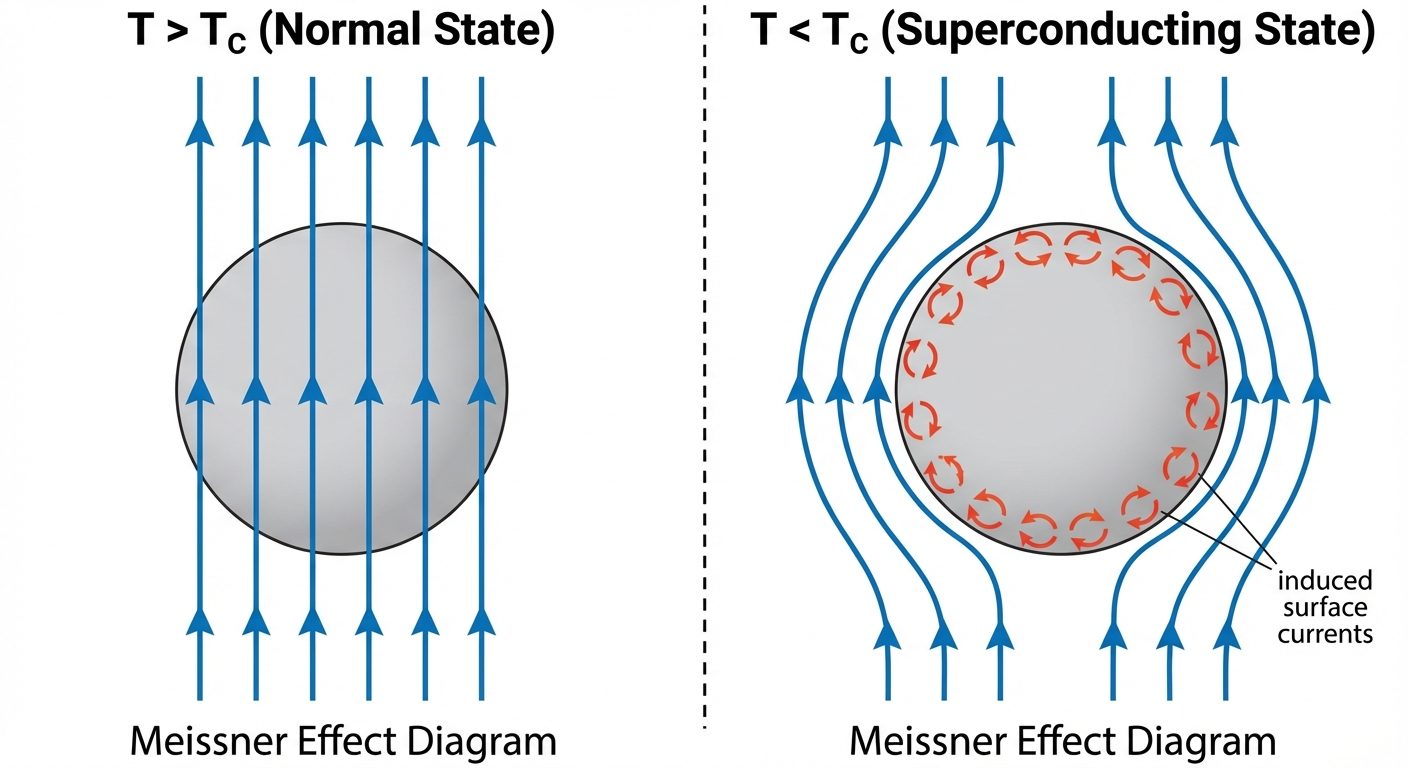
The Meissner effect is the expulsion of a magnetic field from the interior of a material during its transition to the superconducting state.
- When : The material acts as a normal conductor; magnetic field lines penetrate it.
- When : The material becomes a superconductor. Surface currents are induced which generate a magnetic field exactly canceling the external field inside the material ().
- This proves that superconductors are perfect diamagnets ().
4.3 Type I and Type II Superconductors
| Feature | Type I (Soft Superconductors) | Type II (Hard Superconductors) |
|---|---|---|
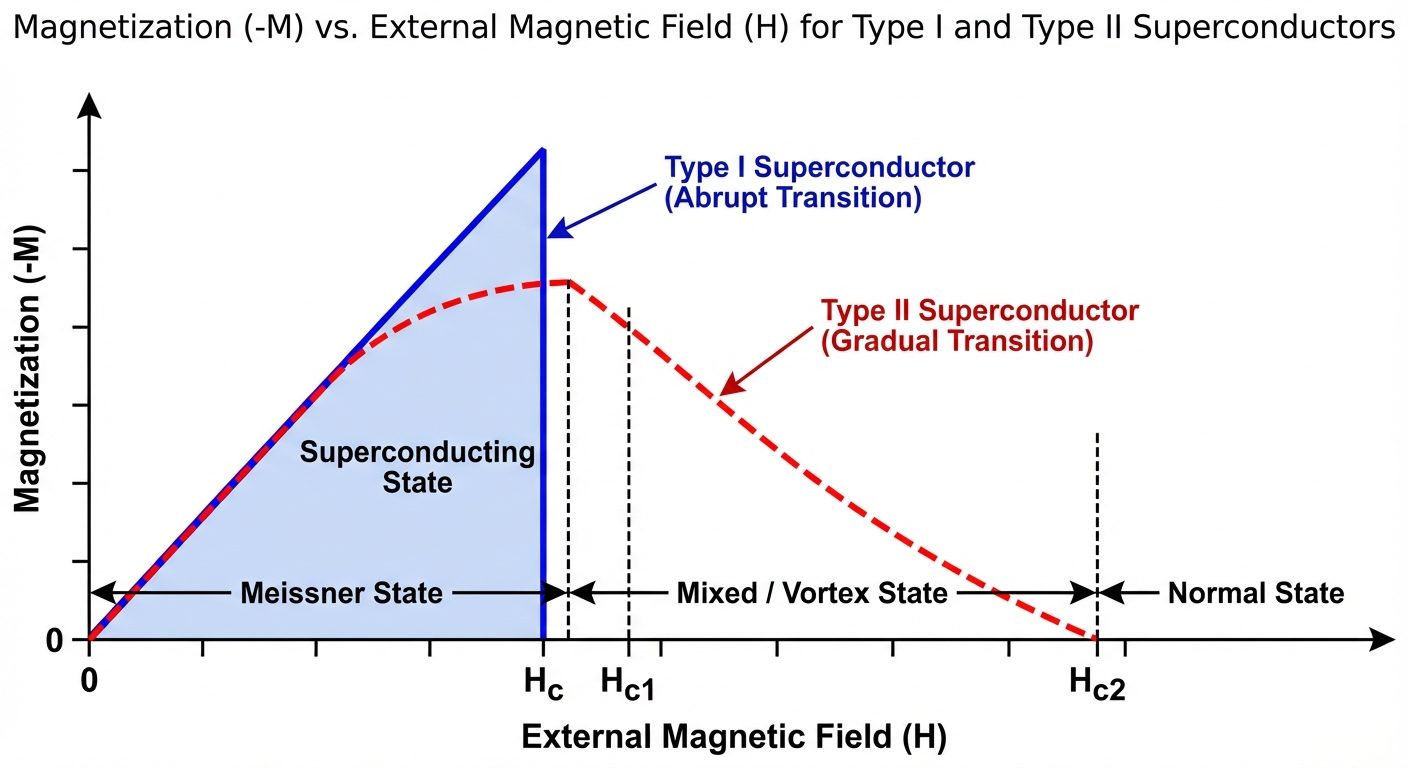
| Transition | Exhibits a sudden, sharp transition from superconducting to normal state at . | Exhibits a gradual transition. Has two critical fields: and . |
| Meissner Effect | Strictly follows the Meissner effect (perfect diamagnetism). | Follows Meissner effect up to . Between and , field lines partially penetrate (Vortex State). |
| Critical Field | Low critical magnetic field values (unsuitable for high-field magnets). | High critical magnetic field values (suitable for strong magnets). |
| Examples | Lead (Pb), Mercury (Hg), Tin (Sn). | Niobium-Titanium (NbTi), YBCO ceramics. |
4.4 Applications of Superconductors
- Medical Imaging (MRI): Superconducting magnets produce the strong, stable magnetic fields required for Magnetic Resonance Imaging.
- Maglev Trains: Magnetic Levitation trains use the Meissner effect and magnetic repulsion to float above tracks, eliminating friction and allowing high speeds (e.g., SC Maglev in Japan).
- Power Transmission: Superconducting cables can transmit electricity with zero resistive loss, increasing efficiency significantly.
- SQUIDs (Superconducting Quantum Interference Devices): Extremely sensitive magnetometers used to detect faint magnetic fields, used in geological surveying and brain activity monitoring (MEG).
- Particle Accelerators: Like the Large Hadron Collider (LHC), which uses superconducting magnets to steer particle beams.
Did this save you a night before the exam?
LPU Notes is free, and it stays free. Ads cover part of the server bill. The rest comes out of a student's own pocket: the domain, the storage, and keeping the site up through the weeks everyone needs it at once.
The payment button didn't load. An ad blocker or a filtered network is the usual reason. to try again.
Nothing here is ever locked, and nothing unlocks. Chip in only if it was worth it. What it pays for →